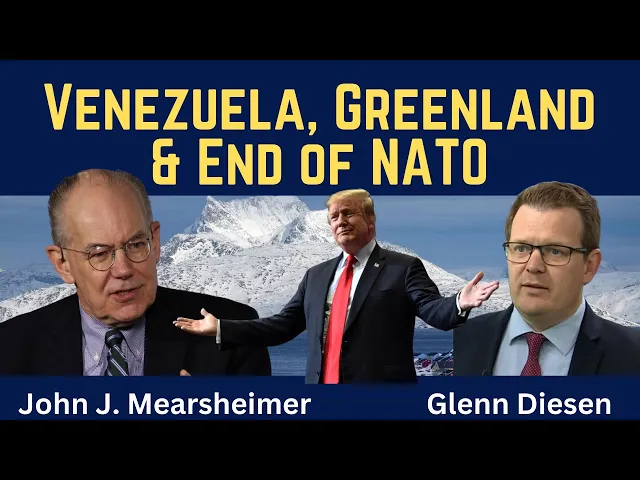
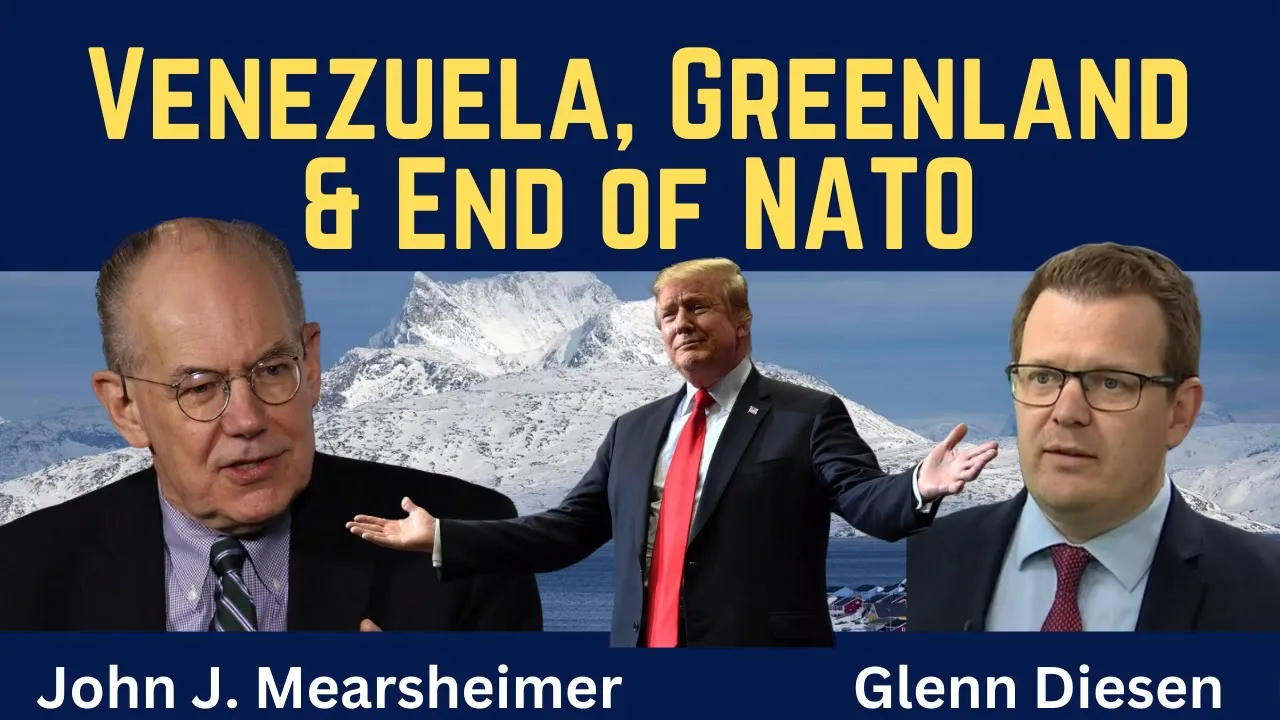
Welcome back. We are here today with uh Professor John Merchimer. Uh so uh thank you very much for coming back on the program.
>> My pleasure as always, Glenn. So we see that the American people were sick of forever wars and nation building that were costly. They harmed America's standing in the world and rarely successful.
So for this reason the Americans voted for Trump who consistently criticized these kind of wars and uh advocated for America first instead. So um so obviously we have not gone down this path. There's a a lot of criticism of course his base is split.
But from a realist perspective though, what are the strategic interests um of the United States in Venezuela? Uh besides the stated reasons such as democracy promotion or narot terrorism, uh what what do you think the United States aims to achieve with this? Well, when you talk about America's interests in the Western Hemisphere, uh it's important to understand that the Monroe Doctrine basically lays out what our interests are.
What we want to make sure happens is that no distant great power, whether it's Imperial Germany, Nazi Germany, or the Soviet Union in Europe, or Imperial Japan or China today in East Asia, forms a military alliance with a country in the Western Hemisphere or puts their own military forces in the Western Hemisphere as the Soviets did uh with regard to the Cuban and missile crisis. That's what the Monroe Doctrine is really all about. It's keeping distant great powers out of the Western Hemisphere, which we of course dominate because we're so powerful.
Now, this operation had nothing to do with the Monroe Doctrine. Uh there's no danger at this point in time that either China or Russia is going to form a military alliance with Venezuela or is thinking about putting uh their military forces in the Western Hemisphere. This is just not an issue.
This is not about great power politics, which is what the Monroe doctrine is all about. This is in my opinion a good old-fashioned case of imperialism. Uh this is a case where the United States uh was interested in running the politics of Venezuela.
Apparently, if you listen to pres uh President Trump, uh his most important concern is who controls the oil in Venezuela. And he thinks basically that's our oil. It's ours to determine what it is used for and how it is used.
uh this is just blatant imperialism or a neoc colonialism. This has little to do with the Monroe Doctrine. Well, the US has intervened in the past in Latin America more than once, but do you see this as being consistent with this kind of patterns or is this something different?
Uh it because it certainly it feels more brazen than it perhaps was in the past. the the uh as you said there were open reference to to to taking the the oil for example and uh while while Trump said that we will run Venezuela now he now has argued that uh well that the new acting president of Venezuela Deli Rodriguez that she could hold power in Karacas as long as and this is a quote she does what we want otherwise there will be more strikes. I mean this well is this uh not needing to get rid of the existing government as long as they do as they're told.
I mean how how are you seeing or assessing this? >> Well Glendon there's really nothing new here. As almost everybody knows the United States has a rich history of interfering in the politics of countries in the Western Hemisphere.
We view any country that is moving toward the left uh to be a threat to us uh and we invariably go in and try to topple the regime. You want to remember that President Trump is not only talking about doing regime change and social engineering in Venezuela these days. He's also hinting in a quite overt way that we may do Colombia.
We may do Nicaragua. Uh we may even do Mexico. Uh the United States, he believes, has a vested interest in interfering in the politics of any country in the hemisphere uh that he doesn't like.
And uh this is really nothing new. Uh the United States has a rich history in this regard. Uh Chile in 1973, uh Guatemala in 1954, on and on.
But what makes this so brazen uh to use your word, which I think is absolutely correct, is that Trump doesn't try to justify what he's done uh with diplomatic language or liberal rhetoric. Uh he basically says in very blunt terms that we uh we can run Venezuela. Uh it's no problem.
Uh, and Venezuela's oil is our oil. Uh, and he sounds like a blatant imperialist. Uh, and you don't see much evidence of that.
Usually when the United States goes in and acts in an imperial way in the Western Hemisphere, uh, it covers up its behavior uh, with liberal or idealistic rhetoric. Uh, but President Trump doesn't act that way. He's a Texas Chainsaw Massacre kind of guy.
You can see him coming a mile away. He's very blunt and uh and therefore uh it's appropriate to say that this does look brazen. Well, what does this mean though for the wider world order?
Because uh over the past 30 years, the so-called liberal rules-based order uh entailed more or less that the idea that international law would apply to everyone with the exception of the west under the leadership of the United States because we were the champions of liberal democracy. So international law uh could be put aside if it was required for a liberal democracy or humanitarian or humanitarian law. So um this was kind of an important part of the hegemonic order.
And to a large extent we saw this being born in Kosovo when we said that well it wasn't legal but it was legitimate. So essentially we said liberal democracy creates legitimacy outside the rule of law. So this was kind of the how how we can run uh an empire a hegemonic system and give it all legitimacy.
And I feel in terms of attacking Venezuela the Europeans we did our part that is we gave the Nobel Peace Prize to Machado under the idea that you know if the United States would go in with its military force this would mean to install democracy and this would be peace. I mean, this is the whole um liberal uh all the the yeah the the peace thesis uh that the democracies don't go to war, they're more peaceful, etc. and that this can be delivered by military force.
But uh uh but we saw instead that Trump, he didn't take it. It was a nice layup. You know, he could have had this legitimacy, but he said he he didn't want this excuse.
He was even dismissive of Machado taking over power and um instead he referred to how much tremendous amount of wealth we're going to take out of the ground. Should it worry us though? I mean that Washington now doesn't bother to keep up the pretense.
On one hand, it's nice with some honesty. On the other hand, it's important the stories we tell about ourselves that we kind of have some restraint by at least pretending to abide by certain ideals. Yes, for sure.
Let's just talk a little bit about international law. Uh, as you know, when the United States was the unipole, this is during the unipolar moment from roughly two uh roughly 199 uh3 until about 2017. We're really the only great power on the system in the system and we threw our weight around uh all over the world.
We nevertheless paid careful attention to international law. Uh, and if we violated international law, we went to great lengths to say we really were not violating international law. Now, what's going on there?
The fact is that you need international law. You need international institutions. You need rules.
Uh, in an incredibly interdependent world like the one that we live in, rules and laws are absolutely essential. And the key point to keep in mind here is that the United States wrote almost all of the rules and almost all of the laws. So we had little problem obeying the rules or obeying the law most of the time because again we wrote them in ways that were in our national interest.
Uh but along comes President Trump and he really is sooie generous here. He has utter contempt for international law, international norms. He just thinks they don't matter.
And he thinks when he goes out and breaks the law, uh that it it it it's not necessary to justify what he did. It's not necessary to put the velvet glove over the mailed fist. And uh the end result is that international law uh the rules-based system is being trashed.
And the question you have to ask yourself is this in the American national interest or is it in the interest of other countries around the world? And I would argue uh that it's not in our interest. Again, we need rules, we need laws, we need norms.
Uh and the reason that past presidents have paid so much attention to these matters is because they understand that. But Trump doesn't think that's true. He just thinks that he can go out uh and trash the rules-based system and the end is that we will be better off.
And with regard to other countries, the truth is he doesn't care about other countries. He only cares about the United States of America and what he thinks is right or wrong. So that's really what's going on here.
And the end result is not going to be good because international law is important for the United States and for other countries as well. I noticed that from some speech some speeches by HGseeth he treats international law as if it would be some woke plot uh that constrains America from uh pursuing its interest. But uh again in situation like war we have international law has to be some mutual constraint as we have some framework you know around killing each other that limits it and make it in a civilized matter as possible and but also the again with the stories we tell each other though I mean with when when Biden uh blew up the Nordstream or allegedly blew up the Nordstream but uh yes very likely he did uh the Germans were willing to the chancellor was willing to stand next by him and Yeah, pretend as if when he said, "Oh, it wasn't us.
" That uh you know, they were Biden was selling a lie. The Germans was were very willing to buy it. Even though no one I think truly believed it was the Russians who blew up their own pipeline, but at least the pretense was there.
Now there's nothing. Even the Germans now, the chancellor is asking, well, what is the legal justification? You know, we need something.
At least give us a narrative. say that this is about, you know, an authoritarian dictator, but just oil that it seems that there's some real anxiety. Um, but yeah, that brings me back to my question though.
The Europeans, they stayed relatively quiet on this. I think they hoped that their obedience would be rewarded, but instead their, I guess, spinelessness is being punished. Uh, I think Trump smells weakness and now he sets his eyes on Greenland.
Uh, is this uh do you think this is real? Because it it does seem to go beyond mere rhetoric to distract though. >> Do you are you asking me do I think there's a real possibility that he will take >> or is it just you know is this some like a reality show uh tactic where he shifts the focus or is do you think that the United States will take Greenland?
Now, >> I think there is a serious possibility the United States will take Greenland. In a certain sense, I think that people like you and uh me find it hard to imagine the United States invading Greenland and taking it and turning it into the 51st state. It It's kind of just hard to comprehend us doing that.
But I wouldn't be surprised if Trump did it. Uh if you look at Trump and how he thinks about using military force, uh he is willing to use military force frequently. I I believe that he's used military force seven different again seven different countries uh since taking office and uh he's almost at the one year point uh of uh his term in the presidency.
Uh remember he became president last January 20th so we're close to January 20th. So in the past year he's attacked seven different countries. This includes Iran, Iraq, Syria um and a handful of other countries, Venezuela as well obviously.
But what's distinguishing the distinguishing characteristic of all those attacks is that they were smallcale attacks. They're what I call pin pricks. Uh, and he's been very careful not to get involved in nation building, not to get involved in a forever war.
He understands that that's one thing you don't want to do. Remember the attack against Iran on June 22nd of last year, that's 2025. It was a one-day affair.
uh he attacked Iran, declared victory at the end of the day and said the problem is solved, finished and then moved on. Uh and of course if you look at what he recently did in Nigeria, he lobbed a couple missiles at Nigeria. Uh but that was the end.
He didn't get involved in any meaningful way in Nigeria. So when you talk about Venezuela and Greenland, the big question that's on everybody's mind with regard to Venezuela is he going to end up in a forever war? Is this the first case where he's tripping himself up?
Uh has he jumped into a quagmire? And I think the administration believes that that's not the case, that they can do this on the cheap. Uh it's sort of a pinp prick operation.
They kidnap Maduro and uh they bring him to the United States and then they prop up the vice president as the new president. Uh and they use economic coercion to get her to dance to our tune. I think that's their view.
Uh and it's another pin prick operation in the end. With regard to Greenland, right, it would not be difficult for the United States to conquer Greenland. It's not going to be World War I or even a war.
I think uh I think they can in the American military can take Greenland with relative ease. And when you look at Trump's pattern of behavior, how willing he is to use military force when you can do it on the cheap uh and you can get away with it. I mean, he'll get away with it uh uh politically.
I mean, the Europeans will scream for a while, but in the end, it's not going to matter very much. they're not going to put up very much resistance. He has no respect for the Europeans.
So, the fact that he can do it rather cheaply, that it could be portrayed as a another pin prick operation, I think tells you that there's a really good chance that he'll try to take Greenland. Uh, and to go back to Venezuela, the big issue on the table is whether or not he's going to get dragged into a quagmire or not. Uh, in terms of uh getting dragged into the business of nation building or whether he uh will be able to pull this off quickly and easily.
>> Yeah. Well, I saw Steven Miller. He was interviewed and uh he made a point.
He was asked, "Do would you use military force to take Greenland? " And he was kind of dismissive of the whole idea that well, the Europeans aren't going to fight back. So, you just essentially sail in and uh plant a flag and that's it.
It's uh it's probably correct though, there wouldn't be a fight. But, um but have you been surprised by the European reaction to this? Because overall it seems over the past even year now the all all the liberal values which were supposed to unite the west it kind of fell apart in a spectacular way.
Not just the reluctance to find a diplomatic path in Ukraine but also the genocide in Gaza backing an ISIS leader to take power in Syria by supporting the destruction of Iran's nuclear facilities. uh and of course now bombing or attacking and kidnapping the president of Venezuela by giving the stamp of approval time and time again and supporting it. It's uh um yeah again all the things that have been packed into one year.
I've never seen anything like this before. How much how much can the west actually absorb if we define the political west based on a a region of values? >> Yeah.
U couple points on what you just said Glenn. First of all, the genocide in Gaza. Uh I think the fact that the Europeans and uh the United States have supported Benjamin Netanyahu uh in terms of his execution of genocide in Gaza was a deadly blow to the liberal international order.
uh the idea that a group of liberal countries, a group of countries that emphasized the importance of liberal values uh blatantly supported uh a genocide uh that the whole world could see taking place in Gaza uh dealt in my opinion uh a truly serious blow uh to the liberal international order. Uh and then when you add everything else that's happened under Trump uh to the support for the genocide, you can see where this order is in deep trouble. And furthermore, it's really hard to argue that liberal values mean very much in the West.
It looks like empty rhetoric. So all of what has happened and this goes back to the Biden years because you want to remember uh that October 7th took place during the Biden years and the Americans especially but also the Europeans supported the Israelis uh in executing the genocide in Gaza before uh President Trump came into office. Trump of course continued to support the Israelis and continues to support the Israelis as they execute the genocide.
But again, this is just a huge problem. Now, the question is, what's going on here? Why are the Europeans uh why are the Europeans not pushing back against Trump?
Uh and I'd make two points there. Number one, the Europeans are desperate to have good relations with the United States because they want the United States to stay in Europe. The United States uh is making all sorts of noise, and this is especially true with regard to President Trump, of pulling American troops out of Europe, of eviscerating NATO, of reducing the size of the American military footprint.
And this horrifies European leaders because they understand uh that uh the United States serves as a pacifier in Europe. So they want to keep us the Americans in Europe. They want to keep NATO intact and they think that the way to do that is to appease President Trump.
So, anytime President Trump does something that's outrageous and they're opposed to it, they nevertheless back President Trump or they criticize him in a very soft way because they want to make sure he stays in Europe. They want to make sure he likes Europe. But the problem with President Trump from their perspective is that he's basically a bully and if you show weakness, he'll just slap you around.
And we all know that Trump has unmitigated contempt for the Europeans to start with. Uh the Europeans are nowhere near the European countries are nowhere near as powerful as the United States. And when they get down on their knees and they appease him, he's just going to slap them around.
He's going to treat them with contempt. And this is of course what he's done. Now, you might expect the Europeans to learn from this and do a 180°ree turn and uh stand up to the Americans, but no, they're so desperate to keep the United States in Europe.
And they're so used to being um in a position where they gravel uh at the feet of an American president that they do what an American president wants. that you have a situation where Trump can pretty much get away with anything uh and uh not receive uh or not get any serious criticism from the Europeans. And this gets back to our discussion of Greenland.
Uh what would happen if he took Greenland? Be very interesting to see whether the Europeans finally stood up to him. You would think they would.
Uh but I wouldn't bet a lot of money on that. Well, he saw at the Munich Security Conference in February when um JD Van spoke uh at at the closure, I forgot his name, closing the ceremony, he broke down in tears because of the speech, you know, how he referred to the Europeans and of course and there was a national security strategy more or less calling for regime change in Europe. Uh you know, blaming the EU for destroying European civilization and and now of course the threat to take Greenland.
We would think at some point they would start to grow a spine and do something. But uh but it was an interesting comment by the prime minister of uh of Denmark. She made a a point that if uh the US attacks uh and takes Greenland then that would mean the end of NATO.
But do you think more or less this is already like we've spoken about the decline if not the collapse of NATO or at least becoming a shadow of itself. But uh do you think that this would be something now that would just destroy NATO completely because um well the the US doesn't seem too interested in keeping it and the Europeans can't ignore that uh well reality has shifted dramatically. >> You also want to remember uh that the whole question of Ukraine is intertwined with this issue of the future of NATO.
uh you know there are many people who have been arguing uh before the Venezuela crisis recently broke out [snorts] uh that NATO was in deep trouble and if the Russians won in Ukraine which certainly looks like it's going to be the case that this would do serious damage to the alliance. So if you marry that simple fact about what's happening in Ukraine uh to a possible invasion of Greenland, uh one could make the argument that uh it would be a deadly one two combination that would basically ruin the alliance. Uh the alliance might remain in name, but in terms of being an effective alliance, in terms of looking like uh what it has looked like between 1949 and 2025, uh those days would be gone.
Uh NATO would be a shadow of itself. It would be uh effectively wrecked. I think you can make that kind of argument.
Again, I think the Europeans will go Excuse me, Glenn. I think the Europeans will go to great lengths to prevent that from happening in [snorts] large part because NATO means for them keeping the United States in Europe, keeping the American pacifier in place and they're desperate to do that. Uh so it may be the case that uh if Trump were to invade Greenland, and let's hope he doesn't do that, uh the Europeans would nevertheless swallow their pride.
uh and not back him. They would criticize him, but do it in a way that uh wasn't um so damaging that uh it would wreck the alliance. just seems like a a key challenge for the political west is to renegotiate the relationship between the US and the EU because you know beyond the rhetoric about Trump there is something significant here about the distribution of power that is the US it can't afford to be as generous as it was after World War II it has other priorities it can't be everywhere Europe's not a high priority its relative power in the world has al has also declined uh so the Europeans kind of want America of the past that is to commit and continue to well essentially pay for everything.
It just seems that for the Europeans they're either like just super subservient to the US or they become very anti-American. They always they seem to polarize a bit. Just seems that it would be possible to have a more reasonable relationship.
We just adjusted to the new multipolar realities that is uh uh both sides benefit from a partnership from security cooperation economic ties but but um at least you know maybe divorce go from being married to neighbors or something along those lines just uh uh something that works for the United States because dismissing the new interest of the United States it's uh I think it's is a folly I mean of course Trump tends to be much crudder than other leaders but uh but there's something beyond below the personality there. There's a real shift in power which has to be addressed. The idea that we can just continue as if it's the bipolar or uniolar order doesn't really make that much sense.
Yeah, I think you're exactly right, Glenn. And I would marry what you just said to uh this whole notion that there is uh a group out there or a civilization out there, whatever you want to call it, uh which is labeled the west. During the cold war uh when we came up with this term the west it made eminently good sense because we were dealing with the US Soviet competition which took place mainly in Europe.
The heart of the US Soviet competition was in central Europe and all of the countries on the western side of the divide were closely allied with the United States. uh and of course those countries on the eastern side of the divide were closely allied with the Soviets. So in that context it made eminently good sense to talk about the west and we were tightly integrated.
Furthermore, after the cold war ends and you move into the unipolar moment, uh there's obviously no Soviet threat anymore, but uh the countries of Western Europe are thoroughly liberal. They share the same values as the United States does. And what happens is that the West that's left over from the Cold War decides to move NATO eastward uh bring more countries in Europe into the West, right?
And continue to argue uh about international politics as if there were uh this group of countries that you could call the West. And in fact, it made a lot of sense. And furthermore, the west during the unipolar moment was interested in spreading liberal democracy all around the world.
As you know, the United States during the unipolar moment adopted this foreign policy of liberal hegemony. We were interested all Frank Fukyama in spreading democracy uh all across the planet because we thought that was all for the good. The Europeans bought into this enterprise.
Uh it was reflected most clearly in NATO expansion. NATO expansion was initially all about spreading liberal democracy, economic interdependence and so forth and so on, Western institutions into Eastern Europe. So it was very easy during the unipolar moment as it was during the bipolar moment to talk about the west.
uh but that world has gone away and a lot of it has to do with the fact that for the first time in American history uh the most important area of the world for us for the United States is not Europe it's East Asia because of the rise of China. So this is a very powerful imperative u for the United States to pivot to Asia and pivot out of Europe. Uh, and when you get somebody like Trump who's the president and who has contempt for Europeans and you marry that to the structural imperatives that are pushing us to pivot to East Asia, right, [snorts] uh, you're going to see big cracks in the transatlantic relationship.
And it's very important to emphasize that as the transatlantic relationship uh deteriorates, right, as US European relations uh worsen, uh the Europeans will be on their own in ways they have not been in a long time. I think you'd have to go back to 1945 and the years before 1945 uh to find evidence of uh cases where Europe was pretty much uh on its own and didn't have the American pacifier in place. [snorts] And what this means is that you will see fractures inside of the west.
And you can see this in Europe today. Uh there are all sorts of fault lines inside the EU and inside uh Europe more generally. And by the way, as we've talked about before, the Russians will go to great lengths to exacerbate those fault lines.
The Russians will go to great lengths to exacerbate deteriorating relations between the United States on one side of the ocean and the Europeans on the other side. So there just a lot of forces at play here that are undermining this concept of a of a rather homogeneous west that existed during bipolarity and existed during unipolarity uh but is now beginning to wither away. This idea of a year being all alone it is interesting.
It was predicted by some though that is uh I did an interview on this channel with um the Harold Kuyat the general Harold Kuyat. He is the former head of the German armed forces and he had the highest military position in NATO. Uh but he he made he wrote an article gave an interview back in January of 2023 so three years ago now in which he predicted that well we already more or less lost the war in Ukraine.
The Russians will take this and when it's obvious that it's lost the Americans will start to pull back. And uh that the title of the article is something along the lines we will be left all alone facing a very angry Russia. Uh so I I was wondering how you would tie this conflict now in Venezuela to to to Ukraine because if you look at Denmark it's a bit ironic they they they the Danish government prides itself to some extent that they were the first one to recognize Kosovo.
So again, a breakaway, which isn't too well, they find themselves on the other side now, but uh but also they they sent almost all their weapons to to Ukraine and they've been among some of the most hawkish uh in this proxy war against the Russians whereas you have said last time we spoke a direct war on Russia. Now, so what does this mean though? Because this of course adds to the desperation because when when we joined in on this uh war against the Russians uh you know we're standing behind Biden and he would fight till the end.
Uh now of course it's it's very different. Uh how do you see this playing out? Well, I think that what's happening in Venezuela and even if you add uh an invasion of Greenland to that uh problem set in the Western Hemisphere, it pales in comparison to what's happening in the Ukraine war.
The fact is that um what Trump has tried to do with the Europeans visav the Ukraine war is shift the burden of supporting Ukraine uh onto the shoulders of the Europeans. And the Europeans of can't of course cannot shoulder that burden. They don't have the financial resources or the weaponry to support Ukraine.
[snorts] And uh Ukraine is going to lose the war. And once Ukraine loses the war, there's going to be a blame game. And the Europeans are going to blame the Americans for withdrawing support for Ukraine and shifting the burden to them.
And Trump will blame the Europeans. He will say uh they didn't cooperate with me diplomatically and uh I therefore turned over the responsibility for dealing with Ukraine to the Europeans and they did not measure up to the task. So they're responsible.
So you'll have this blame game and then you'll have a blame game inside of Europe itself. Uh you'll have people like Victor Orban on one side and uh Keith Stormer on the other side and Mcronone on the other side and they'll all be arguing about who's responsible and where we go from here. And at the same time, as I said before, the Russians will be going to great lengths for good strategic reasons to exacerbate those tensions inside of Europe and to exacerbate those tensions across the Atlantic Ocean.
Uh so I think that you're going to have a lot of trouble in Europe moving forward and most importantly, you're going to have poisonous relations between Russia and Europe for as far as the eye can see. One does not want to underestimate the catac cat catastrophic consequences of the April 2008 decision to bring Ukraine into NATO. Uh it has for the foreseeable future and we're talking about a long time into the future poisoned relations between Russia on one side and Europe on the other side.
And this is going to be as I said before an increasingly divided Europe. uh and the United States is not going to be serving as the pacifier in ways that it has done in the past. This is going to be terrible for Europe.
Uh and I think Europe is in real trouble. And I think that's a bigger problem for Europe than the whole question of what's going on in Venezuela or what's going on in uh uh with regard to to Greenland. Uh and and by the way again to go back to my point that the Europeans are desperate to keep NATO intact which means keeping the American pacifier in Europe.
This is why the European leaders appease the Americans and here we're talking about President Trump. Why they appease President Trump at every turn. But that's not a winning strategy because as we talked about uh you have to stand up to Trump if you have any hopes of getting your way with him.
Uh, the Chinese figured this out. By the way, remember early in his term, his second term, President Trump tried to get tough with the Chinese with tariffs and the Chinese made it clear to him in no uncertain term that they had cards to play and they would use those cards. And the end result is that Trump backed off.
Same thing with the Houthies. Remember, he said he was going to go in slam the Houthies. He said that President Biden was a pussycat.
He didn't uh wage war against the Houthies in a meaningful way. He Donald Trump, a real man, was going to go in and do it differently. Uh and he bring the Houthies uh to their knees.
Well, he went in and uh he tried to defeat the Houthies and he failed and he quit. He backed off. He said, "The Houthies are tough ombres.
I can't defeat him and I'm backing off. " Right? And that's how you get your way with Trump.
you stand up to him and if you don't stand up to him, he'll walk all over you. And of course, he's been walking all over the European leaders. He's been humiliating them at every turn and that will continue to be the case until they stand up to him.
But I don't see much hope they're going to stand up to him anytime soon. >> No, I don't see that either. So uh well last time we spoke you you had just given a speech at the at the European Parliament uh the EU Parliament arguing that uh Europe's future was bleak.
Do you think Venezuela has made it any bleak or it doesn't really play that much into the whole uh political west? Of course, besides if US actually takes Greenland though, >> I I don't think what happened in Venezuela really matters much for the overall direction that uh US European relations are moving in or uh European Russian relations are moving in. I I think what happens in Ukraine is of great importance there.
I mean, the thing you want to remember about President Trump is that he uses military force and he does outrageous things so often that uh what is very important one day, a week later is not uh even a front page story. Uh it could be the case that a week from now, Glenn, the United States will be attacking Iran again. It may be that the Israelis and the Americans will launch a major air campaign against Iran.
I'm not saying that's going to happen, but it's certainly in the realm of possibility. And there are a lot of people who think it's going to happen sooner rather than later. But once that happens, the front page story will be Iran.
It will not be Venezuela. So another dimension to this is that the Venezuela situation is not likely to remain on the front page uh either here uh in the United States or in Europe because uh we'll be off pursuing another escapade. Uh this is one of the ways that Trump gets away with uh all of these um endeavors that he's pursuing.
He he he does something, people start to criticize him, but before the criticisms can sink in, uh he's off attacking another country. Uh and then people start to criticize him and before the criticisms sink in, he's on to another country. Uh so uh as long as he doesn't get bogged down in a forever war, or to put it slightly differently, as long as he doesn't get bogged down in nation building, uh he'll be able to continue this policy uh for the foreseeable future.
And this is why the big question at this point in time is where does Venezuela lead? Right? He he thinks and his advisers think uh that they went in they won a quick and decisive victory and now managing Venezuela will be a minor problem that will free them up to move on to the next the next escapade.
That's their view. Uh and there are a lot of people I'm one of them uh who has real doubts about whether that's true. Uh, I think that, you know, when you go in and you break a country like Venezuela, you effectively own it.
And he claims that he owns it, right? He says that we're going to run it. Uh, when he starts talking like that, uh, you say to yourself, okay, if you, President Trump, are going to run uh, Venezuela, doesn't that mean you're going to do nation building?
And if you're going to do nation building, isn't this going to be long, difficult, and messy and likely to lead to failure? But then there are other people in the administration who argue that we're not going to get seriously involved in running the country. We can do it on the cheap.
Uh we'll see what happens. But uh if he gets bogged down uh in Venezuela, that will greatly limit his maneuver room uh to attack you know more countries down the road as he's been doing since he took office about a year ago. Well, he's great at shifting the focus.
Last week we're speaking about the Epstein files and now of course they're all gone. But uh but I'm not sure how long you can play this game before there's a massive miscalculation u in which he gets drawn in. That could happen already.
But uh I know you have places to run now. So I just want to thank you again for letting me pick your brain. Oh, thank you Glenn for having me on the show.
It was a pleasure talking to you. I just wish we had some uh more uplifting subjects to talk about these days. I mean this is the new year.
uh uh we're supposed to think in terms of happy new year but uh given events in the world uh it's hard not to be thoroughly depressed. >> Yeah, very much agree. So, well, thanks nonetheless.
>> You're welcome.