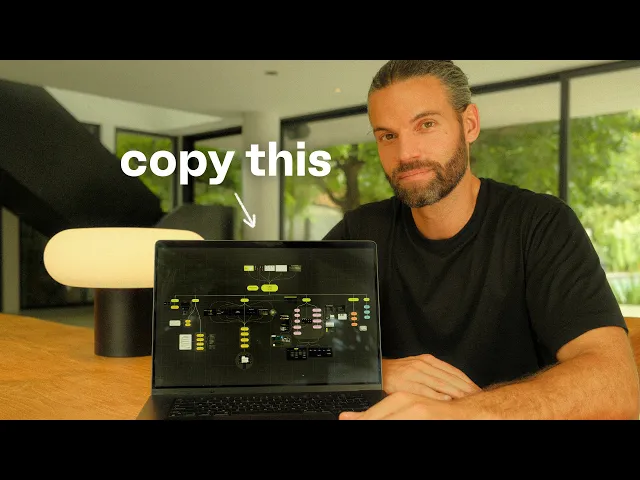
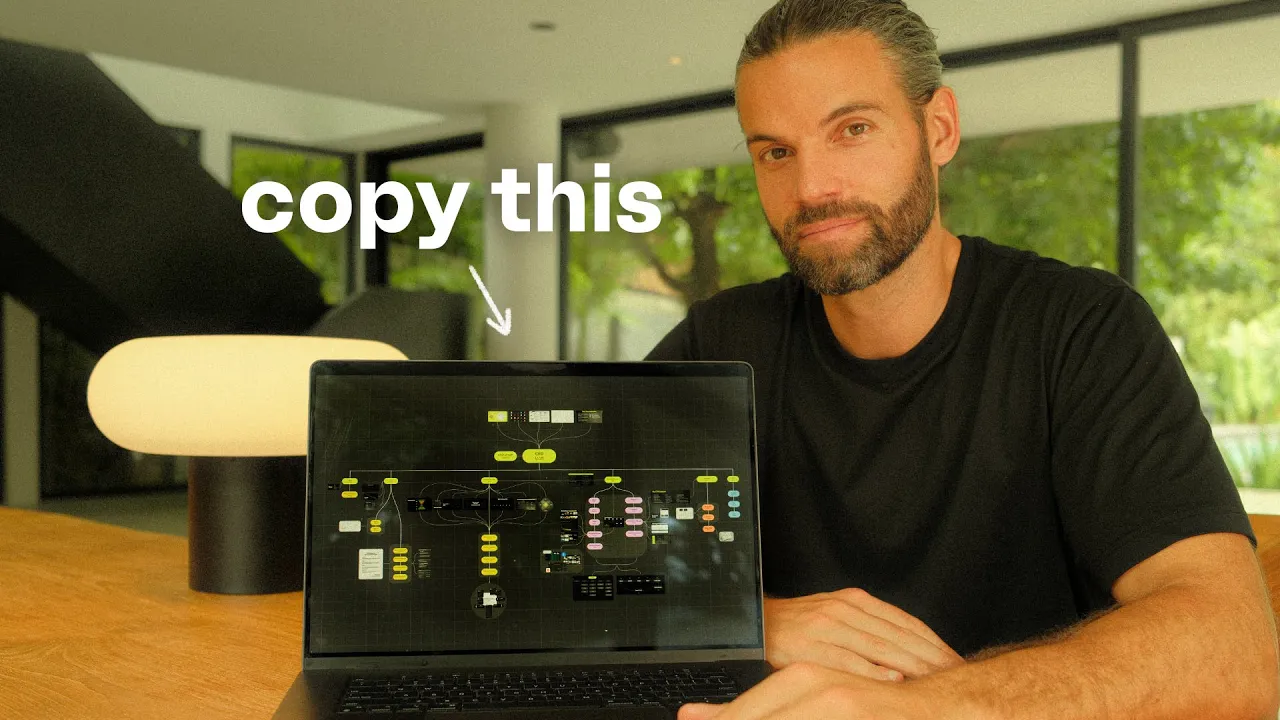
If Da Vinci was an entrepreneur, this would be his masterpiece. These are the 34 people behind Founder OS and the 38 systems that glue all of these pieces together. If you've ever wondered how to build a successful 7figure business, you want to actually build a peer behind the scenes of a real successful business.
And that's what we're about to do here. You're going to get the systems, tools, playbooks, frameworks, and some personal stories to help you go and understand the glue behind my companies and then go and take this and implement it into your business. And without all of this gone and seamlessly connected, there's no way that I could run Founder OS while also just living the dream life that I'm able to live.
Traveling the world, hanging out with friends, being able to remove myself from operations while also having a business that's well on track to do over 8 figures a year. Success leaves clues. And what I've tried to go and do is dig up every single clue I've got, put it here into this neurob so you can go and steal it and implement it into your business.
We're going to go and dive into all the core aspects here across the finance area of the business, the sales department, customer success, all the way over to creative direction and how I run the studios department, marketing, and lastly, technology. Before we get into the org chart, let's just start with the CEO and the role there. Where I like to get started is first figuring out, well, what is my icky guy?
Icky guy is a Japanese term that stands for your reason for being. Your icky guy is at the intersection of what you love, what the world needs, what you can be paid for, and what you're great at. And so here you can see on the screen my icky guy which includes things like building a teams design building systems which is really at the core of everything for founder OS traveling the world coaching founders building communities building in distribution from day one because firsttime founders focus on tech second time founders focus on distribution.
My goal is really with any of the businesses that I create to over time create an autonomous empire where I can remove myself from my business for a month and come back to a business that's stronger than when I left. Once you've got your icky guy nailed down, now I really am able to go and every single day with every core action that I make, make sure that I'm further optimizing for my icky guy. And when I find that there's stuff that's outside of that that just doesn't fire me up, that's the kind of stuff that I'm either going to automate, eliminate, or delegate.
The next aspect here as a founder, as a CEO, you got to always be learning from mentors, masterminds, books, coaches, and courses. Those five areas have been responsible for about 95% of my success. The more I level up, the more my business levels up.
You can see here some books like the 21 irrefutable laws of leadership by John C. Maxwell, Scaling Up by Vern Harish, 10X is easier than 2X. I use Read Wise, hook it up to notion so that when I'm reading different books, say on my Kindle, if I go and highlight any key lines that I like in that given book, it's going to automatically go and sync that from my Kindle over to notion so I can easily refer back to this stuff.
It's also super useful to come up with great content ideas because I can see the sort of ideas, references, inspiration that I have in all this reading that I'm doing to then come up with amazing content ideas, YouTube ideas, newsletter ideas, you get it. Next key principle that I think is really important and it's been instrumental in my success over the last 15 years is really having a clear vision. You know, without a vision, you're going to go nowhere.
So, here you can see a taste of my vision for Founder OS. Let's keep moving along here. Your vision is all good, but the key thing is then how does that vision translate to your day-to-day?
And that's exactly where the personal board meeting comes in. I've always thought, you know, it's kind of crazy that as public companies, there's these things called board meetings where the CEO is held accountable to the board and to shareholders, but that doesn't exist in private companies. I turned all that around 10 years ago when I invented the personal board meeting, and it completely transformed my businesses and my life.
I get into my mission, my vision, and this is something that I revisit every single day. I actually have it printed off in my notebook. I revisit this every morning and every night, which really hones in my subconscious to help me accomplish this vision at a blistering pace.
95% of the decisions that you make in life are subconscious. And by reviewing your vision and your board meeting daily, you really start to accelerate your momentum in life. So, I've got my icky guy in there.
I've got my personal 30-day goals. I've got my business 30-day goals here. I've also got my personal vision in life, which is quite a bit different actually than the business vision.
We're always reverse engineering those 10 year goals, threeear goals into one-year plans, 90-day plans, and then getting after it. And then a key part of each month is I'm also reflecting on what went well, what didn't go well, and what did I learn. And this process of constant reflection allows me to continue to learn where my gaps are, what I need to be learning, and then kind of evolving from there.
The next aspect is the 5-year reflection. Founder-led businesses, from my perspective, it's pretty simple. You're a founder plus a creator.
If you don't go and think about this right, what you'll quickly find is that you're in an idea drought and you're on a content hamster wheel. We want to avoid that at all costs. Now, the cool thing here is that when you combine your icky guy with the 5-year reflection, it becomes really easy to go and come up with endless content ideas and ways to share your vision and your mission with your community.
I go and include questions in here, right? Like reflecting on the past 5 years, what were the kind of things that I wish I had known 5 years ago? and I just speak to my younger self and the combination of thinking about you know what have I learned what are the problems I've solved what are the different stories that have changed me these are the sort of things including the systems that I have that I just openly share with my audience content in a sense becomes effortless because I'm not having to go and manufacture a bunch of stuff I'm simply just building stuff internally in my businesses and then open-sourcing that stuff to the founders that I serve as we keep rolling here let's start with the finance side of things.
Now, there is one system that I've implemented here that when founders implement it, I know for a fact it completely transforms their business. It's called the CEO scorecard. Years ago, when I was building businesses, I'm more of a creative type.
I'm a marketing type and sometimes the finance side of the business can get a bit neglected because it's not my favorite thing. The cool thing is with this CEO scorecard, it makes it effortless for me to understand the health of the businesses that I'm operating. My CFO essentially every single week sends me a text message of the core elements of the business I need to know about so I can understand the health of my different portfolio companies.
I'm going to see things like our revenue, our cost of goods sold, profit margin, cash in bank, and things like our different sales metrics like show rate and close rate. What this allows me to do is instantly see a snapshot of how my business is performing. Hayden's also then going to send me generally three to five bullet points.
If he was in my shoes, what would he be focused on implementing the next week? Now, when I see this CEO scorecard text come through on my phone before I even sign off for the weekend, I'm going to make sure that every single one of those points are implemented before I even sign off and then wake up on Saturday. Absolute gamecher.
Highly recommend you get ripping with your own CEO scorecard and put your CFO to work already. So on the finance manager side, I got the legend Georgie. And so he's just taking care of things like invoices, payments, general accounting, simple stuff.
So my CFO can focus on stuff that only he can do. Now, as you see here, CRO Matt, well, that's me. As I've gone and built this founder brand, I've learned that there's a lot of aspects of the company that I just like to be involved in myself.
The sales team is first off one of my strengths. I've been running sales teams for the past 15 years in my businesses. I like to actually be in the mix.
When you have the right systems in place, the right people in place, and you've been doing this long enough, it's actually relatively easy. We've got a team of absolute weapons. I meet with them twice a week, once on Monday, once on Friday.
We have projections. They send me end of day reports. And so, it's pretty easy just to run that system and know what's going on.
The other major hack is that when you're involved in sales, you're hearing what your customer is asking for and you're also understanding their objections and you can use this intel to then go and formulate where your product or service should be evolving into. It's a super helpful aspect of things to kind of keep your finger on the pulse of your business and the customer tastes and preferences. Part of this too, right, is we've got the founder journey all laid out.
Understanding your customer journey or in our case the founder journey is a critical system to have in place. It's not only useful for your sales team to understand post sale exactly what the customer should be expecting, but obviously it's really important for the actual customer themselves. So if you have that meticulously laid out in terms of the next 12 steps, they have clarity and your team has clarity on all the systems, all the steps that are necessary to create an exceptional customer experience.
The next system here is my offer stack. There's a massive misconception amongst founders around their offer. Most founders believe that there's only one offer that they're selling, and that's just not the case.
You have an offer stack. When you think about this, you likely have like three, four, maybe up to seven offers that exist across your product journey. It is an offer, as an example, in your Instagram bio to get someone to go and follow you.
It's then an offer on your newsletter page to make it enticing to get someone to leave their email and sign up for your newsletter. Inside of your newsletter, then you likely have a CTA or an offer to drive people then to a sales call and speak with someone on your team. Then you likely have an offer that you present to people on a sales call to get them to actually convert to your product or service.
As you can see here, every single one of those offers along that offer stack need to be labeled. the copy, the scripting needs to be dialed in. And when you get this right, what happens is that you create a slippery slope.
You make it virtually seamless from someone hearing about what you do to suddenly joining your newsletter and eventually going and purchasing from you. When this is done right, people just end up almost mistakenly kind of ending up in your funnel in a way. And before you know it, you know, two weeks after, maybe someone's watched a YouTube video, they find themselves in your community or in your product or buying your SAS product because that journey is just so damn smooth.
So that's what we've done at Founder OS. And this is one of the many things that we help implement in founders businesses inside of Founder OS. Here's an example of my offer stack.
The average person's social bio converts about 5% of people to followers across my platforms. My bio converts around 20% of page visitors to followers. This is the power of viewing your bio as an offer.
Similarly, the average person goes and probably sees about a. 5% conversion in their newsletter. We see a 5% conversion.
Again, 10x the average. bringing that level of detail, that level of copywriting, and making sure that all of these little pieces word by word, sentence by sentence, are all planned out meticulously and specifically allows you to go and achieve these sorts of conversion rates. As we go and we start to then look at the actual squad um that is comprised, there are two aspects on the sales team to think about.
Number one are the setters or in some businesses this is called your sales development reps or SDRs. These are the people that are hunting for leads. The beautiful thing at Founder OS is we get inundated with leads.
So, we don't need to hunt. We are actually just having these folks screening founders to make sure that we're not going and accepting anyone into Founder OS that doesn't meet our high bar. We're essentially trying to create like a Harvard for entrepreneurship.
And so, we only want to accept people into Founder OS that we believe are the perfect fit. Moving on here, we have our brand strategists. These are the folks that help founders actually go and join Founder OS.
These are folks that I've worked with for a long time. I love this team to be honest. All of them super skilled with our founder marketing philosophy which as you can see here are comprised of these four things, right?
Number one, we live the founders's journey, right? We understand their challenges, dreams, and aspirations better than anyone. You know, our goal is to be a founders's best friend.
We want to have your back like a brother or a sister. The next aspect here is focus, right? We create unparalleled value.
Next is impute. Right? People are going to go and judge our product, our content, our process as a reflection of what founder OS is all about.
It's important that from day one when founders even see my personal brand or see a piece of content or read a newsletter that they are impressed by that because that is indicative of our product in the back end. This kind of attention to detail is a continuous theme. Lastly, we believe that every single touch point, it's a statement.
We're pushing around 80 million plus organic views per month on our content across all platforms. That's a lot of freaking people. I'm from Canada.
I think that's like twice the population of the country every month. For many people, they ignore those details. But I think for us, we love those details.
You know, I get probably more jazzed up than any human in the world on just a tiny detail being done right. you know, the right pixel, the right button, the right newsletter. These things bring me a weird amount of joy.
So, let's move along here because I could get into details forever. The next aspect here is like making sure that the entire team understands our brand positioning, which is really thinking about your thesis, the two to three core parts of that thesis, and then the core mechanism that helps you deliver on that. So, for us at Founder OS, our whole belief is that the best way to build an online business is to grow your personal brand.
And the best way to grow a personal brand that is systemized, beautiful, and hyperp profofitable, you got to be creating organic content. And if you're watching this and you're not yet creating organic content, now is the time to get going. And when you're looking to go and create organic content and build amazing, profitable personal brand, the most powerful system I've ever discovered is called the content GPS, which is going to help you go scale your audience, convert those people to emails, and then drive them to revenue.
on the sales side because your sales team has so many touch points, right? One person's having 200 conversations a month and you have five people. That's a thousand conversations going down.
Sometimes I see founders go and focus so much on a detail that maybe only touches like 20 customers in a given month. Meanwhile, they go and ignore the actual sales scripts that they have their sales people using. Your sales team is one of your greatest marketing engines.
We've gone and meticulously gone and created our sales script, payment plans, follow-up sequences, HubSpot automations, and honestly, that's not even scratching the surface. So, making sure that all of those different words that founders are hearing from us on sales calls, all of the different ways that we talk about our product, our service are all dialed in and consistent so that we maintain this immaculate brand positioning. As we continue here, the most important part, I would argue to Founder OS is our founder success area.
We go and help founders install content GPS's in their business. In order to do that right and provide an insane level of service, it's important that we have everything systemized. The content GPS here is all about going and helping founders scale on platforms like X, LinkedIn, Tik Tok, Instagram, and YouTube.
We have OSS for every single one of these platforms to help you scale and then drive people through core CTAs to things like newsletters into workshops and then drive people to your actual product. We help people across any industry implement this content GPS whether you're a course creator, SAS business, coach, consultant, agency, it doesn't matter. This system works no matter what industry you're in.
And so this has gone and meticulously gone and systemized and we then have a process by which we can go and create content GPS's for every single founder that we serve. And our goal is that when you join Founder OS, 4 weeks later, we've gone and implemented this content GPS in your business. The next aspect here are things like the founder OS90.
This is just one of over 180 systems we have behind the scenes in the founder success area. We're helping founders with things like their posts, their CTAs, and DM sequences. They essentially have a robust infrastructure so that over 90 days they're driving predictable growth in their company.
The next aspect is things like launch OS, right? Right? So, an operating system to make sure that no matter what launch you have throughout the year, you're going and being able to launch products the same way that we launch products.
And launches are things that I've really perfected over the last 15 years, building multiple sevenfigure and 8 figureure businesses. And I think it's really comprised of these eight areas. Getting your landing page dialed in, making sure you have your social media growing, your newsletters funneling people to your launch, you have your funnel mapped out, your metrics, your assets, your workshop, and your emails.
When you have this stuff dialed in, your launch can't fail. Next here, you are a media company. And when you think about building a media company, you should probably be the CEO of it.
What we do here is we have all the SOPs, the goals, the training, the onboarding, all of the different systems necessary to build an amazing team, an amazing workflow, so you can create your own personal media company. Next, we go and have systems for things like workshops so that people can go and drive folks from their audience to sales. And then we have things like the founder s content idea machine which helps founders go and come up with 30 content ideas in just 30 minutes by going and writing things and coming up with ideas around tools, facts, systems, guides, playbooks, quotes, stories, reasons.
When you go and implement this sort of idea machine in your business, you can't help but be overflowing with a sea of high converting and compelling content ideas. And lastly, just like I talked about how I've gone and figured out my icky guy in my business, we really go and help founders hone in on their icky guy. Too many founders are working on a business that they hate.
And I think it's one of the saddest things to see. Founders need to move from a state of being in a scarcity mindset to being in an abundance mindset. And your icky guy and when you've unlocked your calling really helps transform that.
So, it's something I'm just more passionate about helping founders with. The squad on this side, we have four founder success managers on our team. I'm going and running two meetings with them as well a week.
We're doing different call reviews. We're actually watching them coach different founders and then giving them advice on where they could have improved, what the gaps were. We're also looking at different systems that founders may be bubbling up that we don't yet have in founder OS because there's always more we can build.
One of the most underrated aspects of your product is your proof. People don't buy what you sell, they buy what others want to buy. And so a core aspect that we're constantly going and generating at Founder OS almost effortlessly are testimonials around what we do.
The key thing here is that you want to have that systemized, right? When founders go and they're achieving success, you want to make sure that success actually becomes great marketing collateral so that you're going and capturing those testimonials on a tool like Trustpilot. I also use testimonial.
to for this and it helps us go and scale up that proof um so that people are hearing about the good work we're doing. Next here is the creative director side of things. At Founder OS and with my personal brand, my goal is to create this Pixar for founders.
My kind of core purpose in life, screw business, is I really view myself as more of an artist than an entrepreneur. And my goal is to every day be unlocking as much of my creative potential as possible. To constantly just like find different references, push the needle, and try to create the most inspiring founder content in the world.
I think we got a long way to go. But that said, this is something that you can probably tell we're really passionate about and you should stay tuned to this channel because we got a lot of cool stuff on the way. So, what the hell is a creative director anyways?
A creative director is one part taste and one part details. Taste, my belief is that it's the ultimate competitive advantage. And the key thing there is to have a strong brand identity.
Now, on the details side, I really see the CEO and creative director as the chief detail officer. So over here you can go and see some of the core metrics and the core data points that I'm looking at every single week to understand the details of our creative. How things are performing, how things are growing.
The details matter and in your business these are the kind of metrics you should be tracking on a weekly basis so you can continue to be learning, developing, coming up with banger ideas and then going and adding those to your personal media company. the squad here to keep it simple. You know, we got a few editors, O on the short form side, Tatiana doing animated videos, Sarah doing long form videos, we got Memo doing long form videos as well, Diego as our YouTube producer who's coming up with ideas, packaging, he's filming as well and even doing the string outs and edits himself.
We have motion designer John who goes and creates all of our motion graphic guidelines. So, we have folks like Cat and Rocks that are doing our graphic design and making sure that the brand identity translates through any images that we have. Diego making sure that that brand is translated through video.
And then John making sure that that brand is translated through motion graphics. The brand when it's done right should almost feel like it's coming just from one person. We're all translating that brand through the same aesthetic, the green, the kind of ways our animations come up, the color grading on our videos, the B-roll that we use.
These are core aspects that we want to make sure that we're programming into our audience so that it's recognizable and it stands out. Some of the details that really matter to us are the branding of thumbnails. There are a thousand ways you can make thumbnails.
And I think one of the most popular these days are these cringe clickbaity thumbnails. We like them to look a little more aesthetic. We want to create something that's tasteful, a brand that's memorable.
And so you can see here a little bit of that visual direction. The next aspect here is then the elements of viral titles. Here you can see things like curiosity, intrigue, you know, we're trying to go and amp that up and everything that we do to really encourage people to take that click.
You know, 90% of the success of any YouTube video is the packaging. From there, we use tools like Thumbnail Test and TubeBuddy to go and test that packaging. We generally go and create around 15 thumbnails per video.
We run that through AI. After the video is posted, we're running thumbnail tests for the next 6 months to make sure that we're constantly dialing in the packaging of videos. Constantly iterating on that, I think, is a key aspect of building a great founder studios here um at our company.
So, a couple tools that I think you need to know about, right? Thumbnail test, no-brainer. You definitely need to know about that.
YouTube Studios is really the backbone of everything that we do. giving you a clearer picture into the views, your audience, the other kinds of videos on YouTube that your audience is interested in. So you can constantly just be deepening your knowledge of your audience, serving them to the greatest of your ability.
And I think that naturally the growth kind of just stems from there. One of 10. com.
This thing is magical. Essentially, it's going and looking across all of YouTube for outliers, outlier thumbnails, and outlier titles. And what you can do is you can go and scroll through the platform.
It's created the best of the best packaging on YouTube. You can go and save those the different bookmarks into the platform and then use that for inspiration for your own YouTube ideas. I absolutely love this.
I nerd out on this even in my spare time. I just love checking out different packaging that's cranking it on the platform and then using that to come up with banger ideas for our YouTube. So, you'll love it too.
Go check that one out. Here you can see our content waterfall system which allows me to go and turn one X thread into 24 other pieces of content. X is a great place for us to test our ideas.
I'll just go and whip up a tweet, put that out, and sure enough, you'll see stuff that really performs. And then you understand that, oh maybe we should go and turn that into a newsletter, an IG reel, a Tik Tok, a YouTube short, a long form YouTube video. All because we learned from X that that idea had some steam.
The next aspect here is showing you kind of our YouTube workflow. I spend a good amount of time on ideiation. Then I'm going and actually writing out the scripts for ideas so that they're meticulously planned out.
I'm obviously involved in the filming of it as a founder brand. I am one part creator, one part founder. But after that part, the post-p production is completely delegated.
Editing, publishing, repurposing, all of that is managed by Diego and Nick on my team. And I get to remove myself from all of that. So, I can just get back to business.
The video workflow looks something like this. You got ideation here. I'm coming up with ideas.
The calendar is all planned out by our social manager, Nick. From there, packaging is primarily managed by Diego. Our recording then happens just like this right now.
And then the distribution, the editing, the performance is all managed by others on my team. This video workflow, we have experimented with so many different kinds and this one is a beast. And so if you're setting up your own video team, even if it's just you to start, start to think about your workflow in these different stages.
As you start to scale it up, pay attention to the parts of it that you're like, damn, I hate scripting. Cool. Delegate that part.
You know, you hate editing, which is probably the first part you're going to want to delegate. and go and find yourself a badass editor on a site like ytjob. co.
Let's keep ripping here. We got some momentum. We talked about my design team, Cat Rocks, my social manager, Anna, event coordinator Danny, because we're running founder retreats twice a year right now.
Next one's in Austin, and we're starting to ramp those up to four a year and eventually 12 a year when we have the retreat center in the Doommites. That whole team is responsible for my CTA system, which essentially you can think of your CTAs as like a net that goes and captures your audience across social. So, we have different call to actions across the different platforms on my Instagram bio, Instagram stories, link LinkedIn featured section, my cover photos, the end of my expost, the end of my LinkedIn post, and my YouTube descriptions.
There are about 16 of these core locations across each platform that when you implement this right, this is how we're going and driving around 20,000 newsletter subscribers per month, all while spending zero dollars on ads. And this has helped us grow the Founder us newsletter to over 172,000 subscribers in just two years. Along the way, this team is responsible for setting up our profitable profiles, right?
It's not enough just to go and set up your ex account, set up LinkedIn, and let it run. Screw that. Because you don't own LinkedIn, you don't own X.
You don't own Instagram. You don't own YouTube. And so, you need to make sure that you're driving that rented audience on those platforms to your owned audience in your newsletter.
When you go and push a LinkedIn post, as an example, maybe only 10% of your audience goes and sees that post if you're lucky. When you go and push a newsletter to all 172,000 subscribers you may have, you're probably looking at like 63% of those people seeing that post, right? Which is pretty insane.
And every single person's going to get it in their inbox. Much more control and much more powerful distribution. Next aspect here are things like our footage organization.
A key part of Founder OS Studios is the fact that we have amazing B-roll. We want to have the best founder B-roll in the world. And so, as I'm traveling the world, we're shooting a bunch of content.
And we're meticulously organizing this into a Google Drve folder with all the different folders for things like driving, eating, masterminds, reading, all this good stuff. So that in our short form and long form video content, we constantly have organized folders that we can pull from to do some effective video storytelling. Last aspect here, and then we're going to move on to the next area of my business, is my content calendar.
You probably want to go and pause this video, take a screenshot of this. This content calendar is a beast. When done right, I think this is the quantity that you need to be posting on each platform.
I wouldn't post any more than this. I think the thing to focus on after this is just raising your bar of quality. You can see that on X, I'm posting twice a day.
LinkedIn once a day, YouTube, I'm posting every day shorts, and then posting long form videos every other week. On Instagram, we're posting a real a day and a carousel a day. And on Tik Tok, one short form video a day.
That is the content mix that's going to help you become omniresent. Let's keep rolling here. Next aspect is marketing.
So Nicholas on my team, an absolute goat, runs the marketing side of things. And underneath Nick are, you know, Niels on the newsletter side. Niels helps me go and create the Foundest newsletter, which is the only newsletter you need to build a profitable personal brand.
Now, the cool thing about our newsletter, right, is that it's not just some run-of-the-mill twice a week newsletter, but we have an entire amount of logic behind our newsletter as well that has a bunch of different email sequences based on what people are clicking on. We have this whole email infrastructure that exists that I think is probably the most powerful part of our entire marketing engine. If you don't have your email funnel really ripping with tons of sequences around all the different logic that you have across your customer, you are missing out and leaving a ton of money on the table.
From there, I have my book editor Neva book coming soon helping founders with a bunch of the stuff that I always talk about in much more detail though. Lastly, here we got the man, the legend, Dawn. Dawn is probably the biggest character on my team.
He is the chief technology officer, a Florida man who currently lives in the Philippines. Absolute goat. And underneath Dawn, he has a web flow engineer because the founder.
com website is built on web flow. And then he's got two VAS underneath him. Don's core role is making sure that HubSpot is running like an absolute machine.
So much logic is loaded into HubSpot, which then allows us to program different emails, make sure that the customer is being served, and track people all the way from awareness through to transaction through to renewal, referrals, and testimonials. And so basically the entire business is all tracked inside of HubSpot. That is the 34 person team, 38 systems.
I'm going to go and give you a download of every single one of these systems in the lead magnet that's below in the description of this video. Give this away. Honestly, that lead magnet is probably worth like 10 grand, but we said it.
We love you guys and we want to do anything that we can to support the founder freedom movement. So don't miss out on that. I don't know how long we're going to leave it up for.
That was a lot, but I hope you got a lot out of it. Like and subscribe and welcome to the founder freedom movement.