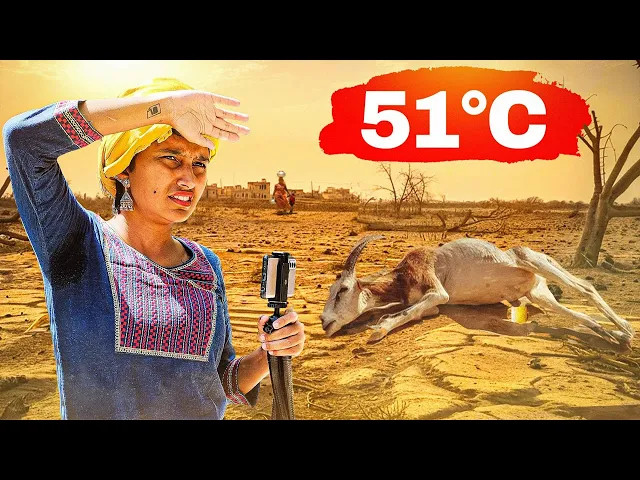
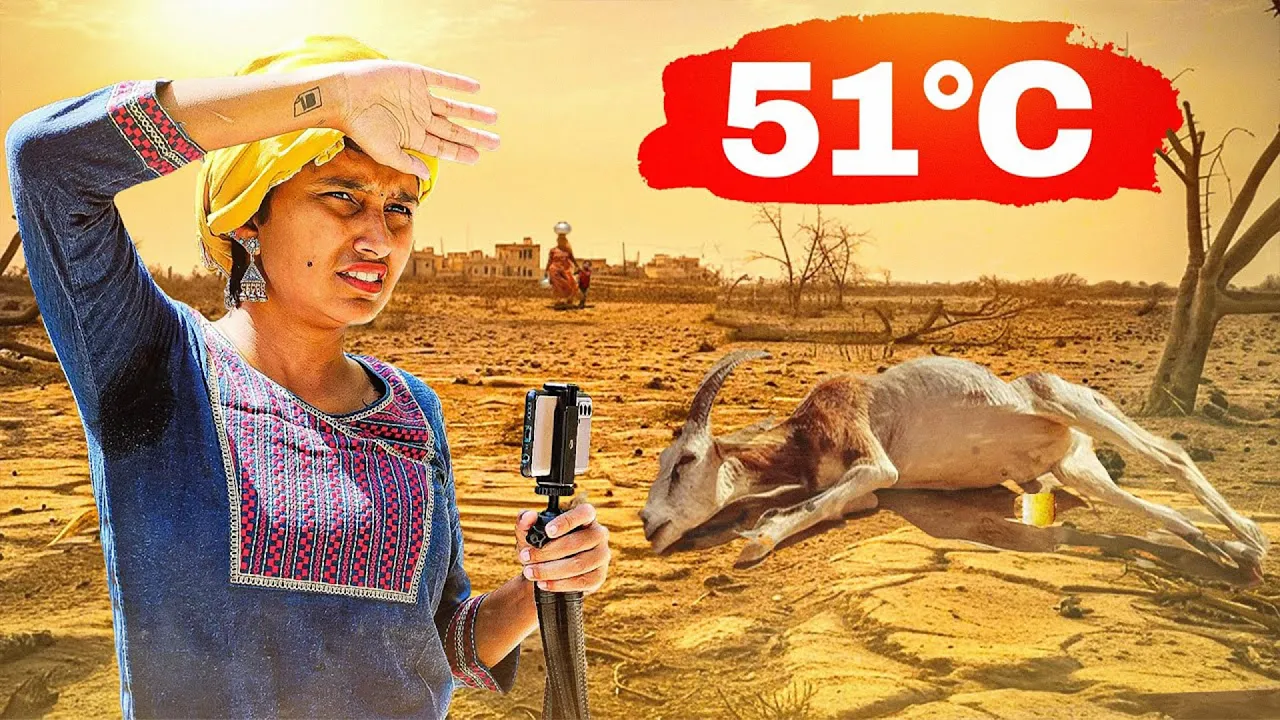
Today I have come to India's HOTTEST and DRIEST place It is so hot here that the temperature often crosses 50 degree celsius! The wind speeds here cross 60 kmph often Sometimes, the wind here travels faster than a car This is India's BIGGEST desert Rajasthan's Thar Desert The total area of the Thar desert is more than the area of Himachal Pradesh, Uttarakhan, Punjab, and Haryana It is also known as "Marusthal" or "Land of the dead / Land of the sand" because living here is not easy at all. There is a huge problem of water scarcity here Where the average annual rainfall in India is 1200 mm, it is only 300 mm in the Thar region.
There is just ONE river here which looks fully blue in the map but but in reality, this is how it looks in the summers Can you see this skin irritation here? Is this happening due to the water? "Yes, only due to water.
" Is there a problem with the water? They're saying it has lots of flouride? "Yes, it has flouride.
" What happens due to it? "The knees pain a lot. All joints pain a lot.
" And yet this desert is the world's most populated desert. It is home to more than 20 million resilient Rajasthanis! It is home to some of the strongest women How many times do you go to fetch water?
"Sometimes 10 times, sometimes 20 times in a single day. " It is home to some large-hearted people "You will find these chilled water campers for free everywhere across the city. You won't have to spend even a rupee for water here.
And you will get chilled water everytime. " People of this city create music out of only a couple of stones * Kutle Khan doing Kutle Khan things! * Welcome to my home Thar desert has 11 districts.
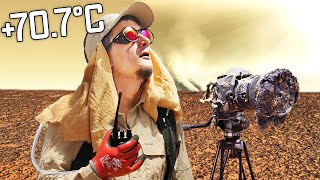
And our first stop is the Golden City, Jaisalmer To protect ourselves from the scorching summer heat, we mixed ORS to our water to stay hydrated But before we even reached our first location, our phones started to heat up "And this is the condition inside the car" Phone camera started to show heat warnings Steering wheel became a little too hot to touch We tried to cool our phones down with cold water bottles We wore white safas dipped in water so that our head remains cool "Is the camera too hot? " We covered our camera with cloth because it started to heat up as well. The sun-screen started melting as well inside the car But because I had to stay outside all day, I applied a lot of sunscreen and packed my head properly The surface temperature here right now in Jaisalmer is 61.
4 degree celsius What we saw when we reached Jaisalmer was absolutely beautiful! We saw huge sand dunes everywhere There are huge sand dunes here everywhere till your eyes can see And they're formed because the sand here blows over 100 kmph everywhere That is why these huge sand dunes are formed here These sand dunes continously change their position and height And that is why they are as dangerous As they are beautiful They are the reason that Thar experiences dangerous sand storms that cover the entire city sometimes. Due to this reason, at several places, one can see the roots of the trees And at other places, these roots bury deep inside the sand On the very first day, my shoes wore out due the extreme surface heat "This is camel's faeces.
. . It has turned white after drying completely.
" "This bug is dead Desert heat guys, desert heat. " Making videos like these requires a lot of hard work, money, and time So please, like the video and leave a heart in the comments and please press subscribe so that we are motivated to make more of them This deadly dangerous heat sometimes consumes the wild life here whose dead bodies we saw in an area where they left the dead to decompose Camel, cow, insects. .
. we saw mortal remains of all here Living beings which could not survive this hot summer in the desert It was so hot that one the first day when we went to get our fuel our car we could not because the machine was not working due to intense heat. Water had to be added to it many times to make it work.
But this was only our first day in the desert. * Kutle Khan doing Kutle Khan things! * Just when we left Jaisalmer, we saw SO MANY solar panels!
Housed in between this vast desert is India's biggest solar power plant Bhadla Solar Park! It is the biggest solar park of not just India but the world It could fill over a 1000 cricket stadiums! 2000 MW electricity is produced here everyday which could power all of Uttarakhand Other kind of renewable energy is also produced here such as wind energy We saw so many windmills on our way!
While going through them we realised that this desert provides electricity to millions of houses across India! And with this, we reached Phalodi which clocked this year's highest temperature all across India It is 1:30 pm right now and we are on our way Let's check the surface temperature here 70 degree celsius surface temperature My shoes are completely worn out We saw many dangerous mines on our way These very mines make Rajasthan the "museum of minerals" More than 80 minerals are found in this desert such as copper, calcium, and this - granite. While walking around Thar, one will find a lot of marble stones on their way They say that India's 90% marble comes from Thar desert of Rajasthan only.
Over 1000 million tonnes of gypsum comes out of this great Indian desert every year And that is why Rajasthan is one of the biggest producers of gypsum in India And you'll find these sandstones also everywhere in the desert. We just flew this drone it got so hot It's battery usually lasts for over 20 minutes but due to heat, it could only fly just over 5 minutes In such unforgiving heat few plants can survive But in Thar, we saw many resilient ones which survive and thrive in this heat Like this one - Khejdi tree It is Rajasthan's State Tree To save these trees, India's first Chipko movement started where people from the Bishnoi community hugged these trees to stop them from getting cut The leaves of this tree are very small so that water evaporates less from them. Earlier, these leaves didn't have thorns Now they have thorns so that no animal can eat them How amazing this is!
The trees have also developed things to survive in this unforgiving atmosphere just like the humans living here This is a "Kaakdi" or "Aakh" plant It is a wild plant You'll find many of them here along the desert You'll find these plants here as well (Ow! ) They have thorns as well Called the Ker plant, the very tasty Ker Sangri is made from what grows on it. We'll eat it later in the video as well and tell you how it tastes!
We found this HUGE cactus plant on our way! Varun is 6 ft tall for reference And this plant is much taller than him. Also it is very wide.
"I think this is Pilu fruit. . .
But I am not 100% sure. Rajasthan audience please let me know in the comments if it is Pilu or not? Many strong animals have also found there home in this desert.
Such as the camel. Rajasthan has the most number of camels in the country. They are also called the "Ship of the desert" But the most interesting thing is that Rajasthan has the most number of goats in the country as well * Producer randomly talking crap with goats * Rajasthan also has the most number of sheep in the country.
The special animals of Thar include the great Indian bustard and Chinkara chinkara, Even in this sveltering heat, you'll find more than 140 species of birds here! There's also a temple where rats are fed and protected. You'll find a lot of such huge trucks carrying fodder for the cows, buffaloes, and goats.
You'll find a cow or a buffalo in almost every house which give milk. You'll also find donkeys which help in carrying essentials for people such as water and other stuff. "In the jungle, all the weight is carried by the donkey, you don't have to worry at all" Not only do these animals survive here, but they make the life of people easy here "This might be reptile house.
" Will there be a snake inside? "Yes. Either snake or other such reptiles.
And see how many there are. There might be many here. Not just one.
" While travelling across the desert, we saw many different kinds of houses. But every house had one thing in common. They were made using locally available materials so that they remain cool during the summers and warm during the winters.
Cow dung is applied to the floor and walls houses in the village. Then the roof is made out of the wood of the local trees that are termite resistant and they remain cool You'll find these types of houses as well which are made from these small broom like sticks So the walls are like traditional coolers "You put water on it and it will cool like a cooler but only when you sprinkle water on it. " "Basically, one person should keep pouring water on it for the other person to enjoy cool air.
" Local materials are also used in houses of Jaisalmer. which have been made using these yellow stones. They are also called yellow sandstones.
From these stones only, all the city's hotels, houses, restaurants are made from these stones only. In fact, Jaisalmer is also known as the the golden city due to these stones only. Then we reached the most populated city of Thar desert Bikaner - who's normally bustling market was quite empty due to the summer heat.
"It is hotter than usual From 12 pm to 4 pm in the afternoon, the market is completely empty "And this wasn't the case in previous summers? " "No" But even then, we found fun and frolic in this market! "No one's coming or what?
Due to the summer heat? " "Only hot air is coming actually" "Hot air won't be buying stuff na? " "We are just sitting idle.
" "You put papad in the sand and it will get fried automatically. " "Which sand? " "The sand all over the city" "Forget papad, even humans get fried in this heat, friend" "Stay a minute friend, we will get you chilled shikanji!
" "Come Ankit, the kind folks here have made cold shikanji for us in this scorching heat. " "Thank you so much" In this Bikaner market, we found several vegetables that grow in the rough soil here. Such as Ker and Sangri "Where does Sangri grow?
" "Where there's lots of heat, there. It won't grow in rain, storms, etc. only in heat.
" We saw lotus stems, kaachdi, and aloe vera in this market. In this very market, we ate Ker Sangri and and Gatte ki sabzi for the first time! We also ate the world famous Dal Baati, Sev ki sabzi, and ate way too many kachoris!
We also got a head cloth from the market which helped us with the heat of the desert. We also saw traditional Rajasthani footwear - Mojdi and also saw Bikaneri sarees. * Shopkeeper showing us his amazing collection * And in this very market, we saw the huge heart of the residents of Thar!
This is Bikaner's main sabzi market and right next to it they have put a lot of water canisters which the passersby use to quench their thirst in the wild summer heat for free. "Our Bikaner is one such city where no one will refuse you for water. You roam around the city and you'll find these water campers in every other shop You don't have to spend ONE RUPEE for water here and you'll get chilled water here in this dangerous heat.
" We also found good samaritans who were giving out water to the people on the road. And we also found water near the bus stand where there was ample water for humans and for our voiceless friends, the birds and animals. Maybe when there is a scarcity of a particular resource, only then we understand the importance of it.
Maybe the scarcity of something teaches us to keep our hearts large. Because in the Thar region, water scarcity is a centuries old issue that teaches one a lot of things. The biggest problem in Rajasthan's desert is the scarcity of water.
We saw many such 'tankas' in Thar which are the lifeline of the people here. Rainwater is stored in these 'tankas' It is very clear water this. They put these bricks or other blocks so that the rainwater is not polluted with other contaminants.
And just like this, this one 'tanka' quenches the thirst of many villages. But when it doesn't rain for a long time, then these generations old 'tankas' get dry. Like these man-made reservoirs These are made from the hard work of the local people under the MNREGA scheme.
Made in such a way that they store every last drop of water. but in the extreme summer, they get dried up. "The reservoir is completely empty.
. . " "Show us please" "Hop on the bike and we'll see.
" It is completely dry right now. In which month does it dry up completely? "By January February, it dries up.
" And then it stays that way for six months? "Yes, absolutely. " "There is 18,000 bigha land here in this Oran and there are 6-7 such reservoirs and all of them dry up during the summers.
" What is the water from here used for? "For everything. Bathing, drinking, cattle feed, etc.
" How many people depend on water from this reservoir? "Around 10 villages. " And how many people in those 10 villages?
"Around 50 thousand people" Where do they get water from? "Here only" And when the water dries up? "Then it is up to God" To address this scarcity of water, India's largest canal was made here in Thar.
Right from the middle of this desert flows this canal the Indira Gandhi canal which brings water from Punjab to Rajasthan. Seven desert districts receive water from this canal. But there are several places where this canal has been unable to provide water.
Does the water come here from the Indira Gandhi canal? The canal has reached but we get water every 15-20 days and that too it reaches only 20-30 houses here and not all. In many places, the water has reached from this canal but it is so polluted that it has become the reason for many skin diseases and other ailments "Can you see this?
" Is this happening due to water? "Yes, only due to water. " "Skin diseases happen due to this water.
A lot. " Is it just a one off case or many people are suffering due to it? "80% people suffer from it.
I got it. My kids got it. My mother and my father got it.
" What does the doctor say? "It is fixed. The doctor takes 3000 rupees and prescibes some medicines.
" For this very reason, many villages get their water from water tankers which are quite expensive. Water from one tanker lasts around three days for one household And that is why many villagers resort to digging tube wells for water. but the water from these tube wells is quite brackish sometimes.
Which water do you drink? "We drink brackish water from the village tube well. It has a lot of flouride.
" What happens due to flouride? "Health deteriorates. Knees hurt.
Kids get weak. " The women bear the most brunt of this water problem. "We have to go get water on our head in this unforgiving heat also.
" "I go to get water 20 times a day" Twenty times in one day? "Yes" You carry water on your head everyday? "Yes, I do.
" How many times do you go? "10 times! " *laughs* Wow!
And you're still smiling about it. Do men go to fetch water? "Not really no.
It is mostly us girls and women. " "We are poor people. I don't have a father or a mother.
What to do? " Do your studies get affected due to this? "Yes, of course they do.
" A lot? "Yes, a lot" Brother, will you talk to us? Boys just ran away!
You will want to stay in this village only or do you want to get out of here? "I am never going to leave my village. " Never?
"Never. " And do you want to see your village grow and prosper? "Yes, a lot.
I have lots of dreams for my village. " You have big dreams for this village? *Nods* In just seven days, no one can claim to understand.
the desert completely. But one can see it, hear it. Thar's silence, its strong wind, its cries for water, its smile.
I heard all of it. I also heard Thar's amazing instrument - Khartal! Many communities in this desert have been preserving its music, its culture for generations and taking it ahead for the coming ones.
And just like this, we want to bring the diverse and interesting cultures of India to all of you. So please let me know about your districts in the comments below. Who knows?
Maybe I will come to yours next? And till then, Subscribe to your mate, kk. create!
!