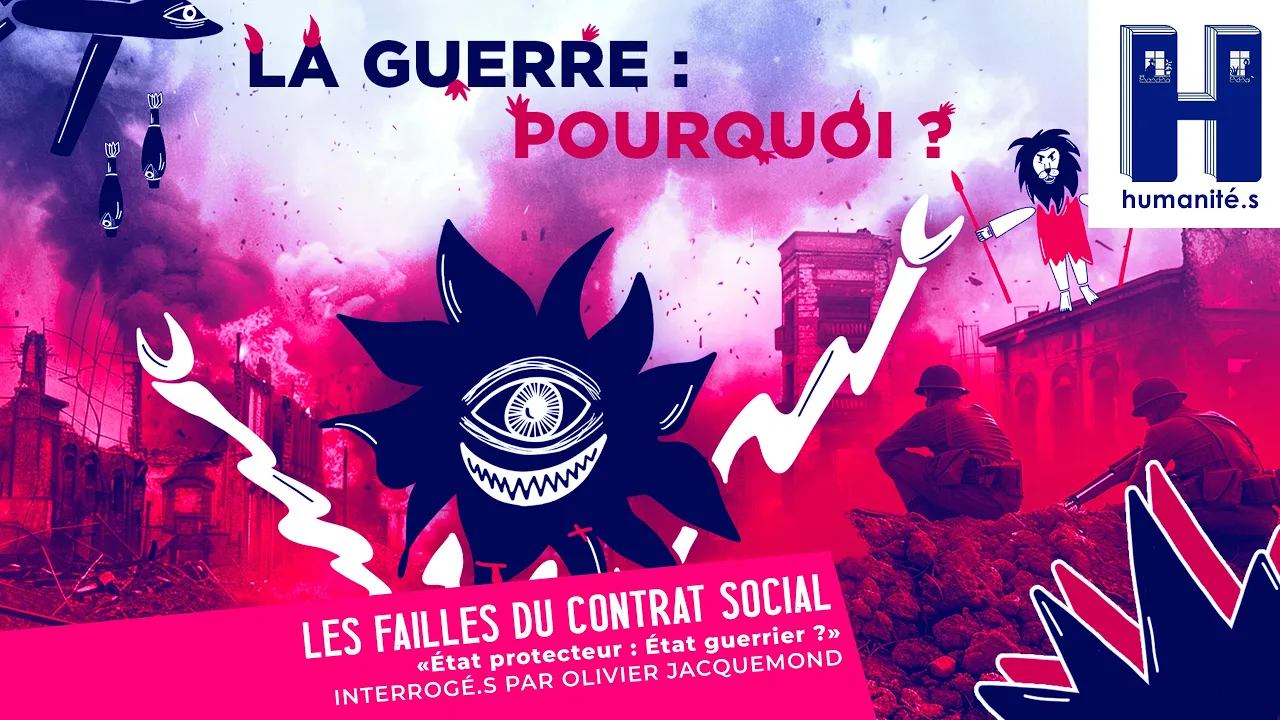
There is one form of violence that is legitimate and acceptable, namely war violence, the violence between states, not between people. We're here at the world-renowned Père-Lachaise Cemetery, where thousands of visitors flock every year to honour those buried here, including names such as Édith Piaf, Jim Morrison and Colette. It's also a memorial to those who lost their lives in wars: the First and Second World Wars, but also the victims of genocide.
We've chosen this spot to explore one of the flaws in the social contract by asking how the state's promise of security made to its citizens can coexist with the sacrifice of going to war? We'll probe this flaw through 4 works: Pourquoi la Guerre? (Why war?
) by Frédéric Gros; Necropolitics by Achille Mbembe; Le Déchaînement du Monde (Ruthless World) by François Cusset and Drne Theory by Grégoire Chamayou. Hello Chara! Hi Olivier!
All good? Just fine, you? Thank you for coming to this memorial.
We're in Père-Lachaise Cemetery, facing Bartholomé's Monument to the Dead, one of the most iconic features here. We're not here by chance. Because, as I mentioned in my introduction, there are many monuments commemorating those who died in war, during the First and Second World Wars.
It's a place to sharpen our focus on how violence and the state relate to one another. Let's start with some figures. The Great War, the First World War.
One French soldier in every five died in that war. Let's take another country, say Serbia. The rate was one in three.
The overall figure, between 8 and 10 million soldiers gave their lives. It's huge. The civilian death toll is roughly the same.
Deaths in WWII jump to 20 million soldiers and 40 million civilians during the Second World War. Colossal. The figures are absolutely staggering.
It thus encourages us to question a state that is supposed to protect the lives of its citizens, yet in times of war, calls for the sacrifice of those very same citizens. Striking the right balance can be tricky. A question arises as to how we can manage tension between a protective state, a security state that safeguards the lives of its citizens, and a state ready to send and sacrifice human lives on the battlefield.
We can grasp the dynamics of this link and tension by reflecting on the very foundation of the modern state: the social contract. Can you guess where I'm heading? Absolutely.
Interestingly enough, you say that the state protects its citizens, and you've just touched on the First and Second World Wars. The Ukraine war and riot control blast balls used in French yellow-vest protests also come to mind. So can we really talk about a protective state?
We'll get back to the ‘yellow vests’ and internal security. Let’s first turn to war globally and the link between violence and the birth of the state. Broadly speaking, social contract theories suggest a deep and essential relationship linking the establishment of the State to violence.
They go hand in hand. The transition from 'state of nature' to 'state of culture' or 'state of society' is one from a 'state of violence' to a 'state of cohesion, harmony and social security'. Numerous intellectuals see it that way.
A more recent example than Hobbes springs to mind straight away, but I'll come back to Hobbes soon enough. Take Freud. In Totem and Taboo, Freud explains and proposes an origin hypothesis or story.
He elaborates a Darwinian assertion that man in the state of nature lived in packs; wild, primitive hordes structured around the figure of a tyrannical father who tyrannised his sons and had exclusive control over women. Then the children ultimately rebelled and killed this father. With this inaugural act of violence, they took power.
But rather than abuse the power they had inherited, they established rules and taboos. The famous first taboo concerns incest. This is the advent of controlling power with prohibitions, setting limits, taboos, and non-transgressable mores and rules.
These appeared in early forms of religion, sacred power and statehood. There's a clear link between violence and the birth of the State. That's Freud's idea.
Hobbes' concept is better known. Man is a wolf to man. People living in a state of nature are in a state of war with each other.
It's anarchy, primitive violence, unleashed violence, destructive and self-destructive violence. Humanity is thus afraid. The sole escape from the primitive state involves relying on a third party, the State, the Leviathan, to guarantee the security of its citizens in exchange for their obedience.
That's the only way it can work. In return for obedience, the State guarantees not to revert to a state of war of all against all. In a way, that answers my question: yes, the State protects, but only if we are obedient citizens.
Exactly. In fact, the State is engaged in efforts to bolster its authority. It seeks to increase its power and legitimacy.
As soon as it emerges from this original violence, two types of violence will then take root. We can call this acceptable and unacceptable violence. Basically, unacceptable violence is internal violence, which occurs within the State.
This violence risks undermining State institutions and authority. This covers all forms of internal violence. You mentioned yellow vest protests, and they sometimes use black bloc tactics for example.
The forces of law and order will be called in to reinforce and also re-establish public order. This is clearly important for the State. It shouldn't escalate into civil war.
That also means that protest movements always entail internal violence, right? Right. The state always responds to the threat of civil war by saying: No.
We will restore public order to keep this from degenerating into civil war. There's thus a perpetual fear of the ‘enemy within’. There is one form of violence that is legitimate and acceptable, namely war violence, the violence between states, not between people.
States present themselves to to each other by espousing a certain number of rules, by respecting these procedures and laws, international conventions, institutions such as the UN, the UN Charter, which mean that war is regulated and thus legitimate, oddly enough, even to the point of respectable, though using this term may seem highly abusive. And that's how the State wants it. It goes beyond merely wanting it; it actually prefers it in some respects.
How so? It reinforces the State's authority. Only the State is susceptible to, and may also wage, war.
Thus, at the start, war created the State. That original State is no more. The State then continues to wage war to reinforce its authority.
This is interesting, but I don't see how the State can get stronger by sending people off to war to be killed. Just think of the young Russians who were forced to flee Ukraine when war broke out. It's astonishing.
Is there any way out of it? Certainly from a moral standpoint, we say: war is wrong. Yet at the moments when wars are declared, the war in Ukraine is just one example, the people are behind their state and the political leader who declares or starts the war.
Even though opinion polls in Russia are rigged, we saw that at the start, in February 2022, there was support for military action. Both Machiavelli and Marx observed that the act of declaring war entails a diversionary tactic. It's an escape from internal issues that shifts our gaze outwards.
An identified common enemy creates cohesion at a societal level. People stick together because it's a hard time and we just have to go through it. It represents a diversion from domestic problems and class struggles, as Marx would say.
It's also propaganda for the State, saying: Look what war does. War is dirty, war kills. But at least it's under control, because we are responsible states.
We're thus showing you on the outside what could happen to you on the inside if we weren't the guarantor of order. War is essentially a projection of what we don't want at home. That alone helps forge community and cohesion: bolstering the State.
Yes, I understand. What you're saying is crazy. It is crazy.
There's also an underlying paradox. The war waged by a State is supposed to control the level of violence within its society. Can you see the totally paradoxical side of this assumption?
Can you understand why? Yes, I can. In fact, on the one hand, war controls violence, but it's as if.
. . For me, war itself is violence.
Yet what you're saying is like dissociating war from violence. Absolutely. That's a very good philosophical reflex.
In other words, you took two terms, war and violence, and wondered: Why are we separating these two terms? How do they relate? How are they perceived?
It's too easy to say that war is legitimate, legal and accepted on the one hand, and that violence is unacceptable on the other. It's almost as if war had a positive connotation. Right.
We thus no longer think of the violence, though there is certainly violence in war. Perhaps it's a legacy of the social contract, and what I was saying, between internal violence and external violence. On the one hand, the social contract lets the State (born when freed from primary, primitive, archaic violence), regulate violence and thus become both guardian and monopoliser of legitimate violence.
This is how Max Weber views the modern state. The State acts as guardian internally with the forces of law and order, and externally through war with the armed forces. This violence is thus instituted, legitimised and accepted.
However, violence also exists outside the law. Internal, savage, untameable violence that we don't want. It comes like a resurgence of the same archaic violence from which the State freed us.
Hobbes and others see the social contract as based on the opposition between these two forms of violence. A kind of violence we want, which the State controls, and a kind we don't want. It's perhaps a little too simply, overlooking what violence really is and the fundamental ambivalence behind the term.
In this regard, regardless of our moral compasses and feelings about it, all violence is destructive, but also potentially constructive and creative. Violence changes situations. It transforms, it creates something out of nothing.
For example, the first law, a constitution, comes from nothing. There could be a coup d'état, an overthrow of power, followed by a new Constitution establishing, for example, democratic institutions. Why not?
It was born from violence. Exactly. That's the paradox.
In any case, ambivalence and ambiguity. The same for revolutions too. That's right.
An abolition of privileges, the Declaration of the Rights of Man. Violence had a significant role. Violence really does have a link with creation and even with law and order.
For example, a law would have no application, no impact, if it were not backed by force, order and imprisonment to punish transgressive behaviour. The law is thus accompanied by violence or force. That's a core concept.
How about another view of this link and the underlying continuity between violence, States and war, in the argument that they are not separate, but relatively the same thing? For instance, an alternative reading of the social contract. The anthropologist René Girard took up Freud's hypothesis that we set out earlier, yet he did away with the Oedipus complex, incest and so on.
Let's just put talk of murdering the father aside. He says: All archaic societies have mimetic violence because people want the same thing. Mimetic means the same violence.
Thus, we want the same things, so we fight each other to get them. It's thus a situation where everyone is at war with everyone. A terrifyingly raw, savage and dangerous violence.
-It's a bit like Hobbes too, isn't it? -Totally. It's a merger of the two.
But to escape this violence where everyone is battling against everyone else, we'll find a scapegoat. It's just like in the school playground. You find someone to blame, and it's horrible because everyone turns against them, concentrating and channelling all the violence of the group, now pacified internally because there is an external object onto which they can project their violence.
The State also plays this role. The State will thus channel, concentrate and regulate the wild violence within us. Bear in mind, however, an interesting point: René Gérard says that this violence will never go away.
It always threatens to flare up, resurface and reappear. Violence is thus latent, lurking in the shadows, waiting for the scapegoat to disappear. This leads to another hypothesis about violence.
Violence is not something that exists but then disappears. Violence is a sort of energy flow. That's how François Cusset describes it, citing authors such as Georges Bataille and Baudrillard.
It's an energy flux. It flows but doesn't disappear. Violence needs to be expressed.
It always finds ways to express itself. As French chemist Antoine Lavoisier put it: 'Nothing is lost, everything is transformed'. It's the same with violence.
Violence is not lost, it is transformed. -Like energy! -Exactly like energy.
It needs an outlet. That's the whole story of modernity too, of seeing what outlets we want to create. -There's just no escaping it.
-Absolutely. I wouldn't say it was morbid, but it was a very pessimistic way of seeing things. And yet it's somehow pragmatic.
Right. There's a pragmatic dimension that leads us back to something else. Setting aside the moral aspect, Hegel said that ultimately war and violence are the real driving force of history.
It's a terrible thing to say, but wars do bring technological progress and sometimes medical advances too. It's progress, ultimately, like in 1945, which led to social welfare based on the resistance. Human progress can take great leaps in wars, which are often accelerating movements.
We can assume the Hegelian view that, ultimately, violence brings something and war also brings something. In Necropolitics, Achille Mbembe argues that war is one of two sacraments of our time. In other words, war, paired with imperialism and capitalism, has ushered in modernity.
Yet he mentions a second. I said ‘two’ sacraments. Can you guess the second one?
I don't know, but you're scaring me. I don't know what to expect. Sure you do.
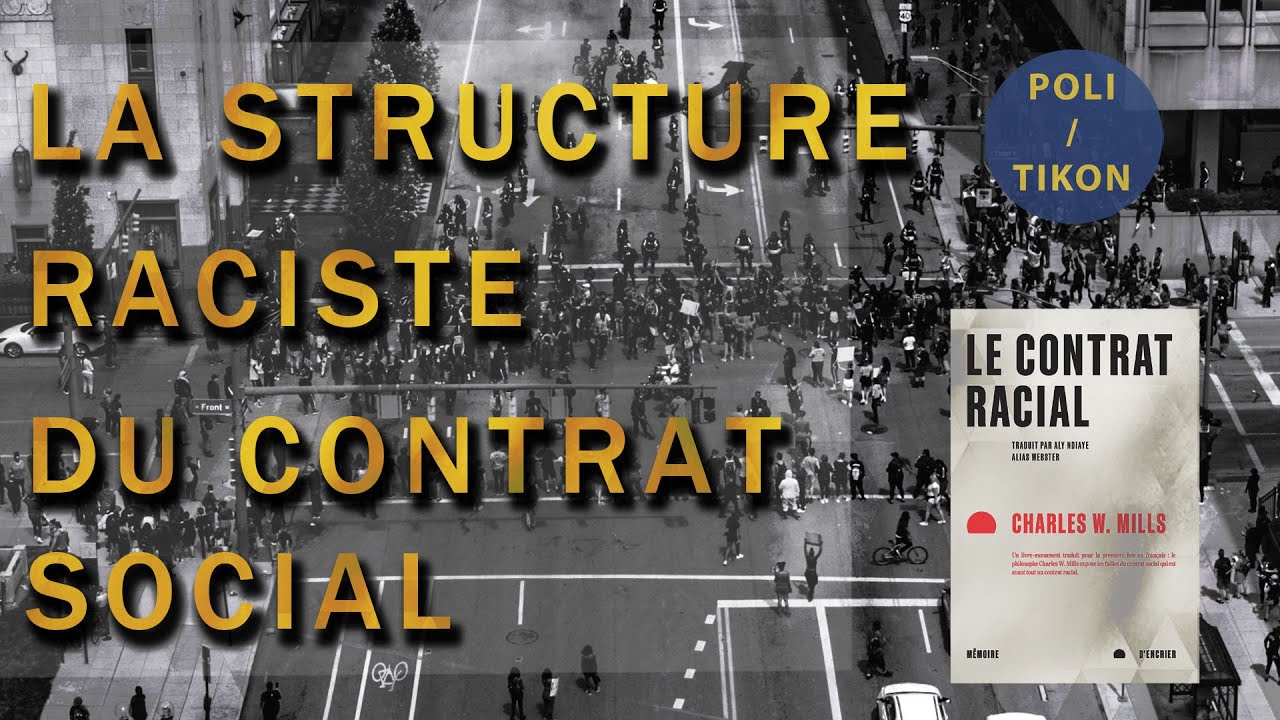
We've already explored one flaw in the social contract. -Racial contract? -Exactly.
-OK. It's a whole theory put forward by Charles Mills, which views the social contract in terms of 'just us' for 'justice' and therefore equality just for us. It enabled the West to live peacefully despite inequalities with the South and colonised indigenous peoples.
War and race complement each other perfectly. They work hand in hand to create a more peaceful, more harmonious West. This lens enables us to understand how the sociologist Norbert Elias was able to say that European civilisation, the West, is moving towards the euphemisation of violence, towards increasingly pacified mores, towards civility.
Excuse me, please, how to hold a fork, a knife, table manners and all that. It's because we subdued our violence, but perhaps we turned it around and sent it outwards. -Right.
-Can you link the two? -It somehow concerns the colonies. -Exactly.
It's concomitant, in fact. We projected our violence outwards, externalised it on indigenous peoples. We spoke in our last session about how a white/non-white distinction creates an inferior status.
If they have inferior status in our Western mental construct, the rules that apply to us do not apply to them. Violence can thus be unleashed there. Hence all the abuses and atrocities committed against men and women; murders, rapes, enslavement.
. . it's because they don't have the same status as us and are outside the law, as we might say.
In this regard, when violence is beyond law and projected there, we really don't care any more. Yes, in fact, if I'm not mistaken, the natives weren't considered as human beings, as people with rights. Thus, you completely shake off the responsibility because it's almost as if you were not to blame for these errors, for doing such things, at least in that period.
It also engenders a form of violence within these societies, obviously like the colonist or occupier, but even against oneself, which turns against oneself. Sartre and psychiatrist Frantz Fanon examined and commented on this, saying that the violence of the colonist will become an internalised violence of the colonised, who will harm themselves psychologically and then be treated by clinicians such as Fanon, who will recognise certain pathologies arising from colonisation. This violence is thus built in.
We render it even more complex by saying: Look at those savages, incapable of playing by the rules because of this internalised violence. That's one side of it. Now the other side: I'm referring to the violence we project outwards, onto people who don't have the means to defend themselves, because they lack the western technologies that allowed us to sacrifice no-one during colonisation.
Just think, 90% of the native Americans died with the conquistadors. We saw that figure in the last session. It adds up, since when war came back to our shores, as it did in the 20th century, we used our colonised peoples as cannon fodder, sending them to the battlefield to die in our place.
For the State. That brings up another paradox. In other words, again, it's difficult to ask us to obey when we know we're going to perish en masse.
What is the meaning of this sacrifice for colonised peoples who come to defend another distant state in Europe? There is no social pact, there is no social contract. That's right.
It makes no sense, yet it worked. It absolutely worked. It only worked for a while, however, because what happened after World War II?
I think this galvanised independence and autonomy movements in the colonies. And fortunately so. And fortunately, because the paradox was insurmountable.
Why should I have to obey the rules and protection of a state that isn't even mine, or at least not where I am or where I live? The rules of the game have clearly changed. We might conclude that waging war in the second half of the 20th century would have become more difficult.
No more wars. Well that didn't happen. They’re still here, sadly, despite World War II, despite Hiroshima, despite decolonisation movements.
But now the nature of war has changed and become technological. Ultimately, it's exactly the same issue as the one we've just highlighted. We no longer sacrifice human lives here at home.
With technology, we take as few risks as possible and intervene in external battlefields such as Iraq and Afghanistan. We can trace that doctrine back to Obama's drones. It wasn't the Ukrainian drones, we're talking about big, stealthy drones.
The doctrine is: we're going to project our power outwards without projecting our vulnerability. It's thus not really war any more. -We don't sacrifice lives.
-Right. But what would be the consequences of this kind of action? Here's the real twist.
We can theoretically say that we're ultimately waging war without waging war. It's the fantasy of a zero death war. Some people are dying on the other side and that's like cheating.
Because there's a warrior mentality with ideas such as chivalry that defines war as taking the matter of death seriously. François Cusset tells us to take this question of death seriously. It wasn't Cusset who said that, it was Frédéric Gros.
What does that mean? It means that if I go to war, I accept that I may die. That's the only way I can take another's life.
We are equal before death. But that was before. That was before.
Technological warfare creates a dichotomy, a gap where this sacrifice no longer exists. The symbolic exchange of death no longer exists. Which means that this violence we refuse to accept.
. . It comes back to us somewhere?
But how? Because it can't get out, it comes back to us. It comes back to us, particularly in terms of the reactions of those we attack.
Terrorism, for example, is violence that will resurface to bring terror and violence into our homes, which really plays on this mechanism of imbalance. That's how Baudrillard viewed it in The Spirit of Terrorism, an article he wrote after 11 September, saying: The violence of the system turns against the system itself. We're not here to say whether it's good or bad, of course.
-We could say it's bad. -It's a fact. In other words, people who live with violence often willing to give up their lives— the martyrdom and sacrificial side of terrorism—to restore the balance between the dead in the West and the dead in the rest of the world.
There are other forms of inherent violence in our societies. Mass murder in the USA is another example. Why are there more and more mass murders inside the country?
From another perspective, there's another tendency. . .
How should I put this? Let's say junk food and porn food. There's also a sort of pornography of the image through violence, our scopophilia.
We want to see images that are increasingly more violent. We're thus in a system where violence comes back to us through different channels because we haven't expelled it. It produces exactly what we initially sought to avoid (in the Hobbesian scheme): inner violence, including by finding bad objects.
That's according to Achille Mbembe. The era of colonisation has passed, the world is shrinking along with a resurgence of fear towards the other and hate speech that is divorced from reality. That's also a form of violence: a violence against the other.
What happens when all these forms of violence are combined within society? Worried about losing power, the State will try to regain control by taking security measures, authoritative measures, asserting its presence as the guardians of order. That's what gives rise to, for example, exceptional measures and emergency laws that infringe our freedoms.
You mean to say that the authoritarian nature of the State, instead of calming people down, reinforces their fears. Right. We've reached the core essence of the State.
A State born of violence, a primordial, original violence. It also fears being challenged by this resurfacing violence. It thus regains control by being more authoritarian or securitarian.
However, all it really reveals is that the State is contingent. It exists, but it doesn't have to. It's just seeking to cement its legitimacy by force and violence.
Several classical theorists maintained that the State is first and foremost a reputation. You have to believe in the State, its authority and power, otherwise it will collapse. Retaking control through security, law enforcement and a return to harmony, albeit a harmony regulated by law, is a way of showing that it still has the upper hand.
However, the State, power, is still contingent. It's depressing. It's not so bad, because it really depends on how you look at the State and whether or not it's an authoritarian state.
The survival of authoritarian states hinges on its increasing dependency on the use of force. So it's not as hopeless as all that, since in fact, that's the logic of authoritarian states. Their strength and survival always require a perpetually escalating use of force.
Especially when they feel threatened. Any comparison with Russia today is irrelevant. Oh yes, it is.
A democratic state is different. It accepts the contingency of power in its DNA. This is what seems to make democracy fragile and vulnerable.
But in fact, it's a strength. Because mandates are renewed in five-, seven- or four-year cycles, depending on the country, thus power changes hands, which proves the extraordinary vitality of democracy. That's really the heritage and treasure we should preserve together.
That's why democracies seem so ill-prepared for war. It may seem like a weakness or naivety for these democracies, yet it proves that the democratic state does not need war to survive. Its impetus and dynamics stems from the citizens, the people, our freedoms and our values, enabling us to defend this heritage and this contingency that is actually built in.
Therefore, succumbing to the temptation of security ultimately undermines the democratic principle. We should understand that this freedom is our capital, which we must therefore defend. It's a shared treasure.
So when you see a monument like this, for example, it really does block the view. A fitting metaphor for the security state. Behind this wall is a path that leads to the Gambetta exit of the cemetery.
That's the way to freedom, to look behind the walls. A poetic touch! Thank you, Olivier.
Thank you, Chara.