The world is crazy right now. You're building a company in a very competitive market. How do you stay sane?
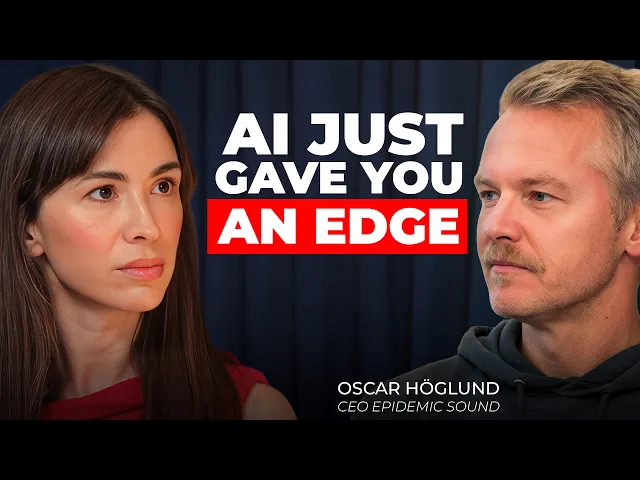
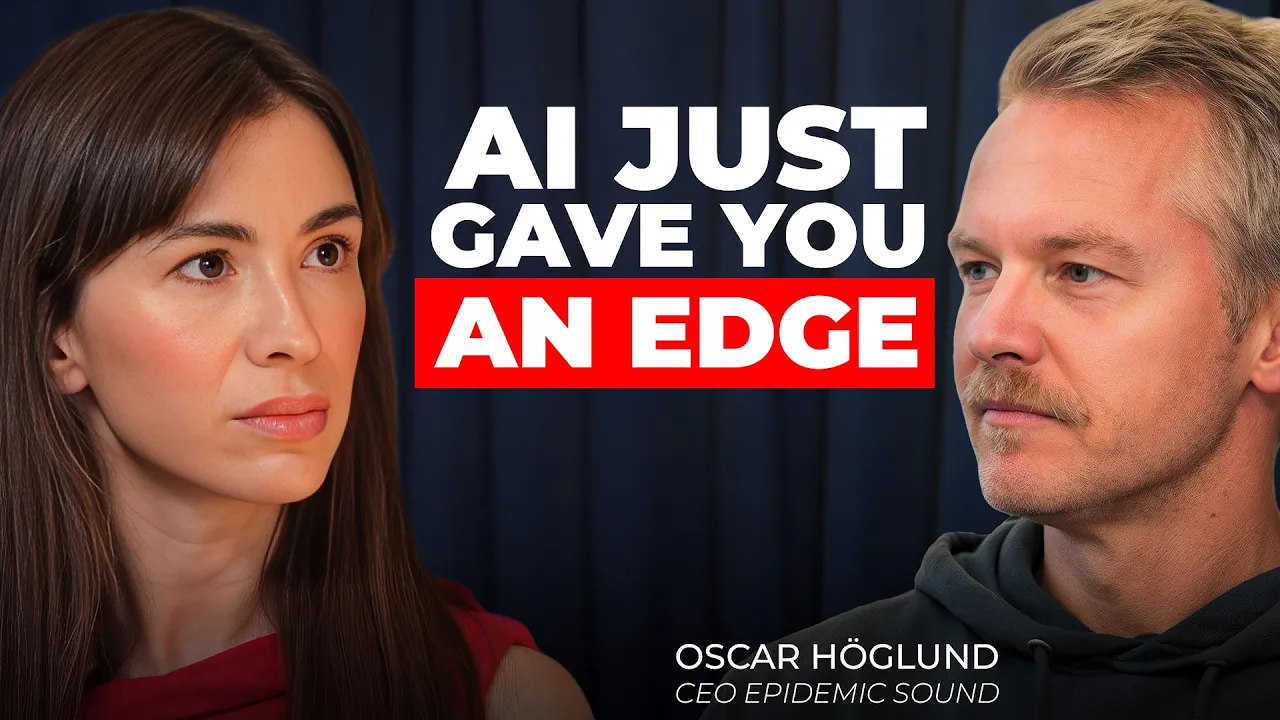
>> If I were to boil it down into one word, it's >> This is Oscar [music] Hogland, the co-founder and CEO of Epidemic Sound, who grew a $ 1. 4 billion company behind 3 billion views on social media every single day. >> One of the most important things that we ever did was trying to understand value chains.
>> Can you explain value chain? >> If you understand the value chain you are in, you can get leverage. and leverage in my world is with a small amount of input, you can get a huge amount of output.
>> With more data on viral content than almost anyone, Oscar is building an AI that will change everything. But success came at a price. The darkest moment that almost made him walk away.
>> My wife said, "This doesn't work anymore because our life now is better when you're not here. " >> Oscar rebuilt everything after that night. Now he breaks down the framework any founder can apply.
How to scale bigger, make more money, and avoid the mistakes that cost him everything. Hello everyone, welcome to Silicon Valley Girl. I have Oscar from Epidemic Sound.
Today, Oscar's company is behind 3 billion views on social media every single day, and that's just YouTube, right? >> Correct. >> So, you know a thing or two about going viral.
Have you seen any patterns behind videos that stand out, that use your music? Is there anything like, "Oh, this is happening right now. " >> Well, first off, thanks for having me.
And then to answer your question, we soundtrack huge amounts of online video every single day across all platforms. And so we're privy to see a lot of different trends. I think that what's at the core of all of those trends, however, is like a very philosophical thing, which is content creation and going viral is ultimately about helping create meaningful human connections.
And so what we do is we facilitate creativity and we help spark interest. >> Do you see any correlation? Like if I'm a YouTuber, cuz I use music, but I feel like the way I use music is like, okay, I was at Sharon's concert yesterday.
Let me just use that shirt like and that the way it works for me but I'm trying to understand the mechanics like do you see anything like oh this ch music performance better with this like have you noticed something while analyzing that data >> ultimately what you're trying to achieve with music as we said on the outset is you want to help create an emotion and this similar to common belief if you only use commercially well-known music as a storyteller as a person looking to help create a specific feeling, you abdicate from that power because you don't know exactly who's had what kind of experience with a 9-in nail track or an ed track, regardless of how romantic the track might be or how full of energy it might be. I I'll share one interesting trend which we saw a few years ago, which was coming out of co I don't know what the American expression is, but I think it's called comfort food. As in if you're if you're feeling down, you'll eat a a bucket of ice cream to make you feel good.
And we could literally see in the world that there was a world where the world was feeling low postco and there was a lot of comfort food going on. So a lot of music which was very reassuring, calming, warm, uh classical music had a huge spike because people wanted to feel reassured. It's going to be okay.
>> Have you seen any like 0ero to one examples where creators came with not a lot of views then they added music and boom it started exploding? To be quite honest, we see that all the time when there is a unique and distinct connection between what's being said visually and then what's being said from an audio perspective when that creates >> either an extreme symbiosis or an extreme dissonance but that there's something which people find fascinating. There was a story that I heard many many years ago which relates to the crosses right and so the background was that one of my co-founders was having lunch uh with a tabloid editor um and this is many many years here in downtown Stockholm and so the tabloid editor was eating and looking at my colleague and he said have you understood this the crosses my colleagues go like the crosses what do you mean [snorts] and he said well humans are drawn to crosses in the sense that if on my tablet if I put a very famous um sports star and they talk about their sport success, nobody cares.
Okay. However, if I put that sports star on the front of the magazine and they tell me about that they're battling um alcoholism or some kind of substance abuse, >> nobody's anticipating that that's going to happen. And so people are immediately drawn to something where there's a cognitive dissonance.
And so that's like that that's something about humanity and the nature of being human. >> And then my co-founder was like, "Wow, that's insightful. I don't know what to do with that information, but I'll save it for a rainy day.
" And so years passed and then uh my co-founder, who's a serial entrepreneur, his name is Zach, he was running one of the biggest uh commercial TV broadcasters in Northern Sweden, and he was their head of content. At the time they were looking to go from being a small insignificant player to try and break through and become the big broadcaster of their time and they had tried many things. They struggled and then eventually they had decided to go all in on this one format and the format was the most commercial TV show you can imagine.
It was an entertainment show. It was designed for Saturday slots at 8:00 and it was all about um two teams battling it out together. And it had been engineered in such a way that the show was meant to be great for men, women, young, old.
There was adventure. Uh there was a com an element of competition. You could be eliminated.
There was danger. There was humor. They basically created almost like a Frankenstein.
They put together different parts and they engineered the most commercial show you can think about. But the show needed a front runner, somebody who is going to be the face of the most commercial show ever. and that this broadcaster, their entire future was betting on this show because it was incredibly expensive.
And so my co-founder was put back to the point in time where he was thinking about the lunch that he had like, I need to create a cross, something that people are excited about. And he said, "Okay, what's the polar opposite of the most commercial thing ever? " and he thought about and this was back in Sweden and so we have this incredibly beloved uh cross-country skier.
His name is Gundasan. He's from the north of Sweden and he's about as far from commercial television as you can imagine. Always wearing a hat, always in the in the bushes and always out skiing.
>> And he said that this guy has to be the front runner of the show. It makes no sense whatsoever, but if I've ever felt a cross in my life, this is one of those. So he suggested to his boss, they all think that he's had a stroke and they said, "This is not going to happen.
" And he says, "It has to happen or I'm going to quit. " I didn't want him to quit. And so they put him on the show.
This was a show that altered the course of history in Swedish TV production. It became the most popular show ever. It still runs 10 years later.
And it's one of those crosses. And I bring it up because I think that that's the role that music can play as well. I think that when music really sets something apart and when you see huge engagement, virality, and things exploding, it's when music can play the role of a cross.
You can tell a visual story and a different audio story. Building out crosses, I think, is incredibly important when you build businesses, when you build podcasts, when you tell stories. >> Absolutely.
And you're are you building a tool for that? I was talking to your CTO and I think he mentioned something if you can talk about because this is fascinating for me because we still can't figure out music progression. I have amazing editors but I feel like we have to have an additional person on the team which you know is it's expensive but if we could have a tool that could analyze the video and tell us like hey this is where progression needs to start.
This is where you pause. >> So if I were to frame it I'd say the following. What we're trying to do is we want to try and usher in a new world where everyone who's a storyteller, whether or not you're a 200 person editing team and a full production or if you're a solo entrepreneur, >> we feel that it's about time such that everyone gets access to same kind of tooling and a level playing field such that you would want recommendations like a music supervis supervisor, somebody who can help you edit, somebody who can help you understand when music makes sense, when it doesn't, sound effects, how you master, how you make it all come together.
Historically, that's been incredibly expensive and difficult to pull together. But we found that we've come to an inflection point now where we have the roster of music, the roster of catalog customers and the understanding of the platforms out there such that we're very very confident now that we think that AI has an incredibly important role to play here such as an unlock. It's never going to be the case that AI could or should replace the human connections, but it can play a crucial role in facilitating that.
And so what we're able to see now is we can accumulate huge amounts of data in terms of this is the music that we have at hand. These are all the artists. This is all the art that we work with.
And we've known historically over time this is how it's performed. This is where there's engagement. This is where there is feedback.
And we can start to play that back individually to content creators such that we're going to be in a position where basically everyone has access to all of these insights. And so you can start to utilize services which were previously only made available if you had huge budgets. And so this is going to help you analyze how is my own video performing the music that I've used, what are my peers using, what are the different platform trends.
>> So when is it going to happen? >> So um this is something that we are working on as we speak. We've already started to release quite a few tools within this area.
So we released AI voice a few months ago. We've released the opportunities to uh alter the length uh of the track such that that was actually a pretty big breakthrough because historically the way that an editor has had to work is if you found a track that you liked, you would typically have to re-edit your content, your story to fit the track because it was very cumbersome to try and do it the other way around. We've now gotten to a point where we can actually do the opposite such that you have an edit, you're super happy, the story works, you've cut it in the way you want.
You have this incredible track, but it turns out it's 1 minute too long or it's uh a little bit too short. Well, you can now use our AI tools to use that track. So, allow for the artist track and vision to be slightly adapted such that it fits better to the actual uh stories that you're looking to make and that you have in your head.
So, can you give advice to a creator or maybe a small business owner who's doing some content for their business? Uh, what are the steps that they should take to increase the views to create this emotional connection with their brands? >> I think the first job to do is okay, let's establish what would I like to sound like?
What are the values? What are the core stories I'm trying to tell? And then using that insight, that's when you come to Epidemic, right?
And so you come to the platform, you create a free account and then you can start to use the tools to look at your videos. We would come with suggestions. You tell us this is my channel.
This is the direction I want to go and we then can aggregate huge amounts of data to determine that this is where we think that you're going. And then we can start to serve you suggestions. And the more we interact with you, the more we get to know you and the better our suggestions can become.
>> And then I think it also comes down to being I love the term being a ferocious learner. And so I think as a storyteller, as passionate as you tend to be about the stories you want to tell, I think you should be similarly about who do I look up to, who else sounds or feels or creates that emotion, that connection, and then from that information, we can derive a lot of insights as well and help build recommendations around that, too. Listening to how Epidemic Sound streamlines workflow for creators, making music licensing simple so you can focus on storytelling, it reminded me of a great tool that does something similar, but for a different part of the creator workflow that eats up just as much time.
Because no matter how good your content sounds or looks, most creators still lose hours every week just trying to keep up with their audience. That's where Pop. store, store, who's sponsoring this part of the video, comes in.
It's designed as an all-in-one creator HQ. Everything you make, share, and sell can live in one place. But the feature that's been getting attention is their AI assistant.
It scans thousands of comments and DMs across Instagram and Facebook, flags the important ones, and helps creators reply fast without burning out. According to their data, it's been shown to double engagement and you get more reach because the algorithm pushes post with high interaction. It's basically the assistant every creator wishes they had.
One that never takes a day off and makes you look way more responsive that you might actually be. It's called Echo and is designed to help you stay connected with your community without sacrificing the hours you need for editing, filming, or honestly just living your life. So, if you're trying to grow your content while juggling everything else, Pop.
Store might be worth checking out. You can set up your own AI assistant and stop spending every night buried in your DMs. I'll leave Pop.
Store link below if you want to explore it. So, I heard you say uh when you build a product, you start with a feature, >> then it becomes a product, then it becomes a marketplace. >> Yes.
>> I absolutely love that because as someone who loves building companies, it's really hard to start when you think about your company. Oh, I'm going to build the next marketplace. But it's really easy to think about your company when you think I'm going to build a feature which is going to make people's lives easier.
Can you talk about Epidemic Sun? How you built it out? >> Absolutely.
U so first off that quote's not mine. I've heard it and I've used it profoundly. So like I >> I love it.
I heard it from you. So for me feature product platform. >> Yeah.
>> And so in the early days when Epidemic launched uh I would 100% argue that we were a feature. We were a feature in that we were a one-trick pony. We were a nice to have and not a need to have.
And the initial innovation that we came up with was that we were five co-founders. We came from storytelling. We'd made TV shows.
But we saw earlier than most that the internet was transforming. It was moving from a world which was initially very techcentric. We would anticipate that there's going to be a picture component to this.
But over time, we were utterly convinced that everything online is going to be videocentric, but we also knew coming from traditional TV production that most problems could be solved bar the music one because music was a very complex legacy business. It had evolved over time and despite best intentions, it was a complex beast where it was very difficult to clear music to use it in television and bar impossible to use it online where consumption would happen instantaneously all over the world. So we were pulling out the little hair that I had left uh and saying that this needs to be solved.
And so step one for us was a legal innovation. We took a step back and we said the traditional music industry hinges on representation such that a track that's created has multiple interests. There's a producer, there's an artist, there's a songwriter, there are label, there are publishers, there are pros and they all contribute with fractional pieces of value.
They all feel entitled to the upside, but nobody has like final say. Nobody can determine how or where this track gets used. And they have two things in common.
They all sort of hate each other with a passion quite often because they have very competing views in terms of who's contributed most value and they all have veto rights such that if one party was unhappy with any commercial deal, the track was made void and you couldn't use it in your video. It couldn't go on YouTube or on Tik Tok and other places. >> And so at its core, our initial uh like big innovation was let's move away from a model of representation to one of ownership.
And the only way of doing that is by doing right by artists. So we said we'll start to pay handsomely upfront and acquire all of the rights. We make sure that we keep the artist whole because we think that if we can build a huge compelling catalog of amazing music >> made specifically for soundtracking content bringing stories to life.
We think that will be a huge breakthrough >> because we can then be the only provider in the world which has a complete catalog where we can reach out to storytellers and say hey this similar from everyone else we have 100% of all the rights here so we can indemnify you and say you can use this for all of your content across all platforms across all of the world and epidemic [clears throat] exploded like there was instant product market fit but we were a onetrick pony and that's what I mean by we were a feature we were nice to have But we were more like a vitamin which is great if you take your vitamin in the morning but if you forget >> you still live. Yeah. >> You want to be something which is a necessity.
And so the first innovation the first part of the journey was being a feature. >> And so what we did number two is we said let's complicate let's complement the legal innovation with software. Let's make sure they become a soundtracking platform.
We want to be at a point where we understand our customers so well that they cannot think about editing a video without having all of our tools made available to them. And so that was point number two. That's when we became a product.
We realized that okay, we're past feature. We're a product now. Like we're integrated into we work with millions of content creators.
We soundtrack 70% of all the world's biggest YouTubers. And that was like our version of getting to a product. The third point was how do you become a platform?
um how do you get to a point where there are more people seeing value and providing value through the infrastructure that you've built? And so about 6 months ago, we realized that we're having our Amazon moment. And what I mean by that is there was probably a point in time where people at Amazon said that, okay, we've been building out the best tools, the best infrastructure for years to help our business grow, to help our business scale, to be insightful.
We've developed processes and we've hired people such that our infrastructure is amazing. Why don't we open this up as a product for the rest of the world such that other people can scale using our internal infrastructure? A version of that discussion probably happened.
They decided to call it AWS >> and the rest is history, right? So cloud. So everyone got access >> most profitable product that they had.
>> That wouldn't surprise me. Um, but AWS was the result of an internal tool that was so good that they turned it into a platform and everyone started using AWS to power and to scale their businesses. Now, how does that relate to us?
Well, 6 months ago, we realized we've gone to a point where we are probably the best positioned. We have the most amount of data. We have the most sophisticated uh group of employees.
We built the most amount of proprietary um data stack such that we understand better than anyone else how music travels online, what kind of emotions it make, how it can commercially make or break content creators, where uh music could and shouldn't be launched um and in what order. And we said, I think that this is our platform moment. We should probably open up similar to what Amazon did.
And we said, we're called Epidemic, so let's call it Antidote. So we become a platform for helping both storytellers and artists and people who have IP to connect to each other. From a tactical perspective, one of the most important things that we ever did was trying to understand value chains.
>> Can you explain value chain? >> Before we [snorts] had a product which was good enough for online creators, we started in our local vicinity which was broadcasting in the Nordic. We realized that there were roughly about 5,000 freelance editors in Sweden 16 years ago when we launched the company.
No matter how hard we racked our brains, we couldn't come up with a plan to reach, let alone persuade 5,000 freelancers to use our music instead of everything else out there. >> And so we needed to understand like what was the ecosystem. And it turned out the following was true in Sweden back then.
We realized that yes, there are 5,000 [snorts] freelance editors, but they're freelancers and there are a total of 50 production companies that produce the vast majority of all the TV shows in Sweden. And we said, okay, can we can we entertain the idea of reaching out to 50 production companies and trying to persuade them? And the answer was still no.
Like we don't have enough cloud. And then we took another step in the value chain and we said, "Okay, of the 50 production companies, who do they work for? " And it turns out that there were four major broadcasters who were commissioning the vast majority of all the shows from the 50 production companies and from the 5,000 editors.
And we said, "Okay, can we pull together four meetings with four major broadcasters? " And the answer was, "Yes. " >> Of course we can.
And because we understood their pain points, the following happened. like all of the four deals within like weeks as I remember it was probably months they all closed and they said that >> you've understood where we're heading we're on the journey >> our catalog at the time was tiny >> but the vision was right the empathy and the customer centricity was there so we signed multi-year deals with all of these broadcasters >> day number two what they did is they said that because all of the revenue from the production companies come from us they called the meeting the day after and they summoned 50 production companies to come and meet Epidemic. >> They did the work for you.
>> And then the week after the 50 production company booked 50 separate meetings where they summoned 5,000 editors and say that if you want to make any of our shows, you have to come meet Epidemic cuz they're a new kid in town. >> Wow. >> And so like that's how I came to understand the power of understanding.
If you understand the value chain you are in, you can get leverage. And leverage in my world is like with a small amount of input you can get a huge amount of output. >> I love this story.
>> Uh is that also how you hire people cuz your team >> is amazing. So your product officer used to build the initial Amazon app. You have exco of CLA.
>> I was like reading through the list. I'm like this guy knows how to hire. >> Yes.
>> Can you uh give us a little secret? Well, first of thank you. I tend to agree.
Um, I have a very strong belief in a few things obviously, but in terms of philosophy when you hire, I only believe in hiring people smarter than myself because I fundamentally want to hire smart people to tell me what to do. Again, taking impressions from others who've said this before me, but I strongly feel that if I'm the smartest person in the room, we're all doomed. And so, I need to make sure that I have other people who are way smarter than myself.
And then you find the >> And then you find the crosses. Exactly. And then you find the crosses.
>> Love it. Uh and you don't believe in hustle culture as a sweet, right? Cuz what I've seen from the last weekend when we spent time with your company, we're doing snaps.
We're eating crayfish. So you're proving it's actually possible to build a billion dollar company without having to hustle all the time and everyone is relaxed. >> Um what do you think is wrong then with [laughter] American culture-wise [gasps] in the US?
you're going to have to hustle. >> I love the US. Uh I deeply respect US culture and I take a lot of inspiration.
I try and mix the best of as many worlds as I can. I studied at Wharton in the US and I there was this term I learned which is uh being a ferocious learner and I really took that to heart. So I try and try and learn as much as I can, read as much, study as much as I can.
And so where I come down on hustle culture and and basically what you need to succeed cuz it's not as clearcut as I don't believe in in hustle culture. I think that in order to be successful as an entrepreneur in general and as a storyteller in particular my current best thinking until I come up with something better is that there are four components. I think it starts with talent and I'm going to a hot take.
I think this is the least important and so you need to have talent when you start but talent isn't enough. Talent is a ticket to ride and it allows you to participate and it's less about talent in absolute terms but more talent relative to your competitor set >> like do you have an edge from a talent perspective but that's just a starting point. Point number two I think is grit.
Like if I ever were to get a tattoo, Swedes are the most tattooed people in the world. >> Really? >> Um, fun fact, h I have zero tattoos as of yet.
I'm 47. It's [laughter] not too late. >> It's coming.
>> If I get one, my favorite word all categories is relentless. Like I have it on sweatshirts because it just reminds me it's it's cousin to the word grit. >> And I think it's such an important component.
So you need to start with talent, but then you need grit and you need to be relentless. You need to acknowledge and be willing to sacrifice. It's probably going to take 70 80our weeks for many many years before you even lift.
>> Did you have those weeks in your life? >> Oh yes, very much so. >> So witnessing like fast hustle.
>> Very much so. And so I think hustle can mean different things for different people. One version like the harsh um definition of hustle is dishonest.
Hustle is saying that this is great, it's not, and then trying to sell. And so that's one version. I think hustle also means just going at it constantly all the time >> like 70 hour weeks.
>> Exactly. And so I that's why I wanted to create some nuance because I think it's super important that you need to acknowledge that there is a lot of grit, a lot of relentless. And I think that that's I rate that higher than talent.
I because talent is your ticket to play but then grit on top of that which you can choose that's like a very important component of success. But then I think the third part is is lost on most people and we alluded to it before. You need to acknowledge that in your career, in your line of work, in the industry you choose, there are tons of taste makers, facilitators, and gatekeepers.
And you only identify and let alone meet a fraction of them. So there are so many people who have a say in your ultimate success and in your liftoff. And the only takeaway that makes sense for me is that you need to create a culture.
You need to conduct conduct yourself as a person who other people want to succeed because they will have infinite amounts of opportunity to either help or destroy your opportunity to grow. And the only way I've come up with to do that is to make sure that you are a person who is uh like a a net provider in that when I'm dead on my tombstone. I think there's one phrase.
This was Oscar. He gave more than he took. And I use that phrase all the time.
I think as an individual, you should conduct yourself where you want to make sure that you're always giving more than you're taking off the table. >> I absolutely love that. So if you push that out there and it's deeply selfish because if you do that it makes you feel good in the moment because it feels good to give much more so than to get.
It's it's selfish because it scales so incredibly well such that I try and like often when people reach out to me like one way to prime yourself is that when I'm introduced to somebody that I've not met before I just the first thing I say is hey how can I help? It's just a reminder not also hey how are you or who are you but hey how can I help and invite them to ask me to do something because if I can be helpful in any way like not only will that compound because suddenly oh that compounds over time so I'll have hundreds and eventually thousands of people who are indirect backers of me and my colleagues and my company because I've helped them because when they when they mention I was like he's always so helpful yeah they helped me do this they didn't have to they opened the door they made an intro if you do that enough times there is going going to be and you never know where it comes from. There are always opportunities when they have the the chance to reciprocate.
Can you recommend anyone like we're doing this new Netflix show, who should we reach out to? Like Epidemic is great. I've spoken to them so many times.
I can only endorse them. And so I think that you need to really sort of lean into that point and it's it's great because it gives you also a sense of I'll give you another example like a concrete way of doing that is introductions. Um I pride myself in doing great introductions.
I don't do them often. I do them about once a week. But if somebody wants an intro, I always do an open intro.
So let's say that you want to meet a friend of mine here in the industry and of course I'll reach out, are you okay? And then are you okay? I'll do a little bit of homework.
You can use chat GTP or something else or just read up online and then I take what I know and I do like two paragraphs. So I explain you in a serious but also like a fun fact about you. And they'll take the other person also serious and then a fun fact which I somehow weirdly relate to your first fun fact.
And then you should meet and then I also tend to write in there like I love introducing smart people to each other because two things happen. One, the world is a better place when great people know each other. >> And two, when two smart people know each other and I'm the source of that, your genius like reflects positive in me cuz you think about me in a better way.
>> And so I think that that's the third component. You just do that. And so we just had a great weekend together.
Same thing here. We just we do great stuff and then we think that over time we don't know how but this is going to play out well. >> Quick pause here.
If you're enjoying this podcast, you will absolutely love my inner circle newsletter. So what I basically do is I take all the tips from these podcasts and I apply them to my personal life, to my investment portfolio and to my businesses, this media company and my language teaching business. Sometimes we get amazing results and I share our real tactics.
Sometimes we don't and I share that too. Think of it as an insider version of this podcast. The link is in the description.
Join my free newsletter to stay ahead. >> The world is crazy right now. You're building a company in a very competitive market.
You know, all the labels are after [laughter] everything. How do you stay sane? >> If I were to boil it down into one word, it's disciplined.
I think that the best thing you can do in order to stay sane is be disciplined. I can give you case in point. So, uh my wife and I have three children.
They're older now, but uh throughout the first 10 years of epidemic, discipline was the key. So, everyone always if you're an entrepreneur, uh finance people always want morning meetings. I would always say no to them because it was crucial for me.
I knew that the likelihood of epidemic being successful if I ran the numbers was very low. Um and so I knew that there was a chance for failure. And I said, I'm willing to bet on that, but I'm not willing to bet on my relationship with my family.
And so I put guard rails in place. And I said that I never do meetings before 9:00 a. m.
And because I always went up and sort of took the kids to school, I had a bike, I would drive them to daycare, make sure that that was was was done. And it would be always to like the detriment of uh financial people. But they had to adapt to me, not the other way around.
So I didn't do anything before 9. And then between 9 and 6, I would go at it work-wise like a crazy person. But then 6, I have a function in my phone, stops working, shuts down.
And between 6:00 and 9, I'm unreachable. I never do meetings. I never do exceptions.
So, Monday to Friday, that was the case. Go home with the family, have dinner, put the kids to bed, read a bedtime story, my wife is up in the morning, she's a superwoman, and then she falls uh to sleep around 9:00. That's when my phone starts working again.
And that's when I did my second run. So, I would work from 9 to 1 in the night when the US got up or Asia. Wow.
>> And so, I did a night run and then I'd go to bed. >> But then I would never work weekends ever. >> And then, uh, no.
So I would typically travel during the weeks. So I'd keep the travels Monday to Friday. And then I made a big point of taking proper vacation in the summer.
The hardest moment in my entrepreneurial journey was when I couldn't reconcile family life with business life. Our kids were young at the time. I'd been out traveling non-stop the entire year.
It was probably my sixth or seventh trip to the US in that same year. And when I came back, um, my wife and I sat down and my wife said something to the tune of, "This doesn't work anymore because our life now is better when you're not here. " And that was without compromise or without any comparison, the darkest moment in my entire life.
Um, day after I called my co-founder and said, "I'm gonna quit. " I get all stoked up when I talk about it. Um, and we made some like incredible [snorts] changes.
Like we rethought the business. I rethought my role. We made a ton of big changes.
And I was super close to quitting. Uh, cuz I've always been family first. And as I said, I work to live.
I don't live to work. >> Is that when you discovered this discipline thing that works for you now? Especially when it comes to kids, right?
>> Yes. But it's true for exercise, like being disciplined. It's true for food and alcohol like everything in moderation but just having >> sweets have a different understanding of moderation.
[laughter] >> Okay, alcohol. Fair point. Alcohol.
Fair point. [laughter] But otherwise, I think that um I think the discipline is the unsexy answer to success. I love it.
>> That's how you get somewhere. >> What are your top three favorite AI apps? >> Oh, so I'm a huge user of the different Google suites within Gemini.
Chat GPT use all the time. I think I'll stop there because I say these are the two where I'm investing most of my time now to make sure that I understand them and more importantly they understand me so I get more and more value from them >> playing with anything right now like vibe coding or >> uh yes so I can't disclose too much but from a vibe vibe coding perspective um we think that there's a huge opportunity to be the default provider of music to vibe coders like if you think about vibe coding >> I think it's a beautiful thing because roughly what 1% of the world's population can code. And what VIP coding is is looking to try and solve for is how can you get the other 99% of the world's population to code.
We think that within that world, like all of what they're building is currently muted. Like there's no music component to that. We think that that needs to change.
>> For someone who's willing to start a business using AI, what would be your one advice that they should stick to? One of the best frameworks I ever learned was when I was a mediocre management consultant. I worked for BCG for a few years and it was not my calling.
Uh I got the job, I did it, I learned a lot. Uh but ultimately it wasn't for me. But they taught me a framework in terms of uh do you know when you're allowed to call something an analysis when you've analyzed something.
So when you ask the question why three times and so the example is the following. There's this company that doesn't make money anymore. You need to understand like why is that?
Analyze it. And the only time you can call it analysis is if you've dug down into why three times. Okay?
So why is the company not making money anymore? You look at the revenue numbers. Have they gone down?
The answer is no. You look at the cost numbers. Have they gone up?
Yes. Okay. So it's a cost question.
Like the costs have increased. That's why we're not making profit. That's the first why.
So why have the cost numbers gone up? You look at the inputs. Are they at the same amount?
like are we buying the same amount of uh input? The answer is yes. And you look at the unit cost.
Is the unit cost the same? And you go no, the unit cost has gone up quite a bit. Okay, so it's not about the materials per se.
It's about the unit cost having gone up. And then you ask the question like the third time, why have the unit costs gone up? And you go down and you analyze and you ask a number of questions and you realize that well we used to have three providers and we would play them out towards each other and such that we were the market maker.
But then one of our suppliers went into bankruptcy and the other two suppliers acknowledged that and they merged. So we have one supplier and they dictate the price. And so the answer is like the reason why we're not making any money is because there's a cartel going on down here.
And the the solve is let's do a tender, we invite five other suppliers and we introduce competition and then we'll start making money again. >> But you have to ask the question why? Three down, three times down.
And that's when you have an analysis. So in the age of AI, I think that as as the name implies like you have artificial intelligence uh which is in abundance. I think you need to be really good at asking like making an analysis of different situations like going down three steps.
Why why why is this going to work? Why isn't it? Why is this?
If you can understand that root cause and then you can deploy AI around that in order to help quickly serve or understand and build things. So complement the human condition being curious and being rigorous and having uh discipline and then unleashing AI tools to help you understand and answer these questions as soon as possible to find inefficiencies and market opportunities. >> Yeah.
Before just rushing into an idea, just dig deeper. >> Don't just go why. Go why?
Why? Why? And then >> I love that.
>> Thank you so much, Oscar. Oh my, that was amazing. That was so good.
Thank you. >> I hope it was okay. >> Thank you.
is great.