B: Sweden. It's a long time coming huh? Yeah finally. Yeah, it kinna blew our minds that we've been doing this for about six years now. So, it's good to be here. Ahh great. Thank you. Yeah, so, if you don't know who I am my name is Blake Dyer. I've lived with teal for 15 years. she escaped from her abusive situation to... My kitty cat explosion. And, so, it was funny... I was introducing her on stage the other night in london, and talking about how I... I was like, "shit. you're always so serious." You know? And
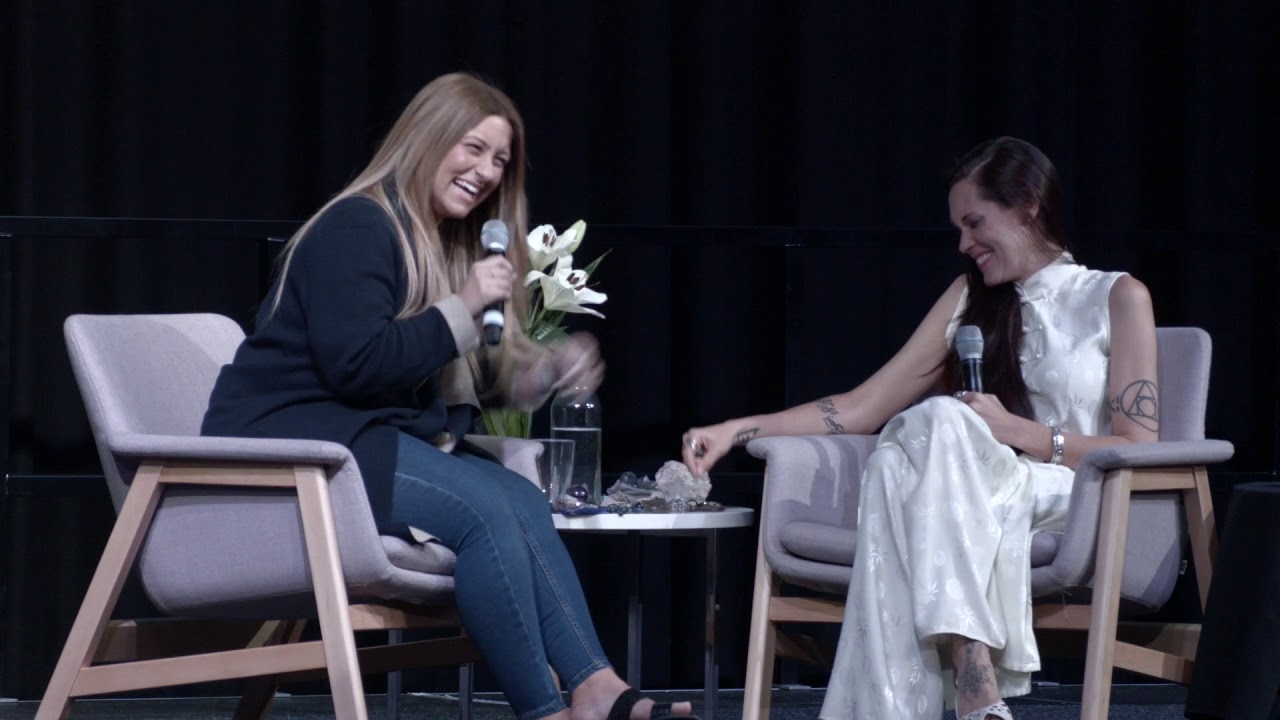
I was thinking I was gonna bring a bit of a happiness into her life, by showing her how I live. And it turns out that I was just suppressing everything. and that wasn't true happiness. Audience: ~ Laughs ~ B: So now I'm sad and happy. At the same time. It's much more rich, you know? Yeah. ~ Applause ~ B: It's all of it. You know? So, I thank her for that. And it's so good to be able to bring her to you guys, and, be here, and... Teal Swan COME OUT! ~ Applause ~ T: Hi.
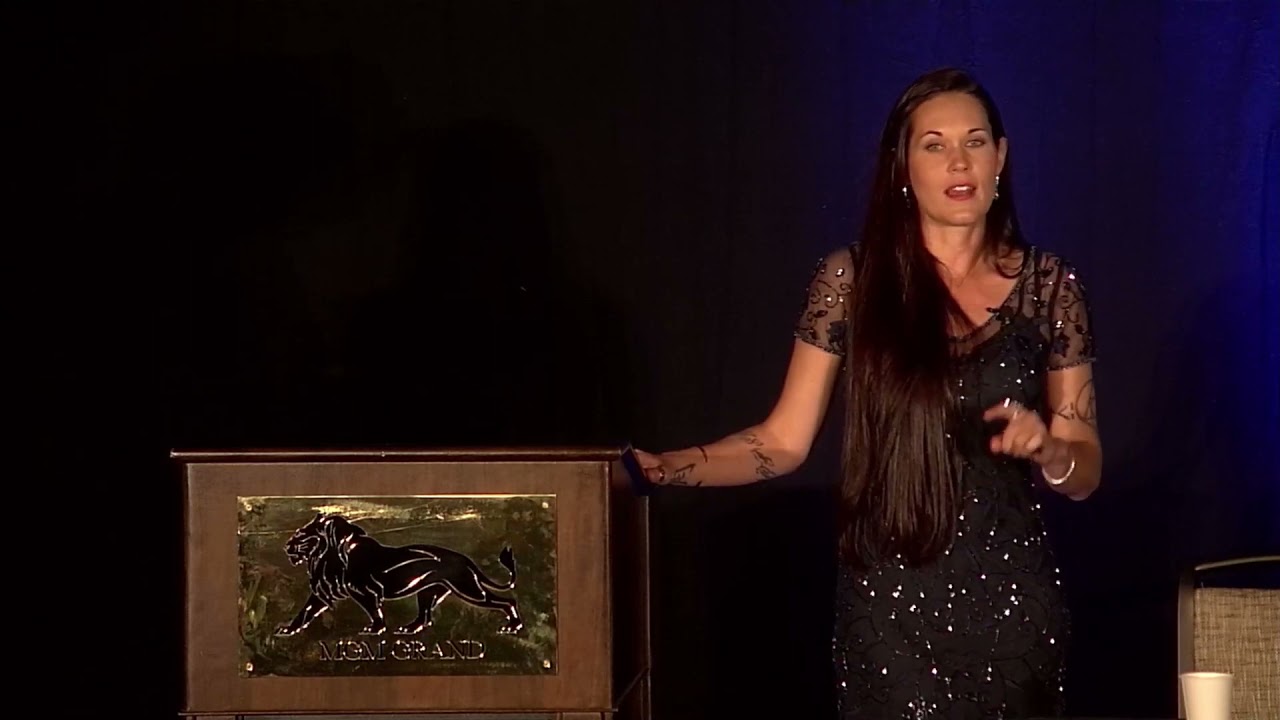
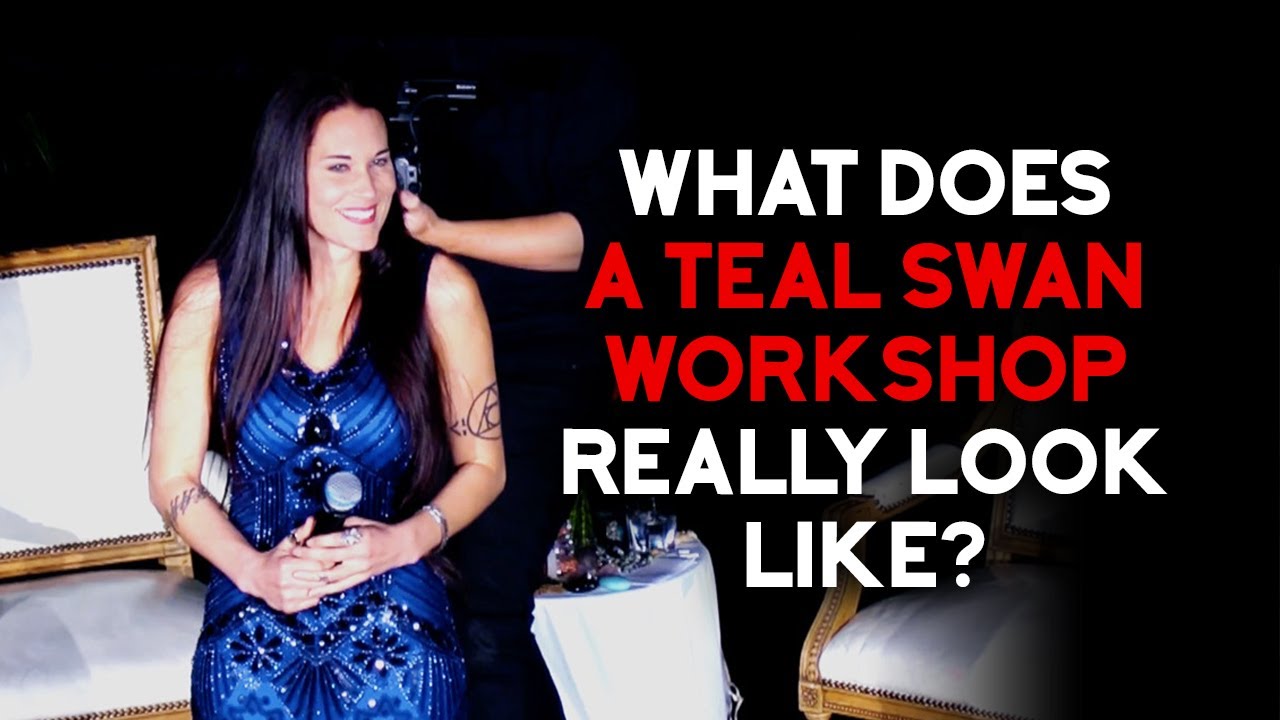
Thank you. I love you guys. It's good to be here with you guys. Is this working? We're good? Alright. It's good to be here in Sweden, this is the first time actually for me. In body. Audience: ~ Laughs ~ T: I may or may not have been checking up on some of you. So I decided that I'd ham it up and be like super american and wear like a, pageant dress today. Do you like that? I couldn't help myself. But, ok, so, I have to talk to you a little bit about this culture, By raise
of hands I wanna know how many of you are actually from this area. A fair bit, ok. Ah, let's go nordic countries. Oh yes. Ok, before we start, I wanna throw you into an exercise actually, this morning but before we start doing that, I'm gonna talk to you a little bit about... nordic countries and how that relates to how patterns are passed through families. Families, it's not just genetics that we hand down, And as some of you may know, genetics are actually 12 dimensions. So if you dissect genetics, beyond just what we see on a
physical level, what we see is 12 different dimensions to genetics. So you actually come into your life experience having downloaded every memory from every ancestor that has ever come before you. That should overwhelm you. But the most important thing to understand about families, is that it's the tools, that we cope with, that we pass from one generation to the next. And that's where we get the most in trouble. Because some of those tools, they work for us. And some of them don't. And most of these tools are developed based off of survival. Whatever helped us
to survive. In the nordic countries, what life looked like way back when, in the wintertime was that a whole bunch of people had to cram into a very small area to survive through the winter. Now, just for fun, I want you to imagine what would happen if I did that with say, a group of brazilians or mexicans? Audience: ~ Giggles ~ T: Just tell me what would happen? What would happen in a hot blood culture is I would open that door in the spring and I would be lucky if I found body parts. So, the
tool that was developed in the nordic countries, was stoecism. Which is the capacity to create emotional distance even when you're physically in the same place. And this is not something which the nordic cultures have transcended. It's a tool that has been passed and passed down, regardless of the fact that we now have all the technology in the world to not be living you know, 16 people, or even 100 sometimes per Small... little... housing unit. and this in terms of what I'm concerned with in the world is what is, the least beneficial to the nordic cultures.
I've got some good news... I'm doing a whole blog on this, by the way. I'm doing an energetic diagnosis on stockholm. Audience: whooaaa. T: ~ giggles ~ yeah. I had fun last night. I was such a peeping Tom, I was like... Looking inside people's houses. Nobody uses drapes here. It'll be fun thought. I promise. When you read this you're gonna like it. But, what I wanna start off with today, in the experiential exercise we're gonna do is based off of my findings here. It's not much different from places like Norway, same thing, sort of nordic
culture. Same tool, same coping mechanism. Which is to create so much emotional distance. But as I will keep touching on, over and over today, This emotional distance is why so many people in this area of the globe, don't actually know what it is that they're missing. It's like there's so much emotional distance between each other and so actually a lot of emotional needs that are being unmet. But nobody even knows what it would look like for them to be met. So, it's almost like I'm confused about why I don't feel quite right, but I don't
know what it is. I'll get into that later. The first exercise that we're going to do, because I want to pop this bubble, That exists, between all of you guys. Is we're gonna do a similarity exercise. I really like this, I'm hoping it brings the tone emotionally up in this room, before we start the meat of this workshop. So, we're gonna... where's Karina? Hi Karina. I'm having my resident german organize things for me. Because I can't do it. I'm gonna explain the exercise and then she's gonna explain how to organize yourselves into the exercise. Sound
good? OK the exercise goes like this; I'm gonna get you in a group, and then I'm giving each one of you 4 minutes. So let's say that 3 of us were in a group, right? I would get 4 minutes and during those 4 minutes I'm the center of focus. Usually I like to do this in a circle, but this time I'm not gonna do it in a circle because, this is obvious, we're gonna break our necks if we try that. You guys are gonna focus on me. If it's my turn. And for 4 minutes it's
their job to tell me how they are the same as me. Or how I'm the same as them. Same thing. So, what might you say? K: Um, like something easy to start would be we're both women. T: OK we're both women. By the way, I'm gonna stretch you here, because you can say things like that if you really want to, but, I want you to keep going deeper and deeper and deeper. You can use your intuition if you want to. We can tell a lot more about people, than we consciously think. So, dig deeper. How
am I the same as you? K: We both enjoy good food. T: That's true. B: do me do me. T: No, no, no it's my turn. So you go. B: But my turn? T: No it's my turn. B: OK. This is how it's gonna go. Audience: ~ Chuckles ~ B: So I'm doing you? T: Yes. B: OK. T: He acts like he's never done this before. B: We are good at intuitively, subconsciously matching clothes. Audience: ~ Laughes ~ B: Sorry that wasn't very deep was it? T: Nor accurate. ~ Giggles ~ B: Oh sorry, I'm
horrible up here. You shouldn't put me up here. OK, um... we both enjoy, I don't know, depths of people. T: We do? B: Yes. T: That's true about you? Audience: ~ Laughs ~ B: Yeah. T: For those of you who don't know, Blake is the most avoidant of all the people in my group, of doing anything deep. Especially shadow work. Nooo. B: You want more? T: I want one thing. Come on. B: One thing. T: You guys better be better than this. T: this is what happens when we don't pre prepare. You see, like, I
just tell my team I'm showing up and you guys get ready to be thrown into whatever and you're not gonna know what it is. And this is what I get in return. Ok. K: Were both good at trusting our emotions. Also the negative ones. T: That's true. OK, so, this is how it goes, better than that, one person... it's gonna be my turn. I get 4 minutes. I'm literally saying nothing. This is your challenge. You wanna treat all of these things like they're meditative exercises when I put you into the experiential exercises, if you wanna
get the most that you can out of these workshops, My suggestion is not to chit chat. And this is what we do as people, when we get really super uncomfortable right? We immediately just start talking about something that has nothing to do with the exercise, that is making us feel vulnerable. But I don't want you to approach it this way, So, if I am the one who is the center of focus in this scenario, for those 4 minutes I don't get to say one thing. I just get to notice what people see in me. Because
some of these people, you're not gonna have ever met before. Hopefully. And they're still gonna have to kind of feel into you, see into you, and listen into you, and really pay attention so as to try and ascertain what is the same about you. And feel, when you're in this position, how much closer it makes you feel. We're gonna be talking today about the difference between closer and further apart, as two basic movements within the universe, that you need to concern yourself with. So, feel how when somebody is telling you how you're literally the same
instead of how you're different, it kind of breaks down that barrier and pops the bubble. So, that will be 4 minutes per person. then we're gonna switch. But, I don't want any of you to be quiet ok? I'm really challenging you. So, it would be, if we were, of course we're a group of three, she goes, then he goes, then the next person goes, and for as long as that 4 minutes takes if we have to continue, we'll keep going. So, we'll do a second time. Until that timer goes off. And we're gonna be breaking
you off into groups of 8. So.. Would you like to explain how this arrangement goes? Experiential Exercise T: You guys ready? Ok, since I have a lot of newbies here, I'm going to explain how this synchronization workshop actually works. Those of you who have heard this shpeel already this is gonna be remedial, but for those of you who have never been to one of these workshops, I am extrasensory. What that means is, I couldn't fully plug into the matrix. Um, the majority of people, actually let's go here, I want you to imagine, that upon coming
into your physical life here on the planet earth, it's almost like plugging into a video game. But, any of you who have played a video game know that, you have an avatar right? So, usually, there's an avatar in the videogame and it's kinna moving around for you and you're pretending you're that player. But, in this time space reality, coming into life, is a bit like you become the avatar and totally forget the aspect of you that's sitting on the couch. And that actually benefits source consciousness That benefits the process of expansion. For that forgetting process
to occur so that you can fully engage in your three dimensional life here. When I came into this time space reality I opted into several influences which made it so that that filture was broken. One of them was that my mother had a rhesus factor that was different than mine. So she was RH negative blood factor and I was RH positive. So, her body was attacking mine in the womb. And at a very crucial phase, when my nervous system was forming I wasn't able to form "well". So, what it's like for me living is what
it would be like for somebody if they took ayahuasca, and then had to function normally. So, yeah, just imagine being super high on ayahuasca every day but not pucky. That's my life. Which was quite frankly hell growing up. I sort of like to joke about the fact that if I didn't do this work I would literally be in an institution. Which is pretty much the case. Like, I'm doing this work because it's literally the only thing for me. You know? It's like watching 400 different TV channels at the same time. But the benefit of this
is that I can see pre manifested reality. I'm actually visually seeing, not like in the mind's eye, like visually seeing, emotions, and I can see the human energy field. I can see inside bodies, I mean all kinds of different stuff. When your dead relatives visit, I can see them. So, being extrasensory, what I'm doing here in the crowd is I'm watching the collective consciousness. I will feel the rise and fall, not just feel it, be able to visually see the rise and fall, if some of you don't get it, I'm also visually seeing it. So,
that was a little joke you guys. So, what's interesting, that most people don't know Is that you are all actually totally tapped into this collective unconscious, it's just most of you are not consciously aware of the fact that you're tapped into each other's subconscious. So, this room represents a collective conscious that can be treated as one thing. Like, an individual entity. Right? And the way that it looks is a little bit like an ocean or a body of water. Only, if you could turn that water into pure light. And so, I'm watching it kind of,
go between you two... Two? Between all of you. And when somebody has a question, That vibrates the closest to the collective asking, Then that person in the crowd will light up. It's almost like if somebody was to take a flashlight or a tiki torch, or something, and put it into their energy field. They just become super super bright. And that means that the group is who selects who ends up on stage with me. Now the fun of doing it this way, there's both fun and also a practical application for this, The fun is, is as
I have no idea what the hell is gonna happen, when I go into a city. I don't know what a person's gonna ask me, I don't know what their issue is, I don't know whether it's gonna be somebody who comes up here and says: "I want you to die." Yeah, so, it's kinda like gamble chocolates. You guys gotta have those here right? Do you have the chocolates... it's boxes of chocolates, you know? You get like the different flavors? Ok. Some people who come up here will challenge you. It will be very difficult for you. It
will probably personally trigger you, other people will be super fun for you to watch. This is why I say that there's a practical application to doing these workshops this way. It's that if you are a match to being in this room, then you have to be a match to the collective consciousness of this room. You couldn't actually be sitting here experiencing whoever is up here on stage with me if it didn't apply to you in some way. Your capacity to figure out how this applies to you is about your level of consciousness. Because it will
be tempting sometimes for somebody who comes up here to say something, and you'll be like: "Oh I don't relate to that at all. I don't know why they're up there. This is not my thing. Like I wanna have my question answered." But actually everything that happens on this stage has something for you. Absolutely everything. And I don't know whether it's something they're gonna say, something I'm gonna say, but you're game today is to play the game of "How does this apply to me?" That's how you're gonna suck the most, for your own personal expansion, out
of whatever happens up here. And I'm gonna help you with this. Sometimes when I'm helping them with a question I will ask you guys to reflect on a question. For example. But that's how this is gonna go. So, don't take it personally if you, yourself individually don't get selected to come up here on stage, by the group. It's not personal for me, and it's not personal I can assure you, for anybody else in this audience. Put the intention out there, however, that whatever you want to know, or need to know is going to come to
you through the venue of myself and the person who is up on stage. And the other thing that I'm going to ask, because obviously being up here in such a vulnerable position, most people don't feel like I do about being on stage. I could literally fall asleep up here. Like I gotta help myself, it's bad. Like I was just saying when I was down here, I could curl up and go to sleep, in front of you guys. Like my level of comfort in front of a crowd is not normal. There's a reason though, do you
wanna know the reason? In my childhood everything that was horrible happened behind closed doors. Without anybody watching. So this actually is super safe to me. Graciella's teasing me, she's like: "We're gonna get you wallpaper of an audience, So you can fall asleep at night." But for the majority of people, This is actually a higher fear than like, anything. Did you know that? The number one fear in the world is actually public speaking. So not only am I requiring people to come up here and be in front of an audience of hundreds upon hundreds of people,
I'm asking them to be open about their most vulnerable aspects in front of hundreds and hundreds of people. So, what I want from you, is to... really put your undivided attention and unconditional presence Towards the stage if you can today. Because what I can do is I can actually use the energy of the collective consciousness to create great shifts within people. So it's not just me that's gonna be doing this magic today it's also the focus from all of you. Do you want me to explain what unconditional presence means? Unconditional presence is one of the
most important thing you can learn, when it comes to interacting with other people. it is that, this is the no conditions, it doesn't matter whether you're happy, it doesn't matter whether you're sad, It doesn't matter whether you're doing this or doing that, there's no condition, upon which I am present with you. Present means my focus is on you, I am completely feeling you, I'm completely listening to you. I'm coming to understand you. That's presence. So, to give presence that is not conditioned upon anything is really, really awesome. really really awesome, when it comes to developing
relationships. And today is your opportunity to practice that with whoever is on stage. You guys ready to begin? Ok, you're gonna have to bear with me, Because these stage lights have bathed everybody in a nice blood color. So, I'm hoping I can pick out what color people are actually wearing which is usually how I identify people. But... Let's just give this a try shall we? OK, so, get clear on whatever question you have in your mind. And when you have it you can raise your hands. Alright you have selected, strait where my hand is pointing,
almost in the very last row, there is a man, yeah you're the only one waving. Yes, like this, yeah. Hey it works. It's working. ~ Applause ~ I'll also give you a little mild suggestion, for those of you who end up here, with me on stage. If you have a handheld microphone, you literally have to be close enough to make out with it. For somebody to hear you on the stage. Hi. He: So nice to see you in person. T: You too. He: You look very sparkly. I like it. T: I couldn't resist. He: I
did not expect to be picked. So I just raised my hand, and figured that, if I get picked, there is something for the audience. T: What? ~ Laughter ~ He: So, I have two questions, I've been thinking about lately. T: OK. He: So how about, I give them, and then you can pick which one you perceive to be the most relevant for the audience. T: Or you. He: Or for me. T: OK. He: My first question is, regarding loneliness, I rarely feel lonely. Is there something wrong with me? Audience ~ Laughs ~ T: What's your
second question? He: That is question number one. Question number two is... what is the wisest way to deal with frustration and adversity? T: That's too broad. Let's go with the first question. He: The first one, alright. So where do we begin? T: There's something so wrong with you. ~ Laughter ~ He: Did you say wrong or raw? T: I'm teasing you. He: Yeah? T: I said there's something seriously wrong with you. OK, describe your life to me. Describe your day. He: My day? T: Yeah. Do you live with people or alone? He: Sorry? T: Do
you live alone or with people? He: I live alone. My day is, I feel like a horse. Just ~ kicking away ~ And the horse wants to get out and run. T: To do what? He: Run. T: But like, to do what? Practically? Because that's a horse. He: It's a horse yeah. And me running is working on projects And things I'm really passionate about. And I do love cuddling with the other horses but then I wanna go out there and run. And this makes it so that I rarely feel lonely. T: Why is this a
problem though? He: I don't know. That's why I don't know why I'm here. But that's the question I had in my mind. T: Well I know it's the question you had in your mind, but why did you have that question? I mean like, you can only be asking that if you're having relationship issues. He: Yeah. So... When I've been in relationships, I enjoy my projects more than I enjoy my relationships. T: Yes. Exactly. He: And that makes it difficult for them to work. T: Exactly. He: Yes. T: Um, OK, So... JUst for fun I want
you to start us off at the beginning. I'm gonna work you through an understanding here. In your childhood, I want you to picture yourself, At the dinner table. Can you do that? He: Yeah. T: How much choice did you have over what you ate? He: I just ate whatever I was given. I was quite happy about that, I think. I ate a lot. Always hungry. T: Talk to me about your family. He: What do you wanna know? T: I want you to describe them. What did they expect of you? First and foremost. He: Ok. My
Dad had expectations in me, that I would be an achiever. Yeah, so, he really, for him school and education is very important. And he wanted me to be good at the same things that he was good at. T: Umhum. So what you just said is, everything. I'm sorry I just set you up. Basically, I set you up to demonstrate my point here. He: OK. T: What you're working with and the reason you don't feel lonely is because you have an avoidant attachment style. Have you ever heard about this before? He: A little bit. T: In
your childhood there's two polarized opposite traumas And should get this out of the way right now and say that the majority of relationships actually on the planet today are dysfunctional. So, when you hear somebody like myself or a psychologist, or whatever, talk about dysfunctional relationships, and it's not the rarity, it is actually the norm. It's just that everybody has a family that falls somewhere on this dysfunction scale, you know? For some people it's like, we're all the way over here, where like, Dad is dead drunk and Mom is like a super codependent and like, bad
enough maybe that like, you know, The Mom walks in on a little girl getting sexually molested, and is like: "Well that, I didn't see that." You know. Really dysfunctional. And then, somewhere over this way we've got your type of family. Right? In that type of a family, when the children are born the children are actually treated more like dolls. All of the children are treated like dolls. Because it's an expectation that they fit whatever the needs of the parents are. So for a minute I want you to imagine that... Imagine you're watching a little girl
playing with a doll, Or a little boy, in the case of your father. It's an expectation with the doll that if the little girl doesn't wanna play with it anymore, she can put it on a shelf and it goes... ~ stays still ~ and when the little girl decides she wants to feed it it goes ~ opens its mouth ~ You see? Watching a kid play house with a little doll, there's a striking difference between that and a real baby. And that's that, that doll is on your schedule. That doll is dressing in what you
want it to dress in. That doll has the future you want it to have. But with an actual human infant, it's the reverse. It's, this little being comes in and is like, I'm taking a crap in my diaper now. Regardless of whether it's 3:00 A.M. or not. I want to eat now. I want to eat this thing versus that thing. I want to wear this thing versus that thing. And I have my own potential and porpoise. So, there begins this war, Because when a little child has their own identity it often invalidates the desires, or
even the entire personality of the parent. This is where your Dad came in. If you had a pencient to be a musician, and maybe that was your perpoise coming in, that would fly in the face of everything your Father values. So, he has a choice right now, either he accommodates your values, or he says: " You replace your values for my values." Now, in our childhood, and even in our adulthood our single biggest need is connection and closeness. And I cannot stress this more. Because all of us have to get this on the globe, or
else we're not gonna get each other. A human infant, is in the animal world, And absolute embarrassment, in terms of, you know, independence. Because it is completely relationally dependent. If you put a three month old baby on the floor and you don't feed it and do what you're doing with it, that is a dead infant. And that's at three months. We're born three months premature actually, because we couldn't actually fit through the birth canal. So, we come out unformed actually, to be honest. And even after that, You've got something that's completely dependent on Mom and
Dad. Now, that's survival that you're talking about. That is the most primal aspect of the nervous system. That prioritises closeness with the social group above all else. Because that is the only way to live. So, I want you to get that about yourselves. You are programed 100% and physiologically to need other people. It is a bigger need than food and water. Because it is what guaranteed you food and water. So as a child, this why you'll see somebody like me, keep pulling people back to childhood, over and over and over again. It's not because I'm
on some vendetta against parents. I keep pulling you back there because it's your programming. This is the foundation of your imprinting. It was way back in those days, that you laid the foundation for what you are. And at your most primal essence you are in need of closeness. So, can you accept that so far? He: Yes. T: So when you have a parent who says: "My approval and closeness with you is completely dependent upon you giving yourself up for me." You do it. You figure out a way to do it. Which is how we arrive
at your attachment style. And by the way, we can talk about the opposite attachment style, if you'd like, in a minute. Because all the children are expected to be dolls. Some succeed at it. Others don't. The ones who succeed at it, both of us, right now we're actually representing in our family units, the exact opposite rolls. What we represent is two children who were both expected to be dolls. One made it and one didn't. It created two opposite styles in relationships Because both of us would have gotten the message, " You can't have me and
have you too." So when Dad is like, you can't have yourself, and this learning happens so early, like so early, a lot of these memories you don't even really have a lot of access to anymore. It's just a vague feeling. When Dad says you can't have you and have me too. You gave yourself up for it. Knowing that the consequence would be, being isolated and ostracised like I was. And what I did was watch you, the kid who did make it work, Feeling totally ostracised and isolated realizing that to be close I would have to
lose myself. So we're both terrified of each other's fate. But, let's explain you. When you get close to somebody, you lose yourself. Because it's the way you learned to have relationships. He: That makes sense. T: The closer you get, the more suffocated you're gonna feel. The more you're gonna feel like you need space, and what you get out of your projects is a feeling of being an individual. Does that make sense? He: Yeah T: You don't have a very defined sense of self actually. Which is probably the opposite of what most people have told you.
They probably tell you, you're a super narcissist. Like, you're just focussed on yourself all the time. Right? Yeah. It's a form of rebellion, is what you're doing. You guys understand there is a difference between freedom and rebellion right? Rebellion is not freedom. With rebellion you're still completely at the mercy of whatever you're rebelling against. so, they'll look at you and say: "You've got a really defined sense of self." "Like, consider other people for once in your life." But actually you're in a constant fight to try to define yourself. Because your inclination, because that's how you've
been taught, the minute that you get close to somebody, you're in relationship with, and begin to get intimate, you suddenly are losing track of your needs, versus their needs. Your wants versus their wants. Preferences... It's like, it starts to defuse. Do some of you relate to this? So, when you start to feel that feeling in your body, That will threaten your sense of identity. Which is also a form of survival. And so you will go run away to be alone. But, the reason that you are not feeling the sense of isolation so intensely the way
that somebody with the opposite attachment style might feel, is because you don't have those boundaries. He: Which boundaries? T: A sense of self. Do you understand boundaries? Do you guys want me to talk about boundaries? OK. I love talking about boundaries, because no one gets them. Actually first, let's play with this, If I was to say: "Talk to me about boundaries, like, define what is a boundary." What would you say? Just out of curiosity. He: First of all, I think it would be interesting to talk about it. because I think me being more skilled at
putting up boundaries, would allow me to feel more safe, when I'm with other people. T: But that's... Oh God I'm so glad you're up here. I cannot even tell you. You are like the perfect example... So, did you hear what he said? I really wanna be able to put up boundaries. Do you see that against movement? That is classic of this attachment style. And most of us, by the way, I set you up again to be... You know, in a normal world, If I ask anybody what boundaries are about, they always describe that, boundaries are
related to almost like a barrier. Or a push you away. Right? He: So, can I try again? T: You didn't fail. It's just... I guess... go ahead yeah. I'm interested. He: I trust you. OK, so most people associate boundaries only with a conflict. So, boundaries are about when you push somebody away or when you say no. That's not a boundary, you guys. A boundary is nothing more than a defined sense of self. So, you understand definition right? If you imagine static, imagine static on a screen. And when that static starts to condense into a picture
of a person, they start to become defined in that static right? So, a boundary is nothing more than what defines you. It's that simple. So, are you ready for a boundary? He: Yes. T: My favorit. What's your favorite icecream? You guys do eat icecream here right? ~ Laughter ~ He: I do now. There's one with no sugar in it. Called Nix it's amazing. T: I need to find this. He: How I found it? T: No I need to find this ice cream, like this is my favorite thing. He: Yeah it's with xylitol and stuff, it's
great. T: OK. He: Nix T: So what's your favorite flavor? He: it's um... I can't translate it, it's like a, T: You can't translate it? He: I don't know an english word. Fudge. T: Fudge? mmmm. You're lush aren't you. Um, my favorit is coffee. That's a boundary. Sit with that for a minute. Isn't that incredible? My favorit is coffee and his is fudge. That's a boundary. The only point at which we start to become concerned with boundaries in relationships is when there's a conflict. Here's an example, You and I are in a relationship. You wanna
go work on a project right? That defines him. Right now his desire... so you get that? A definition is, my needs, my desires, my preferences, my thoughts, my feeling. So right now in this moment his feeling is he wants to go work on a project. My feeling is I would like to cuddle, and then some. That's a boundary conflict. Do you see that? So right now our sense of self and what we need, it doesn't match. So what would you do typically in a relationship in that scenario? He: What just happened? T: Yeah. He: I
would say, Teal I see that you wanna cuddle right now, that would be lovely. I want to work on my project. Can we do this another time? Would that be OK with you? T: Ok, so, what's the problem? Do you guys feel the problem there or no? Do I need to spell this out? What you literally just said is: Teal I see your need, my need is more important so I'm going to put it first. What you didn't do is open the door for me, because you never learned that this could happen in the past,
this is really important if you have this attachment style, You never learned that somebody else was capable of considering your best interest. So, you never actually opened the door for me to allow for your need. So a relationship with you is a war. If you get anything today, that's the thing I need you to get. Because it will totally transform your relationships if you get this. Your relationships today are a war. It's you or me. Do you notice that? And watch this in yourselves if you've got this issue. In your mind, you win right now,
or I win right now. Right? Either I get you to stay home and cuddle and then some... or you get me to let you go. Do you feel this energy? This is called a zero sum game. Do you want me to explain zero sum games? I did come from america after all. ~ Chuckles ~ You guys that was way way more of a laugh than that. ~ Laughter ~ It will be more funny when I explain what a zero sum game is. A zero sum game is I win, you lose. And we're actually playing these
games in relationships All the time. And not really realizing it. But it makes trust impossible. So let's talk about trust shall we? I can define trust for you in about a second here. Trust is I can rely upon you to capitalize on my best interests. This is important for you to notice, I didn't say I can rely upon you to give up your best interests for my best interests. Because that's, when we've got your attachment style, that's what we start to think. We start to think that to develop trust, We have to give ourselves up
for the other person. That's your education in childhood. Right? That's not what I said. Trust is, I can rely upon you to capitalize on my best interests. That means to consider my best interests. A relationship which is founded on trust is founded upon the principle that because we are in a relationship, your best interests are part of my best interests. and vice versa. So there is no possible way that I could damage you without hurting myself. And if you do the same thing in return, Then you're considering my best interests as well, then both of
us are actually making space for our needs, wants, thoughts, feelings and boundaries. Does that make sense so far? He: Yeah. T: I need this to be so practical before you get off the stage though. it's ridiculous, because sometimes when I'm having these philosophical conversations about the reality of the planet earth, it doesn't make sense in practice. Right? You guys with me so far? Audience: Yes. If I in this committed relationship, if we were in this scenario, If I hear you say, I really wanna work on a project, that's your best interest which is part of
mine. Right? Now I want to make the space for you to do that. I also want you to make the space for me to be you know, loved. Can you do that? He: Yeah. T: OK so then what we do is we sit down and we have a conversation about it. We're in a roll play. He: Alright. T: OK, so.. say it again. Say it like you're actually gonna take my best interests as part of yours. You understand this is agressive? It's literally choosing with your free will, this is a big important thing, OK? For
somebody who's in your shoes, it might not actually be the place that you're in, in the healing process. To actually be in a relationship. I really need to make that clear, because sometimes sometimes there is this assumption that... Because the ultimate form of human life is to be in really committed and intimate relationship. That that's the most healthy thing for somebody to do. If you've had imeshment trauma to a serious degree, You know that period in your 20s, at least in america, in your 20s there is this period where you're supposed to be just like,
super self centered, you know? So it's the time that you go to spring break and like you go and you change your major 400 times, in college and that phase where you don't have to consider anybody else's best interests, Might be really important for you. I wanna put that on the table as a potencial. Because what will happen after a person really feels that they get to choose with their free will to have complete independence, they will then chose into relationship. And so instead of sort of fighting the other person, they're like: " OK, well
I choose to take your best interests as part of my own." Where do you think you might be? By the way? Because I don't want to shove you into this next practice if you think that this might be a good thing for you. To have this "moment without" considering anyone else. He: I'll get there sooner or later, so it's good to practice the real thing. T: OK. But can you maybe restate what I said to you though? About where you might be? He: What is the most relevant place for me to be in my healing
journey? T: Yep. He: Yeah. Currently I've decided to explore freedom and independence. T: Perfect. Ok, so, this is what it looks like, if you're gonna do that for now, It means that what matters is, you try not to hurt the hell out of other people in general, But, you're not committing to a relationship so you don't wanna lead on into thinking that she's going to. You know what I mean? Like if you ever engage in a sexual relationship, for example, you literally from the get go say: " This is literally only a sexual relationship." But
you've gotta really feel into a woman, Because, let's just be honest, we lie. I'm calling some of you out, because, girls, if a guy says to you, I'm literally just like, gonna full on outright tell you this. If a guy says: "I'm literally only in this for sex." He is literally never gonna change his mind ok? Cuz, what we love to do as girls, is be like: "Oh my God me too. It's just like, you know, it's just fun" But in the back of our head it's like: "Wedding bells?" " I think I know the
dress I'm wearing." We cannot be like this anymore. OK? So, making some accommodation for the fact that women are generally terrible at taking a man at his word. I need you to really be honest with women. Durring this period, so you damage As little amount of people as you can. But, when you're in this phase, you're actually going through what a toddler needs to go through. Which is, being able to say no. Being able to pick only what it wants. It's that whole independence phase. So you're gonna go after what you want, you're gonna think
what you think, you're gonna pay attention to your feelings, You're gonna make decisions based on you. It's like a complete autonomy phase. Until you feel like you wanna consciously choose into a relationship Then, when you wanna choose into a relationship, consciously, do you see how I chose to take your best interests as part of my best interests makes you free? He: Yeah. T: This is a big deal for you guys to get this. You don't have to. No one is forcing you to consider somebody else's best interest. You're choosing to do it. Which means that
nobody took your power away at all. So, let's do this. You're in the relationship, He: OK. T: You choose with your free will to take my best interests as part of your own. If you are capable of intimacy, you've already felt into, and have seen into me. So what you're gonna do is you're gonna evaluate what you see and feel in me, and what you see and feel in yourself. And there's always gonna be a little bit of pliability then. Do you see what I mean? He: Pliability? T: Pliability being, you know, if my best
interests includes hers, it's not just me considering her best interest. They are actually part of my own. I'm not gonna feel good going... to doing a project this particular minute, Knowing she feels that way. He: could you say that last part? I didn't hear you. T: ~ Giggles ~ yes. ahhh. OK, actually I'll reverse it on him the he'll get it, I'll reverse it. Ready? If I'm taking your best interests as part of my own, Not just considering your best interests, right? Look I'm gonna show you like this, Right? This is your best interests. Now,
to consider your best interests, right? I'm like: " OK, well that's yours." This is more aggressive. It's to choose with my free will to take your best interests as part of mine. Now, If you say: "I wanna go do a project." It's part of my own best interests. So, it's not gonna feel good for me if you're trapped at home. Is it? He: No. T: That's how you stay safe in a relationship. It's not gonna feel good for me if I've got you stuck here, anymore than it's gonna feel good for you If you're gone,
and I'm miserable at home. Right? So, you and I are going to engage in a process now, at this point, that looks like" "What's the third option?" Now, if you're really connected to somebody, this conversation isn't even something that has to take place as a conversation. You're gonna be able to feel me enough to kind of evaluate your needs and my needs, So that you can find a third option that makes us both feel good. Maybe on this day, you going at all is a bad idea. Maybe, going in two hours is a good idea.
Maybe going now and then meeting up for lunch is a good idea. It depends on the scenario. But we're gonna go back and forth until we find out what that is. Where both of us feel a sensation of relief. Not sacrifice. That's the most important flavor difference to notice. Please me. He: Ok, ok... T: ~ Sigh ~ this is a personal trigger for me, Oh my God. Can I tell you why? Audience: ~ Giggles and laughs ~ Because people of opposing attachment styles attract. And so what happens is, the people who desperately need you around
all the time, Will end up in relationships with, you. And you will end up with people who desperately need you all the time. And then we always feel unloved and unwanted, And you always feel suffocated. He: This is exactly what happened. ~ Laughter ~ He: Until I broke up with her about two months ago. T: Well, do you want me to tell you the truth? Psychologist today, consider this the deathly dynamic. If you walked into a psychologist's office, who practices attachment theory, some of them won't even see you. If they know that you have the
anxious attachment, And avoidant attachment, they will literally just say, "My friends, it's a matter of time." "Bye." Do you want me to tell you why? He: Yeah T: Because you're both always in the "Red Zone". What I mean by that, is that, because you're always feeling suffocated in the relationship, Because of your trauma around intimacy, any time there is closeness in the relationship it pulls your nervous system into fight or flight. That's the Red Zone. And because you're constantly pushing away because of it, it pulls my nervous system always into the Red Zone. I'm constantly
in fight or flight. And so it's a volatile relationship that is full of addiction patterns. You start to become actually abusive, because you said what is called an intermittent reinforcement pattern, He: Could you explain that? T: Yeah. You guys interested? Ok, in the intermittent reinforcement pattern, let's say that you live on this. But, in this case it's intimacy right? So, what this person is after, is this closeness, This feeling of juicy closeness, right? So, come here. You have a little collection, of these ok? The entire relationship, between somebody with your style, and somebody with my
style of attachment, which is all you're gonna find so far, is determined by you. The avoidant is in control of the relationship. And some of you who are on this end of the spectrum, you know how horrible this feels. The relationship is always controlled by the person who can pull away. Because a relationship, it's like, I want you to imagine, There's a kiddy pool in between us, of water. To have a relationship, I have to, with my free will, step into that kiddy pool. And you have to step in too. I'm totally at the mercy
of that. So, If what I need is your closeness, that's what a relationship is, right? Then I'm at the mercy of your capacity to go. And the avoidant is the one who can do it. So, we basically sit here at the castle door, that is mostly closed, waiting for you to open. This is where intermittent reinforcement comes in, and by the way, It's the most powerful addiction pattern you can get into. This is closeness, one of those rocks. You get to decide when you give this don't you? Because it's not one of your dominant needs.
It's suppressed. So, what's gonna happen is, I'm gonna be constantly bidding, imagine that I'm like a little mouse right now, I'm in a bid. Like all day. Now, he is sometimes just gonna randomly feel good enough to go, ohhhh, ok, so maybe that day, if we're in a relationship, that day we had sex. Now, I'm bidding again. You notice that there's no pattern here? This is what makes this addictive. I can't find a pattern, for what makes him come forward into the relationship. And actually give me the intimacy that I need. So, then, I keep
pressing, and this actually, see, I start getting into a starvation pattern. Because I can't figure out how to get him to be close. Now, then maybe next time, he kisses me on the cheek and I'm like, "Ok it's better again." now if you're in this type of an addictive pattern That will cause instantaneous relief. And I'm recommitted, completely recommitted. But then you go away again. You get emotionally distant, you wanna go do a project. So, each time you do this, I get more frantic until, pretty soon, I'm actually completely smuthering you because it's like, instead
of doing this, it's like (~ Grabbing ~) Because now there's no predictable pattern. And so it becomes a full blown addiction. And I mean very serious, like, some would say more powerful than heroin actually. Because when I'm in this type of a mode, My body is giving off certain chemicals, and when you hand me one of those... ~ Deep sigh of relief ~ It's a whole other chemical cascade. Which includes endorphins. Which are more addictive to the human body, than opioids. It is one. hehehe. Do you understand that so far? He: yeah and I recognize
myself, a lot in it. T: So the first thing you've gotta get, and this is why I'm say like, you have a lot of responsibility in relationships here, to not be the one who tortures, Because, if what we were having a conversation about was how to not have a relationship and how to be independent, the person in the hot seat, would be the one in the anxious attachment style. That would be the person that I would be like, "Ok, you've gotta fix this little issue here." But, the reason that you've gotta be the central focus
is because a relationship is about choosing to be together not apart. Does that make sense? So, that's something you need to know. In your relationships, because of your attachment style, actually the relationship is at the mercy of you. That should make you feel a little better too though. He: Why? T: Because in childhood you were powerless to your relationships. Specially with Mom and Dad. That's why you got into this whole thing. You look confused. He: I am confused yeah. T: Why? He: But in a good way. I think you're really describing what has been going
on in my life. T: Yes. He: And I don't feel so good about being, About having this power. T: Good. He: Because I don't trust myself yet. T: Well, but that's the thing though, I mean... you are actually healing from an addictive relationship style. The avoidant and anxious is an addictive style, so just like an addict has a day where they go: "Crap I'm like, completely at the mercy of my addiction." When you're in this type of relationship pattern, that's the day you're having and that's actually a good day. It's the day where you actually
realize the reality. The reality is, you are, you know, you have been Completely out of control, honestly. You've been at the mercy of your own attachment style. So, you haven't actually been picking partners that are right for you anymore than if I was in this relationship I would be picking a partner who is right for me. You know? We're basically going for the heroin needle. Both of us. Does that make sense kinda? He: yeah. T: I don't really need this to feel amazing. I need it to feel like, "Ok I've gotta be more careful in
the relationships that I get into." And here's just a little tip, once you start into relationships again if you have your type of pattern, the person you pick is really important. Because you are gonna need to rehabilitate yourself in relationships. You guys get that right? You're gonna actually need to rehabilitate yourself. And this is where I completely freakin disagree with the majority of experts on the planet. The majority of experts think that this is, they say that this is a death sentence, but then they're basically saying, you need to learn how to be closer. Right?
And you people in this chair, Need to learn how to give people more space. Have you hear that before or no? It's B. S. Do you want me to tell you why? Audience: Yes T: Ok, to heal, to heal is to experience the opposite. Right? And when it comes to the traumas that we experience in our childhood, That's the experience. So, to heal is the opposite of the experience. What is the experience that caused me to be traumatized in childhood, if I have this attachment style? Abandonment. What is his? Enmeshment. What is the opposite for
each of us? He needs to, so if he's been enmeshed, he needs complete autonomy. That's why I'm saying, for him to choose this period of time where he's like, it's only me and mine, or whatever, Is healthy for right now. Before you choose, if you want to, into a relationship. What's healing for the person who's been abandoned? total and complete closeness. So this is not somebody, if you're on this side of the spectrum, your opposite experience is not to learn how to give people space, It's not: "Oh you were abandoned when you were little?" "Learn
how to give people space." ~ Laughter ~ What you need to do is be incredibly selective in choosing a partner who can be with you all the time. I mean, what would be the best, if I could design it, if people were in this type of attachment style, the best for you would actually be to start a business together even. And to have a kind of relationship where you can't do that where it's like, guaranteed you're gonna be together. Where it becomes so, the closeness becomes so predictable, that it actually pulls your nervous system out
of fight or flight, You get the opposite experience from what you have experienced, and then, by virtue of doing that, you're gonna naturally create more autonomy. So, that's where the health starts to come into play. And we've already figured this out, in the psychology field this is called the paradox effect. Where ironically the closer that a couple is, the more autonomy they can tolerate. But when a couple get into crisis, get into conflict, they can tolerate much more less autonomy. So, the more secure and the more closeness you can guarantee somebody, especially who's been in
this position, The more that they're OK with space. And that's gonna be your best friend when you get into a relationship. Because for you, let me show you physiologically, ok? If somebody that you're in a relationship... Oh wait I've gotta go here first, You need to pick somebody who is OK with distance. Just like I, if I'm in this roll, like, I need to pick somebody who's like, dude, my life is about you man. You need to pick somebody who likes distance in relationships. Ok? But, even then, if you get a woman who clings, at
any point, how do you respond to this? I'm teaching you the paradox effect. Your first instinct is to pull away isn't it? He: Yeah. T: I'm gonna save your life here, in relationships. Do the opposite. It's really hard for you isn't it? Look at you. ~ Laughter ~ T: You're making me anxious, God! Man! Audience: Hold her hand. He: Thank you. T: Yeah, yeah. Audience: ~ Applause ~ T: He doesn't mean it ~ sigh ~ See? Do you feel this? Like, even though he made that physiological move, like, all his energy is like, ( ~
afraid and retreating ~ ) But practice this, like, actually try to come forward. Like try with your energy. ~ Laughter ~ You see, I have sympathy for this, can I tell you why I have a sympathy for this? You're like this because of trauma. You've learned that this means death, to come forward. So I understand that this is scaring the living daylights out of you. I get it. But the more forward you come, actually I'm just gonna sit here until you can do it. Feel the fear, you're gonna have to feel the fear, and when
you feel ready just energetically come towards me. When you can, don't rush yourself. There we go. Do you feel how that just relaxed me? He: umhum. T: I wasn't yanking on you so intensely because you did that. So the paradox, this is the paradox effect, I'm gonna show it to you visually, the paradox effect is, if somebody is pulling for closeness And you come closer, they relax. So, actually for people like you, that is your greatest self save mechanism. In a relationship. If you come closer to the person who is clinging, they can tolerate autonomy.
Cool huh? ~ Applause ~ T: So, do you get this or no? He: I get it. Yeah. Audencie: ~ Says something ~ T: Oh lord. Hi Matias. This doesn't apply to you at all does it? If you have a disorganized attachment, which is what thats called, this is literally just about trauma, the disorganized attachment only happens in situations where there is enough of a threat to your immediate safety, usually physically, or sexually or emotionally, or all of the above, It's perpetrator bonding. So, what we're calling disorganized attachment, oh my god, I knew I was gonna
get into this you guys, I'm in Stockholm. ~ Laughter ~ Do you guys like study this in school, or is this like...? Alright I'm just gonna go there, I'm sorry, this is like really not politically correct to do, but I'm doing it. Um, I'm in Stockholm where they came up with this little syndrome, which, ~ giggles ~ yeah, you guys know the story right? Do I have to tell you the whole story? OK, no. Stay here for me for a second and I'm gonna have somebody else come up. Matias, come up here for me. Can
you do that? I've gotta use a guy. Ok, keep me on track, I'm talking disorganized attachment here. Alright, I'm gonna explain to you how disorganized attachment forms and how it's actually really just stockholm syndrome. If I'm in a situation, this is the captive situation, and by the way, come here. The first thing that you have to, accept is that your childhood is actually captivity. I know that we don't want to accept this, because we love children and I hear that Swedes especially love children, So, we don't want to look at childhood the way that it
is. But, in childhood you're actually in a prison. Your happiness in your childhood is completely dependent upon the benevolence of your keepers. That's Mom and Dad. And how well they can attach to your, or even perceive your needs and wants and preferences and how you're feeling and thinking. But if they can't you're like, really out of luck. Because you're captive in that household. I mean the states not gonna come in, if you have parents that are just emotionally avoidant and take you away from them. Nor would you really want then to honestly. But, like, you're
not gonna run away from home at 3 are you? So, your house, that's your prison. Now, when you're with somebody who is a dangerous individual, This is a person who cannot consider my best interest, that's the first thing to get ok? This person cannot consider my best interest. It's literally all about them and their wants. And I am trapped in a house, what is the safest place to be? Because when I'm out here trying to get away, what's he doing? Is this safe or not? Ok so what's safe? This is safe. What I'm gonna do
is I'm gonna endear myself to this person in every way that I can. I'm gonna start to mirror them, they don't consider me anyways, so I'm gonna start to fool this person, basically, plakate them into thinking that I am exactly what they are. I have the same thoughts as you, I have the same feelings as you, my life is about you, and we're completely on the same page. Now when I do that, he goes, and relaxes. But what's happening in my body right now, is that I need this closeness for my survival, I'm obviously, I'm
human, I still have that, I especially need this one, because if I don't have... I mean he controls my entire life, right? So, I need that closeness, But at the same time like, What am I really wanting to do but I can't do because I'm captive? I'm wanting to run. So, this is what gives rise to a disorganized attachment, it's at the same time as I wanna be close, I want to run away as fast as I can. And this is torture in relationships. It is the hardest pattern to work with, because any time you're
in close vicinity with somebody, you go straight back into this pattern. And so, even if you're with, like a technically "nice person" which you probably won't be a match to if you have that attachment style, to begin with. Even if you're with a really nice person, you start to sort of turn them into this. So, the way to rehabilitate this, is... it's a very slow process, It's almost like, have any of you seen people work with damaged dogs or horses? Let's pretend that he's a really super flighty, been beaten type of dog. Right? You want
me to do it with a horse? He: I'm a horse, yeah. T: Oh. Thank you. ok, if he's a really super damaged horse, what I'm gonna start doing is, I'm going to start recording our successes in tiny little itty bitty increments. So, the first thing I might do, if you're a horse this is a whole different deal for us. Go back to my days, of training, I'm not looking at you to begin with. I'm not squaring off with you because as a horse if I do this, I'm now a predator. So, when I'm walking around
you, I'm not gonna be looking directly at you to begin with. I'm gonna be letting you know, and my whole body posture is gonna be that I'm safe. Now at this point you're probably running around and going nuts Until the moment that you shift and turn your body towards me. If a horse does that in a pen, it's like, at first you'll sort of see him doing this... And then there will be a moment where they go, that one little look, is so important. It means their energy came towards you for the very first time.
Now, when you're trying to train a horse in this way anytime they give you that tiny little indication that they're coming towards you, there's a reward of some sort, like, the pressure is taken off. So, if I was walking towards him like this, and he's running around if he turns towards me, I go: ~ steps away ~ I remove the pressure. And if we're working on a lead line it's the same thing. Tention, tention, release of tension. So, this person is getting a reward for coming closer. And that actually teaches the nervous system in a
very somatic way, that it's safe to come into relationship in that case. So as this applies to humans, when somebody has a disorganized attachment what they need worse than anything, is somebody who can sit here with them, let's pretend you're a person that is disorganized attachment in this case, And what they are gonna say and do is: "I'm here and I'm not gonna come into your bubble, I'm also not gonna leave." And that will put pressure on them, and there will be anxiety But eventually, there's gonna, you usually see a breakdown actually. In that person.
Because it's the first time they've had somebody who's committed to not doing either abandonment or a forward moving transgression. So, in our relationships, let's say that I'm working with somebody with a disorganized attachment, if they're in a relationship with somebody, or even not, the first thing I'll have them do is lay down on a bed together. Just like that, next to each other. You guys are interested in this right? I'm not like, losing my whole crowd? OK. I'll have them lay down on a bed next to each other, and then it's the person who has
the disorganized attachment that gets to initiate the closeness. That's the important part. So, the other person isn't going away, with their attention either. It's not like they're daydreaming on the bed next to you. It's like, their focus is actually on the person next to them. And they're completely with the other person but they're also not, coming over and infiltrating in any way. So the person who has the disorganized attachment is then the one that reaches out their hand maybe. And they can practice a few times. Like if we're working with somatic, you know, body work,
which is so good for trauma, they'll maybe reach over their hand and then touch and it's scary so they can pull it back. But that doesn't cause the person to go away at all. And then they try it again and eventually you can have a sort of safe relationship where they are the ones that are initiating the level of closeness. Or distance. And it's really amazing what happens, I mean that's just the beginning. This is like, a long process that I probably can't go into completely here, but it's very powerful for a person who has
the disorganized attachment to have the capacity to choose their level of closeness or distance for the first time. And to realize there are no consequences for it. Because what a person with a disorganized attachment learns is that there's a consequence for everything. It's like hell in relationships, because they're like: "Well if I'm not close you're gonna go away." "But I can't handle you to be that close." You know, because of terror. So, that's the general way how to rehabilitate that. Where are we? Do you need to know anything else? He: Do you still wanna do
the roll playing? T: I guess. He: "I guess." T: Ok, let's pretend we were in a relationship, But you have to take that, what I said to you about the paradox effect, never forget it. Keep it in mind when we do this. Give me another scenario. A conflict between you and me. He: OK. Ok, let's say that you want the dishes to be cleaned when you get home from work. And I don't want to do them. Is that too simple? T: No that's fine. It's fine, let's do it. T: This is more of a normal
thing. it doesn't involve our attachment styles so than you. ~sigh~ alright. He: Or do you want something with the attachment styles T: No. It's fine. He: Ok. hahaha. T: I want all the dishes to be done. And you don't wanna do them. Ok, so, I see that you don't wanna be doing the dishes. Why is it that you don't wanna do the dishes? See, because I'm taking his best interests as part of mine, I'm trying to understand him. This is how we have a relationship. I want to feel you, I want to hear you and
I want to understand you. Why don't you want to do the dishes? He: Because, when I'm going about my day I like to be focused on what I'm doing. And then when I'm done with my day, then I'll do the dishes in the end, before I go to bed. T: Why? He: Because I want to be in the flow during the day. T: Why? He: because otherwise I get distracted. T: And what does that do to you? He: That makes me think of other things, than what I'm focused on. T: OK, do you know what
your issue is? He: yeah. T: You're not getting vulnerable enough for me to care. Do you know what I mean by that? He: I think I do. T: Relatability, especially women, I mean this is unanimously about people but, especially women, most women, unless you're dealing with a full on nut case, they really care about pain. So you're gonna have to involve me in why does that create a problem for you. like, painful, not just like: " I don't want to." Watch my tone of voice, "I just wanna be in the flow." "I wanna be in
the flow, and when I wanna be done with something, I wanna be done with something." That was almost a like, ~ middle finger ~ I mean we're fighting already. Let me into your pain. This is where a relationship begins, for you especially. Why is that a problem if it distracts you from what you're doing? Why is that a problem? He: Because, I feel really, really good when I'm completely absorbed by something. T: Ok, and when you're not? He: And when I'm not, I feel... distracted. And I'm feeling like I'm not being as useful as I
could be. T: And when you're not as useful as you could be? He: Then I feel like I'm wasting myself. T: And when you're wasting yourself, why would that be so bad? He: Because then I feel like, I'm not taking responsibility. T: And when you're not taking resp... Look at how avoidant you are of vulnerability. I want you guys to recognize yourselves in this. There are some of you who fit this bill. He's not being vulnerable with me. Can you tell? Keep going. Why would it be so bad? To waste yourself? He: Just then I
would feel, I would feel useless. I would feel bad. T: And if you're useless why is that so bad? He: Because then I feel like I have no value. T: OK. OK. ~ Applause ~ T: Ok so what I'm hearing in this relationship is that if you do the dishes before I get home, you feel like you have no value. He: Yeah. T: To who? I would be curious about to who, but like in this case I'm not even asking that because I'm challenging it. To who? Useless to who? Because obviously, you'd be useful to
me doing that. ~ laughter ~ He: I'm a bit confused right now. T: That's good. I've taken you out of your comfort zone. He: Yeah you have. ~ Snickers ~ T: Do you want me to fill in the blanks for you? He: Yes please. T: Which I can pretty much guarantee a girlfriend won't be able to do for you, but I'm gonna do it for you. "I feel useless because in my childhood my Dad made me believe that if I wasn't doing certain things, I was a complete waste to society and washing dishes was not
one of those things. He: You got it. ~ Laughter ~ Ok, so then, this is interesting cuz that shows you that you have something to work on. On your own. He: Yeah, but... T: Do you get that? T: No, but I've shown you the relationship, what do you mean no? He: Sorry? T: I wanna show you what a relationship is like. You're gonna take me on a wild goose chase now. He: Ok. T: That told you something, you're in the business of awakening, otherwise you wouldn't show up today right? OK, so then that told you
something interesting. You are still operating from a previous belief that was implanted by Dad. "If I do the dishes, what does that mean about me?" Right? Now, that's just something to look at. Like, it's not even something you have to solve right now. But it's just interesting to notice that about yourself. You know? Woo, I'm really operating from this interesting sort of a judgment pattern. Now, for me being into the awareness business It's sort of like, ok well what does that mean about how I treat people who wash dishes in restaurants? If I have that
belief I can guarantee you that you are looking at them with the same sort of philosophy . Now, if you're committed to reducing suffering then, you know, that would be an issue for me if I was in your position. But it's about looking at that. Is it true? That whole exploration. But that's like for you to do. If I'm in a relationship with you and you just said that, I don't want you to be in pain in that way. If I care about you and I love you there's no way I'd want you to be
washing dishes feeling like a useless person and a failure. Which is what you feel like. So, I'm taking that as part of my reality. Right? Can you take me as part of yours? He: I'll do my best. When I come home from work and what I see is a bunch of dishes in the sink. I feel like I have to take responsibility for that also. And so I'm gonna stress about it as long as it's in the sink. And I feel like I can't go on to doing anything else unless that's done. Which is so
much stress. It's like, I feel the pressure in my body everywhere. He: So, when there is distraction around you, you feel like you can't relax when you come home. And being able to relax is important to you. T: Yes and the the dishes are distracting because if I wanted to relax and there's dishes in the sink, that's all I'm thinking about. Oh God, oh God. He: How distracted are you? ~ Laughter ~ T: Like REALLY distracted. He: Really? T: But it's not even distraction, like distraction is your word, my word is pressure. He: But why
do you feel pressure? T: Because it's responsibility. He: But why do you feel responsible about it? T: Because I don't trust you to do it, is the truth. He: Why don't you trust me? T: So I feel it's going to fall on me again. He: And, do you feel like, I will never do it? Even though I say I will? T: No it's that it's always a fight. Like, I feel like the reason you do it is always cuz I make you do it. I feel like if I didn't get you to do it, it
would never be done. He: So you feel like you have to take responsibility for me? T: Yes. He: OK. How often do you feel like you can trust me? T: Almost never. He: And what could I do to make you trust me more? Well let's say that, so right now, taking both of our, so this is where, we're in the pattern right now of trying to find the third option. Right? I'm showing you what to do in relationships. We've both seen the vulnerable truth. Right? What I need, I'm aware now, out of looking at that
what I need is for you to take full blown responsibility for those dishes. Without me asking. But I don't want to force you to do that in a way that's gonna make you feel useless, I mean, if you don't wanna do the dishes at all, we have to have a little conversation about that, maybe even. Is that a boundary of yours? He: let's pretend that it is? T: Well then I want you to take the responsibility of finding somebody else to do it. By the way if you wanna know how really successful people think, this
is how they start thinking, "I don't wanna do that job, so I'm gonna do more of what I love doing so that I can pay for someone to do that job." But I don't wanna be responsible for that as your woman. He: So when I'm in a relationship, and you and I have two needs where we don't have a consensus, If I want you to feel more close to me and I wanna feel more close to you, T: No, you just did it. He: Sorry? T: Why are you asking me that question? You just did
it. I feel closer to you when you include me in your vulnerability. If you've got a major conflict or an issue there is some pain underneath it. And when you include me in that, I'm included in your life. You made it happen already. And then even amping it up and the cherry on top is: "What is the third option?" How do we accommodate for each other? We're accommodating for each other. This is what a relationship is, it's not compromise. It's not compromise. Compromise is horrible. Strike it from your vocabulary. What compromise is is, I'll take
some pain and you take some pain. That's not what we're after. We're after the solution that causes both of us to feel relief. And as if we're closer. He: And I don't really see the difference between compromise and accommodation. T: That's because you're not taking my best interests as part of yours yet. Are any of you getting this or no? Audience: Yes. T: OK. ~ Laughter ~ T: Ok, again. He: Yeah. T: If I am going to take your best interest as part of my best interests this is now part of me. I don't feel
relief unless you feel relief. So it's not a compromise for me is it? I don't feel like I'm self sacrificing when this is part of my best interests. I need you, I NEED you to feel good. That's my best interests. I've just chosen that with my free will. You haven't yet. The reason this is confusing you is because you've never chosen this yet. You haven't chosen that, how I feel matters. To you. You can't feel good without me feeling good. Make sense? You guys get this? Audience: Yes. T: If I can't feel good, unless you
feel good, it's not gonna feel like self sacrifice. You see? Because if you feel good I'm gonna feel good. ~ Deep sign ~ It doesn't feel like self sacrifice. Do you get that? Ok, so like, let's go back to the scenario we're playing with. If you don't do the dishes, given the process we just took, I'm not gonna feel like I'm self sacrificing in that. Because I now understand why you don't want to and can't. So, here's your third option; Third option is, either you put your energy in whatever direction you want to, and pay
for somebody to do the dishes for you, because what my need is for you to just take responsibility for it however that looks to you, I just need to know it's gonna be done. And like, if you promise me it's gonna be done, you've gotta do it. It's not like, "I promise you." "psyche I didn't do it today." That's a "hell no" for me. Do you get why? He: Say that last bit again. T: OK, if you're gonna take responsibility, so, through this whole process, if we were in a relationship, you just learned that what
the most important thing for me is, is for you to take the responsibility for the dishes. That's our agreement. Right? So, I can't control when you do it, or how you do it, that's up to you. What I really need is to know that you're gonna do it. Whether it's taking responsibility to get someone else to do it, or doing it yourself on your own time, I need it to get done. I need to consider that off my plate and not mine. Does that make sense? Is that something that you can commit to? He: Yeah.
T: Then that's our third option. So, by having this conversation, now if I give you crap for it again, it's my problem. Do you see that? That's me taking responsibility. I don't get to give you crap for it. Because we just agreed that it's completely up to you. As long as it's up to you. But if you don't do it, that's gonna be a huge issue. That's actually a breach of trust. Does that sound ok or no? He: That sounds ok. T: OK. There you go you guys. We just found our third option. But I
can guarantee, after working with you, you're not ready for a relationship. ~ Laughter ~ It's not even an insult, it's like, it's where you are right now. Like, you need autonomy. And lots of it. And to really choose it. Without really guilting yourself for not being in a relationship. Does that sound doable? He: I can do that. T: OK. Thank you. Subtitles by: Tanya Duarte www.tanyaduarte.com