hello everyone H today we would analyze the creation of the state of Israel under international law we would analyze Israel's recognized borders under international law and we would try to address the remaining territorial disputes between Israel and its neighboring countries although the session today would focus on issues of territory and borders and the specific case study of Israel the matters are much wider and this session would intertwine with many other sessions that we would have such as those dealing with issues of acquisition of territory statehood the monteel convention self-determination issues of international human rights international
criminal law the laws of bent occupation and others so please learn this session but make sure that you understand the links between this session and many other related sessions with respect to Israel's borders under international law if I may start with the otman Empire The otoman Empire ruled Palestine for close to 400 years and during this area there were no issues related to recognized borders because the the Empire ruled the entire region and there were no independent states so the issue of borders under International a utterly Irrelevant in 1916 just on the eve of the
collapse of the otoman Empire Great Britain and France concluded the sypo Accords attempting to divide the territories of the otan Empire ascribing what was later became Israel and Jordan uh to Great Britain and what became later to be Syria and Lebanon to France in in 197 the otman rule came to an end with the conquest of by British forces of of Palestine five years subsequently the League of Nations the predecessor of the United Nations instructed Great Britain to administer Palestine with a view of establishing a national home for the Jewish people but without prejudicing civilian
and religious rights of other communities residing in in Palestine the terms of the mandate referred and were based on the balford Declaration of 1917 it is very interest interesting and important to note that the M mate itself did not refer explicitly to terms such as self-determination or statehood but it came very very close to it the Mandate therefore established a British protectorate over Palestine operating side by side with another British protectorate established Again by the League of Nations with respect to trans Jordan what later became uh the kingdom of of Jordan it it is important
to remember that the terms of the Mandate were very much tilted in favor of of the Jewish people in the sense that the Mandate spoke about only one National home for the Jewish people without referring to any Collective rights of of the Palestinians or without referring to any additional National home for other communities not withstanding the fact that the Jewish population in Palestine at that time represented a very small minority of the local population it it is important to note that during that time Brit Britain also established administrative borders between Palestine Jordan and Egypt all
under British control and it also established administrative lines between Palestine Lebanon and Syria following the establishment of of the Mandate the Arab population in Palestine very much opposed the Mandate itself and its terms and a very violent struggle escalated between two national movements the Jewish movement and the Palestinian national movement and Britain which failed to implement the terms of the Mandate and was not willing any longer to pay the price for administering the territory referred the matter again to the International Community this time to the United Nations which replaced the League of Nations when the
issue came before the United Nations the UN General Assembly adopted resolution 181 the partition plan the partition Plan called for the end of the British mandate over Palestine and proposed an alternative regime the regime was the petition of Palestine into three distinct legal political and geographical enti entities 55% of the territory of mandatory Palestine were allocated to the invisage Jewish State and 45% of the land was allocated to the envisaged Arab State hoping that the or calling for an economic unification between those two entities the third entity was Jerusalem which was established as a separate
distinct entity to be administered for at least 10 years by the International Community the Jewish establishment in Palestine reluctantly accepted the terms of the partition plan yet the Arabs in Palestine like the leaders of of the Arab ER countries in the neighborhood opposed the terms of the of the partition plan based in Terraria on the principle of selfdetermination and the Very adoption of the partition plan led to further the escalation of violence and to a full-fledged War the Mandate came to an end on the 14th of May 1948 the British forces left Palestine and on
the 15th of May 1948 the Jewish people's Council led by David benon the first Israeli Prime Minister declared the independence and the establishment of the state of Israel it is interesting to note that the independence declaration did not refer explicitly to the recognized borders of Israel under international law and yet it did refer explicitly to the partition plan I invite you to read the short but very interesting declaration and you would see there that the Declaration refers very extensively to international law to the principle of self-determination and to Israel's commitment to be faithful to the
principles of international law and to the United Nation Nations as I mentioned the very adoption of of the partition PL led to a full-fledged War what we in Israel term the independence War and what the Palestinians term to to be the the nakba when Arab forces surrounding Palestine invaded Palestine and a full-fledged War erupted Israel actually won the independence War exercising control over 78% of mandatory Palestine as opposed to the invisage 55% Jordan took control of the entire West Bank purporting to Annex it in 1950 an annexation which was not recognized by international law is
legal it was recognized as nen void with the exception of British and recognition as alongside the Pakistan Rec recognition with respect to to the Gaza Strip Egypt Egypt took control of the Gaza Strip but refrained from annexing it with respect to Jerusalem Israel took control of West Jerusalem and declared its sovereignty over West Jerusalem whereas Jordan took control of East Jerusalem including the holy sites purporting to Annex it again an annexation which was not recognized by the International Community and by and large by international law in 1949 Israel concluded Ed Armistice agreements with its neighbors
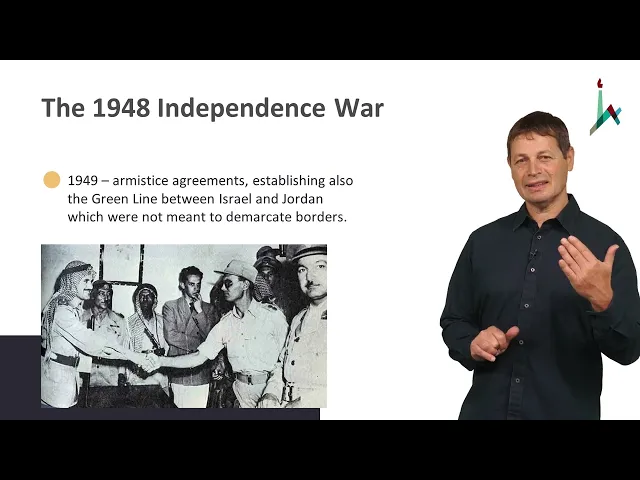
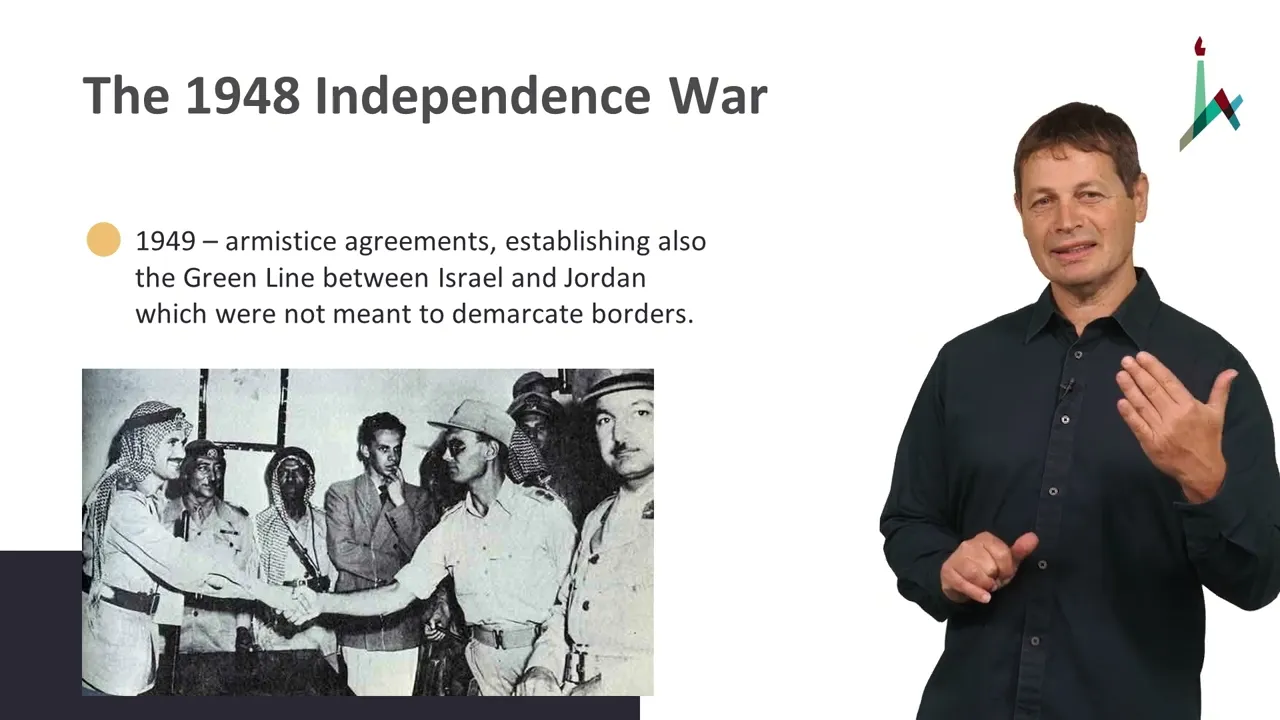
namely with Lebanon Syria Jordan and Egypt the Armistice agreements Were Meant to bring to an end the hostilities between Israel and its neighboring countries the armist this agreements established demarcation lines with respect to the lines between Israel and and Jordan in in relation to the West Bank and East Jerusalem and the demarcation lines were meant to C aliz the de facto results of the independence H War the lines were drawn by a green pencil and hence uh the term the green line the 1949 borders of the 1967 borders the Armistice agreement stated explicitly that its
terms were dictated only by military considerations and the agreements do not Prejudice the respective rights claims and position position of their respective parties in relation to the final resolution of the Palestinian conflict hence one can conclude that the Armistice demarcation lines were meant to be administrative lines and nonbinding or non-final or nonpermanent borders and it's very interesting to to note in relation to the interplay between International and international relations how a non-binding non-permanent border trans transformed itself in a relatively very short period of time into what is now perceived by the International Community as the
recognized borders of the state of Israel but we would refer to that very very soon in 1967 Israel launched a preemptive attack against both Syria and Egypt and only in six days it managed to defeat the armies of Syria Jordan and Egypt during this very short war Israel took control of the entire West Bank together with East Jerusalem and hence the three distinct entities of the partition plan were brought under Israel's control in addition and as you can see in this map Israel took control from Syria the Golan heits it took control of of the
Gaza strep from Egypt and conquered the sinan peninsula again from Egypt immediately after the 67 War the United Nations security Council adopted a very important relevant resolution namely resolution 242 as you can see in the text of the resolution attached to this session the resolution reaffirms the need for a just and Lasting peace in the Middle East and reconfirms the principle under international law of the inadmissibility of the acquisition of territory through the use of Force the resolution is this is accepted by all relevant parties both Israelis its neighboring countries and the entire International Community
and it's the starting point for each and every peace negotiation and it's the starting point for each and every peace Accord that Israel concluded this very short resolution which you read has some very important and strange features the the first is that the resolution was adopted unanimously notwithstanding the fact that it was adopted during the Cold War another interesting element of the resolution is that the resolution reaffirms the principle of the inadmissibility of the acquisition of territory through the use of force and you would expect that because of this res principle the resolution would demand
Israel to withdraw from each and every m meter conquered during the 67 War but despite this assumption the resolution or at least the English version of the resolution only calls Israel to withdraw from territories as opposed to from the territories conquered and hence there's an interpretive dilemma as to how you read and understand the resolution Israel insists that if the resolution calls it to withdraw from from territories as opposed to the territories that means that that Israel need not rraw from each and every millimeter conquered during the 67 War another interesting element of the resolution
is that the resolution calls Israel to withdraw from territories conquered in the recent conflict I.E from the 67 conflict and hence at least implicitly koshes or koshered Israel's acquisition of territory during the independence War another awkward element of resolution 242 is that it fails to call for the resolution of the collective political Palestinian problem and it merely refers to the need for the resolution of the Palestinian refugee problem in 1979 Israel concluded a peace agreement with Egypt the first peace agreement that Israel had with its neighboring countries and the peace agreement entailed the full withdrawal
of Israel of Israel from the sinan peninsula hence there are no territorial disputes between the state of Israel and Egypt and we have recognized borders between us and and Egypt the same is true with respect to the kingdom of of Jordan in 1994 Israel concluded a peace agreement with Jordan hence there are no territorial disputes between Israel and Jordan and we have recognized borders between us and the jordanians with respect to Lebanon in 1982 Israel invaded Lebanon and established in southern Lebanon a security strip which it held for 18 years under the law of religion
occupation in in the year of 2000 Israel unilaterally with Drew from Southern Lebanon back to the recognized borders International borders between Israel and Lebanon and this withdrawal was koshered by the United Nations and hence there are no territorial disputes between us and and Lebanon apart from a very minor dispute relating to the shaba Farms which brings into the dispute the triangle between Israel Lebanon and Syria in 1993 Israel commenced direct negotiations with the PLO leading to the conclusion of a serious of of international agreements term the OS Accords the OS Accord Were Meant to bring
to a final resolution the Israeli Palestinian conflict the Osa Accords recognized the PLO as the legitimate representative of the Palestinian people the osw Accords recognize the Palestinian people and all of its legitimate rights under international law the ords established the Palestinian Authority and the osw Accord treated the West Bank and the Gaza Strip as one unit the ords also treated the very sensitive issue of of territories by dividing the West Bank into separate entities or separate areas area a referred to the urban centers of the Palestinians such as ramala and nablas and area a was
put under the civilian and security responsibility of the Palestinian Authority in contrast area B the rural areas of the Palestinians were were brought under the civilian responsibility of the PA but under the security responsibility of the state of Israel area C the Open Spaces of the West Bank together with the settlements remained under the Dual responsibility of Israel both civilian and security it it is important to underscore that the ords provided a temporary regime which deferred the settlement of very sensitive issues such as Jerusalem settlements territories refugees to a final status negotiations with the hope
that those negotiations would be concluded in 5 years but unfortunately many more years passed and we are lacking the a final resolution of the conflict