This is the largest ocean on the planet and one of the most dangerous. "Beneath its calm surface lies a brutal world. " .
. . Welcome to the Pacific: Wild Ocean .
. . "PACIFIC OCEAN".
. . "A liquid universe encompassing areas larger than continents.
" "In this place," nature displays its most impressive and enchanting force, with a wild diversity that makes each wave the setting for a new event. . .
. "Here," dolphins leap in groups, drawing arcs in the air with almost choreographed movements. Starfish rest among the corals, like jewels embedded in the seabed.
And further down, where sunlight turns to twilight, the giant Pacific octopus glides enigmatically. In this submerged world, small creatures hide under every crevice, while the reefs serve as shelter and fortress. .
. . Despite the name, there is little that is "pacific" in these vast waters.
Far from any coast, where all around is just sea, the mere appearance of a shadow can herald the end. . .
. The sea seems calm. Some seals enjoy the day and swim carefree.
Then. . .
"The silence is broken by a lightning attack! " . .
. A shark emerged from the depths, transforming tranquility into chaos and blood. "The Pacific Ocean does not allow for mistakes.
" "Here," any distraction can be fatal. . .
. No creature is truly safe from the strength and cunning of a shark. But not even it is at the top of the food chain.
Because among the waves, an even more feared enemy emerges. . .
. Imagine a predator so intelligent. .
. that it kills strategically. So merciless.
. . that sometimes it kills for fun.
And so powerful. . .
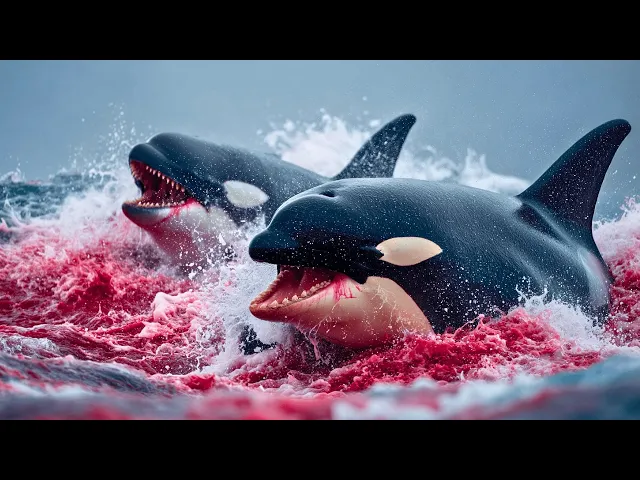
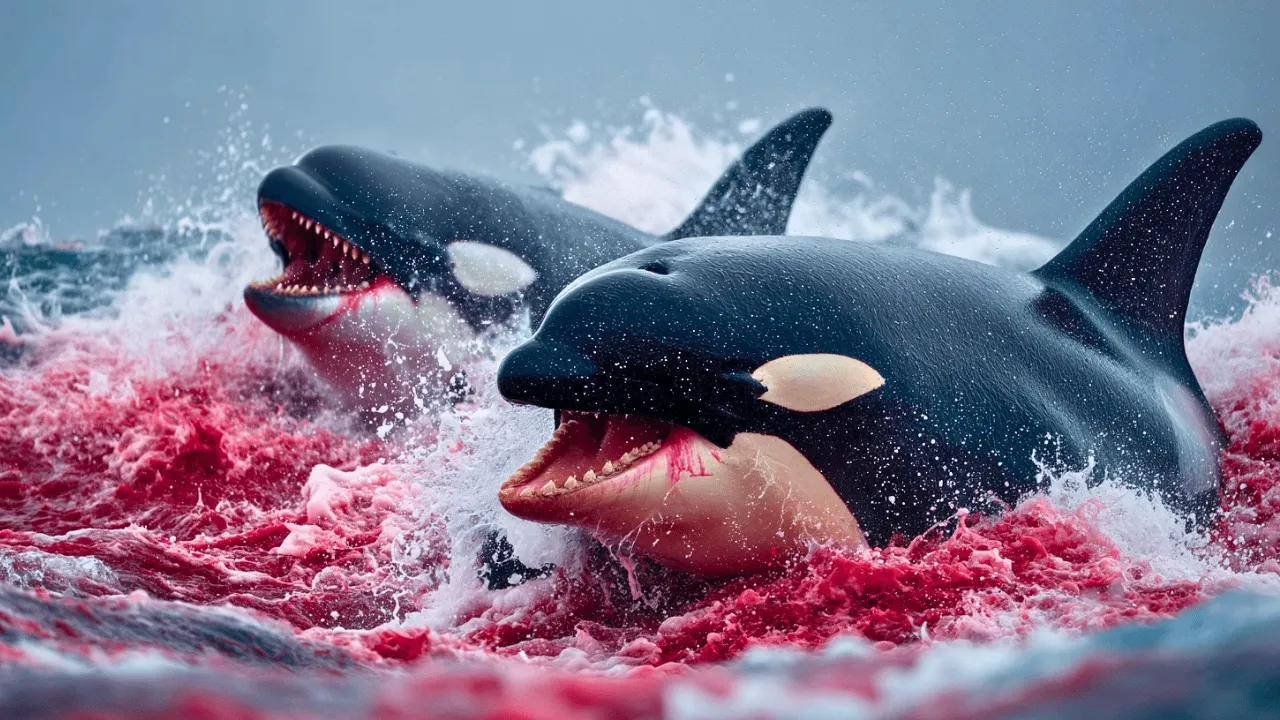
that even sharks flee in its wake. These are not ordinary whales. .
. "They are orcas". .
. "the killers of the sea. " .
. . Don't be fooled by the smile plastered on its face.
Behind it lies a calculating mind. “The orca is the only cetacean known to pass on hunting techniques from generation to generation,” as if whispering in the ears of its offspring: “This is how you hunt. ” “This is how you survive.
” . . .
A group of dolphins leaps joyfully in the heart of the Pacific Ocean. They play, as if nothing could threaten them. But below them.
. . reigns the silence that precedes chaos.
. . .
Three orcas begin the chase. The largest of them, probably the matriarch, leads the group. They are not hungry.
They are just training their calves. And for that, they need agile prey. “A worthy challenge.
” . . .
The first orca rises to the surface as if to show off. A calculated movement to create a distraction. The dolphins dart away, but it is too late.
The second orca emerges from the depths like a missile, violently breaking the surface. “One of the dolphins is hit from the side. ” The hunt continues, the whales surround another dolphin and tear off its tail.
He was seriously injured, but didn't die immediately… then comes the final blow. . .
. In regions like Patagonia, some throw their bodies onto the sand, risking their own lives to capture a sea lion. .
. . But what few know is that some orcas have developed an even darker behavior.
. . .
. . They have been seen attacking whale sharks just to extract their livers—a delicacy rich in nutrients.
The rest. . .
is left to sink. . .
. Contrary to what many think, it is not the blue whale, nor the great white shark, that is the true king of the ocean. It is the orca.
The ultimate predator. Capable of understanding patterns, manipulating the environment, and dominating any other marine animal. .
. . “Are you enjoying the expedition?
” Support our channel with a like. It's a simple gesture and makes all the difference to us. ” .
. . With an area of over 160 million square kilometers, the Pacific is the largest ocean on the planet.
It covers almost a third of the Earth's entire surface. It is about 19 times larger than Brazil. .
. . At first glance, the Pacific may seem like just an immense blue carpet stretching to the horizon.
But behind this uniform appearance lies a surprising reality: it is home to about 25,000 islands, more than any other ocean on the planet. Some islands are as large as countries, like the immense "Australia," while other islands are just small pieces of land, barely larger than a house. .
. . And if the surface is already a universe apart, what lies hidden beneath its waters is even more fascinating.
At more than 11,000 meters deep, in the heart of the Mariana Trench, lies the "Challenger Deep," "the deepest point on Earth. " Down there, in complete darkness and under crushing pressure, creatures that defy our comprehension continue to live in total anonymity. .
. . In its vastness, the Pacific Ocean harbors unparalleled biodiversity.
Researchers estimate that this colossal ocean is home to hundreds of thousands of species of invertebrates—from small mollusks to crustaceans and starfish. . .
. About 80 species of marine mammals cross its waters, including whales, dolphins, seals, and sea lions. There are also hundreds of oceanic birds that alternate between long crossings and brief landings on the islands.
And dozens of reptiles, such as sea turtles and aquatic snakes, complete this intricate mosaic of marine life. . .
. Amidst the abundance and splendor, lurks the darker side of nature. From the depths emerges a creature that represents the pinnacle of ocean hunting: the dreaded.
. . "great white shark".
. . .
The great white shark can reach 6 meters in length, almost the size of two small cars. "Its weight? " Two tons of muscle and teeth.
The equivalent of 25 adult men, concentrated in a single body. . .
. Its 50 teeth, each more than six centimeters long, function like sharp blades that tear apart fish, seals, dolphins, and even young cetaceans. Nothing escapes its voracity.
. . .
The attack begins in the darkness. The predator, attentive, detects almost imperceptible signs. Its vision, adapted to low-light environments , allows it to locate prey with precision, even in the most murky waters.
. . .
With its eyes positioned on the sides of its head, it has almost no blind spots. Its field of vision approaches 360 degrees, offering an absolute advantage in the art of ambush. .
. . When everything is aligned, it moves with impressive dexterity.
And then, at the decisive moment, it darts forth like a natural missile. The speed, combined with the power of its bite, transforms any attempt to escape into a futile effort. .
. . Its bite is not for chewing; it's a cutting tool.
In larger hunts, it tears the flesh into pieces with extreme efficiency. In smaller ones, it swallows the victim whole, effortlessly. .
. . Further down, in the colorful realms of coral reefs, the scene changes.
There, the great white shark may pass imposingly, but it doesn't bother to pursue prey as small as a clownfish. . .
. Even so, the tiny inhabitants of the reef don't take any risks: at the slightest sign of an approaching predator, they disappear among rocks, corals, and crevices in the seabed, seeking immediate shelter. .
. . Popularly known thanks to the movie Finding Nemo, this fish is much more than an animated character.
Its refuge is in sea anemones. This relationship is so intimate that it is also called the "anemonefish. " The nickname is no coincidence: thanks to a protective layer of mucus, this species is immune to the toxins released by the anemones' stinging tentacles, living among them in complete safety.
. . .
For other animals, however, an encounter with an anemone can be fatal. A light touch on the venomous tentacles is enough to cause almost immediate paralysis. When the danger passes, clownfish leave their hiding place and begin to explore the surroundings of the anemones in search of food.
- - - At first glance, these small fish seem too peaceful to harm any creature, but this impression is deceiving. . .
. Despite their delicate appearance, they are versatile omnivores, meaning they eat both the leftovers from the anemones' hunts and small crustaceans and algae. In return, their colorful presence attracts other curious animals to the deadly reach of the anemone's tentacles.
A silent partnership that transforms survival into art. . .
. Even living in isolated areas in the calm waters of the Pacific, clownfish form well-structured social groups. What defines this order is size: the larger the fish, the greater its power within the group.
But what is truly surprising about this dynamic is a little-known fact: "all clownfish are born male. " . .
. The most extraordinary change in a clownfish's life occurs when the group's leader, the dominant female, "disappears," either through death or expulsion. At that moment, a natural and irreversible process begins.
. . .
The breeding male undergoes a profound transformation, driven by a storm of hormones, and becomes the "new female of the group. " While he assumes the position of "matriarch," the male immediately below him in the hierarchy advances in the social structure and becomes the new breeding partner. Thus, the continuity of the group is guaranteed, without the need to seek new individuals or territories.
. . .
While the reef reorganizes itself after the change in leadership, far away a colossal creature crosses the depths of the Pacific with complete discretion: "the sperm whale. " Solitary and enigmatic, it inhabits abyssal regions where light does not reach. .
. . Weighing up to 45 tons and measuring 16 meters in length, it is the largest toothed predator on the planet, a true "Titan of the waters.
" With its monumental size and reserved behavior, the sperm whale remains one of the most enigmatic figures in the oceans. This marine giant "prefers the shadows of the abyss," where, at depths of over a thousand meters, it undertakes long dives in search of its prey, all far from human eyes. .
. . Larger males tend to roam the cold waters of the poles, where the food supply is more generous.
In these extreme environments, their reclusive nature finds the ideal refuge to maintain a solitary lifestyle. They are not creatures that are content with little; their daily hunger can demand up to two tons of food. .
. . The sperm whale's diet consists mainly of giant squid.
. . "prey that can measure more than ten meters in length.
" Hunting them, however, is an extreme challenge. Most of this battle occurs at depths greater than a thousand meters, where the pressure is crushing and sunlight is nonexistent. Under these conditions, vision ceases to be useful.
It is then that the sperm whale resorts to its most powerful weapon: "echolocation. " They are able to emit powerful sonic clicks that travel through the water. "Like a natural sonar," these acoustic impulses reveal the presence of prey hidden in the deepest abyss.
. . .
Their anatomy favors long and deep dives. The sperm whale can spend up to an hour submerged before needing to surface to breathe. When it finally finds prey, which can weigh up to 750 kilograms, it knows it will not be an easy fight.
. . .
The clash between these two titans of the deep sea unfolds in one of the most remote environments on the planet. It is a silent battle, but of epic proportions. On one side, the sperm whale, with its powerful jaw and teeth that can weigh up to a kilogram each.
On the other, the giant squid, armed with tentacles full of sharp suckers, capable of driving deep wounds into the cetacean's thick skin. . .
. The immense size difference between the sperm whale and its prey is usually the deciding factor in this underwater battle. In most cases, the outcome favors the colossal cetacean, which satisfies its hunger with an extraordinary catch.
However, even when victorious, it almost always carries visible marks of the fight—scars that tell the story of the confrontation. . .
. In the same ocean, two distinct stories unfold. In the abysses, where darkness is almost absolute, sperm whales cross the Pacific in silence.
Closer to the coast, another world is revealed: colorful reefs, warm waters, and golden sand. This is where hawksbill turtles live, staying in well-lit areas and rarely exceeding 70 meters in depth, where life is abundant and light still reaches the seabed. The name hawksbill turtle didn't come about by chance.
For centuries, the shell of this species, formed by overlapping plates of amber, gold, and brown coloration, was coveted for the manufacture of combs, eyeglass frames, and other accessories. This intense search for the material, known as "turtle scale," was one of the main factors in the species' decline. .
. . The hawksbill turtle is distinguished from other sea turtles by its elongated head and curved, pronounced beak, shaped to break shells and capture more resistant prey.
. . .
Far from the reputation for slowness attributed to other species, the hawksbill turtle is agile: it can turn on itself, swim backward, and explore coral labyrinths, caves, and narrow passages with impressive dexterity. . .
. Although hawksbill turtles are strongly associated with coral reefs, they don't stay there all the time. During the breeding season, they can travel long distances towards the beach where they were born.
Some even travel more than 3,000 kilometers. This ability to precisely locate its habitat, called "philopatry," intrigues scientists, who believe that these animals use the Earth's magnetic field as a natural "map. " This behavior ensures that each generation returns to historically safe nesting sites, preserving the continuity of the species.
. . .
Migration, however, is far from safe. The hawksbill turtle is targeted by various predators, such as the tiger shark, the bull shark, and the feared great white shark, which roam the migratory routes in search of opportunity. .
. . Still, despite its characteristic calm temperament, this ancient traveler is not easy prey.
Its first line of defense is its shell, a fusion of bone and keratin that functions as a true natural shield, capable of withstanding impacts and bites that could be fatal to other marine creatures. . .
. Even so, faced with the strength of a great white shark, even this almost impenetrable armor can give way. Therefore, hawksbill turtles do not depend solely on it to survive.
When they sense a hungry predator nearby, they don't leave it to chance: they use the rugged terrain of the seabed to their advantage, escaping into narrow reefs and deep crevices. In these winding passages, the hunters' bulky bodies become an obstacle, forcing them to retreat without capturing their prey. .
. . These reefs are often their salvation.
However, there isn't always time to hide. On certain occasions, the turtle must face the threat head-on. In these battles, it resorts to its "swimming ability": it changes direction abruptly, makes quick turns, and shoots forcefully through the water in desperate maneuvers to escape the enemy's claws—or jaws.
In many of these escapes, determination overcomes the odds, allowing the hawksbill turtle to continue its long mission. A mission that, from departure to destination, can take up to two months of relentless movement. .
. . When she finally reaches the beach where she was born, the turtle finds a scene already occupied by several males, ready to mate.
The encounter takes place in the water, usually in shallow areas. A single female can mate with several partners and even store sperm, ensuring she can produce multiple broods throughout the reproductive season. .
. . Three weeks later.
. . the female enters the beach where she was born.
. . "preferring the night to avoid predators.
" Sometimes, she makes false ascents to mislead threats. When she finds the right spot, she patiently digs a deep and safe burrow. There, she lays up to 160 eggs.
At the end, another crucial stage begins : with the same flippers that dug the ground, she completely covers the eggs. Then , obeying the laws of nature, she returns to the sea, leaving the eggs to their fate. .
. . About 60 days later, the sand begins to move.
From it emerge dozens, perhaps hundreds, of tiny hawksbill turtles. As newborns, they must face their first and most dangerous challenge: the race towards the sea. The crossing of the beach, Although short, it is a minefield of predators: birds, crabs, and fish, eagerly waiting to attack.
It is a spectacle of rare beauty, but also of profound tragedy: less than one in a thousand of these small creatures will reach adulthood. With the end of the breeding season, the turtles embark on the journey back. The return trip is long and full of dangers.
. . .
After the long journey of the hawksbill turtles, the ocean continues to reveal different ways of overcoming the challenges of marine life. In the deep waters of the Pacific, speed gives way to camouflage, and the "octopus" is the absolute master of this art. .
. . On the octopus's skin, millions of specialized cells act like tiny artists, capable of changing colors and patterns in a matter of seconds.
More than "changing clothes," it reproduces the "texture of the environment," integrating itself into the scenery. Thus, a seemingly harmless rock or plant may, in fact, conceal. .
. "a patient hunter. " .
. . In a world where predators lurk everywhere, from agile sharks to imposing orcas, this ability to camouflage itself is more than a talent: it's a passport to survival.
But mimicry is just one of the tricks up this ingenious cephalopod's sleeve. Without bones to limit its movements, its flexible body allows it to pass through gaps as narrow as the width of a finger. .
. . Before resorting to flight, the octopus likes to create distractions.
One of its best-known tactics is releasing a dense cloud of ink, not only to hide itself but also to confuse the enemy's sense of smell and sight. This dark curtain is a calculated maneuver to gain precious seconds. .
. . Despite its malleable appearance, the octopus holds a lethal weapon right in the center of its tentacles: a horny beak, similar to that of a parrot.
Made of chitin, it is sharp and extremely resistant, capable of piercing hard shells and carapaces with ease. It is through this beak that it injects digestive enzymes, dissolving the prey's flesh while it is still inside its protective shell. Invisible at first glance, this beak is the only rigid part of its body.
. . .
Among the creatures that can experience the hunter's side of this master of disguise is the blue surgeonfish. With its body painted in vibrant shades of royal blue, marked by an elegant black stripe and crowned by a bright yellow tail, it is one of the living jewels of the reefs. .
. . Found at depths of up to 40 meters, the blue surgeonfish leads a serene life, swimming alone or, occasionally, alongside a partner.
Popularly, it became known to the general public as "Dory," the friendly character from the movie Finding Nemo, which helped transform this species into an icon of the seas. . .
. And so, we come to the end of our incredible journey through the magnificent "Pacific Ocean. " We are immensely grateful for watching and hope to see you in the next video!
Thank you and have a good trip!