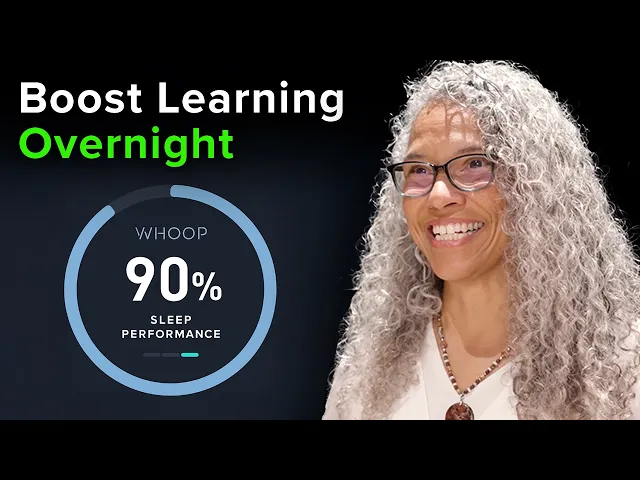
Can you bank sleep? No. There's nothing that can replace sleep. There's so many things that happen during sleep. Deep slow waves of deep slow wave sleep is cleaning the brain. And if we don't get it, we're just less efficient. Also, exercise is really good. That's got to be the number one thing for brain health. Yes, exercise is critical to achieving all of the best functions of sleep, Which is important for that short-term associative learning and memory. Is there anything during wakefulness that mimics sleep? Dr. Gina Poe. Hello, Dr. Holmes. Welcome. I am just beyond thrilled
to have you here today. I've just been such an admirer of your work. And when I just look back on, you know, just all the work that you've done, you know, looking at, you know, memory and and learning and, you know, kind of digging into REM In a way that has really transformed our understanding of that stage of sleep and its its role. And when we look at how your work has evolved our understanding of memory difficulties and PTSD and schizophrenia and Alzheimer's and you know it's it's really um just a herculean kind of level
of of contribution. So thank you. Oh, thank you so much. I appreciate it. When did you become you know interested in sleep? My mother was always a very regular normal good sleeper and my father felt like it was a waste of time and so he did as little of it as possible and that was to his detriment really. he wanted to spend more time working. Uh he was a very hard worker. Uh but that it costs you know there's so many things that sleep is really important for that he was depriving himself of me. I'm
kind of a night owl person and and also you know have so much FOMO. I never want to fall Asleep because I want to do I want to see I want to read. I want to um so I deprived myself of sleep a lot as a high school student and as a as a college student also to my detriment. I don't even remember some of the classes I took in college, you know, totally. Yeah, just blackout. Yeah, just blackout. But my senior year of college, I took a class called neurohysiology and um the first lecture
was given by Craig Heler. He's a biologist uh and he was in charge of the human biology uh degree at that time and he studies thermmorreulation. So, and he gave us a lecture about how he had discovered that when we go into rapid eye movement sleep, we stop thermmorreulating. We stop monitoring what the temperature of our body is. So, we won't shiver if it gets cold. We won't sweat if it gets hot. It's a very dangerous state. And he discovered that, you know, it was so dangerous. So, I Thought that's weird. You know, a lot
of the great discoveries in science start with the words that's weird. Weird. That's really strange. Why? Why is that? But I was, it was my senior year. I had senioritis. I took clay modeling and dance and dropped the physiology class. It was just too much work, even though that was the most fascinating lecture I'd really heard. And then I moved to Los Angeles with my roommate who was going to law school at UCLA. And I was going to go to med school or I was going to do a PhD in public health. I didn't know
which. Um, or maybe both. and I wanted to work for the World Health Organization. I wanted to help um countries get better health care kind of like the chancellor of UCLA did himself. So I needed a job. I needed to take a few classes and I um started as a waitress. I kind of sucked as a Waitress. I kept kept forgetting people's orders and um having to go back to the table. I was sleep deprived. Having to go back to the table. What did you order? Um, and so I didn't make much money and I
was not making the rent. So I sort of put out all my feelers and um, my stepdad contacted his cousin who had a good friend at the VA hospital in Sepulva who needed a lab technician. So I was like, "Okay, wow, biology. At least I could Use my degree, you know. Um, it didn't pay much, but I said, okay, I've never done research before. I'll try this." And so I did. And it was just amazing. I couldn't believe and it happened to be a sleep research lab. They invited me to go to a conference there.
I met all the sleep researchers in the world pretty much and they had no idea why we sleep or how we sleep. And I was fascinated by the fact that these regular people, these good people um who who were Curious could make such a difference. You know, each one of their experiments, you know, took us a long way in understanding what sleep was. And sitting in this week-long conference, I could come up with some hypotheses about what sleep was for given what I was learning and figure out some ways to test it. So I said,
"This is a place where even me, just little old me, can make a difference." And once you find something that's forever, Right? It's not like politics, which are is really great and very very important, but it can change with the wind. science produces things that are forever and can help people and other animals forever. I kind of got captured um at by that job where every day you're facing new puzzles and new challenges and by that conference and then the first time I presented my own finding which was about um consciousness and performance and found
that other people were actually Interested in it, you know, big wig people. I was like, "Oh man, this is where I've got to be." Yeah. So you got hooked. I got hooked. Yeah. Every day I I'm there's something surprising I see in the data. You know, we have millions of of data sets that we have access to, you know, and it's just this treasure trove of just potential insights, you know. I share Your enthusiasm. It's it's just this incredible field um that we shockingly still do not know. We still don't know. There's so much. We're
at the tip of the iceberg. We are which is exciting. Yeah. And but it's a really exciting time to be a scientist because there are so many more tools that we have now than even 30 years ago when I started and there are so many more bright young Minds at it um you know plowing away and getting answers. there's this ground swell of of discovery that I think will really get us over the the hill to actually you know find some cures for some of these currently incurable diseases and make lives you know I mean
that's what I get so excited about is kind of understanding yeah you know the role and and that's like sleep consistency for example to Understand like how crucial that is for physiological resilience you know is like such a and I and I you know, with technology getting, you know, we're like at a point where our sleep staging accuracy relative to, you know, you know, sleep goal standard is 86%. Like it's just getting, you know, just in the last like 5 years, we've gone from 70% to 86. It's like wild, right? Yeah. And 86 is as
good as one human score. Exactly. Another human score. Right. Right. So, you know, we just have this opportunity to look at massive massive amounts of sleep, you know, that that help us, you know, disentangle some of these crazy questions. Yes. And you said something really important that I wanted to just get at. We're probably going to talk about it some more later, but the timing of sleep Um in relation to your own body's physiological rhythms. Uh I just wanted to sort of underscore that because the sleep research field doesn't really pay attention as much to
the timing of sleep. Um but the circadian field uh which recognizes that our bodies have a clock in them that's aligned with the day has known that that circadian rhythm is very consistent. We can manipulate it with light um especially but it's very consistent. Only recently have we I Think really realized at least in the sleep research field that the alignment of sleep with that clock is critical to the functions of sleep to achieving all of the best functions of sleep. you know, you can switch your sleep because it's um you know, influenced by both
circadian homeostatic needs. So, if you stay up really late and drive, you stay up really late late one night, the next night you can go to bed earlier and get sleep earlier and then you might wake up Earlier that day and you can switch your sleep around somewhat during the day. But if it doesn't align with that very rock steady um circadian yeah uh preference preference then you're not getting sleep at the time when so much of your body is ready to accomplish its functions of the functions that sleep allows. I love that you brought
that up because I I think that you know just because we can switch doesn't mean it's good for Us. Right. Exactly. I think there's a lot of folks who are the night owl. Right. and and this idea that going to bed late is okay. And it does come at a cost though. It does. So I think it's it's kind of reconciling that all right we you might have this preference right to go to bed later but you have to understand that there are repercussions to bypassing what would be Your maybe natural pressure pressure for sleep.
I guess the question I have for you is so how how how much variety is there really in the chronotypes, right? You know, cuz when you look at the hunter gatherer and some of Kenneth Wright's work, it seems that we're all roughly going to want to fall asleep around 3.3 hours after the sun sets and, you know, within 30 minutes of each other in the absence of artificial Light. So, how do I I just have a really hard time with reconciling the conversations that are happening around when we can go to sleep and just hey,
go to sleep whenever you want, but just make it regular. I that seems like wrong advice. Yeah, I I I agree with you. I think the reason why I don't know this this I'm just a hypothesis that the reason why night owls are night owls are maybe because they're more attuned to social Um pressures. If you live in a society where there's no social pressure at all to stay up late, if everybody else around you is asleep and there's nothing to do, go to sleep, right? Um so people that are a little more have more
FOMO. Yeah. Um maybe no FOMO. That's wonderful. Good for you. You are free. Um those who have more FOMO, you know, if somebody's up, they're going to want to be up. They're going to be, you Know, what are you doing? What can I can I help? Can I participate? So even though their own natural body is driving them to go to sleep at the regular time, their social brain, you know, keeps them up. I say they I mean our cuz I'm I'm one of these people. And it does come at a cost. It really does.
People with who are night owls sleep live less long. Yeah. And there was a huge study in Great Britain, I'm sure you know about it, worth hundreds of thousands of people, if not maybe it was 80,000 people, I can't remember. A lot of people 000. Yeah. Yeah. 83,000. Thank you. Thank you. But if they expose themselves to light at night outside of the standard deviation of the regular population, they will die of all cause mortality and especially cardiovascular mortality. Um it's a decreased lifespan of 10 years. I Think I mean it's significant, right? Like really
significant. So it's Yeah, I think the title of that study was um you know, brighter brighter nights, darker days. Is that the one that you're referring to? That's what I'm referring to. It's not to make people feel bad, but I I think a lot of it is, you know, just modernity, you know, has kind of created a scenario where we can just bypass all of these Indogenous preferences. You know, going back to sleep timing, because I think this is an area that doesn't get talked about enough or I don't know that um people are aware
of the of what happens to human growth hormone. Like there's something magic before midnight. Yeah. No, it's it's um really interesting to see that. And this is something we've known actually for quite a long time that growth hormone the release of the biggest bolus Of growth hormone aligns with sleep and the deep slow state of sleep. And if you're not in that state at the right time because it also aligns with our circadian rhythms, you just won't get that big bolus of growth hormone release. If you're awake during the time when you should be asleep
um that early part of the night, then you will get maybe just as much growth hormone across the day, but it won't be in that big beautiful bolus. So, how does that relate to melatonin release? Because there's probably like some sort of, you know, Yeah, there is a timing relationship. Yeah, absolutely. Again, this is not my particular field, but I I've seen it and I've read the articles. There is a specific timing relationship. What I don't know, and maybe you know this better than I do, is if you suppress melatonin release, will you get that
growth hormone release? That's a big question. Yeah. I don't I don't know that we have the answer to that, you know, and and so by suppressing melatonin, you mean actually bypassing kind of that natural release of melatonin? Like we all have this like natural preference, right? And would you say that most folks don't actually know when that is because of societ like because of artificial light and like we all have this natural preference for melatonin, right? Yeah. And it's not like you can feel your melatonin being released, but you don't really sleep pressure, right? Yeah.
Yeah. It um Yeah. Sleep pressure, you know, the longer you're awake, the more pressure you have. That's process S, sleep, process sleep. Um the process C circadian process is aligned with light dark cycle. Normally those two are are really well aligned because if you get up in the morning expose yourself to light you're resetting your circadian And you're starting your process s buildup. So the adenosine yeah it just totally lines up to go to sleep you know at a beautiful time and some people it's 9:00 some people it's 10 o'clock 16 hours after 16 hours.
Yeah, something like that. If you fight that urge to sleep and suppress your melatonin with exposure to light, it's a melatonin is the hormone of darkness. It actually won't get released If you've got lights on. Let's just put it this way. If you're able to sleep in a bright environment, your eyes are closed, so it's a lot darker. But if it's a very bright envir environment, like you're outdoors taking a nap, then your melatonin will still be suppressed. Even if you're asleep, your melatonin will be suppressed. What happens then to your growth hormone release? So
growth hormone release and melatonin are very much aligned. I think they're I think it Was something like 20 minutes or half an hour difference between one and the other. And you want them to be aligned because both of them are doing important things inside our cells that help the cells survive and thrive because your clocks are expecting that melatonin and growth hormone to come at certain times, right? Yeah. Yeah. They're both orchestrating that timing wonderfully. Like like I I think the Word orchestrating is perfect because it's like an orchestra. You don't you need the different
parts of the orchestra to come in at the right time. Otherwise, you just have noise. Even if you everybody's got the same score in front of them, if they're playing at different times, they there there's nothing but noise. And that's what happens to our bodies if we're doing things at the wrong time. So, I want to dig into REM. Yes, absolutely. That's my feel. I know it is. I know. I know. We're getting We're getting to it. I know. And yeah, we've went a little off on a little bit of a tangent, but I think
an important one, you know, because I think folks are recognizing now it's in the public consciousness that, okay, sleep is actually important. I need to prioritize it like your dad, you know, who is kind of like sleep doesn't really matter potentially, Right? Like in the 50s, you know, that's what people thought. Exactly. So, you know, we're kind of evolving and and so I think one of the questions we just get a lot is about timing. So, I wanted to just get your thoughts on that as it relates to to REM. What do your findings specifically
reveal about how REM sleep reshapes the brain each night? That's my jam right There. It sure is. Oh my goodness. When I started in sleep research, um really wasn't known what REM sleep is for. It's this dangerous state where you're not thermorreulating and you're not responding to the external world. um and are actually we're actually inhibiting our muscles from from active activity so that we don't act out our dreams. So in a lot of ways we're super vulnerable and in fact You won't go into REM sleep unless your body is ready in a thermonutral zone.
So we didn't really know what it was for but we knew that even if you deprived animals of only REM sleep, let them have as much non-REM sleep as they wanted. In fact, they could get more of it. But if you deprive them only of REM sleep, they had all of the same problems that came up if you deprive them of total REM of total sleep. So your immune system goes haywire, thermmore regulatory system Goes haywire, your metabolism goes haywire. So, we knew it was important and then there were a few decades of studies um
in the 70s and 80s that really showed that if you learned something important but then deprived yourself specifically of REM sleep in the hours after you learned it, you wouldn't consolidate. You wouldn't strengthen and hang on to that memory and put it away as a long-term memory. But there was a hypothesis that um maybe REM sleep is for erasing all those things that you learn during the day that you don't want to remember that you just gunk your brain with just take up space. You take up space useless, you know, facts. And it was a
hypothesis that wasn't testable at the time Francis Crick and and Graham Mitches put it out there. Um and it was intriguing, but you know, the sleep research field said, "What are you talking about? We know That REM sleep is really important for memory not for forgetting. So I was going to University of Arizona for my posttock. I was learning a technique where I could record from neurons in the hippocampus which is important for that short-term associative learning and memory and also important for consolidating that memory out to the long-term storage in the rest of the
brain the neoortex. So you need it for a particular amount of time to both Acquire those memories and to put them where they go. And then you don't really need it. I mean, you will use it every day while you're recalling memories, but you don't really need it for long-term memory recall. I mean, it's always better for richer long-term memory recall, but the semantic facts, all of those are stored away. So, we knew that it's important for a particular amount of time, and that time seemed to be about a week. The more complex, the more
Different, you know, modalities were involved in that memory, the longer you needed to consolidate. But um and the more kind of mindblowing this thing that you learned is, the longer you need to consolidate. But about a week is is is a good rule of thumb. So if we deprive REM sleep right away after learning something, we knew that we didn't consolidate it. We needed REM sleep and we also need hippocampus for about that amount of time. So I knew I was going to Be recording from this hippocampus area, important for learning and memory and for
memory consolidation. And I wanted to see, nobody had really looked at what the hippocampus was doing during sleep, during REM sleep in particular. And I thought, I was so excited. I was like, I'm going to be able to see, is the hippocampus active in a way that's consistent with holding on to those memories or is it consistent with erasing those memories? And so this was The study I did at the University of Arizona. I also did a really cool aging study that was a lot of fun. But and I also did a study with NASA
where we sent some rats into space about navigation. Um but this this one about REM sleep and the function of REM sleep I knew was going to be my bread and butter. No matter how it came out, whether REM sleep was for memory or for forgetting, it's a win-win, right? Happen often. I suppose, right? I suppose it could Have been for nothing and then I would have been back to baseline. You know, there's something about it. Obviously, we can't get at it with recording this way. The brain taught me my that my hypothesis was just
all wrong. Because what it taught me is that REM sleep is both for remembering and consolidating and hanging on to those brand new memories until it can get consolidated. And then later it's for erasing from this temporary memory structure of the Hippocampus those once novel memories that have now been consolidated so that you can refresh the hippocampus make it able to learn something new the next day. Um which we do need our hippocampus all of our lives to do any kind of new associative learning in memory and it can get saturated if we don't clear
it. It can get saturated and that's the only time right. Yeah exactly. So it can get during sleep is the time when we can put those Memories away and refresh. What does it look like if someone is continually getting short sleep, you know, is not going through kind of the, you know, the typical four to five sleep, you know, 90 minutes sleep cycles. What does that human being look like? Yeah. You know, after a period of time, well, okay, lots of things. At the cost, you know, yeah, Cost. Um, so let's start with memory. Our
hippocampus can get saturated with the old memory, so we can't learn new things. And in fact, even with one night of total sleep deprivation, your hippocampus is like you it's not even there. It's it's not even there able to allow you to learn something new the next day. It's like a functional hippocamplectomy. Ectomy being something like you're cutting you've cut it out. Is this a feature of PTSD? So this is what we're researching right now. Okay. Yeah, I knew you were looking into that. So people with PTSD can get totally normal amounts of REM sleep,
but that REM sleep has become maladaptive and dysfunctional because one thing that needs to fall silent during REM sleep is the sympathetic nervous system and the driver in the central nervous system of the you know fight or flight that needs to fall silent during REM sleep is the Locus and that provides what's called neuradrenaline for the brain which works just like adrenaline for the rest of the body. It sort of juices it up. It helps us to learn much faster. But during REM sleep, we need it to be absent. And people with PTSD don't have
that absence of norepinephrine or noradrenaline during REM sleep. And so instead of rim sleep allowing us to erase what was once novel from this temporary memory structure, it Instead continues to reinforce that traumatic memory and keep the synapses in our brain saturated with that traumatic memory so that we can't ever sort of put it to rest once we've consolidated it. Yeah, this happened to me. Semantic memory, the story of it all consolidated. you should be able to erase it from the novelty encoding circuitry of the hippocampus. So this is really an injury of the nervous
system that's impacting the brain. Yes, I work with a research outer of Northwestern who does a lot of this kind of work with PTSD and you know his hypothesis is that PTSD is very much an injury of the nervous system. If you don't address autonomic nervous system functioning, you can't address sleep, for example, you know, so you kind of have to get that back online and be able to basically train, retrain the heart to respond to the inputs of the autonomic Nervous system. I just think the autonomic nervous system is this incredible entry point for
beautiful sleep, right? Like when our autonomic nervous system is dysfunctional, I I really what you're finding. Yes, exactly. Yeah. That just is like so cool. Right. So heart rate for example you mentioned the heart is um supposed to be variable and dependent on the inputs That are coming in it also during sleep uh varies with every breath we take it's a it's a beautiful big juicy signal if your neurodurgic system is constantly on it's almost yeah it's almost like you can't respond anymore to every breath you take you're just flat muted Yeah, it's almost as
if it's just constantly on and then you can't be responsive and you can't you can't adapt like you need to. When we have decreased REM onset latency, for example, is is that a a um indicator of depression risk, you know, so that that's there's been some evidence that that's true and I Yeah, just wondering but there's a lot of Yeah. arguments about whether that or not that's true, right? No, no, no. There is um a decreased latency to REM. And when you Have that, it's often because the pressure for REM is higher. And so why
is the pressure for REM higher in people with depression? And it might be because there are things going on during the day, um things you're learning or um hanging on to that your brain says, "We need more REM to put this away and to put these things to rest." What seems to be the case is that that REM sleep is also not able to do its function. So that Increased pressure for REM or that um earlier REM onset time is probably indicative of the fact that the brain isn't able to do during REM sleep what
it needs to do and it's trying to get more, you know, to get it and it's it's um just not able to. It's kind of like just running faster to stay in the same place. Gosh, one of the things that we see, we're we're trying to disentangle this right now. I'm working with um Jamie Zitzer at Stanford and and Dr. Zyarthur, sorry, at University of Arizona on this question, but one of the things that we see in the data, which is counter to kind of I think what we think about activity levels during the day
and and increasing our need for sleep at night. Yes. Well, one of the things that we see is that's not true potentially that, you know, folks who are really active during the day actually sleep way more efficiently and Do better in terms of their resting physiology when they're getting actually a bit less sleep. So, there's that. Um, and then the the other one is looking at kind of high fit versus low fit. So, kind of categorizing individuals and really high fit, you know, as measured by, you know, BMI and basically all the information that we
have about the the individual in terms of their resting physiology. And so high fit versus low fit. And Basically we see that low fit have this decreased REM onset latency feature. High fit don't h they are kind of what we would think is normal in terms of when they drop into REM. So there's something about the low fit and low fit sleep way longer than the high fit. Yeah. Um and I've heard you talk about this I think on Dr. Huberman's podcast in terms of like that's something that you've Seen or know about. So let's
just step back a second. two states of sleep majorly non-REM and REM sleep and the two are as different from one another as night and day or as waking from sleep. So the neurotransmitter levels change, the neural signatures, the way that the brains, your neurons are active are really different between those two states. And in a way you can think of them as competing with one Another or um actually also cooperating because non-REM sleep the that comes first usually uh is filled with all kinds of amazing events that set the brain up for really efficient
beautiful REM sleep including protein synthesis to stabilize the memories that you formed during the day and muscles and etc. Yeah. Energy, metabolism, uh restoration. So you build up your ATP again, which is, you know, the power structure for the Whole body. Oh, and this the first steps of consolidating memory from the hippocampus to the neoortex all happened in that transition to REM sleep. The other thing I forgot to mention, but I really want to stress here is is cleaning the brain. Oh yeah. Yeah. So those um deep slow waves of deep slowwave sleep um actually
have been found to clean the brain through The glimpmphatic system and we're still just learning about how this what the mechanism is but one of my next studies is actually going to be on the locus the noradrenaline structure which is um organized anatomically um from the brain stem goes to the forbrain and then back through to the back of the brain. And it fires. This is some studies by Axana Shenko and Susan Sarah. It fires at the rising phase of that slow wave of slowwave sleep. And it's unmilinated Axons which means that when it fires,
it takes a while for the for the signal to get to its structure because uh it's like it's an uninsulated wire. It takes a while to get there and then that structure the anatomical structure of it sweeps nor adrenaline from the front of the brain to the back of the brain. NonREM sleep is not a time when there's no neuradrenaline in the brain. It's a time when there is neuradrenaline, but it's very specifically timed to those Slow waves. And what it does, one of the things that it does um just like adrenaline does is it
constricts our blood vessels. It increases our blood pressure and it helps blood flow more quickly. Yeah. And the tissues like I mean gosh like the downstream effect of that is massive like inflammation. Massive. Yes. Exactly. And so if it's pumping it's it's active uh at about one Hertz or slower. It's causing this wave of vasa constriction to go from front to back. It helps clear all of the junk from our brain into our lymphatic system and out. So, it's a beautiful time when we're cleaning our brain. And if we don't get it, if we don't
get deep, big, beautiful, slow waves that um sweep through the brain, we're just less efficient um much less efficient at cleaning. Do we know if there's an association Between that cleaning process and neurodeenerative diseases and there there's got to be is it birectional like you know? Yes. So, that's one of the things that exercise really helps boost the amplitude of our slow waves. We don't know exactly why, but it does. Um I mean that's got to be the number one thing for brain health. Yes, I think so. I think it is because it helps you
sleep better. I Mean just the the downstream effect of exercise is just, you know, crazy. It is. It is. You don't want exercise like boxing that it'll injure your brain. Totally. Yeah. Yeah. Yeah. I mean, not to say anything against boxers, but it's, you know, repeated injury to the head is just obviously not a good thing and especially leads to a lot of neurogenerative diseases. But anyway, other than that, um, exercise is Really good. And so cleaning the brain is really, really important for to prevent neurodeenerative diseases. As we get older and older, the amplitude
of our slow waves gets smaller and smaller, unfortunately. But exercise can help reverse that amplitude um, decrement. As we get older, it is kind of no wonder really that we, you know, develop mild cognitive impairment, um, memory difficulties and neurodeenerative diseases, much more susceptible to it as We get older and older because the amplitude of our slow waves and our brain cleaning process becomes less and less efficient. So you'd say one of the like number one tactical things that you can do during the day to initiate this beautiful process that you just described like it's
really poetic like how you descri um is exercise during the day. Yeah. Yeah. Yeah. It really really really helps. High intensity does it matter like just like anything you know I don't really know. Well, I think even walking, you know, long distances, um, would would help, but I think probably just given my own physiology, what really does help is if I can get the blood flowing, you know, if I can feel like out of breath, it's a, you know, aerobic exercise, um, that just helps me sleep a lot Better at night. It's not just slow
strolling, right? Although that's not bad for you. Yeah. Um but something that gets the blood moving something vigorous that there is something I think like psychological to to that you know that's powerful you know when you feel like you've just put in some work you know it's kind of like all right I can rest now like you kind of earned it Which I know people don't like to hear that but I there's something to that you know right it might be that in one way it stresses the um autonomic nervous system and and causes it
to be more elastic in the sense that you know it pushes it and then allows to relax so that you can then fall asleep just beautifully. Some of the things that happen or many of the things that happen so many different things happen during non-REM sleep Including these things called sleep spindles and these things uh maybe explain what a sleep spindle is. Spindles are just these crazy amazing really amazing little um one and a half second long uh happens you know a few times a minute. They come from the phalamus which is called the gateway
to consciousness. It's the it's where incoming sensory information gets sort of through a circuit board translated to our cortex which you know handles what Is this why is it you know what is how does it relate to each other. Anyway, the phalamus and the neoortex uh communicates really uniquely positively well during sleep spindles and it is when the hippocampus seems to start to translate or or put those memories away into a schema. Um so for example, you know, if you learn calculus for the first time, how does calculus fit in with the rest of the
world? That sleep spindle state is the time when You're starting to, you know, make those connections and and put them into the right places, the new things that you're learning into the schema that you already have um about the world. The frequency of sleep spindles is 10 to 15 hertz. So 10 to 15 times per second. For one and a half seconds, your phalamus and cortex are going bing bing bing bing bing back and forth um communicating. The number of times you have that per minute is interestingly associated with Your IQ. So yeah, the more
sleep spindles you have, it's a really pretty direct correlation with um at least some types of IQ. Is that genetic or is that like how your early sleep like how you're sleeping as an infant and child? It's got to set you up, right? Yes, I think it sets you up for having a schema with which to understand the world um more intelligently. So yeah, that's wild. I have never heard that. Interestingly, uh, marijuana destroys your sleep spindles and um, also so there's an interesting link between sleep spindles and schizophrenia and the high THC levels in
today's marijuana and the tendency for young people especially to tip over into psychotic breaks. So anyway, that's just that's an aside, but sleep spindles, fascinating, are destroyed by by THC. THC also destroys REM sleep. So it kind of takes Over all of REM sleep with this kind of 10 to 15 hertz. Yes. But instead of organized in a spindle um organization, it's just kind of constant. So too much of a good thing is a bad thing. And I think each sleep spindle needs to be ended um a after one and a half seconds. And it's
ended by the locusterous noradeneric pulse which probably what like stamps that new memory that's being written into the your schema stamps it in with just a little surge of Adrenaline that really just says okay this is what's now what is now. So when you learn something new, no matter what your basil frequency of sleep spindles is, if that learning is able to push your sleep into a higher number of sleep spindles, then it's a sign that you've really learned that thing and consolidated into your memory. What else destroys the sleep spindles? Oh, yeah. THC. Yeah.
Alcohol. Well, yeah. Alcohol, sleeping pills, many of them um destroy sleep spindles. Not all of them. Um so pay attention to which one you're being prescribed if you're taking a sleeping pill but yes alcohol does and um that type of sleep is called the N2 stage of sleep. So you talked about zone two exercise. This is N2 stage of sleep which has these sleep spindles. Sleep spindles are also it's it's easily destroyed. So you really need to have You know sleep in the right place to schizophrenia. Uh people don't have good sleep spindles with schizophrenia
and it's the chicken or the egg, you know, like I like I think about like, you know, early childhood, you know, and I I think about this from this perspective of, you know, sleep health equity, like just thinking of urban environments, underserved communities, you know, just like war zones. Uh yeah, sleep is not good. Sleep gets disrupted if your parent has to work three jobs and you have to be put in daycare early. Disruption of sleep is not good. And so yes, sleep is extremely important and these sleep spindles are really important to developing your
brain into all that it can be. Do not sleep deprive your child. Yeah. Do not if you can possibly avoid it. Yeah. Yeah. Let your kids sleep. Yeah. Let them sleep. Um don't wake them up to, you know, stimulate them with more learning. Um they're your brain is working hard when you sleep. It's doing really important things. It's not a waste of time. Yeah. So that's an N2 sleep. And then from N2 sleep, you go into REM sleep. All of those deep slow waves and the sleep spindles set up your brain to Consolidate start consolidating
those memories so that during REM sleep your brain is actually as active as it is during um wakefulness but in a different way. So instead of being attuned to the outside world like we are when we're awake listening to each other talk etc. During REM sleep we're attuned to our internal conversation. So um and that's when we are able to sort of reformulate our schema based on the disperate things that we learned during the day and erase Some things that are no longer working for us and instead strengthen other things that allow us to be
more creative and insightful and really clearing. Actually that's the unique time when you can clear the brain of things that are no longer working for us, no longer true. downscaling the novelty of what happened the day before so that it doesn't remain as though it was novel whenever we recall it which is not good especially for bad memories. You want to Not have to relive when you're recalling a memory all of the emotional activity and intensity of it. Yeah. Yeah. You want to be able to remember all the facts, the important things about it, but
not at that level of intensity. Not that not as though it's happening right now again. Right. Wow. So that's that's my research is that dual um activity of REM sleep, The dual function of REM sleep, both to strengthen the things that are important, put them away, reformulate your schema based on the new information, and to put to rest the parts of their memories that don't you're not they're not needed. The brain is really an a metabolically expensive place uh to be. It's only 2% of our body weight, but it takes even at rest 20% of
our met metabolic um energy. So we need to tightly maintain which synapses we're Which connections between neurons which are expensive metabolically to maintain and which we need to um to not maintain in order to preserve for our entire lives our ability to respond to the environment um in a an adaptive way. Do you see kind of how spindles change over the course of a a lifespan? Like do you know what, you know, a diseased spindle look, you know, looks like like versus a healthy like Yeah. Well, we definitely know what a Diseased spindle looks like
versus a healthy spindle. I don't know myself as much how spindles change with age. Sleep definitely changes with age in general. The amplitude of our slow waves we talked about already. Is it a marker of neurological health? It is. I think it is because One thing that changes with age is our spindle and with insomnia as well is our spindle sleep and our REM sleep gets much more um fractionated. So u not it's Long consolidated you know wakefulness free cells we wake up a lot more often and I think that's due to a autonomic nervous
system dysfunction. Yeah, that that can build actually that locosurillus area that I talked about is so important for our ability to respond to the world around us. It is actually the first to be um compromised when we deprive ourselves of sleep and and it is uh the first to show a buildup of Misfolded proteins um called tow proteins hyperphosphorated tow. The degree of hyperphosphorilated towel that builds up in our locus is also really linearly related to um our susceptibility to Alzheimer's disease. Even in very very you know in brains that um we get from people
who have died before they got Alzheimer's you can start to see there might be a buildup and the greater the bra um diagnosis of Alzheimer's and memory dysfunction and All of that the bigger the buildup of this hyperphosphorated towel and it seems to start just really early it's also um builds up in Parkinson's disease so the locus is kind of the earliest um with Parkinson's disease the dopamineergic cells um to which the locosurus projects um start to build up um their misfolded proteins and compromises our ability to move. So so then our question is you
know how do you prevent that? How do you get good Healthy sleep to make sure your hyperphosphorated towel clears? And one of those is sort of a positive feedback loop. Great slow waves um then feedback can clear that hyperphosphorilated tow and then the locus reels can cause great slow waves. It's kind of this positive feedback loop and we don't really know how and why exercise helps that process. It's an area that needs to be further investigated. It seems like anything That we do during the day that helps create better conditions for sleep at night like
you know like whether it's it's managing stress throughout the day in a proactive way like engaging in breath work and mindfulness and tending to your relationships living your purpose all of these things right up your purpose is a good one actually you know one of the things that calms the locus down during during the day and reduces our neurodurgic levels is Learning actually so if we for example will, you know, have something terrible happen to us. Um, if we can, you know, remember our purpose and think about the, you know, the how this might fit
in with the grand scheme of things, this terrible thing that happened and sort of figure out a way to learn from it. Um, you know, what not to do next or what to do next to avoid it. That feeds back a signal to our locus to say, "Okay, you've done your job. We've Learned from this. Now you can calm down and um there are actual neurotransmitters and uh that go back to the lucasillus and have it calm down. You don't want it to be sustained activity over long periods of times. It needs to be responsive
to acute stressors and then once it's done its job it needs to calm down again and it needs to calm down before you go to sleep. So um breath work is a good way to do it. Again, um we don't know Exactly why, but it's interesting. The locus is positioned in a place in our brain stem that is right next to um a system of cerebral spinal fluid and every time you breathe it gets um compressed and then every time you breathe out it gets relaxed and compressed and relaxed and that actually moves the locus.
If you've seen this video that I've seen, I I'll try and find it for you. Of every breath you take and every pump of your heart really Actually physically moves your brain. It massages it. Yes. Isn't it that's a good way to say it like feels like it's massaging it back there. It does. And it might be what helps to clear it of hyperphosphor. we could hypothesize that exercise when you're really pumping it, it's really getting like the Swedish massage versus just like that's a great way to think of it. Um, so I, you know,
with the learning I Think about like when I'm really engaged in a task and I'm super fired up about like the thing that I'm doing, like I'm just in the present. Yeah. You know, and that changes my nervous system in ways that are really profound, you know, like I'm not thinking about the future or the past. And I wonder if there's Yeah. Like I wonder if there's some sort of relationship there like why learning is the thing that you found that really does help. Yeah. Well, I think the locust activity really is to the reason
why it's active is to help us learn. It actually helps us put just one-time learning into a long consolidated um state. It makes sense that once you've learned it, you know, that learning signal feeds back and says, "Okay, great. Stop." You know, you're good. Okay. Um, so maybe the sympathetic nervous system needs not just to be fight or flight. It needs to be fight, Fight, learn. Interesting. The other thing I wanted to ask you about just is there anything during wakefulness that mimics sleep? You know there's yoga nidra like you know kind of the non-sleep
deep breaths like you know is there any evidence that the problem is that a lot of the things that we know about sleep we know through pretty invasive measures you know measuring Neurotransmitter release in the brain you know requires a probe in the brain you know which parts of the brain are doing what and there aren't many people who are instrumented in that way and we can't teach rats how to do yoga nidra. Yeah. At least we haven't succeeded yet. Yeah. Actually, Jack Feldman at UCLA is has um a way to control our breathing. I
love him. Yeah. In the brain stem side. Yes. He can control the breathing of rats such that they are breathing like uh breath work. Interesting. And interestingly, they also are able to um not get PTSD as much from a traumatic you know event. So breathing is training their nervous system. Yeah, that is interesting. But We in terms of other things, we just it's just there's a limit between what we can do in in other animals and what we can do in humans. So we don't know the answer to that question really. um except that I
have seen a study with people who can achieve really great levels of transcendental meditation and the brain wave activity you see in them when they're meditating is this theta rhythm that you get during REM sleep. But we aren't able to tell Whether other neurotransmitters like noradrenaline and serotonin which are normally off during REM sleep are also off in people who have transcendental meditation. So we don't know if it can accomplish all the same things that REM sleep can even if you have a theta a beautiful theta rhythm. So far I would say the answer is
no. We there's nothing that can replace sleep. And in fact no one has been able to replace if you don't sleep you die. So, and and and There's so many things that happen during sleep, like I said, metabolic, immunologic, cleaning and consolidating, etc. that even if you could replace three of them, but not the rest, you're going to suffer. I do a lot of research with um shift work, um you know, which is really an interesting population, you know, with the goal to to see, hey, you know, what Are some things that we can do
to offset some of these dilarious effects of being up during the biological night? you know, we're seeing exercise really does seem to help resting physiology just generally. Um, but are there are there anything any things that you'd recommend um for shift work that you found maybe in your research that would be useful for that population to just call out or Yeah, the better you can align your circadian Rhythm with your sleep rhythm, the better off you're going to be just on average as much as humanly possible. As much as humanly possible. So, if you're a
shift worker and you can really use blackout curtains uh during the daytime so you don't see that bright sunlight, protect that sleep. Yeah. Protect that sleep and that circadian alignment. Um you're not then Suppressing your melatonin rhythm, etc. If you can, as a shift worker, say you work midnight to 6:00 a.m. or whatever, 10:00 p.m. to 6:00 a.m., if you can treat your body as though you have flown around to the other side of the world, that much control over your light dark cycle, your activity, your meals, your all of that. Obviously, not obviously, but
I'll tell you that if you do fly around to the other side of the world, it takes a while for your Circadian sleep, you know, and social world to all align. But they do eventually align and you're fine. You're absolutely fine. But if you're trying to follow fly around the world every 3 or 4 days like some shift workers unfortunately have to do, your body never really has time to catch up. So you're constantly misaligned. Yeah, you're constantly misminded and it is deletarious to your health all kinds of ways. We're under review right now and
And was a 20 um 70 acute care surgeons and um just to talk about how dilitterious it is to to the health um of these humans. But the mean age of the the group was 43 and they had on average over the course of the last 10 years um had at least two nights where they were on call per month. was the average and the resting physiology again mean age 43 resting physiology looks like a 60-y old. I totally believe it. Yes, I totally Believe it. I wonder and and it brings me to the question
of is the quality of melatonin and the bolus of HGH that's released when you're falling asleep during the day. Is it just simply different than you know because of the clock the expectations of what should be happening endogenously is just misaligned with the natural light dark cycle regardless of like yeah there have been studies to show That shift workers for example um the less aligned everything is the smaller the human growth hormone release is so less aligned in terms of the natural light dark cycle so like okay so even though I'm regularly going to bed
at, you know, 10:00 a.m. and waking up at 400 p.m. No. So, you know, say like I'm just wondering like is that okay? If you're regularly doing that and you're controlling your exposure to light to be aligned as though that were your new day, that's okay. That's actually not so bad. It doesn't really matter what side of the earth you're on as long as you're aligned with all of the the rhythms. So if you're on, you know, the wrong side of the earth for your for your work shift, as long as you can control your
your Environment such that your body believes it's on the right, even artificially with artificial light and Yeah. then then it'll be fine. It's going to be okay. Yeah. Yeah. There's one study I'm thinking about where they take animals and shift them was you know 6 hours or 12 hours and it was only measuring across a few weeks and across those few weeks there as long as they controlled everything they were able to get everything aligned Again. Um it was a little muted in terms of its total amplitude but it was at least aligned. So it
might never be as good and again it's really you know controlling the world around you. You have to basically live in a cave to because stuff happens around. We just all have to get into cahoots to just let's just align ourselves with the natural light dark cycle, Right? Exactly. Yeah. It's not going to happen. No, it's kind of my dream though. Well, I mean, there are things that have to happen. Hospitals have to be staffed in the middle of the night, you know. Well, decrease the amount of folks who need to be in that situation,
you know. Yeah. build a roster sizes so you know people only have to do it, you know, Once a month maybe as opposed to, you know, like I don't know. I have so much like empathy for Yeah. YouTube, you know, there's just really amazing what they do for our society. Yeah. Emergency workers, for example. I mean, emergencies happen all times day and night. They're constantly having to disrupt their circadian. these uh first responders are putting their lives on the line for us, Not just in terms of putting themselves in danger at the moment, but putting
their long-term survival. Yeah. Really trying to figure out, you know, what are the I mean, creatine has been a really cool I don't know if you've heard much about, you know, the use of creatine to to offset sleep deprivation and help with cognitive functioning. And yeah, it's a emerging area. Um, it's funny. It's it's a molecule that's been Studied for, you know, it's the metabolism. Yeah. Yeah. It's, you know, it's so it's cool to kind of see that more research going into this area of like, okay, how do we help these folks, you know, like
just pay down some of this risk, you know? Yeah. I really think the Nobel Prize winning um research is going to be about metabolism. Um, Interesting. I mean, what what gets you really excited in the next 5 to 10 years in terms of, you know, sleep, cognition, performance, like you know, what do you we get really fired up about? ATP, energy is important for everything that our cells do and our entire bodies and um it is the longer we're awake actually, the more ATP gets broken down to ATP stands for adenosine Triphosphate. I know you
knew that. uh when it gets uh broken down by the metabolic cycle to make energy to cells, the next stage is ADP, adenosine diphosphate, then AM adenosine minof phosphate. And by the time it gets to just adenosine, it no longer holds any power to for our for our cells. And the longer we're awake, the more ATP gets broken down into adenosine. Somehow during wakefulness, we're not able to keep up. We're just not able to keep up With it. The first thing to happen when we fall asleep, you know, this is why a power nap is
called a power nap is our mitochondria catch up and make turn adenosine into ATP again. And that adenosine signal that buildup of adenosine is part of process S that drives us to sleep because our body is saying our brains are saying ah too much adenosine we need to convert it to ATP again. So when we are sleepd deprived uh even if we've drunk caffeine We and we are don't feel sleepy that's because we've blocked that adenosine signal. So our brains don't know how much adenosine is built up there. But so when we're sleepd deprived um
that adenosine just keeps building and our brains become less and less metabolically able to keep up and not just our brains the rest of our body as well. And so we are actually causing all kinds of damage. Uh reactive oxygen species. This is when we become vulnerable to we're in an allosatic overload and this is the basis for aging and disease essentially. Exactly. Exactly. With aging also our mitochondria are less able to keep up. And the relationship between sleep and aging and mitochondria um function is is really interesting. I think so when we're sleep deprived
the first thing we that happens uh when we're you know like at 4 in the morning when I'm staying up All night I get really hungry for high energy foods like oh yeah you know candy bars and that's because my body is recognizing I'm in a deficit here an energy deficit give me high energy food you know forget the salads I just want something really high energy to feed me our brains work on the aerobic system they can't work anorobically So it needs glucose to to function. That is of course very unhealthy for many Other
things. Um I mean the sleep deprived person's going to eat roughly somewhere in the tune of 300 more calories a day just because they they can't they're out of whack in terms of their perception of what's actually happening. That's right. And um and we I know that burning 300 calories a day is enough to get you from overweight to a beautiful weight, very healthy weight. So 300 calories can make all the difference in The world for sure. So yeah, the other thing that happens is actually our metabolism goes haywire. And if you do it with
a rat and measure how much they're burning, they're actually burning more energy. They're eating more food. They're burning more energy and they're just not they're just not able to keep up. I also feel really cold about 4 in the morning. Uh could be sympathetic drive. That's ways of Constriction. My hands and feet just get really really uh really cold. Interestingly, I'm just I'm throwing all kinds of facts at you right now. Um, melatonin uh is part of the signal that vasa dilates. So, actually, you can tell you can tell when your melatonin is being released
and it's a good time to go to sleep because the vasoddilation it induces actually makes our hands and feet warmer. Yeah. It draws from the core and gets Yes. Because we are trying to cool our bodies from the inside. I don't know exactly why we want to cool our bodies, but that is what happens. And so a flushing of our hands and feet, ears, you can see kids when they get melatonin release, their ears get bright red, right? And and it probably because the vasoddilation makes them itch and so they start, you know, rubbing their
ears. Oh, that's so true. So put that kid to Bed immediately. Let them go to sleep. Yeah, that's the signal. That is the signal. That signal. Yeah, that's fascinating. So, you know, if you were to What is your dream study to do right now? And maybe you're already doing it. I know. There's so many. It's so like that's the thing that keeps me up at night. It's Just like there's too many questions. Like I can't even like Well, one dream study is how can we deepen sleep? How can we So your hypothesis healthy sleep, deeper
sleep's better. Deeper sleep is better. Um, deeper sleep does all of, you know, sleep aligned with your melatonin rhythm and growth hormone and and big beautiful deep sleep that slow waves that clean your brain. All of that makes sleep more efficient. So how do you prevent the aging age related decrease in slow wave amplitude the disease related decrease in slow wave amplitude the non-ex exercise related you know uh decrease in slow wave amplitude so that we can do a better job a more efficient job at cleaning our brains setting us up for the next stage
of sleep which is that spindle stage when we're consolidating our memories um and the very energy Taxing state of REM sleep so you build up that beautiful um energy ATP DP so that when you go into REM sleep and you're doing all the really hard work of pruning and and increasing um synapses. Yeah. So, you know, how do we make sleep more efficient? And so, I kind of am interested in in all phases of that deeper deep sleep, more efficient beautiful spindles, and a deeper more prolonged and healthy Adaptive REM sleep. Those are the three
areas that I think are really exciting. And I I started with REM sleep and I'm move moving back to nonREM stage two and now I'm moving back to deep slow a sleep. So um you know because I see they're all related to one another. They're all interrelated. If you were to have to define healthy sleep, what would that definition look like? So on a macro level it would be actually interestingly um so a healthy Person given all the time no social pressure no work pressure all the time they want to sleep in fact more time
than they want to sleep nothing to do but in a darkened room but to sleep they will still only sleep 8 and 1 half hours a day. So, eight hours 12 minutes. Yeah, eight hours. It depends on the study. Eight hours 12 minutes. Um, in one study it was eight hours and 45 minutes. Yeah, but they that's gave them 16 hours a day with nothing else to do. So, but around 8 and a half, something like that. 8 hours and uh and 15 minutes, something like that. That's in a very, you know, rarified condition. In
our actual modern life, those who do the best are seems to be those who sleep about seven and a half hours, something like that. So um that is five cycles is that right of 90-minute cycles and you can see the sleep change across you know more deep Slow sleep in the in the first part of the night more REM sleep in the last part of the night that's not 7 and 1 half hours in bed that's 7 and 1 half hours asleep exactly so that's a longer time in bed I try and sleep without an
alarm those who can just wake up spontaneously so much better than an alarm waking you up out of the wrong cycle for example stage of the cycle I think that that's what that healthy I PE some people can do better okay at least On much less sleep and and I do okay on much less sleep but I think it's at a cost maybe cognitively am I okay you think you're okay work at UPEN you know I I think it's not it's not we can't perceive our own declines you can't perceive our own I I think
my muscles aren't being repaired 100% well I I think something there my metabolism is still being screwed up I think I'm okay but in fact there's a lot of stuff if I can't Perceive. We we see that that sweet spot for our population in terms of like the really physiologically healthy folks, you know, the BMI that everything's is about 7 hours and 42 minutes. Yeah, totally believe that. Yeah, that's that's really beautiful. I love that there's some data. The less fit Yeah. are are spending way more time in bed because I think there's inflammation. There's
things that that They have to do, their body needs to do, right, in order to repair and regenerate. And it takes way more time. It does. It does. If you're able to get that much sleep and that's what you get consistently and you get at a consistent time at night, I think you're doing well. I think it's going to be better maximize what you're what you're already doing. If you find yourself at a time of life when you're suddenly sleeping need A lot more sleep and you that enough is not enough anymore. It might be
that your sleep has changed and it's become inefficient and you need to address whatever physiological concern menopause menopause, you know, estrogen goes offline and all of a sudden you're like Yes. Yeah. spending more time or you know just really inefficient sleep, right? Or or you've um gained weight and your or your muscle is being lost and You get sleep apnnea. So your sleep is you're being awakened a lot more times than you know than you realize during the night. And so suddenly you need nine hours of sleep. you should go to a doctor and see
what's going on um if that suddenly happens or you may have an infection. Sleep is really good for helping us fight infection. So on the precipice of sickness and you know like Yeah. Yeah. Don't don't deprive if you need 9 Hours and you get it. Absolutely. Because there's something probably going on during that extra time. We have really good data on you know people who are sick. We have kind of a a sick prediction algorithm. We can basically tell when you're sick, you know. um because we have so much data about the individual. But um
one of the things we haven't looked in is just what does their sleep architecture look like and you know how long are they sleeping And pretty sure they're probably sleeping longer you know to try to you know recover from it. We're able to kind of detect sickness 3 days prior to even symptom onset you know which is kind of interesting. So just looking at you know how kind of that manifests would be really interesting. interlucans affect our sleep, the quality of your muscle tissue and how that impacts sleep. And you know, I Think that's another
um thing that we could lean into from a metabolic standpoint. You know, that there I think there's probably really strong relationships as people age. You know, you know, if the quality of the muscle tissue is good, you know, you can probably preserve sleep, I would think. Yeah. And vice versa. And vice versa. Yeah. Yeah. Exactly. All right, Gina, we're coming up on time Here. Um, I've got a little rapid fire for you. These are true, false, yes, no. Okay. Okay. Uh, oh. Um, I know. All right. True or false? REM sleep is mainly for dreaming.
False. I think there's a lot of things that go on during REM sleep. We always dream. Um, and it's the fun part of of REM sleep. This is not rapid fire, But I think that the the same neural activity that causes dreams is the thing that causes insights and causes our us to make new connections between things in our schema and also helps us to divorce um emotions from memories. Uh so I think dreams are part of it. Dreams are the conscious tip of the iceberg I guess is what I'm trying to say. Amazing. Okay.
Yes or no? Can you actually catch up on sleep after several nights of sleep deprivation? Yes and no. Okay, I'm thwarting your rapid fire yes. No. They're great questions. They're great questions. So, some things catch up within 2 or 3 days. Other things take a lot longer and we actually haven't even found the end of some of these processes. So, um try not to do it. For example, the locosurus. Even if you're sleepd depriving yourself for fun reasons, you're going to a concert or You're uh at, you know, Magic Mountain at some, you know, um
so random. Yeah. A theme park, I say. Um your locus is under stress. The longer we stay awake, the more stressed it is. And if we don't have antioxidants to prevent it, our locus will actually degrade. It will generate melatonin. So critical for that, right? Melatonin is really important. People Don't realize it's not just the sleepy hormone. It does so many other protective likeact. So if you find yourself having to stay up late, eat a handful of blueberries, something with antioxidants in it. And when you're sleeping, certain genes are going to turn on and off,
right? That you never get back. Oh yeah. Oh my goodness. Like that's what I always think about. I'm like cuz that I'm never going to be able to catch up on those genes that should have gone on and off like during sleep. Our DNA is repaired. Yes. During sleep. Uh, so if you're not repairing your DNA, the cell will die and then you'll never get that cell back. So it's basically you're withdrawing from the bank account, you never get That money back. Yes. Exactly. And speaking of bank account, if that's one of your questions, can
you bank sleep? No, you cannot bank sleep. Okay. You can't put sleep in a savings account. There's no So some people there are researchers, sleep researchers who really say that you can bank sleep. No. No. What you can do is you can be sleep replete and then if you're sleep Replete fill the tank the tank of but as soon as you sleep deprive yourself you're going to be depriving yourself of that. So it's not like you can go over the amount of that you need and then draw down to normal levels when you're sleep depriving
yourself. Start as with as much as you need and then every time you sleep deprive yourself you're getting less of that what you need. Got it. Okay. Amazing. That that that That that's a really good one because we've we've been wondering about that. Okay. One more thing about that. Yes, ma'am. Um if you start below the maximum that you need and you start sleep depriving yourself, you'll get to the bottom much faster. Right. So, okay. Yeah. So, the more sleep deprived you are, the more that you're just your declines are going to happen faster. Yes.
Faster and and faster. All right. All right. True or false? Forgetting is just as important as remembering when it comes to healthy brain function. Yes. and you went into death. So, um, yeah, I wouldn't call it forgetting so much as eliminating those synapses that you don't need. Yes or no? Is it possible to improve emotional resilience simply by improving Sleep quality? Yes. H, easy, easy one. That's exciting. True or false? Sleep affects your ability to make complex decisions and solve problems creatively. Yes. One of the reasons why teenagers I think are so much more emotionally
labile is because they are kind of chronically sleepd deprived relative to their own circadian drive. And so there Was a beautiful study that showed that if you paid teenagers to sleep, they will sleep more. And this was done for an entire month and they feel better. They do better cognitively. They do better in school. their parents, their teachers, their friends, everybody says, "Oh, they are they are so much better." They say they feel better. But as soon as you removed that impetus because of social pressures, school pressures, they will sleep deprive Themselves again and feel
bad again and be emotionally labile. So if you have a teenager, if you're a parent, you have a teenager who's really emotionally labile, maybe you should think about finding a way to help them get more sleep. Yeah. Pay them to sleep. pay them to sleep. I know. And you know, it's controlled. I have two teenagers, so I get it. You know, you know, the technology, you Know, is so hard. It's It's just like takes over the brain in ways that I don't think. It is addictive. Yeah. And it's just like you have to get that
under control. But yeah, this protecting the kids sleep. I feel so grateful that my kids really buy in, you know, to that. I know. It's like my It's like the one thing I, you know, I know we got right, you know. Yeah. Yeah. And the problem is if you're sleep Deprived, it's like being drunk. your judgment goes out the window and you can't even Yeah. Yeah. You you can't then make the good judgment to go to bed on time because your brain is already, you know, not making Yeah. The prefrontal cortex especially is one of
the first areas to be and that's their judgment and decision- making. Yeah. Which is in teenagers still forming like it's not even actually like Fully formed yet. Yes. And sleep is an important part of formulation of that. Exactly. Yeah. I think we need like a whole like national global rejig on you know kind of sleep health for for adoles. just even from babies on up, you know, obviously there's genetic component, you know, to to disease predispositions and and whatnot, but I I think there's there's a lot of environmental things that I just Feel like all
of our resources, government, if it went into kind of sleep health and autonomic regulation, like the world would be a happier place. Like I mean, just think about like all of the leaders in our history who are operating on short sleep. Yes. Like let's just do that analysis. Yes. Exactly. Dr. Poe, I cannot thank you enough. Thank you for being so gracious with your time and just all the contributions that you've made to this space. You are just a phenomenal human and scientist and thank you. So are you. Thank you. Thanks for the good work
you do um here at Whoop. I appreciate that. Thank you.