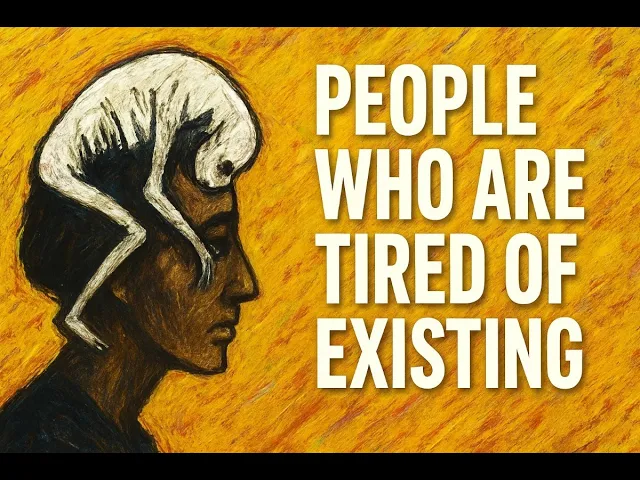
[Music] There's a certain kind of exhaustion that sleep doesn't fix. You wake up after 8 hours and still feel heavy. Not in your body, but somewhere deeper.
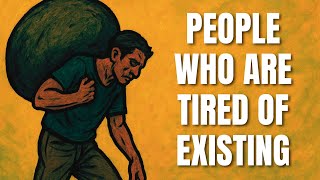
It's like your soul is carrying invisible luggage you can't put down. And when people ask what's wrong, you can't point to anything specific because it's not one big thing that broke you. It's a thousand little things that quietly drained you over time.
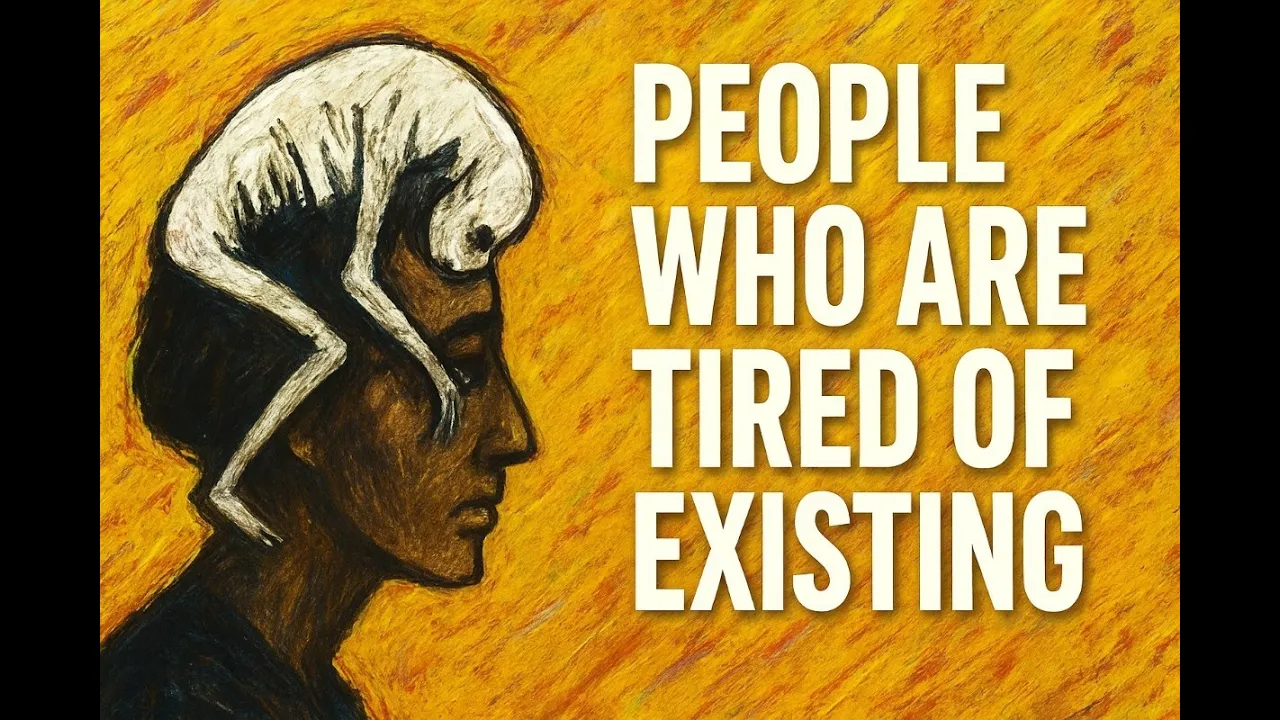
See, people who are tired of existing don't necessarily want to disappear. They just want the noise to stop. The noise of expectations, the noise of comparison, the noise of pretending to be okay when every day feels like a performance you didn't audition for.
Psychologists call this state emotional exhaustion. A point where the mind stops fighting, not out of weakness, but out of depletion. [Music] It happens when your emotional output has exceeded your emotional input for too long.
When you keep giving energy to survive but receive very little back in return, it's not always visible. On the outside, these people might look functional, working, smiling, doing what needs to be done. But inside, everything feels muted.
Joy feels like a distant language they once knew how to speak, but can't remember anymore. What's fascinating is that this isn't just emotional, it's biological. The brain under prolonged stress begins to rewire itself for survival.
It starts filtering experiences through the lens of fatigue. The reward systems slow down. Dopamine responses weaken and motivation, that spark that makes life feel meaningful, fades like a dimming light bulb.
So when someone says, "I'm just tired. " It's not laziness. It's the mind saying, "I've been carrying too much for too long.
" This is where psychology meets humanity. Because behind every tired soul is a story, not of failure, but of effort. People who are tired of existing are often the ones who've tried too hard to keep everything together.
They're the peacemakers, the helpers, the ones who always show up, even when they have nothing left to give. They've learned how to survive in chaos, but never how to rest in peace. Think about it.
We live in a world that rewards productivity, not peace. You're praised for working overtime, but never for taking a quiet day to think. You're celebrated for pushing through, but rarely for slowing down.
So, what happens? People learn to equate worth with movement. And when they finally stop, they feel guilty as if rest is a form of failure.
This guilt is part of what keeps people trapped in quiet exhaustion. The mind starts whispering, "You don't deserve rest until you've earned it. " But that's the paradox.
If you wait until you've earned rest, you'll never get it. Because in modern life, there's always more to do, more to prove, more to fix. And so, you keep running even when you've forgotten why you started.
One of the most painful truths is this. Being tired of existing doesn't mean you're weak. It often means you've been strong for too long.
You've carried emotions you never processed, responsibilities you never asked for, and expectations that no one could possibly meet. And after years of pretending that weight doesn't matter, your spirit begins to whisper, "I can't keep doing this. " There's a psychological term called anhidonia, the inability to feel pleasure.
It's not about sadness. It's about emptiness. Imagine living in grayscale where even good things feel neutral.
That's what happens when the brain goes into self-preservation mode. It stops reaching for joy because it's learned that joy is unreliable. It's safer to expect nothing than to be disappointed again.
People in this state often start pulling away. Not because they want to, but because social energy becomes too expensive. Even small talk feels like lifting a mountain.
They might cancel plans, stay silent in conversations, or spend more time alone. Not because they hate others, but because their nervous system can't handle one more emotional demand. But here's the thing most people misunderstand.
These individuals aren't giving up. They're trying to protect themselves. When the world becomes too loud, isolation feels like a form of safety.
It's like finding shelter in a storm. And even though the silence can feel empty, at least it doesn't hurt. This kind of fatigue is cumulative.
It builds up from years of emotional suppression. Every I'm fine you said when you weren't. Every time you smiled instead of cried.
Every time you stayed quiet to avoid conflict, each of those moments adds up until one day you can't fake energy anymore. That's when you start noticing small signs. Music doesn't hit the same.
Laughter feels forced. Time feels slower. You look around and wonder when life stop feeling like life.
There's another layer to this too, meaning fatigue. When people lose touch with what gives their life purpose, everything starts to feel heavy. It's not that they hate their existence.
It's that they can't find a reason to keep repeating it. Wake up, work, scroll, sleep, repeat. Days blur together, and slowly they start asking questions like, "What's the point?
" But the question itself isn't hopeless. It's a sign of awakening. Because when the soul asks, "What's the point?
" It's really saying, "I need a reason to stay. " This moment, as bleak as it feels, is often where transformation begins. Because tiredness in its deepest form, is a signal, a message from the subconscious saying something in your life is no longer aligned with who you are.
And that realization, while painful, can also be freeing. It means there's something to be reclaimed. Purpose, authenticity, or even simple peace.
One of the most profound discoveries in psychology is that meaning is medicine. Victor Frankle, a psychiatrist who survived the concentration camps during World War II, wrote that humans can endure almost any how if they have a why. People who rediscover their why often find their energy returning, not instantly, but gradually.
The tiredness begins to shift from despair to direction. It's the difference between I'm exhausted because nothing matters and I'm exhausted because I'm growing. So maybe the goal isn't to erase the tiredness.
Maybe it's to listen to it. To treat it as a messenger instead of a curse because somewhere inside that exhaustion is a voice whispering, "You've outgrown something. " Maybe it's a job that drains you.
a lifestyle that no longer fits, a version of yourself that survived but no longer thrives. And if you're feeling that pull, that quiet ache that says there has to be more than this, you're not broken. You're awakening.
There's a strange beauty in that. Because people who've known the weight of emotional exhaustion often become the most compassionate souls you'll ever meet. They understand pain without words.
They sense when others are struggling even behind smiles. They learn to speak softly. love deeply and value honesty above everything because they've learned that pretending doesn't heal.
And maybe that's the paradox of being tired of existing. It humbles you. It strips away illusions and forces you to look at what's real.
You start to realize that life isn't about constant achievement or endless motion. It's about alignment, about finding the quiet spaces where you can breathe without pretending. If you're listening to this and something in you resonates, that invisible fatigue, that quiet ache, remember this.
You are not alone. You are not strange for feeling this way. You're simply human in a world that often forgets how to rest.
You don't need to fix everything at once. You don't need to force joy or fake energy. All you need to do just for now is to stop running from your tiredness and start hearing what it's trying to tell you.
Because sometimes being tired of existing isn't the end. It's the beginning of living differently. You see, the moment you admit that you're tired of existing, something shifts.
For the first time, you're being honest. Not with others, but with yourself. And that honesty, though it feels heavy, is actually the beginning of healing.
Because until you name your fatigue, you'll keep trying to fix it with distractions, new goals, new habits, new screens, anything that feels like movement. But what you're really craving isn't more movement. It's meaning.
And meaning doesn't always come from grand achievements or life-changing breakthroughs. Sometimes it's found in the smallest, quietest moments. Watching the rain hit the window.
Hearing a song that understands you. Sitting in silence without needing to perform for anyone. It's in those moments that your nervous system finally says, "Thank you.
" Because rest is not laziness. It's repair. When you start to rest, not just physically, but emotionally, you begin to notice how much of your life has been driven by survival.
Every decision, every plan, every reaction, it's all been about avoiding pain rather than creating peace. And that's understandable. Your brain is wired that way.
The human mind prioritizes safety above happiness. That's why even when everything looks fine on paper, you can still feel hollow inside. Because safety without meaning eventually feels like a cage.
Here's the truth most people never say out loud. When you're tired of existing, it's not because you want to give up. It's because you want something deeper to live for.
You want a reason that makes waking up feel worth it again. A reason that's bigger than obligation or habit. And the beautiful thing is that reason doesn't have to be huge.
It just has to be real. In psychology, there's a concept called existential fatigue. It's when the soul grows weary from living without a clear purpose.
Not because life is bad, but because it's directionless. You can have comfort, stability, even success. But if it's not aligned with who you truly are, it will drain you.
Humans aren't meant to simply survive routines. We're meant to feel alive in them. That's why people who go through this kind of emptiness often start questioning everything.
Their career, their values, their relationships. Not because they're lost, but because their soul is tired of pretending. It's saying this version of life no longer fits.
And that realization, though painful, is sacred because it's the first step toward authenticity. You begin to ask deeper questions. What would my life look like if I stopped chasing approval?
What would I do if I wasn't afraid of disappointing others? What if peace mattered more than productivity? And suddenly, the exhaustion starts to make sense.
It wasn't weakness. It was resistance. Your mind fighting against a version of life that no longer aligns with your truth.
Here's something most people overlook. Energy doesn't just come from sleep or nutrition. It comes from alignment.
When your actions reflect your values, you feel light. When they don't, even small tasks feel impossible. That's why you can work 12 hours on something you love and feel energized, but 2 hours on something you hate and feel destroyed.
The body follows the soul. So, what can someone do when they feel this tired? The answer isn't to overhaul your life overnight.
It's to begin small acts of honesty. Start noticing what drains you. Start noticing what nourishes you.
Maybe it's certain people. Maybe it's your routine. Maybe it's the version of yourself that's always trying to appear strong.
Once you see those patterns, you can begin to release them. Not in a dramatic way, but gently. Because healing isn't a performance, it's a quiet returning.
Somewhere along the way, you start realizing that the world isn't asking you to be perfect. It's you who's been demanding that. You've built impossible standards out of fear that if you rest, you'll fall behind.
But behind what? Behind who? No one really knows what they're doing.
Everyone is just trying to find small reasons to keep moving forward. And the moment you stop comparing your timeline to others, you begin to see that peace was never behind achievement. It was always behind acceptance.
There's something powerful that happens when a person accepts their exhaustion without shame. It transforms the way they treat themselves. Instead of pushing harder, they start listening deeper.
Instead of asking, "What's wrong with me? " They ask, "What is my mind trying to tell me? " And slowly that question becomes the bridge back to life.
You start rediscovering wonder. Not the loud cinematic kind, but the subtle kind. The quiet beauty of small things.
The way sunlight spills across your room in the morning. The smell of coffee. The way your favorite song makes you feel seen.
These tiny anchors remind you that life doesn't have to be extraordinary to be meaningful. It just has to be felt. And feeling, ironically, is something we unlearn as we grow older.
We're taught to analyze, to optimize, to stay productive. But we're rarely taught to simply feel, to sit with sadness without fixing it, to hold joy without fearing it will vanish. People who are tired of existing are often the ones who've lost touch with that raw emotional connection to life.
They've become numb, not because they don't care, but because caring has hurt too much. The way back isn't through more control. It's through surrender, through allowing yourself to be human again.
To cry without justification, to rest without guilt, to admit that maybe you don't have all the answers right now. And that's okay. Because sometimes the most courageous thing you can do isn't to keep pushing forward.
It's to stop, breathe, and start again from a place of truth. One of the most profound studies in positive psychology found that people who regularly engage in awe moments, small intentional experiences of wonder report higher levels of life satisfaction, and lower rates of burnout. So even when you feel empty, seeking awe can help reawaken something inside you.
It could be watching the night sky, listening to music that moves you, or writing a letter to your younger self. Because awe reconnects you with existence itself. It reminds you that you're still here and that being here still matters.
And maybe that's the quiet miracle of being tired of existing. It strips life down to its essentials. It removes the noise, the performance, the illusion.
It asks you to rebuild not a perfect life, but a true one. A life built on what genuinely nourishes you. So if you're in that place right now where even simple things feel hard, where each day blurs into the next, I want you to remember this.
You are not behind. You are not broken. You're simply being called to reconnect.
Your tiredness is not a flaw. It's a compass. It's pointing you back towards something real.
Maybe towards slowness, maybe toward honesty, maybe toward meaning. And when that reconnection begins, even in the smallest way, the world starts to look a little different. Colors feel warmer.
Music feels closer. You start to laugh again. Not because everything's fixed, but because you've made peace with the imperfections.
And that peace, that quiet acceptance, is where real life begins again. The truth is, there will always be moments where the weight returns. Days where you question your direction.
But now you'll know what it means. You'll recognize it not as the end, but as a signal, a reminder that you are someone who feels deeply, who thinks deeply, who lives deeply. And that's something to be proud of because maybe being tired of existing doesn't mean you failed at life.
Maybe it means you finally paused long enough to realize that life deserves to be lived consciously, not just endured. And that pause, that breath, that gentle awareness might just be the beginning of everything you've been searching for.