limit limiting beliefs. We love them, don't we? I'm not entitled to rest until I've been productive.
Taking a more positive view towards myself would just make me arrogant. If I can't do something without asking for help, I'm incompetent. And if I speak to strangers before they speak to me first, I'm bothering them.
You don't need me to remind you it's your limiting beliefs that are holding you back in life. Mentally, spiritually, physically, socially. So within the next few minutes of your time, let's cover the six ways you can completely obliterate your limiting beliefs so you can not only improve your life but flourish.
Come on then. Okay. Point number one is find them.
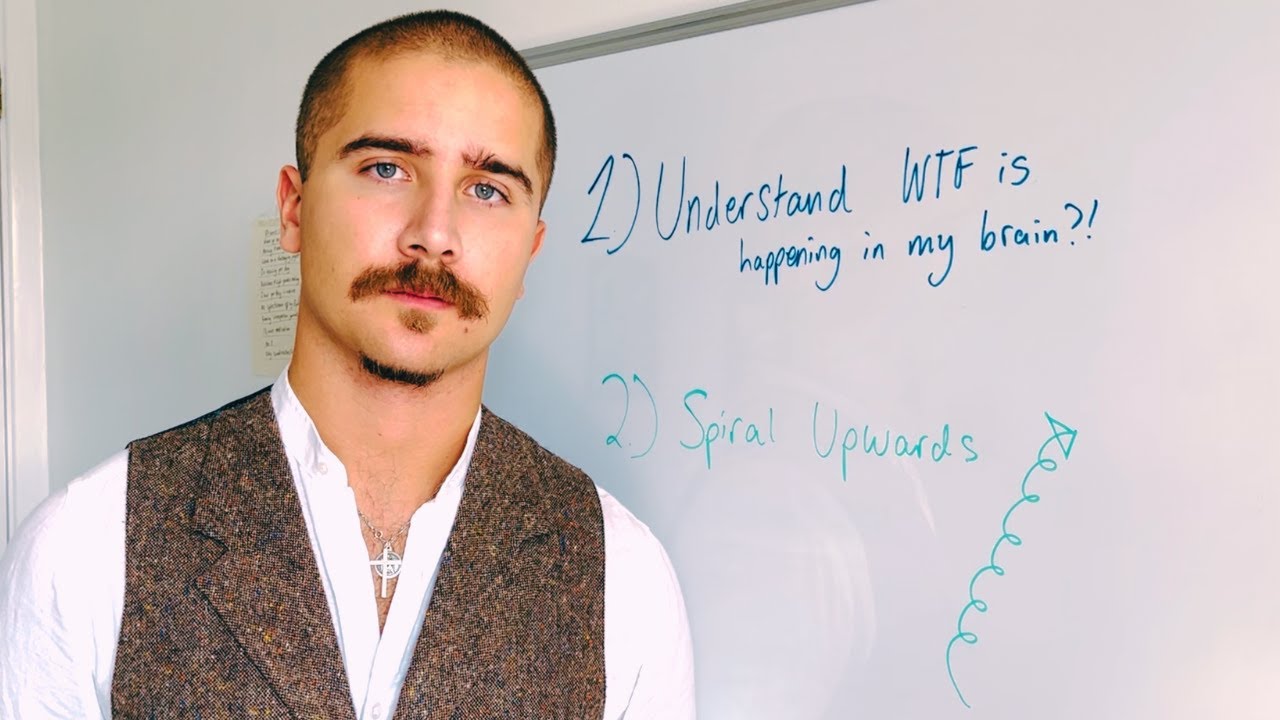
And by the way, these six points are based upon the work of the brilliant philosopher at the University of London, Rebecca Rosh's work. I've been reading her work recently and it's been awesome. Hence, we're stood in front of the whiteboard about to dissect it together right now.
I've got an itchy nose. But first of all, and as you already know, in order to solve any problem in life, you have to first become aware of what that problem is. And it's exactly the same when defeating your limiting beliefs.
In order to defeat them, we have to first become aware of what they are. Now, before we dive deep into the content on the board, which will help us with the practicalities in terms of how to figure out what your limiting beliefs are, let's first of all quick quickly zoom out to tackle two questions you might have thus far. You might be thinking, Louis, okay, first of all, why do we have limiting beliefs in the first place?
And why isn't the brain continuously thinking beautiful, positive, growth oriented thoughts? Number two, why doesn't our brain have a direct relationship with truth and reality all of the time? Why does it create these thoughts and beliefs that are so far out of whack with reality, it's unreal?
Here's my answer based on my experience of life and knowledge thus far. Number one, the reason why we have limiting beliefs is because they're a survival mechanism. Your brain convinces you of these limiting beliefs in order to help you avoid a potentially dangerous future situation.
Your brain is on your side. I know it's the familiar culprit of most of the problems we have in life, but it is on your side in terms of the intentions that it has for you. It wants you to survive.
And these limiting beliefs are a way of helping you do so, no matter how negative they are. Okay? And then number two, the reason it doesn't always have a direct relationship with truth is because the filters that your brain uses to interpret the information from your experiences and knowledge that you absorb throughout life, they're not the best filters.
Yeah. They are quick, energy efficient. They're biased towards selfserving interests.
And your brain doesn't always have the idea in mind of, oh, I'm going to interpret this situation exactly how it is and not add any of my beliefs onto the fire. Okay, faulty filters we could call them. But now we've covered that and hopefully that's illuminated the path we're walking on right now a little bit more.
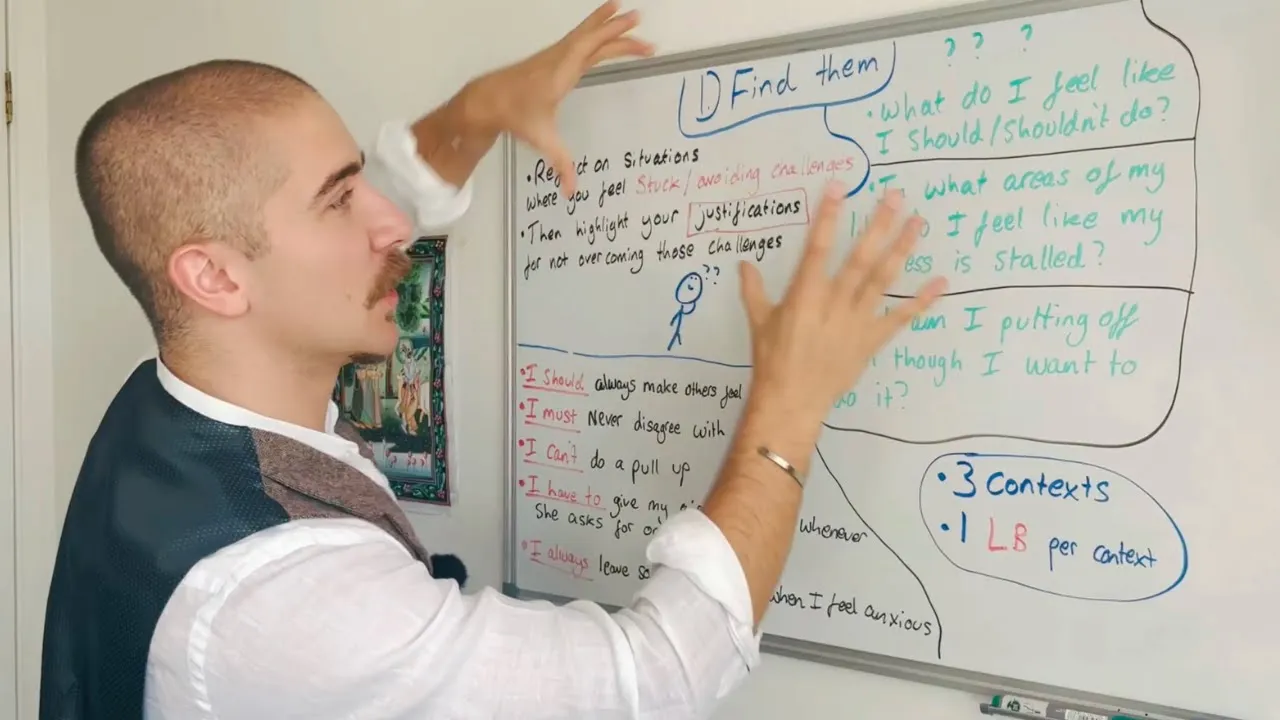
Let's now deep dive into the practicalities in terms of how to uncover what your limiting beliefs are. First of all, you might have an inkling inkling as to what one or two of your limiting beliefs might be right now coming into this video. But if you're unsure, then this is all you need to do in order to find out what your limiting beliefs are.
You simply reflect on situations where you feel stuck or as if you're avoiding challenges. Okay? And then you highlight your justifications for not overcoming those challenges.
Because remember what we're talking about is the limit. What does it mean to limit something? It means you prevent it from doing something.
Okay, that's the last part. I need to stop saying okay. Okay.
Now, moving over to this side of the board, these two parts are linked. So, a practical way in order to find out your justifications for not overcoming these challenges in your life. Here are three questions for you to introspect on.
either right now you can pause them as we are going through them in the video and feel free to make notes on your phone or a journal or just think about them or save these videos to or save these questions to introspect on after this video. They are what do I feel like I should or shouldn't do? Number two, in what areas of my life do I feel like my progress is stalled?
And finally, what am I putting off even though I want to do it? Now, let's quickly zone in on this final question because this highlights a peculiar characteristic of limiting beliefs, the double-sided nature of them. At the heart of a limiting belief is an internal conflict between something you want, but then the belief itself.
Remember really keep the word limit at the forefront of your mind and what it means to limit something to prevent it from doing something. But the internal conflict okay if we take the example of the limiting belief of the one that we covered at the beginning of this video which was being more positive towards myself would just make me more arrogant. What is the conflict there?
Well, the want of this person is they want to have a more positive relationship with themselves, but the limit is of course the belief that if they do so, they're going to become more arrogant. You see how there's the the want, the desire, and then the belief is the limit. No, no, no, no, no.
Don't do that thing. Otherwise, you're going to become more arrogant. Another quick example of that is the other limiting belief of if I speak to strangers first before they speak to me, then I'm going to come across as a nuisance and as if I'm bothering them.
Okay, what is the want of this person? Well, it's a social thing, right? They want to be more open and out there to people, make more intera or start more interactions.
That's the desire. Oh, I really want this thing. Limiting belief.
No, no, no. Don't do that. Because if you do that, you're going to become AC, you're going to come across as a nuisance to other people.
It's your brain helping you prevent or avoid a potentially dangerous future situation. So that is the internal conflict with the limiting belief. Now, let's move over to this side of the board.
We just got two more things to cover before we move on. If you want some more characteristics of limiting beliefs, then here are 1, two, three, four, five, five sentence starters that highlight how they might manifest in your brain when you're thinking about them. Number one is I should, for example, I should always make others feel happy.
That's obviously going to limit you socially because it's an impossible ask. Number two, I must I must never disagree with this person. I can't I can't do a pull-up.
It might be a fixed mindset. I That was one of my limiting beliefs three years ago. I couldn't do a pull-up.
A year later, I could do 20. Jesus. Bloody hell.
Little flex. Sorry. Had to.
I have to. I have to give my girlfriend a lift whenever she asks for one. And lastly, I always I always leave social situations when I feel anxious.
your limiting belief might register as a general rule for your behavior which is obviously not serving you and is limiting you. Now, this is all some juicy food for thought, but if you want one final practicality in terms of unearthing your limiting beliefs, then this is what I'm going to suggest as we go through the final five points in terms of how to dismantle your limiting beliefs. You can either keep one in mind if there's one that's really troubling you at the moment.
But if you want to go a little bit further in terms of your introspection, then this is my tip. Pause. Think of three contexts in your life that are currently important to you.
For example, it could be your romantic relationships. It could be your performance at work. It could be your performance in the gym or whatever sport or activity you're doing.
whatever contexts are important to you right now. And then just think about one limit in belief for each one of those three contexts. Why one instead of 10?
Well, if you think of 10 for each three of those contexts, you're going to come up with 30. And that's going to overwhelm you and start to convince you, "Oh my god, my mind's a mess. And how am I going to be able to tackle all of these in one go?
" We're going to start small. And if you want to go further in terms of defeating your limiting beliefs, then we can. But for now, three maximum, one minimum as we go through the rest of this video.
Okay, let's move on to point number two. out. And by the way, I'm going to leave the segments in in this video when I'm rubbing off the whiteboard, as some of you already know we do already, just to give yourself a opportunity to absorb and take a moment Point number two is accept that you view the world through a filter.
This is a very quick point and TLDDR. All I need you to do is genuinely accept that we see things through a filter. Nothing more.
But to explain this a tad further and to use the work of Emanuel Kant, the big boy philosopher. We've got the big boys in here today. He distinguished between two things in our perception of things as humans.
One is numina. So the reality of things in themselves, you know, the reality of this whiteboard irrespective of how we perceive it as human beings. But then there's also phenomena which is things as they appear to the observer.
Little philosophical hottake. This then created the branch of philosophy known as phenomenology. But back to this point, the main idea here to illustrate how our filtering system works as humans is you watching this video right now and seeing all of these bright lights and me here, fancy flashy images and whatnot.
What you're seeing is more so a consequence of your relationship to what you're seeing rather than the reality of those things within themselves. the screen you're watching this through, the whiteboard that you can see here, my clothes, my face, everything that we, this is the bottom line, everything we perceive as humans is through a filter of our relationship to this thing. And our brain is always filtering things and information in our awareness based on their utility.
If we didn't have that capacity, then everything in our environment would become important and our brain would just be too overwhelmed. There are thousands, literally thousands of things happening all around you right now, but you're focused on this center point in your screen. Why?
Because it is efficient for your brain to do so. So you can lock in and pay and pay attention to one thing and one thing only. Your brain is filtering.
So when it comes to the context of beliefs, your beliefs are the filter by which your brain relates to things and perceives them. That's all I need you to accept in this point. Accept that you perceive the world and information through a filter.
And the reason why I would like you to accept that is because when you accept it, it then becomes easier to change your filter, which we're going to get into. Point number three. Point number three is slow down and articulate it.
linked to point number one, but I just wanted to re-emphasize the importance of capturing your limiting beliefs and writing them down, either on paper or typing it on your phone. The reason why is because you don't understand something until you write it down. Most of the time, our limiting beliefs arise in our mind as confusion.
They come to us halfformed. So, we're going about our daily life and we're feeling heavy. Our shoulders are tense and we're thinking this limiting belief and we start to feel depressed and anxious and then we're wondering why.
Well, it's because we haven't taken it out of our mind and put put it on paper and read it and realized how ridiculous it is. Just to give you two examples of this to demonstrate how to highlight the potential ridiculousness of a limiting belief. We're going to take these two quick examples and structure them with what this person wants.
The limiting belief in conflict with this want and then questioning the why behind the limiting belief, the LB. For example, let's imagine this person, let's call her Stephanie, wants to rest and read a novel for 20 minutes a day. But her limiting belief conflicting with this desire is resting for 20 minutes is selfish.
Okay, Stephanie, let's go one step further. Now you've written that limiting belief down and simply question why. Well, the reasoning registers as I should be able to work non-stop without resting.
Can you see how when it's written on the board, it's almost laughable? Not in a judgmental way because I, you know, Stephanie's a fictional character, but I have limiting beliefs exactly like these two. just writing them on the board or writing them on your piece of paper.
99% of the time you're going to laugh at the limiting belief when you see it in front of you because you can see how unreasonable that is. What in what world would a human being not be able to rest while working 12, 10, 15 hours a day? Second example, let's take Derek, 25 year old male.
His want is to decline an invitation from a friend to go to a barbecue. The limiting belief in conflict with this desire, however, is if I say no to others, they won't like me. Okay, Derek, why?
Well, because it's rude to say no. Is it? Think back on other people in your life, Derek, who have said no to you.
When they say no to you, do you dislike them? It would be my guess that you probably like them and respect them even more. So this is how you highlight the ridiculousness of a limiting belief.
You highlight the limiting belief that is in conflict with a want. When you've highlighted it, you question why. And if you cannot come up with a reasonable explanation as to why you have this limiting belief, drop it.
That's it. That is it. Upon that point with some limiting beliefs, you might simply just fact check it with reality to see the ridiculousness of it.
If you imagine, let's say John, 29year-old male, his character is coming out of nowhere. Let's say that his desire is to get everything ticked off of his to-do list for the day. And the limiting belief underlying that is I should be able to wake up and do everything that I want to within a day.
Okay? So, he's got that limiting belief written down on his piece of paper. But then he fact checks that with reality and realizes he's only got about 8 hours within a day beyond work and all of his other obligations to do things on his to-do list.
And if there's 16 20 things on there, he hasn't got the time within the day to actually fulfill that belief. So that's another way of highlighting the ridiculous the ridiculousness of the limiting belief. You can question why or just fact check it with reality.
Point number four. Point number four, three more is try a different filter. I just wanted to check it in the video quickly and emphasize the point again of tending carefully to your vulnerabilities.
We need some emotional first aid compassion here. I know a lot of the times in videos when I mention something like that, I go to cringe a little bit, but it is important because uncovering your limiting beliefs is difficult because doing so, like we said, is going to unear hot psychological material, maybe bad memories and troubling thoughts and emotions coupled with these beliefs. So, and these beliefs have probably come from your childhood.
So they've been buried for a long time and now you're unearthing them to change them of course and do something very productive. But that doesn't mean it's not difficult to change them. So tend carefully with compassion.
Just quickly here before I give you a practical tip of how to change your filter. The reason why it's hard to change your filter again the way you perceive information for a another one is because the brain prefers familiarity. No matter if that familiarity is negative.
Adopting a new filter descends the brain into chaos until the brain gets used to that new psych gets used to that new psychological territory. Which is why unfortunately the brain will maintain a old negative filter to confirm negative limiting beliefs rather than embracing the unknown and just changing the filter completely. For example, let's say Derek.
No, not Derek. who used him. Let's say David, 27y old male.
Don't know where these characters are coming from. Let's say his old limiting belief that isn't serving him is people don't appreciate my efforts. So, he's at work one day and he's trying to adopt the new filter of no matter or yeah, when I do something good, people do appreciate my efforts.
But his boss comes in, gives him a bit of feedback on a project he's just completed and says, "Oh, David, really well done. I'm really proud of you. " He gets that new information, but instead of adopting the unknown new filter of what belief he wants to adopt, his brain passes off the comment of his boss by reconfirming his old belief by saying, "She's just saying that she doesn't actually appreciate what I care or what I've done.
" That is one way that to demonstrate how the brain can prioritize staying in the familiar negative rather than embracing the unknown. It's hard to embrace the unknown. But here is something practical to help you with it.
Thank you, Derek. No, not Derek. Got his name wrong again.
Thank you, David. Look, to be honest, completely rejecting your limiting beliefs might be too much of a difficult task for you to do right now, especially if this topic is new for you. So, instead of completely rejecting them, just contemplate the opposite whenever your limiting beliefs arise.
It's very simple to do. And the reason why this works is because by contemplating the opposite belief and questioning, well, what actions would I take if I adopted this belief? How might I think differently, behave differently, and treat others differently?
You are rehearsing a new psychological blueprint. Let's take let's make it a woman this time. Let's take Jennifer.
I love that name. Let's take Jennifer, a 33year-old young lady. Her limiting belief is strangers don't like me.
Okay. Well, don't worry about rejecting that belief then, Jennifer. Belief has arisen.
Let's contemplate the opposite. Well, what would your life look like if strangers did like you and that was your fundamental belief? Well, you'd make more conversations with them.
You'd smile more if you believed that strange strangers like you. And then you'd make more friends. Contemplate the opposite of the limiting belief and rehearse that new psychological blueprint in the context or in the example of what was his name?
David. Yeah. Struggling with the boss giving positive feedback.
Let's say that limiting belief arose of ah no one cares about my work. Okay, David, let's contemplate the opposite. What if it were true that other people did appreciate your work?
How would you act towards your boss? Well, you'd be a lot more welcoming to her feedback, meaning she'd probably enjoy the conversation more, resulting in her wanting to give you more positive feedback because it also made her feel good, meaning that you get more positive feedback. How far can you go with that?
Contemplate the opposite. And what this means as well, just last comment on this, is instead of completely rejecting your limiting beliefs, you understand that before you contemplate the opposite, the limiting belief has to arise. So, it's not a case of you're going to completely get rid of them.
They're still going to arise, but the fact that they arise sparks the cue for you to contemplate the opposite. Then you're no longer fighting the limiting beliefs existence. Point number five.
Thank you, Jennifer. Point number five, reject the double standards. This is a quick one this point and it's similar to the idea of you know when people say ah if you wouldn't speak as negatively to others as you do towards yourself in your head then don't speak to yourself that way.
It's a great idea but it's kind of missing something. It's not as practical as I'd like it to be. So this idea involves the understanding of the beliefs you have towards yourself.
You'd never aim them at others. Just think about it. Let's take these three beliefs.
Let's say, yeah, LB is people only want to be spoken to if they smile at me first. Let's imagine you're at a networking event and there's someone there who, you know, has that limiting belief and they're looking at you and they really want to start a conversation with you, but they're waiting until you smile at them first. You'd be like, "Mate, come over.
I'm here to talk to people. Come over here. " Another way to highlight the ridiculousness of a limiting belief.
Number two, if I ask my classmate for help, they'll think I'm a nuisance. Again, imagine you're in the class and someone asks you for help. Do you think they're a nuisance?
No. In fact, you'd probably be delighted to help them because it strokes your ego, doesn't it? So, again, don't inflict that belief on yourself.
And finally, I can't rest until I've been productive. Perfect example, my mom. She's probably the most productive person in the world.
Works seven days a week. She definitely has this limiting belief and I do as well. But when I observe her act in this limiting belief, saying, "Oh no, I haven't been productive today.
I feel guilty watching the TV. " I'm always telling her, "Look, you've been running around like a headless chicken all day. Have a relax.
" But yet, I can't tell myself the same thing. I definitely can. This video is basically therapy for me.
Okay, point number six. Final point. Yeah, I like that point.
That was good. It's just a bit more practical than the, "Oh, don't speak to yourself. You wouldn't speak to others how you speak to yourself in your head, so don't do it.
" No, just hopefully that was a bit more practical. It definitely helps socially as well because if you ever have the limiting belief, which a lot of us do have, of ah, if I speak to strangers or start small talk, then I'm going to be coming across as bothering or a nuisance to the other person. Just think back to last time someone sparked up a conversation with you and how you felt.
You didn't really care about them. You didn't want to reject them. You probably had a good time, right?
Finally, point number six, accept you're not a rational robot. Throughout this video, we've taken a very logical approach to defeating your limiting beliefs by highlighting them on a piece of paper or whiteboard and using that as evidence to highlight the potential ridiculousness ridiculousness of them so we can discard them. But that leaves one part of the puzzle slightly left out, the heart.
Your mind can understand something on a very logical level, snap its fingers, and then sink into that understanding. But your heart, which is tied to your emotions, is going to take a while to catch up to that understanding. And the reason why the heart is involved, I'm using that philosophically, by the way.
I'm basically talking about emotions. The reason why your emotions and your heart is involved is because limiting beliefs themselves aren't related to facts. Of course, they are related to feelings.
Which means that it's going to take time for you to defeat them, replace them, and overcome them. especially the ones that have been more ingrained over time and have kept you company for a very long period. With some, you might be able to just philosophically understand that they're ridiculous and then discard them, but with others, it's going to take a while.
So, be patient with yourself while your heart catches up. If it makes you understand this a little bit better, then Aristotle said that it could take years to practice a new virtue such as courage or patience. So you're in it for the long run.
Keep going. Final point on that is adopting a new filter or a new belief might come or might include having to learn a new skill socially, logistically. So that's another reason why it can take a long time.
For example, the adopting the new belief of strangers like me will require you to settle into conversation and embrace it a little bit more which means you're going to have to develop your conversational small talk and interpersonal skills which take a while to do. So that's going to accompany your limited or your new belief. So, you're going to get a new skill out of it and a brand new filter to interpret reality, which will take time to settle into your mind and your brain.
But how long specifically will this all take? Well, here's a way of thinking about it as proposed by Rebecca. Let's imagine you have a friend who's trying to make changes in his life and drop his old limiting beliefs and adopt new ones, but he's in a toxic relationship where his partner is always having a go at him, saying horrible things like, "You're useless.
You're worthless. You're not good for anything. How long is it going to take him to change?
" Very long time. But they say he ditched that old partner and got into a new relationship with Jessica, who is much more loving, caring, and supportive. How long do you reckon it will take him to make that change?
A lot quicker. So imagine how quickly you could make the change if you ditched your toxic relationship with yourself and adopted a much more healthier one. In summary, thank you Jessica.
Number one, find your limiting beliefs. Number two, accept you see the world through a filter. Three, slow down and articulate it.
Four, try a different filter. Five, reject double standards. Number six, accept you're not a rational robot.
Thank you very much to Rebecca Rosh for her continued work on this topic. I'll leave links to her work down below if you want to check her out. And thank you to you for your time and attention.
If you enjoyed this video, leave a comment down below of a triage of emojis of a magic wand, a fountain, and then the third emoji is your favorite emoji. See you in the next one. Stay disciplined, playful and dangerous.