so before the break we saw that the right to self-defense uh is limited not only by explicit restrictions that are found in article 51 but also by uh certain implicit or unenumerated restrictions that have been developed in state practice and also in the case law of the international court of justice um but one has to recall that over and Beyond self-defense force can also be used uh in in derogation or deviation from article 24 in two other sets of circumstances one being uh Collective self-defense and the other being uh collective security so Collective self-defense uh
is is is is an institution that essentially carried on from the League of Nations uh period which means that when a state is being attacked in ways which are internationally unlawful namely um in violation of two4 uh any state in the world could basically uh join the attacked State never the attacking State they can join the attack State the defending state in order to help it exercise its right to self-defense and the uh the understanding here which so this is explicitly mentioned in article 51 which talks about the right of individual or Collective self-defense and
the uh the underlying premise here is that if attacking States would know that once they attack a state uh they would then open themselves to counter force not only by the state that they have attacked but also by any other state in the world that would wish to join it that would create a significant deterrence against the use of force uh in violation of article 24 and it would also prevent um a domino kind effect when an aggressive state is not targeting um five or six State at once but it is really directing its aggressive
intents every time against another state a little bit like we saw before uh in in the events leading up to World War II and shortly thereafter uh first the anelos and uh aggression uh or threats of aggression against Czechoslovakia and then uh the attack on Poland etc etc so the self the collective self-defense institution allows all potential VI victims to to bind themselves together and to um confront the aggressor State when they actually are attacking the first state in the series of um of attacks um in terms of how does this actually uh play about
uh uh the right to self-defense does uh require according to the international court of justice uh opinion in Nicaragua which I've mentioned a few times because it's a very Central decision in in regarding the use of force and in Nicaragua the United States of course was not attacked by Nicaragua directly it was coming to the assistance of Nicaragua's neighbors who were allegedly attacked by by Nicaragua uh but the court says in order to invoke Collective self-defense uh you actually have to to uh jump through different Hoops you have to actually show that certain conditions have
been made so it's not enough uh that you are claiming that you have been uh that another state has been attacked actually you have to show that objectively such an attack has been uh perpetrated that the state that you are coming to assist actually considers itself to have been the the victim of an armed Attack under the charter and that that state has requested such an assistance so there would be three conditions that need to be met an objective armed attack a subjective statement of an armed attack and a request for help in order for
a state to come to assist another state and uh under the case at hand uh all three actually conditions were not met hence the United States had no uh ability to invoke uh the right to self-defense this is different from other situations where in state practice it is generally considered that Collective self-defense was validly exercise Kuwait in 1991 is a prime example where Kuwait was invaded by Iraq uh already in in August 1990 uh there was no question that the use of force by Iraq was a serious violation of the UN Charter and was an
act of aggression and an armed attack uh the government of Kuwait called upon all states of the world so you don't really have to invite a specific State the call for assistance could be a general call they uh basically considered themselves to be under attack and they called on all states to uh support them and the Coalition that the United State has assembled we will see momentarily they were also operating with with the support of the security Council but even if they were not supported by the security Council you could still say that they had
a right under article 51 to come to the assistance of Kuwait another uh famous instance is um is Afghanistan in 2001 where after the United States has been attacked uh in 911 uh the United States uh considered itself to be under attack and considered itself to be entitled to uh use self-defense in order to respond to that attack in Afghanistan and the NATO member states that are aligned with the United States have actually exercise their right to se to Collective self-defense and have have contributed forces to the US operation uh against uh the territory of
Afghanistan so this is another illustration of the use of force in Collective self-defense um and this is the statement uh by the NATO uh Council Minister ministerial meeting uh of the North Atlantic Council which actually proclaims that self that armed attack occurred and that NATO would exercise Collective self-defense uh with uh in solidarity with the United States pursuant to Article Five of the NATO agreement the NATO treaty where NATO member states are actually required legally to exercise the right to self-defense when a NATO member state is is subject to an attack so what you actually
have here the combination of article 51 which generates a right to self-defense and Article Five of the NATO treaty which creates an obligation to actually invoke the right to self-defense to Collective self-defense does create a rather strong and robust security mechanism which would threat which would serve as a sort of deterrent against a state which is is considering attacking a NATO member State and this is of course uh the NATO alliance is is is is a very um prominent example of security Arrangements but it is not the only example that we have of a security
Arrangement the one area with regard to Collective self-defense where we do have um historically a controversy uh has to do with the specific interface between the right to Collective self-defense and the right to self-determination so self-determination is a right under General international law which uh which uh recognizes the rights of peoples to uh basically determine their political future uh and that would include uh fighting for Independence uh from um an existing state that occupies their territory or that uh ex that imposes a colonial system of governance upon them uh perhaps also applicable in in apartheid
like con circumstances uh there is um some current of thought uh within international law certainly historically de supported by developing States is that the uh that National Liberation movements which would be military groups that um that exercise force on the part of uh self-determination units people who are fighting for self s determination there is a current of thought that stipulates that such Wars of National Liberation are lawful under international law uh and that third States could actually come to the assistance of National Liberation movements by exercising Collective self-defense like Powers uh in connection with their
struggle I should say that this approach has been heavily resisted by the global North and that we have actually very limited indications of uh of such practice that has gained broad acceptance so it is fair to say that this is a theory uh there have been during the Cold War some involvement in National Liberation struggles by the different sides to the Cold War but it's very hard to uh identify uh broad agreement around the legality of such interventions so it is probably fair to say that Collective self-defense does not apply uh under existing international law
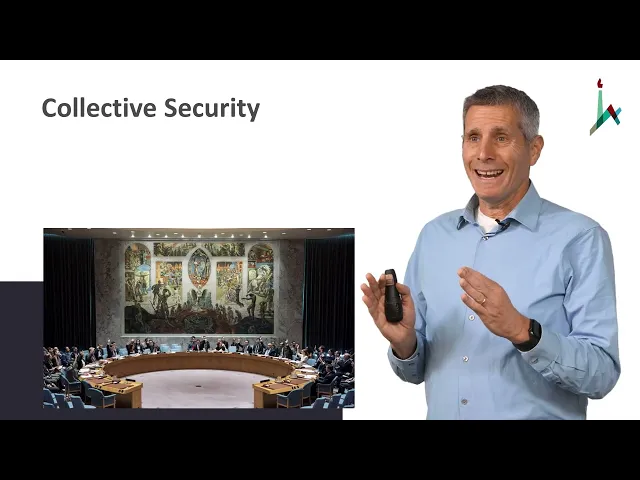
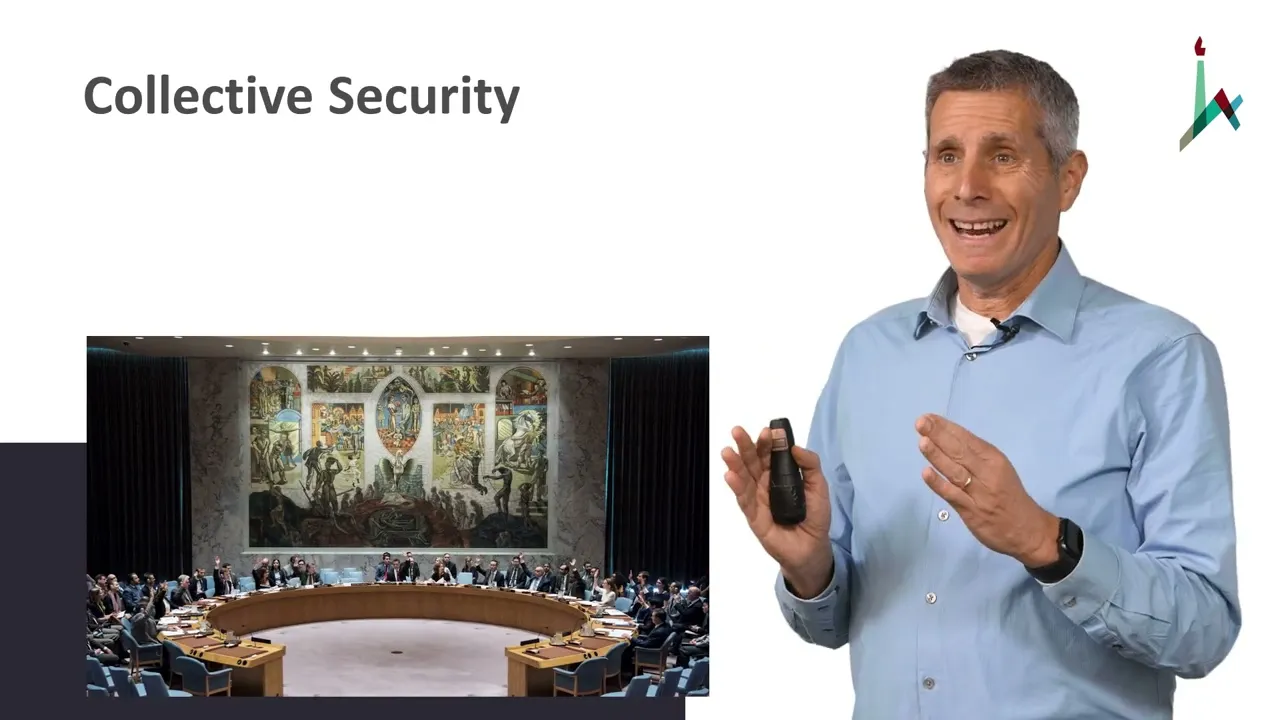
to to such forms of military intervention the third and final exception to the prohibition against the use of force under the UN Charter is what we call collective security so collective security unlike Collective self-defense which is a which is a mechanism that states unilaterally invoke in support of other states that are self-defending themselves uh collective security is a collective mechanism as as as as as as its term indicate which has an Institutional component namely collective security is a is a mechanism that is applied by the UN Security Council pursuant to chapter seven of the United
Nations Charter now chapter seven of the charter is the chapter that governs the extraordinary powers of the security Council so normally the security Council when it operates under chapter six of the UN Charter this is the ordinary operation of of the security Council the security Council can issue recommendations which are non-binding it can also uh generate uh decisions that would be legally binding if they're formulated in in ways which are legally binding um but uh what they cannot do under chapter 6 they cannot enforce their decisions what is unique about chapter 7 that under chapter
7 not only that the the council can issue recommendations or issue binding decisions they can also uh exercise powers of enforcement in order to enforce their decisions uh namely they can apply non-military sanctions under article 41 of the charter and they can also apply uh military sanctions under article 42 of the charter now in order to invoke article uh to invoke chapter 7 to invoke these emergency like Powers uh it it first requires that the security uh the chapter first requires in article 39 that the council would identify the situation at hand as suitable for
the application of emergency powers and article 39 reads that the security Council has to in order to invoke its extraordinary powers determine the existence of any threat to the PE breach of the peace or act of aggression and shall make recommendations or decide what measures to take uh to take forward uh article 41 allows the council in terms of uh of enforcing its will to apply non-military uh sanctions which could include economic sanctions diplomatic sanctions uh travel sanctions uh they could also Al imply in practice the establishment of uh accountability mechanisms such as International uh
criminal tribunals when it comes to article 42 the the council could actually take it to the to the next level namely uh require or impose military sanctions on the state that represents a threat to International Peace and security violated breached International peace and security or engaged in an act of aggression in terms of practice the security Council has used its powers under art under chapter 7 and under article 42 which involves the military option on a number of occasions uh 1990 and the Iraq Kuwait crisis has been one principal example of uh how the security
Council can operate and how it does operate effectively in order to uphold International Peace and security and to enforce the prohibition against the use of force so in that specific example which I've already alluded to Iraq invades Kuwait in ways which are completely unacceptable and unjustified under international law the security Council uh denounces The Invasion orders Iraq to withdraw from Kuwait Iraq does not comply hence the security Council takes it to to the to the next level imposes economic sanctions and diplomatic sanctions on Iraq and also uh threatens Iraq with military sanctions unless Iraq withdraw
from Kuwait by a given date 15 of January 1991 and once Iraq fails to respect this ultimatum the security Council does authorize the use of military force against Iraq leading to the route of Iraq and to the liberation of Kuwait by the powers of the Coalition the us-led Coalition that supported its military effort now I should emphasize that this uh gradual approach is not necessarily dictated by the terms of article 41 and 42 of the charter namely the council could go directly in in appropriate circumstances to uh the use of military force if for instance
no time allows first resorting to non-military Force now other instances in which um uh this uh was uh applied uh with regard to Iraq the security Council has also um authorized sanctions in 2003 required Iraq to cooperate with the um with the uh International inspectors that were there to enforce the terms of the ceasefire in 1991 to ensure that Iraq does not um equip itself with weapons of mass destruction but critically they did not authorize uh explicitly the use of force the formulation that the council normally uses in these decisions is to authorize the C
the the states in question or the organizations that are using Force to use all necessary means this is the UN lingo for the use of force in the 2003 uh uh resolution regarding Iraq there was only an ambiguous threat that if Iraq does not cooperate it will face serious consequences the United States try to argue that this is an authorization of the use of force but most uh States uh and most experts reject this explanation and consider the invasion of Iraq by the United States as illegal other examples for the use of force pursuant to
chapter 7 involve uh the uh sanctions imposed on Libya in connection with the locker B bombing and the refusal of Libya to extradite the two um secret Ser Service agents that were behind uh that attack uh subsequently there has been uh also authorization of the use of force in 2011 against the Qaddafi regime in connection with the Civil War that erupted in in Libya and the uh Threat by uh by Gaddafi to uh use excessive force and essenti to perpetrate um atrocities against the civilian population in the rebel controlled areas of um of Eastern Libya
and here the security Council has introduced a no fly zone and also authorized the use of military force in order to protect the population of Libya there have been some um debates and disagreements surrounding the scope of force that was actually applied so it was uh it was criticized by some countries for instance Russia and China that the force that was used by the Coalition the NATO and other states cooperating with the operation against Libya went beyond the four corners of the resolution resolution 1 19 73 uh and there has been also uh use of
uh article of chapter 7 powers in other contexts the main difficulty with chapter 7 and we will return to this uh when we conclude this unit is that in order for the security Council to effectively exercise its chapter 7 Powers two conditions need to be met uh which are um in international life uh often unattainable one there has to be a good level of consensus on the security Council pertaining the need to invoke chapter 7 and with regard to specific measures under chapter 7 uh the security Council has 15 states five of which are permanent
members according to the Charter decisions important decisions in the security Council including of course the invocation of chapter 7 Powers have to be accepted by a super majority of nine out of the 15 members of the council where none of the permanent members are opposing the resolution I.E invoking their powers of veto and in many conflicts from 1945 onwards certainly throughout the Cold War but also after the Cold War the end of the Cold War there has been use or threat of use of the veto power in order to prevent the security Council from intervening
in a number of uh International crisis which affect the interest of the permanent members of the security Council so there are great political difficulties in actually operationalizing the powers of the security Council and then there is another uh serious impediment and that is that the the council does not have a standing army which allows it to actually uh impose uh military sanctions on States as well at will uh I should say that under the charter the article 43 of the charter uh the drafters did um conceive of a system by which different states would conclude
agreements with the security Council according to the terms of these agreements they would identify military units of their regular militaries that would be uh in a way uh loaned lent to the security Council and brought under its command and control uh when the security Council exercises article 42 power so there will be uh a shadow Army which the uh which the security Council could actually Direct in times of need but none of these agreements were ever concluded Ed so so this Army has never materialized so when the security Council wishes to invoke its article 42
Powers it really has to identify States who are uh willing and able to uh to to take the fight on themselves and this is often a very um requires a lot of heavy lifting because if the conflict so this is the reverse picture of what we were talking about before if the conflict does not pertain to the to the to the critical National Security interest of a state uh its propensity to actually uh contribute troops to fight that conflict would be very limited so both in terms of political will but also in terms of material
military capacity the Charter system uh is working in a very suboptimal way the result of these shortcomings lack of political will and lack of military capacity is that in many very dramatic conflicts around the world involving often very serious humanitarian implications the Security Council is unable to act we've seen this in Kosovo we've seen this in Iraq we've seen this in Syria and the result is that states sometimes resort to powerful State Resort to unilateral use Force outside the four corners of the charter so we have seen humanitarian intervention by the United States in Kosovo
in 1999 probably unlawful but uh one could argue uh fulfilling the obligations that the security Council failed to fulfill uh 2003 the invasion of Iraq again unlawful but one could argue I mean the Americans have argued that they are stepping inside the shoes of the security Council Syria again uh the use of chemical weapons by Assad against his own people Security Council is inactive because of the Russian veto Chinese also speaking about veto so uh the Americans the French the British are using Force unilaterally so so the regime that we are talking about is unstable
uh with regard to these Force partly because of the suboptimal um operations of the uh Security Council very briefly on the Israeli front what is quite dramatic is that the security Council has is hardly ever passed a chapter 7 resolution in connection with the Israeli situation they have done so uh in the uh 1948 1949 War uh of what Israel CS its war of independence uh subsequently the involvement of the security Council has been mostly under our under chapter six which does not have an enforcement track and the most notable decision that they have issued
on the Israeli Israeli Arab conflict is resolution 242 which espoused the uh land for peace uh formula another situation in which the security Council became involved in connection with Israel has to do with the Israel Lebanon 2006 conflict where the security Council had adopted a robust chapter 6 resolution uh which also suggested that there is an International Peace and security Dimension here and also an OS actually um a decision introduce a decision to demilitarize Southern Lebanon so some recall this resolution although it doesn't explicitly invoke chapter 7 as chapter 6 and a half the upshot
of this is that we have uh after 1945 we have a broad prohibition on the use of force we have clear more or less clear exceptions selfdefense Collective self-defense collective security in practice we are still confronted by a reality in which in these areas violence is still rampant and the rule of international law is still partial and this has a lot to do with the relative weakness politically and Military of the security Council and regrettably it appears that without a comprehensive and effective security Council reform the use of force would continue to be the lynchpin
of the international uh uh legal order but uh relatively flowed and weak Lynch pin thank you very much for your attention