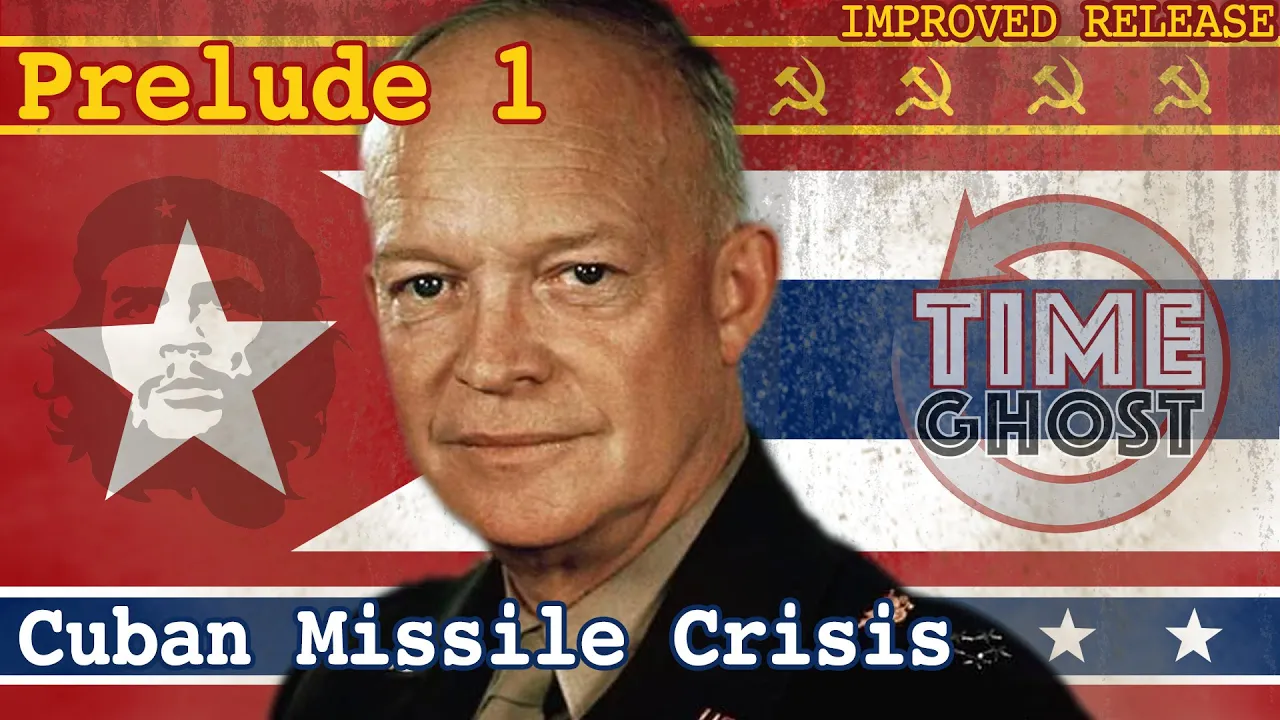
In October 1962, the Cuban Missile Crisis brings the world one launch code away form full on nuclear war between the Soviet Union and the United States. This documentary series will cover that crisis one day at a time, but first we’re releasing two preludes to the crisis to set the stage. Here comes Part I.
This is TimeGhost, The Cuban Missile Crisis; I’m Indy Neidell. Never before and never since has that possibility of our world being suddenly destroyed been so close. In the 55 years since it happened, the Cuban Missile Crisis and its aftermath have been analyzed in books, dissertations, fictional films, and documentaries, but as more of the actual source documents have been made public over the past 25 years, the story looks significantly different from both sides’ original official versions.
To understand the Crisis, we first have to look at where the two superpowers stand in 1962. The capitalist and communist systems have been in opposition from the day the Bolsheviks seized power in Russia after the 1917 Revolutions. The Soviets see the Capitalist system as a scourge of humanity that needed to be eliminated.
On the American side, the communist system is seen as a direct threat to the American way of life. The persecution of communists in the states during the cold war and McCarthyism are well known, but this started already in the 1920s with the Red Scare, when thousands of American communists were prosecuted and incarcerated- and even exiled- for their political beliefs. The hatchet was briefly buried when the two became allies against Germany in the Second World War, but it was dug up as that war ended, and in 1962 it is unclear which ideology will prevail.
The western world, led by the United States, is establishing a system of more or less free trade and alliances based on independence, inclusion, and personal freedoms. The goal is peace and prosperity. The communist world, led by the Soviet Union, though initially in cooperation with China, is developing a system of planned economy and regulated trade that depends on expanding the communist system to client states under Soviet or Chinese control.
The goal is peace and prosperity. As WWII ended, many of the Eastern and Central European countries that had been invaded by Germany and then liberated by Russia’s Red Army fell under Soviet control. The Soviets also kept control of East Germany when Germany was split into east and west, but this was only the beginning of Soviet expansion.
Under Communist doctrine, the Soviet Union theoretically strives for a world without borders, controlled by the dictatorship of the proletariat. To achieve this, it seeds and supports communist revolutions wherever possible. This is a direct threat to the democratic principles of much of the western world, so the US began a policy of global containment, supporting and financing anti-communist movements in Europe, in former European African and Asian colonies, and in Latin America.
This is an expansion of the Monroe Doctrine from the 1800s, named after President James Monroe, which says that any European Colonialism in the Americas will be actively opposed by the United States. “. .
. The American continents, by the free and independent condition which they have assumed and maintain, are henceforth not to be considered as subjects for future colonization by any European powers. .
. we could not view any interposition for the purpose of oppressing them, or controlling in any other manner their destiny, by any European power in any other light than as the manifestation of an unfriendly disposition toward the United States. ” The US has started to apply the spirit of the MD to the entire world, though its direct application within the Americas will prove critical to events leading up the Cuban Missile Crisis and the crisis itself.
This web of principles and theories brings the two superpowers into direct conflict all over the world and provides the basis on which the Cold War would be fought. It leads to a long series of proxy wars, covert operations of influence, and the fanning of regional conflicts to further the interests of each side. In early 1948, the first major confrontations arise when the democracy in Czechoslovakia is overthrown in a Soviet-backed communist coup, and the western Allies introduce the new Deutschmark as the currency in Berlin.
Berlin at the time is divided into four zones of military control between France, Great Britain, the US, and the Soviets, but the city is still governed as one unit by the local powers, right? The introduction of a new currency is a direct threat to Soviet economic control over the city. Up to then, President Harry Truman and the US had not decided what to do with Berlin, they weren’t even sure if they would keep armed forces within the city.
Soviet leader Josef Stalin, though, had decided his gang would keep control over all of East Germany, including Berlin, and milk it for as many resources as possible. They had, in fact, managed to turn their zone’s population against them, by plundering industrial resources, forcibly deporting workers, and even transporting whole factories to Russian territory. France and Great Britain, for their part, are staunchly opposed to a Soviet Berlin and pressure the US to hold out against the Russians, and “officially”, everyone is striving for a reunited Germany with Berlin as its capital.
In an attempt to stop the Deutschmark, Stalin orders a full blockade of the city, so that no food, materials, or supplies can be brought in. The Allies respond by creating an air bridge into the city, flying in enough food and materials to keep the city alive. The Berlin Airlift eventually brings in so many supplies that Stalin gives up and the blockade is practically over by May 1949, though officially its lifted in September, but both sides move to assert their control over Germany.
First, the Federal Republic of Germany is created as a democratic state on May 5, 1949. Then, on October 7th, the SED, the East German Communist party, proclaims the German Democratic Republic, which despite its name is a satellite state to the Soviet Union. With all of this, the threat that the Soviet Union is to the West is now tangible and immediate.
It brings the western Allies closer together and they create the North Atlantic Treaty Organization- NATO- as a bulwark against Soviet expansion. A similar situation to Germany also exists in Korea. After being being liberated from Japan during WWII, Korea has been split into the North under Soviet control and the South under US control, both claiming sovereignty over each other’s territory.
The attempt to create two independent states fails in 1950 when the North invades the South and The Korean War breaks out. While the Soviets and Chinese back the North, a large part of the rest of the world unites in defense of the South, in a combined intervention under the United Nations flag. Ostensibly, the war is between an independent North and a UN backed south; in reality, China and the Soviet Union give extensive support to the North and 88% of the UN forces for the South are from the US.
The war even actually sees direct battle between Russians and Americans as Soviet airmen fight their US Air Force counterparts in the Korean skies. Three years of bloody war end with a divided Korea along the line of the DMZ, not too different from the straight division along the 38th Parallel where they had begun in 1950. Meanwhile in Europe, the conflict around West and East Germany continues to escalate.
In 1952, the Soviet Union proposes the reunification of Germany as a free democratic state on the condition that the new Germany would remain neutral and not be allowed to join NATO. West Germany refuses, fearing the Soviets will not stick to their promises of allowing the new country independence. To what extent the proposal actually comes from the Soviets or is a real East German initiative, and if so a missed opportunity for genuine reunification, is still an issue of debate.
After Stalin’s death in 1953, the Soviet Union propose that it too should join NATO to preserve peace in Europe. The U. S.
and U. K. reject this, seeing it as an attempt to stop the buildup of NATO forces in Europe.
Instead, they move to include West Germany in NATO, and the Soviet reaction is to form the Warsaw Pact in 1955. This effectively joins the Soviet Union and seven central and eastern European satellite states into a single cohesive military force. On paper the two blocks are now in a balance of power state, but only if you don't consider the nuclear arms race.
The Soviets had already begun developing nuclear arms during WWII, but it would take until 1949 for them to develop a functional atom bomb to test. The US is well aware of Soviet efforts, and in response increases its nuclear program from an estimated 13 warheads in 1947 to 2,422 by 1955. In the same time frame, the Soviets are able to increase their arsenal to.
. . 200.
The US is clearly ahead. By the time John F Kennedy is inaugurated as president in 1961, the US has an estimated 22,229 operational warheads while the Soviets possess just 2,492. Furthermore, the deployment systems of the US are so much more advanced, that the Russians have no realistic chance of launching a first strike that would lead to anything other than immediate self-destruction.
JFK knows this, the by now sole leader of the Soviet Union Nikita Khrushchev knows this, the military commanders on both sides know this, the KGB and the CIA know this, but the American and Soviet public do not, and this will prove crucial in the crisis to come. Meanwhile, in Asia, Latin America, Africa, and Europe, the dance of revolutionary and counter revolutionary actions goes on. Four of these hotspots will become critical for Kennedy: Berlin, Vietnam, Laos, and Cuba.
Okay, the developments in Southeast Asia in the 1950s lead to the Domino Theory, formulated by President Dwight Eisenhower in 1954. It states that if one country in a region is allowed to fall to communism, then the rest will swiftly follow. The Laotian Civil War is a proxy war that neither the Soviets nor the US are really keen on fighting, but still have to stay engaged in.
That war breaks out in 1953, but will soon spill into the Vietnam War, which begins two years later, which in turn will partly reignite the Korean War, and it looks more and more like the Domino Theory is correct. So, after New Year’s 1959, when Fidel Castro rather unexpectedly succeeds with the Cuban Revolution, the US thinks it has all the reason in the world to fear a communist surge in its own back yard, and that it needs to be stopped as swiftly as possible. I should point out here that the Western Powers under US leadership have more money than the Soviet Union, more resources, and out-power it in nuclear arms by a factor of ten.
And yet, both sides are capable of destroying the world, and now here we stand, as the 1960s are about to begin, with them facing each other ever more warily, over a world ever more divided in two, and that world will very soon be on the brink of nuclear holocaust. I mentioned Stalin’s death, but if you want to see his rise to power you can click here for out B2W episode about that. You can also click subscribe to never miss an episode of this whole series, as well as all the other awesome series TimeGhost produces, and if you’d like to help us create more and better content, join the TG army and support us at patreon.
com or tg. tv See you next time.