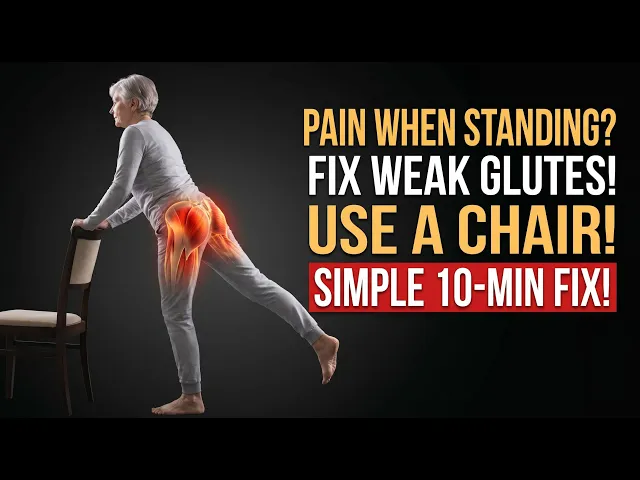
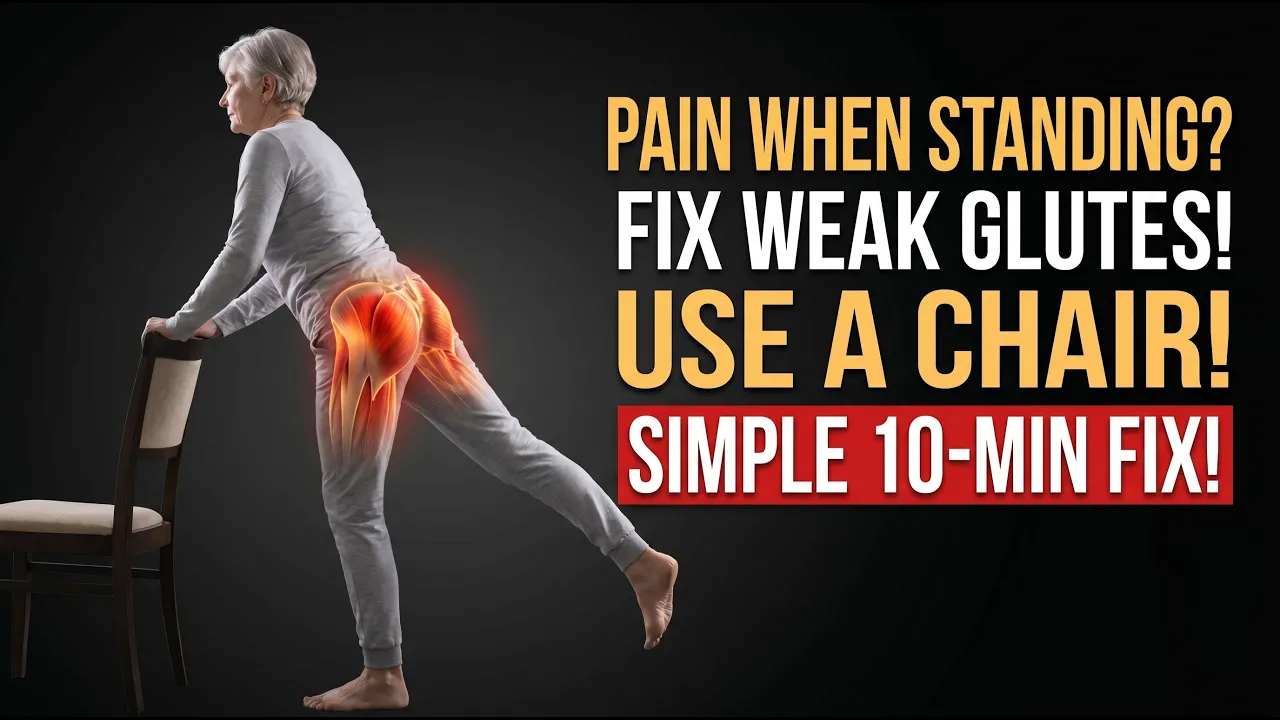
If your lower back throbs, and your knees just ache the very second you try to push yourself up from the sofa, you might be thinking it’s just your joints acting up. It's so common to blame the calendar, right? But the actual truth is, you are experiencing a dangerous mechanical failure— and the great part is, we can actually fix it right here, right now, in about ten minutes with a simple chair workout.
If you are past your sixties, weak glute muscles are usually the real, hidden culprit behind that daily stiffness. And it all starts with a habit you likely do every single day. Every hour you spend sitting down— maybe you’re in your favorite armchair watching the evening news, or just sitting quietly at the kitchen table enjoying your morning coffee— your nervous system is actively forgetting how to fire up those glute muscles.
So, when you finally decide to stand up and walk across the room, that crucial muscular foundation? It's essentially fast asleep. Because of that, all of your physical body weight gets violently transferred directly into your fragile lower spine and the delicate cartilage in your knees.
But today, we are going to reverse that mechanical failure instantly. We are going to wake up those dormant muscles together, using nothing but a sturdy chair. Listen to me: there will be absolutely no dangerous squats, and you will never have to get down on the floor.
Stick with me until the very end of the video, because the absolute most effective movement we have today requires zero leg swinging, which makes it wonderfully safe for absolutely everyone. Before we dive into that first movement, I'd love for you to go down to the comments below and tell me: which joint gives you the sharpest pain during those stiff first few steps of the morning? Is it your lower back, your hips, or your knees?
Let me know down there. And please hit the like button, share this video with a friend who might be struggling with their daily mobility, and subscribe to the channel so you never miss out on these completely safe, science-backed health guides. Alright, let us get straight to work.
Coming in at number four is what I call the Seated Heel Pivot. We are starting right here because it safely targets the side of your hips without making you support any of your own body weight whatsoever. I want you to sit comfortably near the front edge of your sturdy chair.
Keep your spine perfectly straight—imagine a little invisible string just gently pulling the top of your head up toward the ceiling. Plant your feet completely flat on the floor, right in front of you. Now, bring your legs together so that your knees and your heels are just gently touching one another.
You can rest your hands casually on your thighs, or firmly grip the sides of the chair for total security. Now, keeping your heels firmly glued together and touching the floor, slowly fan your knees and your toes outward, exactly like you are opening up the pages of a thick book. The very second you open your knees, you are going to feel a sharp, highly focused tightening deep in the outer sides of your hips.
I want you to hold that open, tense position for three full seconds. Just breathe naturally. Then, slowly bring your knees back together to where we started.
Try to perform twelve slow, deliberate repetitions. The scientific reason this works so flawlessly is deeply rooted in clinical biomechanics. You see, research published in the Journal of Biomechanics actually demonstrated that this seated external rotation actively recruits the deep, stabilizing muscles of your pelvis while keeping all that compressive pressure completely off your kneecaps.
It actively lubricates the hip socket and forces those sleepy lateral muscles to finally wake up, all from the total safety of your chair. Moving right along, coming in at number three on our countdown is the Standing "V" Stance Squeeze. This specific movement requires absolutely zero leg swinging and absolutely no joint bending, which really makes it the perfect restorative exercise for anyone who is dealing with severe, chronic joint pain.
I want you to carefully stand up and position yourself directly behind your chair. Place both of your hands firmly on the top of the backrest. This is going to lock in your balance and completely take away any worry about falling over.
Bring your feet close together. Keep your heels touching, but rotate your toes outward so you create a distinct "V" shape with your feet— think of a classical ballet dancer's posture, just like that. Stand up nice and tall, looking straight ahead across the room.
Now, without bending your knees at all, I want you to forcefully squeeze your heels together and intensely clench your buttock muscles as tightly as you safely can. Try not to lean forward, and do not lean backward; simply stand perfectly tall, actively press those heels into one another, and just squeeze. Hold this intense, warm, burning contraction for five full seconds.
Then, completely relax. Let the tension just melt away, take a normal breath in and out, and repeat that entire sequence for ten total repetitions. The physiological mechanics behind this one are beautifully simple, but they are incredibly powerful.
According to clinical data published in the Physical Therapy and Rehabilitation Journal, when you combine a straight, weight-bearing stance with this isometric external rotation, it creates a massive, superior surge of gluteus maximus activation compared to doing traditional, dynamic squats. Because your spine remains completely vertical and your knees do not bend or twist even a fraction, you are entirely eliminating all those dangerous shear forces on your delicate cartilage. You are actively repairing that neurological electrical connection from your brain straight down to your lower body, and you are doing it without causing a single bit of wear and tear.
At number two, we are going to transition back to the chair for the Seated Glute Shift. Now, this is an incredibly gentle, almost completely invisible movement, but it rebuilds the exact mechanical core strength you desperately need to walk confidently, without limping or swaying from side to side. Take a seat perfectly square in the very middle of your chair.
Keep your posture nice and upright, and place both of your feet completely flat on the floor, right about hip-width apart. We are going to isolate just one side of your body at a time here. First, place all of your mental focus entirely on your right foot and your right hip.
Press your right foot heavily down into the floor, and firmly squeeze your right buttock muscle to slightly lift your left buttock —just one single inch off the seat of the chair. Listen carefully, though: it is absolutely crucial that your upper body remains perfectly straight. You must not lean your shoulders or tilt your torso to the side to help create this lift.
The lifting power has to come entirely from pushing down with the opposite side of your body. Hold that subtle little hovering lift for two full seconds, slowly lower yourself back down to the seat, and then switch your focus entirely over to the left side. I want you to perform eight controlled lifts on each side.
From a kinesiology standpoint, these unilateral pelvic lifts executed from a seated position aggressively target the precise anatomical structures that are responsible for keeping your pelvis perfectly level when you walk. Clinical biomechanics research actually highlights that these are the exact muscles that prevent the dangerous, collapsing "hip drop. " That drop is exactly what causes people to accidentally catch their toes and trip over uneven sidewalks.
By doing this, you are building highly functional, potentially life-saving balance and stability, and you are doing it without ever even standing up. And finally, we arrive at our number one, absolutely most highly effective movement for rebuilding your physical independence: The 45-Degree Standing Extension. Now, in a lot of common exercise programs out there, you are told to kick your leg straight backward or straight out to the side.
Today, we are actually combining those two directions for maximum, deeply targeted muscle fiber recruitment. Stand tall behind your chair once again, holding the backrest securely with both hands so you have absolute stability. Shift your body weight carefully onto your left leg.
It is incredibly important here to keep a very soft, forgiving bend in that left supporting knee; please, never lock your joint backward. Now, instead of pushing your right leg straight back toward the wall behind you, I want you to push it backward diagonally, at a precise forty-five-degree angle. Push it back and slightly outward, aiming your heel exactly toward the back corner of your room.
Keep the movement small, and keep it highly controlled. You really do not need to lift your foot high up into the air at all. Simply push it back until you feel a profound tightening right in the absolute center of your right hip.
Pause for one full second at the peak of that contraction, and then slowly, gently lower your foot back down to the floor. Perform ten to twelve slow, deliberate repetitions on your right leg before carefully switching over to your left. This specific diagonal angle is certainly not an accident; it is a highly calculated mechanical advantage.
Advanced kinesiology research from the Journal of Orthopaedic & Sports Physical Therapy confirms that extending the hip at an exact forty-five-degree angle perfectly aligns with the diagonal fiber orientation of the gluteus maximus. This precise trajectory achieves the highest possible peak muscle activation, all while completely turning off the hamstring muscles in the back of your thighs. You get one hundred percent pure glute isolation, absolutely zero thigh involvement, and a rock-solid, fully supported lower back.
The absolute key to making this entire daily protocol work for you is consistency over intensity. You do not need to exercise until you are exhausted, sweating through your clothes, or gasping for breath. You simply need to wake these vital anatomical structures up from their daily slumber.
Choose just two or three of these gentle chair movements and perform them every single day. Remember, never push through sharp, stabbing joint pain; focus only on the warm, satisfying sensation of your muscles finally coming back to life. If you practice these safe, highly targeted movements daily, you will steadily rebuild that stable, pain-free foundation you remember having years ago.
Your posture will drastically improve, your delicate joints will feel firmly supported, and your confidence to move freely will completely return. Thank you so much for watching all the way to the end, please commit to your daily movements, and stay healthy out there.