So, I think this thought of Agamben's had a major impact in Brazil, because this phenomenon is very visible among us. In other words, we live, in quotes, in a state of law. We are all citizens endowed with rights, but what we see is that in the favelas, in the peripheries , all those bodies of those citizens are cases of homo sacer, because these people are murdered daily, right, and without those murders being considered crimes.
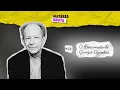
The guest this time on the Matéria Bruta podcast is philosopher and translator Cláudio Oliveira. Cláudio shares with us who Giorgio Agamben is, an Italian philosopher known mainly for his concept of homo sacer and its relationship with the notions of state of exception and bare life. The latter proposed by Walter Benjamin.
Furthermore, in this episode we understand why the question of language and the unspeakable is so dear to Agamben. Giorgio is an Italian philosopher born in Rome in 1942. He he actually does not have an academic background in philosophy.
He has a degree in law, eh, and he publishes in 1965, he defends a thesis, as the conclusion of this law degree, about a French philosopher named Simone Weil. And at that same moment in his life, he participates intensely in Italian cultural life and he becomes very good friends with some artists, such as the poet Elsa Morante and the filmmaker Pier Paolo Pasolini. And he goes as far as participating in one of Pasolini's films, The Gospel According to St.
Matthew, playing the role of the apostle Philip, right? So this relationship of Agamben with artists is something that will mark his thought, his entire trajectory. And from a certain point, already very young, even without having this philosophical background, in 1966 he participates in a seminar in a small town in French Provence called Le Thor, a seminar with Heidegger, Martin Heidegger, right, who will be a philosopher who will deeply mark him.
This is a seminar that is composed of few people, right? And he, he wasn't even a philosopher by training, but you see that, very young, at 24 years old, he already goes to this seminar that occurs in 1966, repeats in 1968 and then, in 1970, he already publishes his first book, which is The Man Without Content, which, by coincidence, is a book that I translated here in Brazil, right? And he goes on building his career as a philosopher, not academically, he goes on building this career by publishing books, right?
eh, of philosophy, that is, he is a philosopher who formed himself alone, right? Self-taught, we could say. In 1974, he goes to Paris and starts frequenting certain French intellectual circles.
He also spends some time in London doing research at the Warburg Institute, right? And from there, he releases new books, right? Right?
In 1977, he releases Stanzas, and in 1978, he releases Infancy and History. And in 1982, he releases Language and Death. These are all philosophy books that give him a certain renown, even while he was outside the university, right?
He only starts teaching at the university in 1988, when he already had five books published. He begins teaching at the university as a philosophy professor. but without having a degree in the field of philosophy, right?
So, Agamben was already an author translated into other languages before the publication of this book, the first book of this project, which is a project he spent 20 years writing that would generate many books, which is the Homo Sacer project. This first book of this anthology, or tetralogy, rather, was published in Italy in 1995. And then, with this book , he truly becomes an internationally known name.
He starts being invited to give courses at American universities, and this is a project he knew from the beginning would take a long time to write, and it takes him 20 years. This project would lead him to write around nine books, right? So, Homo Sacer is a category that exists in Roman law, right?
And since Agamben has this background in law, he is a great scholar of Roman law. He finds this category and thinks it is a category that allows us to illuminate and understand certain phenomena of our contemporary world. This perspective is one that Agamben calls an archaeological perspective; that is, he finds in these archaeological studies of phenomena from the ancient world certain paradigmatic figures that allow us to understand certain contemporary phenomena.
Homo Sacer is a figure, a man who, after committing a crime, becomes "sacer. " And becoming "sacer" means he cannot be sacrificed to the gods, and if he is murdered, that killing is not considered homicide. So, he can be killed by anyone, and this act, this murder, is not considered homicide.
So, Agamben takes this figure from Roman law and interprets it using a category from the thought of Walter Benjamin, who is a very important author for him, right? Agamben was responsible for publishing the complete works of Walter Benjamin in Italy, right? He brings forth Walter Benjamin’s notion of "bare life," arguing that the*homo sacer*is a "bare life" because it is a life stripped of any rights as a citizen, correct?
So, why does he believe this category allows us to understand the contemporary world? These two notions are closely related to another concept very important to Agamben: the "state of exception," which he also attempts to understand through Benjamin, specifically from a thesis in his " Theses on the Philosophy of History," which states that in our time, the state of exception has become the rule. What is the mechanism of the state of exception?
The state of exception is a mechanism found in all modern Western constitutions, stating that under certain situations, the legal order can be suspended. This means that all individuals lose their rights, right? As such, for example, they can be murdered; they become "bare life," they become killable life.
I think Agamben's thought had a great impact in Brazil because this phenomenon is very visible among us. That is, we live, in quotation marks, in a rule of law. We are all citizens endowed with rights, but what we see is that in the slums, in the outskirts, those bodies of those citizens are cases of*homo sacer*, because these people are murdered daily , right, without these killings being considered crimes.
So, we live in a rule of law, but at the same time, we do not. For Agamben, the relationship between the rule of law and the state of exception is indeterminate. Whenever you are in a rule of law, you are also always potentially in a state of exception.
Just as every citizen who possesses rights is also potentially killable life. Depending on the situation, even if you are a resident of Rio de Janeiro's South Zone, a middle-class resident, you could suddenly pass through a certain area of the city and be murdered, and that murder not be considered a crime, right ? A homicide, right?
That is how he understands that thesis by Walter Benjamin, that in our time, the state of exception has become the rule, right ? And isn't it, so there is an indeterminacy between rule and exception, right? The exception itself becomes the rule, right?
For example, that Brazilian man who was killed on the subway in London, uh, Jean Charles, right? Yeah, when he enters the London subway, he is a citizen, but since that terrorist attack occurs, a state of exception is declared and he is murdered. I.
. . he, no, the crime, his death brought no one to justice.
English law did not convict any, uh, any police officer for Jean Charles's death. So, in that moment, Jean Charles was a homo sacer. You have guarantees, but at the same time you have no guarantees, because depending on the situation, if the, if the state of exception is triggered, you become bare life and you are always in that possibility of becoming bare life.
So, every subject of rights is potentially a homo sacer. So, the homo sacer is no longer an isolated case, he is not an exception, but he is a possibility for every citizen, for every subject of rights. It is always an arbitrary decision.
That is why the state of exception is closely related to a category, which is the category of the sovereign. And for that, he will use a theorist who is Carl Schmitt, who is a theorist of Nazism, right? Uh, he will work with the definition that Carl Schmitt gives of the sovereign, which is that the sovereign is one who can suspend the law, the sovereign is one who can trigger the state of exception.
The whole issue is that, for example, on the streets of Rio de Janeiro, every police officer is this sovereign. Every police officer has this power to suspend the law there and treat an individual as bare life, as killable life, right? This issue was widely debated recently in our Congress, for example, when Moro and the Lava-Jato prosecutors proposed exactly that, meaning they proposed that due to a commotion, a situation of unrest, a police officer could commit a murder and not be held accountable for it, right?
So this discussion, it ended up not being approved, okay? These measures proposed by Lava-Jato ended up not being approved, but there was a discussion about it in the National Congress recently, right? The book "What is Philosophy?
", which was published recently by Boitempo, is a book that Agamben published in Italy in 2016. That is, shortly after the conclusion of the Homo Sacer tetralogy, which he finished in 2015. It feels like a book where, having completed the colossal work that is Homo Sacer, he revisits questions he was developing and working on before the beginning of the Homo Sacer tetralogy.
And what were those questions, exactly? The first essay in the book, for instance, consists of notes from the second half of the 1980s, fundamentally dealing with discussions on two aspects: the relationship between language and reality, and the relationship between language and speaking beings. He shows that Agamben is a great problematizer of these two relationships.
In other words, what is the relationship between language and reality? This is a philosophical problem that has existed since Plato and Aristotle; he moves to return to those texts, which already thematized this relationship between language and reality, between words and things. But he is also a philosopher heavily influenced by 20 th-century linguistics.
So, he also works with authors like Saussure and Benveniste. Uh, linguists who hold great importance for him. He almost re-reads the philosophical tradition.
He approaches this philosophical speculation on language through the more contemporary production of 20 th-century linguistics . But at the same time, he returns to a question very dear to him: what it means for these living beings, who are human, to be speaking beings. This is a very important question, and he even proposes a notion developed back in the late 80s, a Latin expression, the notion of*experimentum linguae*, the experience of language, which is his proposal for an experience of the speaking being.
What does the fact that we are speakers mean for us? I mean, what does it change? Our species, by the fact that we are speakers?
So this is a theme he developed back then and which he takes up again in this book. A question that runs through this inquiry of his regarding language is the question of the unspeakable. Always , as he is, very influenced by Benjamin .
He takes a passage from a letter of Benjamin's where Benjamin proposes a project to eliminate everything unspeakable from language. And Agamben takes this and tries to reflect upon it . And he will say that every time we experience something that cannot be expressed through language, right, something that would be unspeakable, what we are actually doing is experiencing language itself, right?
He will say that it is somewhat an experience of language's self-reference , right? So he will criticize this idea of unspeakability, right? And he will bring up this idea that language is actually referring to itself, right?
So , he will discredit this idea of language as a mode of representing reality, which is a very strong idea in our common sense, in our daily lives, right? He will try to deconstruct this idea, right? Which of Agamben's books did you feel most interested in reading ?
Let us know on our social media. Matéria Bruta is the podcast from the Curta channel, with biweekly episodes dedicated to arts and philosophy. Interview by Eduardo Fradquin, editing by Juliana Zalfa, voice by Flávia Mano , and consulting by Franças Carnaúba and Gabriel Reis.
To not miss anything here, check out this tip. Follow the Matéria Bruta podcast on Spotify or Amazon. Subscribe on Google Podcasts or Castbox, or follow us on Apple Podcasts .
I'll leave it here. Until next time. For those of you interested in philosophy, we have a special tip.
The Critical Uncertainties series aims to present important contemporary issues regarding art, politics, literature, economics, international relations, society, and history, and allow the viewer to come into contact with the work of leading thinkers today, including Zygmunt Bauman, Djamila Ribeiro, and Noam Chomsky. Watch whenever and wherever you want at curtaon. com.
br.