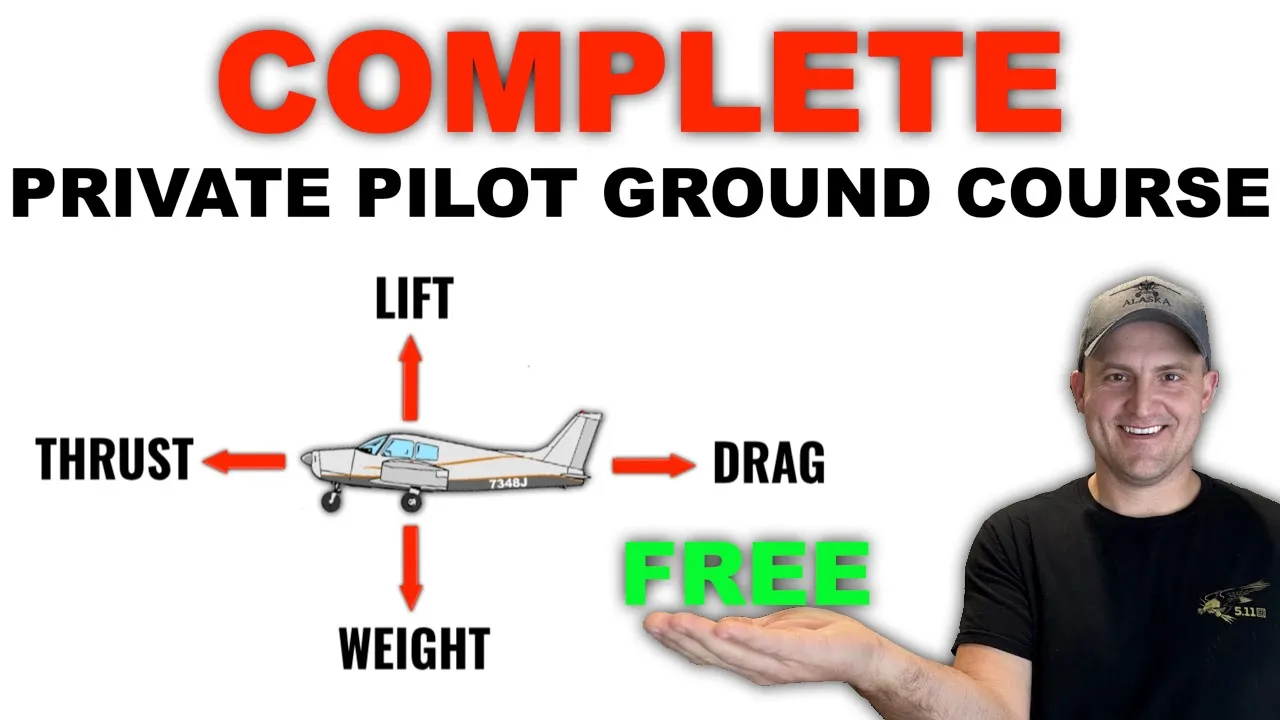
welcome to what I believe to be YouTube's only complete and totally free Private Pilot ground course throughout this series I will teach you everything you need to know in order to earn your wings as a [Music] pilot what's up guys I'm Josh and this is my father-in-law Mike and this is lesson one on my totally free Private Pilot ground course today we're going to be talking about the four forces that act on an airplane while it's in flight this is a super important lesson because if you have a basic understanding of aerodynamics this is going
to give you a good foundation that you can start building on throughout your training plus these questions might be on the written test oh I didn't mention that there's a written test oh yeah there's a written test and you've got to pass it with at least a 70% but don't worry I got you anyway let's take a look at these four forces that affect our airplane in flight as you can see these forces are lift weight thrust and drag now the first Force you should know about is lift as you can see this is the
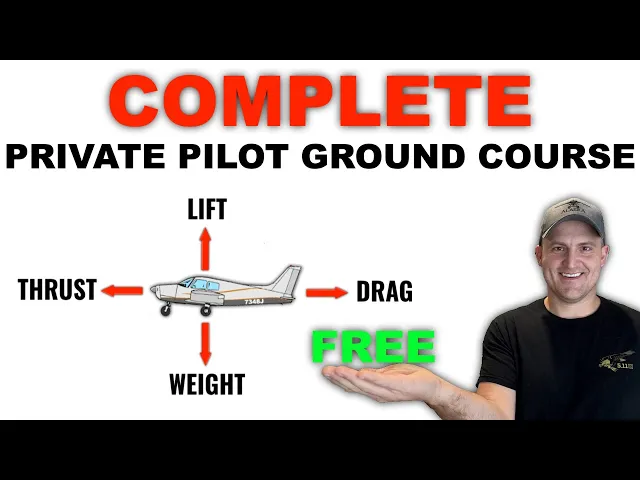
upward force that actually picks the aircraft up away from the ground and this is caused by basically two things relative wind and the wing design now we Pilots have a super fancy name for this Wing design we call it an air foil but I don't want to go into too much detail on that right now cuz we're going to be talking about that in more detail in the next lesson the next Force we need to consider when flying an aircraft is weight now weight is simply the combined load of all the people on board the
aircraft all the fuel any baggage or cargo you might have and even the aircraft itself it includes everything on board the aircraft the other thing you should know about the weight is that it opposes lift and acts downward through the center of gravity now we'll discuss the center of gravity more in an upcoming episode but the center of gravity is basically where the average weight of the aircraft and everything on board is centered if you could hang an airplane from a string and you were to place a center of gravity directly beneath the string the
aircraft would balance perfectly now here's something that may not make a lot of sense yet but it's important to know in steady unaccelerated flight lift and weight are both equal but we'll come back to that here in just a second next we have thrust and this is the force that propels our aircraft forward thrust is typically created by some kind of engine and propeller working together or a rotor for helicopter nerds out there now the important thing to know about thrust is that in order to move the aircraft forward you must first overcome drag which
we depict here as a rearward force but really this Force just opposes forward movement and that drag makes it difficult to move the aircraft forward and there are two types of drag that you should be concerned about as a pilot parasite drag and induced drag what happens when you stick your hand out of the window of a moving vehicle the wind pulls your hand back doesn't it the faster you drive Drive the more your hand gets pulled back this is what we call parasite drag and just like it does when you stick your hand out
of a moving vehicle parasite drag increases as air speed increases as you can see from this chart it increases exponentially with faster air speeds that's one of the reasons why we can't fly super fast in our training aircraft there's way too much parasite drag holding the airplane back at high air speeds now there are actually three different types of parasite drag and the first one is form drag in a nutshell form drag is wind that goes around the shape of the aircraft how much form drag do you think an aircraft of this shape would produce
probably a lot right it's not a smooth round shape that can allow air to smoothly flow around it another type of parasite drag is interference drag this one might be a little bit harder to understand but this type of drag occurs when different streams of air flow create little pockets of turbulence at different places on the aircraft and this restricts the smooth air flow around the surface of the aircraft next we have skin friction drag this type of Paras it drag is drag that's caused by the surface of the aircraft if we were able to
zoom in with a microscope and look at the skin of the aircraft what you find is that it's actually not as smooth as it looks wind can still act on these little microscopically rough areas and reduce the speed of our aircraft as you might have noticed we typically paint or polish the exterior surfaces of an aircraft to reduce skin friction drag but it's never completely eliminated induced drag is the other type of drag that affects our aircraft it's created as a direct result of lift I'm going to explain this more in the next episode but
our wings direct the relative wind above and below the surface of the wing and this creates lift but it also creates induced drag now induced drag is kind of weird as air speed increases the wing gets more efficient and because of that induc drag actually decreases here's what's interesting if we were to look at these two types of drag on a chart what you find is that parasite drag increases exponentially with air speed but induc drag decreases exponentially with air speed because of that there's a magical little air speed range on every aircraft where we
can achieve the least amount of drag possible when we're out flying around and a lot of air speeds you're going to be flying are directly related to this air speed Pilots often refer to this as the lift to drag Ratio or LD Max you might be wondering why it's called the lift to drag ratio and not the thrust to drag ratio well just like lift and weight in steady unaccelerated flight thrust and drag are both equal but all these forces are directly related to each other you're probably wondering why the heck we're learning about aerody
Dynamics today you just want to get into the plane and start flying but if you understand this concept it's going to help you understand how to control the aircraft anytime I make an adjustment to any one of these forces it's going to cause a change in one of the other forces now we said that during steady unaccelerated flight lift and weight are both equal now that I've got my airplane trimmed out for for level flight let's see what happens when I increase my air speed by increasing my thrust all right so I'm I've got the
airplane all trimmed out I'm at 1,600 ft uh somewhere around 85 knots watch what happens when I just increase my thrust Just Watch What Happens here I don't have my hands on the controls but notice the airplane starting to climb so thrust and weight are no longer equal as you can see my wings Start creating more lift when we accelerate when I increase my thrust my lift becomes greater than my weight and the opposite is true when I decelerate okay now I'm trimmed out for level un accelerated flight again at this point thrust and drag
are equal but what happens if I increase my lift watch my air speed as I raise the nose of the aircraft and I'm flying at 80 knots I'm at 2,000 ft okay so watch my air speed when I raise the nose of the air L up so I'm increasing lift right now watch my air speed yeah that's right the air speed is bleeding off I made a change before I increased my lift we were in steady unaccelerated flight when I increased my lift I also increase my induced drag and this caused my drag to be
stronger than the thrust which slowed down my aircraft understanding these basic principles is probably the most important step to learning how to control an airplane and now that you've watched this video you haven't understand understanding that most Pilots don't get in their first ground lesson if you want to continue learning how to fly I recommend starting the playlist where you'll be picking up with lesson two and there you can binge watch the series when you take a break you can pick up right where you left off thanks for watching see you [Music]





![Landing SECRET your Instructor won’t tell you [How to Land]](https://img.youtube.com/vi/JlYpKtkfn2M/maxresdefault.jpg)