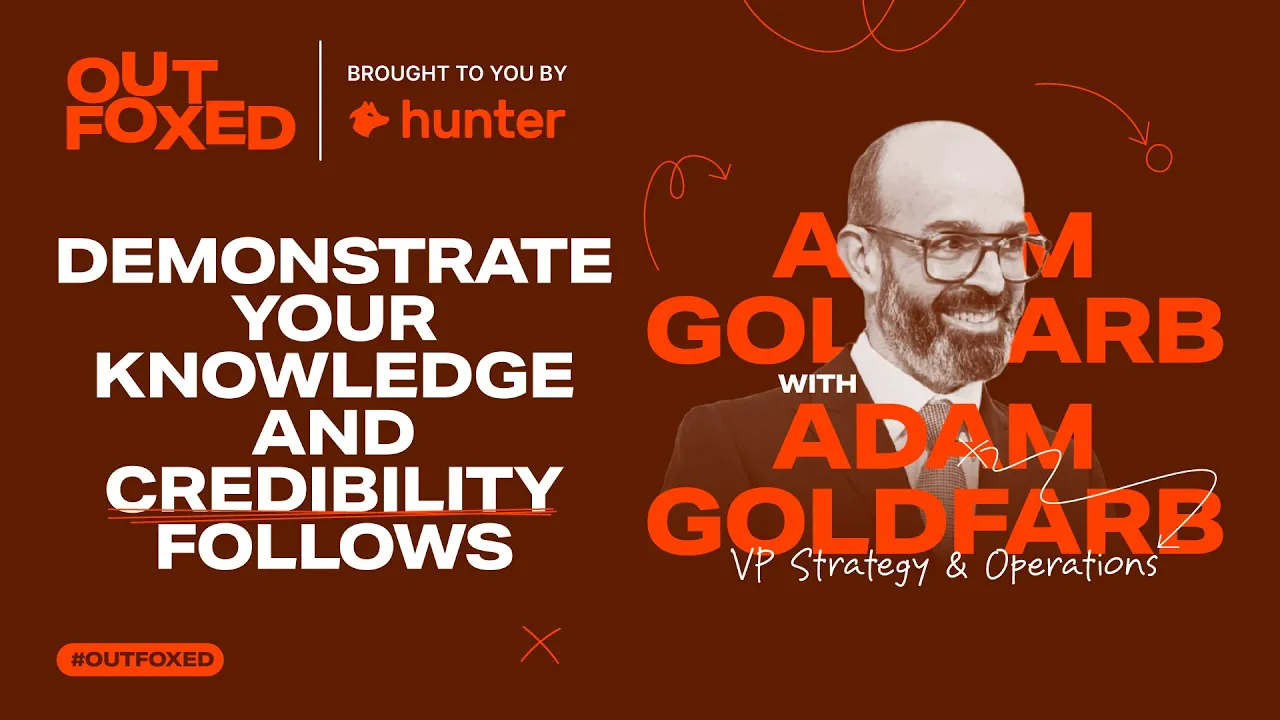
This is outf foxed, the podcast brought to you by hunter.io. Get ready for no playbooks, no posturing, and no ego. This is the podcast for the builders, not the theorists. I'm your co-host, James Nelson, joined by Hunter CEO and Outf Fox co-host, Matt [music] Th, and this is Adam Goldfab. Welcome to the show, Adam. >> Thanks for having me. >> We're really excited to talk to you Today, Adam. But before we get into all of that, could you just tell us a bit more about your background? >> Certainly. So after a pretty extended academic journey,
I've been working in the medical assessment industry servicing autoinsurers for the past 17 years. So initially my roles and responsibilities were more in the clinical realm and then eventually started to move into business operations and strategy, finance, account Management. I felt that a few years ago it would probably be beneficial for me to get some formalized business training outside of just regular day-to-day experiences. A few years ago, I enrolled in an executive MBA program at IB business school. Incredible experience. So obviously the expected outcomes of that were the the learnings from the curriculum, expanded network,
but one of the real tangible benefits for me was developing Increased capacity because you're doing this program while you're working full-time and balancing family life. So you're creating hours that weren't there previously. So once the program is completed, I find I have these unfulfilled hours. my my full-time job is great. So, I'm thinking, well, what can I do to fulfill this time that I've created through the program? So, it's at that time that I decided to pursue Strategic consulting in an industry that I've been very passionate about for probably 25 years and that is high-end
audio. This is an industry that is not very well known in popular culture. Um so basically there are companies all over the world that are manufacturing very complex low volume oftentimes extraordinarily expensive audio components for this very small subset of consumers that are looking to recreate The musical event in their home to deepen their connection to the music. So I saw that there was an opportunity there to be a consultant for these many many organizations and that's what I've been involved in for about last year and a half. >> That's very interesting. Okay. [laughter] Can
you further define high-end audio for people who may not fully understand like what you're really talking about There? >> So when you think about your smartphone, your smartphone has an audio system in it. >> Mhm. So think about taking your smartphone and breaking it out into all these individual components. The amplifier, the streamer, the speakers, and just multiply that by a thousand. So you're the speakers, huge amplifiers, separate power supplies, lots of cables, lots of accessories, And these changes to your system that you don't think would make a difference that defy conventional reasoning actually do
make a difference. It's not explainable, but all these little things do make an impact on a song performance and do change your experience. It's it's really really interesting if you have a a really deep connection to music. >> So, you're you're pro $300 cables. >> I'm going Okay, this is what I'm going to say to you. Okay. >> Okay. If I was to tell you two 8ft speaker cables cost $30,000, I'm talking you would have about 45 options there. >> Wow. >> They're extraordinarily expensive. I I can't explain the the materials, the design. Um they're
it's actually extraordinarily expensive how how highend the cables could be. So $300 is like entry level. [laughter] So my absurd example is absurd in the opposite direction of what I meant. Okay. >> Yes. [laughter] >> That puts it into perspective. So, okay, you've listened to $30,000 audio cables. Do you hear the difference? >> So, I've upgraded my I don't have $30,000 cables, but that's extreme example. But let's say you've upgraded my cables about seven times. >> Okay. >> The differences aren't small. It's noticeable. >> Wow. And so if I bring my wife into the room
and I show her an audio related upgrade and she'll say, "Yeah, this is silly, but I do actually hear a difference." So it's it's not just for for things like me. >> Okay, that's good to know. >> How did you how did you like how did this become a passion for you, Adam? >> I've always been very very passionate About music. I don't play an instrument. I just love listening to music. And I decided, >> it was 26 years ago, I decided to I wanted to upgrade my speakers and the high-end audio store recommended that
I get a new CD player. I was like, what are you talking? Why would a CD player? So, I took his advice. It was a single disc CD player. It had five buttons on it. It was $700 in 1999. And then I put that into my system and I Heard recordings that I had heard hundreds if not thousands of times. There were details emerging that I had never heard before and it just catapulted from there. >> Wow. >> Do you have a go-to reference song for evaluating audio equipment? >> Several. >> Several. Okay. >> Yeah.
>> But um I'm not I'm more into the music As opposed to the few recordings for I love some bands that have terrible recordings, but if the music is outstanding, it'll still be a go-to for me. So, what's the first one when you're like, "Okay, I got to hear, you know, you got the set, you got new speakers, you're in the you're in the audio store, in the audio room, you're like, "Okay, I need you to bring this music with me. What's the like first song you like?" >> So, there there'll be a couple tracks
Off a particular Radio Head album that I will put on that that usually works for me. >> Okay, that's good. Mine's Bonnie Ver's Bloodbank. >> I love Bonnie Ver. Like I can hear things in Bloodbank that I don't hear. Like you can listen on certain speakers and certain systems and there's almost always some element of the song that I haven't heard regularly through my Bluetooth headphones that's like it's just a privilege to hear there's something in that music I haven't heard before or not not regularly anyway. >> Absolutely. There's a lot of layers of Pioneer.
Love it. >> Yeah, that's a good one. >> Remind me Wild Horses uh by the Stones. I've really gone into them lately. And I think when you when you listen to a high quality version of the recording, it's Yeah, I I can kind of see where you're Coming from, Adam. It makes such a difference when you can hear these tiny little elements that you wouldn't normally be able to get to if you didn't have uh you know, a good quality um version of it. It's Yeah, it makes a world of difference. How for sure >>
I' I've got to ask how uh how does someone who has you know a background in in sort of strategy and operations um how does someone like that find themselves Essentially uh selling to audio files that's such a that's such a 180 in terms of of kind of what your background is and what your academical uh history is. How did he get into that? I find that a lot of the founders and chief designers of these audio companies are great engineers. There are they're very passionately about music, but they don't have that business experience. They
may have had success based on the strength of their products. My role will be to See how they can take that differentiator, take that value proposition and then make the most of it. So that's where I saw the opportunity is that they may not have that business experience, they have the passion. So, I feel like I I'm someone that could combine both of those. >> It feels like that's probably a fairly common problem in that space, right? Like I've seen lots of really interesting audio brands pop up and then Never heard from them again or
never seen those products again like this is this is that just my own experience or do you find that this is actually kind of true across that like frequently this is a problem in that space? >> It is it is absolutely a real problem. It's also a problem that it is a contracting industry. So, >> how many people under the age of 35 have sat in front of a stereo system? Their only experience is portable music for The most part. So, um trying to to get the luxury market to be aware of these products is
defin there's definitely opportunity there, but there's a lot of instability there and it's it [clears throat] is not as I said it is contracting and with the recent sort of macroeconomic changes, it's been further challenging for for the IO industry for sure. have the convenienceoriented product lines out there. So like the Apple AirPods for example, you know, Like we've we've had I think from an audio not audio file perspective, but just an audio lovers perspective like the convenience aspect of audio products has just gotten better and better and more plentiful. But I know there's a
tradeoff with the fidelity. So, have they gotten to a point where fidelity and convenience can coexist? Well, or is there still a divide? >> It has gotten So, it has gotten better. So, vinyl, magnetic tape, pure analog Signals are the best sound, but digital has gotten much better and streaming has gotten much better. So, that convenience and that sonic quality are definitely emerging at a much better than they used to be. For sure. Interesting. I want to go back one more time before we get into the first segment, James. So, I have one more question
here. I have to ask it. So, early and and the reason I say this is because I think for our audience, for for Hunter users, for For listeners hopefully of about Fox, you said something earlier that was really interesting. You said um you created capacity that those hours existed though, right? you just somehow figured out how to con configure your life in a way that those hours you were able to use those differently. So like can we talk can you elaborate on that? Like what were you doing with those hours before? Because I think for
a lot of people who are Thinking side projects or entrepreneurial projects this is really really relevant and I don't think it gets talked about as well as some of the other more technical aspects of this. Do you mind going into that a bit? So obviously I can say develop efficiencies but that's not very informative. So with with my day job knowing that you know I I took control over a lot of things starting to delegate educate other people then you're empowering those People to take on additional responsibilities that's one of the ways that you create
additional capacity and then we all are sometimes prone to scheduling errors. Sometimes procrastination creeps in here and there and just recognizing just you have to have that continuous work ethic and it's building up a resiliency as well in in having increased stamina that's also you know physiological components that also add to building that that capacity that Didn't exist before. So multiffactorial. I don't know if that I really drill down on on how I got there, but um yeah, it was it was almost like what I described to my classmates is when the program was done,
we're all looking forward to, but then it happens and you feel like an emptiness with exercise, if you don't continue to use that capacity, it does dissipate. And I did recognize that. So that's why I wanted to drive ahead and make the most of what I had built up. So What's an example of something you were doing with those hours before you started your uh your NBA program? >> So in in the evenings, you know, I would rather than having leisure time, I would be reading the cases and doing the deliverables and then I found
that streaming television or even listening to music wasn't as fulfilling as what I was doing when I was actually accomplishing that level of work. Mhm. >> So that's where I decided to develop the The side business to feel productive and and achieve something and and make a difference with what I'm doing as opposed to leisure activity which we have enough of regardless. So >> Okay. So you weren't like a competitive gamer. You were uh you weren't like a Twitch streamer previously. This was just uh Okay. It was just life. Okay. >> Yes. I've got to
ask, Adam, you've mentioned a couple of times about the physiological element of kind of having The energy and being capable of having the the means to build the capacity and you've mentioned uh kind of exercise a little bit. [laughter] I just got to just got to ask, how do you find yourself um balancing, you know, the day-to-day work that you're doing alongside the side work that you're doing? Does exercise come into play? How do you recharge your batteries to keep yourself ready for the next day? >> So, I I wake up at 4:30 a.m. 6
days a Week >> so that I do get in the exercise. [laughter] >> Nothing will go right unless I get the exercise in first thing in the morning. >> So, that that is something that's been a part of my life for about 10 years. And the benefits are so widespread that it's it's there's no flexibility when it comes to that. >> I hear that a lot. I I I hear almost everybody where you're like, "What's the Secret?" It starts with, "Well, I get up before the sun so that I can exercise." And that's uh I'll
say that's a pattern. That seems like uh yeah, that's been proven. That's great. >> Yeah. If you like the after work late afternoon, there's too many things in the day that can derail you and prevent that from happening. So, when you do it first thing, you know, it's there's a better likelihood of it occurring. >> That's Yeah, that makes sense. There you Go, James. >> Well, that's good to know. And now I know the secret. >> Yeah, I just wrote that down. Um, thank you. [laughter] So, so Adam, uh, this podcast we we approach it
really in a way that like we we want to have segments and we want to make sure that we give people enough time to be able to really talk about what it is that goes into building something. I don't think a lot of that Is done on podcasts like this. Um, and that's why we really want to focus on it. So, I'm just going to rattle off a couple of different uh questions to you about kind of the journey that you've gone through. We would love to hear the reality of what that that has meant,
not necessarily the the fluffiness that I think um we typically would hear from, you know, from from different podcasts. So, the first and you know, the first and foremost thing to ask you really is All about your ideal customers and, you know, how did you go about finding your ideal buyer? So basically I I found that my ideal customer is sort of in two different buckets. Both of them will need to have sort of a pretty identifiable differentiator or value proposition within their product portfolio. So if they're just making box speakers like 500 other companies,
that's not something that somebody going to be reaching out to. As Far as the ideal company, it's either a new entrance that's looking to to make an impact in the high-end audio community or it's an established company but not a very mature large company. I say the companies that I don't haven't had haven't had success with are the the larger companies that have multiple layers of ownership. if they're in a part of conglomerates um perhaps they have worked with consultants previously Um or they have their own strategy lead within their own organization but sort of
once one or two steps below that you know five to 20 employees um that have been around for a few years but definitely I've been in based on my outreach the the less mature company seem to be sort of my more ideal customer. Did you get there through trial and error or were you pretty clear about this profile from the beginning? >> It was indeed trial and error. >> Okay. >> Yes. >> So I' I've probably sent out about between 250 and 300 outreaches. So it' be and I keep data on that. So based on
those findings, that's what I found. >> Okay. We'll play the terminology game later. But >> do you call this a target prospect? Do you call this your ideal like your ICP your ideal like like what's the Terminology you actually use for describing this kind of person or this kind of account? >> I I don't have terminology associated yet. >> Okay. >> So then how do you go find solutions to help you uh help you find those folks? >> So I do either have some background knowledge of a good number of these companies. Um, part of
what part of what I do every day is staying very current with what is happening in this industry. And so, and if I see something interesting, I I just sort of have an instinct like there may be an opportunity with this company here, based on a review that I read, based on an extended forum on on an audio community forum that I've read about, um, based on some compelling adversement that I've seen, based on something I've seen at a trade show. um that's normally Where I get my ideas of who I'm going to be um
drafting my outreach for. >> So something uh something Matt that we you know we talk about and hear about quite often is this idea of having when you write your your email to someone and reaching out to them. It's all about making sure that it's relevant, right? And how do you know if it's relevant? Well, you need to do research to figure out the type of people to contact. what you've just described there, Adam, I That's that is such a it's a refreshing thing to hear because it means that you're probably not going out of
your way to jot down these names as you're going through publications or or you know, scrolling through the internet, but you're do you're taking an action that you're doing probably day in day out and you're getting value out of it. And that research is typically what sets people apart in terms of their ability to be successful with, you know, The sort of thing that you're doing. How did you um I guess my question here, Adam, is how did you did you just kind of stumble into that or did you think I need to research uh
who I could sell to? What was the mentality behind what you've described? my the process that I'm using with with my outreach is I'm trying to capture what what is this company I'm trying to demonstrate that I understand what this company represents what they're trying to achieve And it's almost like because of the era that we live in I know we may touch on this later I'm trying to draft an email or they're going to detect that I'm I'm not using AI to aid in drafting this email that I'm I understand this industry. I understand
what single-ended tri amplifiers are all about. I understand what you're trying to cater to. I understand what type of musical expression you're trying to generate. That's basically the core of what I'm Trying to to to come across in my messaging. So that it'll resonate with them because it is a very small community that is very poorly understood by most people. >> So your first your like one of the key things you're trying to make sure you establish is a certain amount of credibility because I imagine Yeah. Okay. cuz I imagine there's like there's a certain
amount of information that if you're deep in a particular space and I Think this is probably true everywhere, but like it's almost like there's there's something there's one or two things that you know you can say that are going to establish your credibility to the reader so that anything you say after that has like sort of a new gravity to it. Is that >> perfectly? >> That's the idea. Okay. And I assume that came to you the first time you tried it. >> Yes. [laughter] >> Yeah. you know, because of my job title, I in
my day job, I get a lot of outreach, >> right? >> It go it goes to my my trash, but I still read it. I still investigate like where did where did they go wrong with this? And I try to learn from that. Although there's not often a lot of learnings, if they say, "Hey, Adam, looks like you really need a lot of assistance with your real estate Portfolio." Like, you know, [laughter] that that's that's the example where it's just it's just trash. That that is that is junk mail, basically. Yeah. The one that gets
me is uh I know as CEO of an agency, you must be going through blah blah blah. And it's like, well, first off, you telling me my title doesn't help. Second of all, I don't work at an agency. And third, that problem isn't even interesting. So, like, you've kind of failed on all Fronts right out of the gate. I feel like uh that's actually more common than not. It sounds like your experience is a similar one. >> Absolutely. Yeah, we've seen that in our research. This is actually we we we've looked at this from a
data perspective and this is most commonly the issue is that things just aren't relevant like >> they spend so much time I think um I sp they I mean like people who are trying to do outreach spend a lot of time on The technical bits and I don't think spend as much time doing what you talked about which is like really getting to understand the industry to a degree where you know you can establish a credibility right away that's going to allow you to have a different conversation. I think that's really um an interesting part
of your story. I appreciate you sharing that. >> It's not efficient, but it's it's effective. >> That's the key, right? Like you that's the trade-off there. There's a certain amount of efficiency, you know, you're going to have to give up and and I'm curious like have you figured out how to scale that or has what you've learn is what you've learned that you can't really scale that? >> I feel like if I try to scale it, it'll diminish the effectiveness. >> Yeah. Do you write every outreach message by like from scratch? Like is This is
this like bespoke at each time? >> Yeah. Okay. >> Because that I mean that's that's the nature of the audience. It's not like even two manufacturers within the same product line are going to be similar and have it be similar to a certain type of message. That's that's how unique I try to make it. So, and that's partly because I imagine you're trying to speak to the problem or the challenge that you that You perceive that that that business is having or that that brand is having trying to do something which is never going to
be the same right from company to company. Is that right? >> I don't try to offer any insights to what I anticipate their challenges would be in too much detail um because I that could be an unfounded assumption. So, I just want to explain, you know, that I understand [clears throat] what they're trying to do in this. I'm a little bit More generic towards the end about what I do to see if the interest. >> Got it. So, establishing I'm I'm like in my brain, I'm like trying to like reverse engineer what an email from
from Adam would look like. I'm imagining um there's something really really specific to them about what they're trying to accomplish. And then maybe is there a bit about what you've done for others? Is there do you get into like a little bio? >> That's interesting. So that it's often recommended to have the anecdote. I I don't think it'll land well if I say I've worked with manufacturer X and increase their IBIDA by X%. I don't think it's going to land well because of how dissimilar all these companies are. >> Okay. They're not all running around
with EBIDA problems that they're that are top of mind, >> right? [laughter] Okay. >> And I imagine so this is great. So we talked about this um recently. There was somebody who asked a question on one of our webinars and we kind of went into this a little bit but like part of what you're revealing in this is that the audience like you said like this is probably they're very good engineers. They've probably developed a really good unique product with some sort of clear differentiator. And in doing that also They've kind of also raised their
hand and said I'm also probably the person who's really good at this part of it. So if you speak to that for them you're going to create that credibility. Whereas if you tried to communicate with them like they were worried about revenue or like like approach them like a normal CEO or founder you might miss. Is that is that right? >> Yeah. >> Okay. What is great, Adam, so far is That we've got a sense of how you have gone about taking what you've learned in the classroom, taking your day-to-day job, applying it to finding
your ideal buyers, uh, your ideal customers. But that there's something here where where I think that it's worth double clicking and then talking about kind of how you have gone from zero to whatever your client count is now. I think you've given us a strong sense that you're taking all of that and turning in into a Very um a very clear and understandable strategy to do the outreach, but let's talk about the actual outreach. How have you gone about growing the business? >> So, it's I I touched on this a little bit earlier. So, again,
staying very current with the industry. So, I do attend trade shows. I do networking. I'm part of the Toronto Audio File Society. I'm reading the monthly audio publications cover to cover and I'm pretty active on some um specific audio Forms and from there that's where I'm basically generating a list of potential manufacturers that I can reach out to. So that's that's where the growth comes from. And then just tracking my follow-ups and any leads that I've had and I don't use any particular software for that. I have a very organized Excel document. Um but that's
basic basically my approach to to growing and obviously um referrals from any existing clients. >> You want to tell the story how you Landed your first customer on uh for transcendence. >> So it it was through it was through cold email. Um >> okay had a few back and forths did did the pitch sent out the proposal. Nothing as far as the process was nothing too remarkable about how I landed. It was very is very early on in my outreach. It was a sle proprietor very small company. So um it was a sort of a
great way to get started in delivering actually Delivering the professional services for this company. >> Do you think it was an easier or harder experience than you anticipated it would be? >> It was harder in the sense that some of the the expectations started to shift with in in ways that I wasn't able to anticipate. So um that was the the challenging aspect of it. Um but as far as the selling piece that that went fairly seamlessly. The execution got a Little bit tricky once I was um in in the engagement itself. Say more about
that. So like you mean like transitioning from the sellings phase into like getting in there and figuring out how to actually Yeah. So like how did that not match what you'd expected it to be? So it's my sense was you know we we're we're working on whatever needs to be working on um this particular line of Business speakers and and cables and then all of a sudden it's like I need to get into magazines and then get more reviews done. It's like that wasn't what was outlined in the proposal. Um you know we've all talked
about scope free but it was just it was just a very sudden departure that I was not equipped for at the time. We we did I did ex you know get us back on on the our original path. Um but that was you know part of some of the learnings of a new business Is clients don't always act predictably and that was definitely a case of that. >> You mean that wasn't a one-off >> situation [laughter] has been a one-off but that was that was a very swift warning for me that um things things can
be going a great direction initially then all of a sudden um additional intervention is needed. Well, I'm impressed that was a one-off. That's uh You must have really defined like redefined your process well to kind Of keep >> keep it more on guard rails. Is that is that a fair? >> That that would be fair. That would be accurate. >> Okay. >> It only took you one. Well done. >> Yeah. [clears throat] >> Today's episode is brought to you by Hunter.io, the B2B lead generation [music] platform made for every professional. Whether it's prospecting, Fundraising, [music]
recruiting, link building, or just trying to connect with the right people, Hunter makes it easy. So, so Adam, in in the I'm really interested in in sort of what your take is on this. One of the things that we, you know, we all hear about when founders grow and grow and grow is that they eventually have to kind of hand over the reigns in terms of growing the business, growing revenue. Um, just if we could pretend for a second that that That was something that you, you know, you were kind of contemplating, would you trust
someone based on your approach, based on your kind of very customized research and and outreach content, would you trust anyone to do the outreach for you? >> I would need to pass that over to somebody that has been a lifelong audio file such as myself. So I when I when I do consulting with these companies, they talk about working with Marketing agencies and every single time they talk about they do not understand what we are trying to do. They they they don't get it. And so I want to be someone that that that is representative
of somebody who does get it. So if I was to get somebody else involved, they would they would need to have a similar background as myself and similar passion for for this line of business as I do. So that would that would be a necessary component. >> If you contrast that to other experiences that you have, do you think that's unique to the high-end audio space or do you think that that's actually more common um than than maybe I would have expected? There's something that's hard for people to process about the high-end audio space that
I I don't know because we all everyone's heard of Ferrari, everyone's heard of Chanel and Rolex. And I find that just this the synergy among the Equipments using speakers in Spanish. I think it's just really something that's unique and hard for other people to grasp when it comes to highend audio. I do think it is unique with that within that industry as opposed to other industries. I mean, there's probably other industries where there's just a certain amount of geekery that's required to just step foot into it, right? Like you're I feel like high-end audio is
a bit like that. Like there's a Threshold and if you're not willing as a normal consumer to cross a certain threshold, >> it's not for you. Like >> it requires a really deep understanding and it's in some ways it is work. >> It is if you throw money at it, you're not necessarily going to get good sound. That's another thing. If you because everything is so revealing, if you don't take the time to set things up properly, it'll sound worse than the free earbuds You hear in economy class. So, this is probably something the average
person has no understanding. Like, g give us an example of something that you're talking about here where like the average iPod, iPhone, AirPod user has no idea that this is like a thing. Like, yeah, I'd love to hear you give an example of things that don't go well together that actually make the sound terrible. So, if you buy a pair of speakers, let's say you buy $80,000 speakers and they 300 pounds each and you put them up against the wall, >> flat up against the wall. >> Okay. >> You're going to hear the bass double
back against the back wall and all you'll hear is distorted bass overwhelming the rest of the music. >> So, you think these speakers are super expensive. There's no way that they're going to sound poorly. They will sound Intolerable if you don't position them properly. >> And not even you're not even talking about like the angles at this point. You're just talking about something basic like don't set them against the wall. Don't put them in a corner like Yeah. >> So it some people spend weeks setting up their speakers. That's that so that you know talk
about a barrier to entry like there's that. It It is work. Um so that's that's what I that's what I think is so nuanced about this industry. There's a lot to learn and a lot that is very fully understood. >> Interesting. The convenience aspect of this is wild. Like you know, you think most people when they get when they upgrade to like really really good noiseancelling headphones, they think like this is a whole new world. They have no idea. Like they're they're much closer to the OG AirPods or, you know, Airbuds earbuds than they are
to actually like high-end audio sound. Like that's Yeah. Interesting. I'm not I'm not obvious in the sense that, you know, little portable speakers when I'm listening, they do sound good. They communicate the songs. I hear everything well. But when it comes to critical listening, yeah, that those aren't going to do the same thing as as a well set up system. >> For sure. >> And and $30,000 cables. [laughter] Speaking of uh approval, Adam, what is a piece of feedback that you've received throughout your outreach process, good or bad, that has put you in goodstead moving
forward? >> So, it it sounds obvious, but when I get to the the stage of pitching, you know, there there's kind of some people are reluctant to get into the dollars and cents on that on that initial call. And I found getting some Advice from someone who does enterprise sales that getting to the specifics of fees and seeing if they're receptive to that, any adjustment to fees is very critical during that first pitch and you'll have a lot more success when you get to the proposal stage. So that was it seems obvious, but it's easy
to shy away from that um especially if you haven't had a lot of experience pitching. So that was definitely a small bit of advice that I use 100% of the Time when when I'm at the pitch stage. Do you consider yourself a salesperson? >> Okay, so you have your dated view of a salesperson who's banging down doors, always be closing, not taking no for an answer, which, you know, that's a commission driven person. I certainly don't view myself in in in those terms. But as far as consulting, selling, you know, establishing relationships, developing solutions for
customers, I do think of myself as a salesperson from That vantage point for sure. Okay. Yeah, that makes sense. I I think it's interesting like you you referenced an enterprise salesperson like they probably feel a bit the same way like their job is getting the right solution in front of the right buyer. Sales is just a process, but they don't think about themselves as this kind of like what's the like death of a salesman, you know, archetype style, you know, right? Yeah. It's uh Okay. So yes, you're a Salesperson, but not in that sort of
archetypal kind of way. [clears throat] >> Yeah. >> How do you describe what you do to your your wife, Adam, and to your friends and family >> as far as the the outreach or the consulting, >> the outreach element? Yeah. >> So much of what I I've described before. So during those hours when I'm I'm [clears throat] Looking to make um connections with companies, I do spend time um on the website the the tab on the website which now says who we are or our story that's a great place to start to start compiling information
um I start reading some of the reviews to see are there any common themes that the audio reviewers are saying so just maybe I haven't mentioned this audio reviews are like high reviews there's publications they listen to an amplifier speaker they Give their thoughts on it so are there sort of emerging themes um coming from those reviews that sort of align the design philosophy of the company and I start to use that as sort of a central point with my outreach and then making sure I'm finding the current decision makers so that the founder who
who's the existing ownership and once I have all that information that's when I start to send the cold emails out and and and track my outcomes with that. So I think That's basically my process in a nutshell. I love how targeted and I love how specific and detailed this is. It really highlights the depths and the extent that you can go to to really create a tailored pitch. Like you get lost in the terminology sometimes with folks, right? When we do this, they get so caught up in trying to be like, "Okay, well, I've got
this checklist. I read it on a blog. It says I'm supposed to do these things and I do This this thing, right? I wrote the email." [snorts] But there's something so like laser focused about what you are talking about. Like I if you were to think about this in terms of like percentages. So you take your whole process from when you start thinking about an account to the time that you actually do your outreach. What percentage of that time [clears throat] are you spending crafting the email? >> That's an excellent question. It's probably like 20%.
>> Okay. And the other 80 is the research that goes into it. >> Yeah. >> Yeah. >> Because they because you don't it's been shown that if I if I'm going to write a very extensive email, my chances of them responding to it is minimized. So I even Though I'm trying to be very convincing in my outreach, it still is only three or four sentences long. >> In that first email, you talked about like you're like one of the goals is to establish credibility, right? Like that's clear. How many goals do you try to set
for that email? >> That's a great question. After I've established credibility, well, I guess with my closing sentence, I'm just describing that I've worked With other high-end organizations. Again, I don't use the anecdote and my signature has my website. So on my website I do have a few blog articles that they'll [clears throat] go to and and and see you know some of the articles that I've written that'll further will show their interest in my services. So um yeah I guess the second objective is to generate that curiosity and interest to see what I offer
what I'm all about and if that there could be A potential fit there. I what I like about this is like I think so often people try to do too much with an email. They try to go for the whole close, right? They're like they're I'm going to sum up my entire sales process in the first email and I'm going to like home run it. And like you go very you're doing a lot less than that. Like you've like really narrowed down like that first email is really just kind of like an opening line to
establish that Credibility and see if there's even any any interest at all. Um, first off, that probably suggests your recipients, your your contacts are probably not getting hammered with these or you feel like you can distinguish yourself from those enough that how does that pay off for you? Like that like I I really want to understand that better. >> So to address your first question, I don't think they're getting hammered with these because so many people are Not aware that these companies exist. Um, so I'm I'm data oriented. So, as far as success goes, basically
roughly about 60% of my messages will not get responded to. About 15% they'll say that they're not interested, and about 20% will reply with interest. 10% get to the a verbal pitch and then 5% get to a proposal which compared to what I'm reading in Industry standards is fairly solid. >> Yeah, those are >> those are good numbers. >> Yeah. >> Yeah. But you're also not trying to scale it, right? Like you're not playing the numbers game or at least the way you are playing the numbers game, you're dealing with much smaller numbers and so
you're being very precise with the with what you do. >> Exactly. Yeah. Okay. Yeah, that makes a Lot of sense. I think that's transferable. What I see out there is there's a lot of talk, there's a lot of um information in the world if you're trying to think about this as cold outreach. There's a lot that's going to tell you about how to scale and what the ratios need to be, etc., and like what tech stack can help you drive hundreds of thousands of these. But there's certainly a relationship between the customer value and how
much in you know How much you should be putting into the research phase. But I also think just in general your numbers probably are more of an indicator of your process than your industry. Um because of what you're doing to make each one count. And I know I think people are always in such a race to scale. I think you're a really good case study for uh not being in such a rush to do that. >> Right. Thank you. >> Yeah. I like that. Sorry. I know that Was a long-winded compliment really is it was
going to be a question but I realized no you're just like a really good example of what to do I think more than anything >> I brought up tech stack do we want to do we want to talk about tech stack for a second because I think I know the answer already and I'm like I'm really excited to have you actually say it out loud Adam >> yeah I would say I have a pretty Minimalist approach to that um my I [clears throat] just have my my email domain my website my email finder and electron
product signature platform. >> Sounds great. So, it's like spreadsheet, signature, email finding. Uh, do you use a CRM or is this all in a spreadsheet? >> It's all a spreadsheet. >> Yeah. >> Love that. I love that. Email and a spreadsheet and the internet. [laughter] >> Do you do you have a pad of paper and a pen as well? I need to know. [laughter] >> I if I'm if I'm doing a pitch, I'll I'll just drop down notes. I know some people do recordings. I just jot down notes when I'm when I'm listening to sound
speed to try to see if we can work together, but um that's the only time. >> Okay. I I I just kind of got vibes that you have a mole skin and like you making Loads of notes. At least that's what I do. I'm just trying to find someone to relate to. [laughter] But I love that you are so you're so lean in your approach and that kind of more minimalist is is probably a better way to put it and that kind of mirrors your your entire process, Adam. So I would normally ask our guests,
what would you recommend in terms of your tech stack? But I think I want to flip that and say what would you recommend People who potentially have too much tech? What's the benefit of of reducing and simplifying to just the things you absolutely need? >> One of my programs that I I'm finding I'm not getting util is just the electronic signature rate. It does definitely have benefits, but I'm just finding I don't have a high volume. So, I'm not deriving a lot of benefit for that. I know people are I guess using AI to help
Author content or edit. I have philosophical objections against that just because and it's not it's not because of the way I I draft emails. I just found since the dawn of AI which will say in 2022 when everybody's had access to chat GBT when I'm reading posts on LinkedIn I just found that people were losing their creative voice by relying on AI to draft things for them. And I I think of writing as a craft and it can only evolve by reading And writing and editing and rereading and I don't even use it to to
edit what I've created because I even find that can erode what your own unique voice. So um that that's one of my recommendations is I like I said I try to craft my emails so that audience will think there's no way that this person used any type of assistance to generate this message. Do you try to use AI at all for your research? >> Oh, I I use it for inquiries all the time. I just I feel like a lot of people do use it for writing and that's one area where I will not use
AI, but I do absolutely use it my dayto-day. Definitely. >> You're not anti-AII, you're just anti-AII when it comes to writing. >> 100%. That copy. >> Okay. I feel I've struggled with this personally. Like I'm I'm pro AI. Although I often scratch my head about All of us in tech authoring our own demise. So gleefully, it's a struggle uh for me to figure out how to engage with the words the same way that you do when you are not using AI at all. Like there's just I don't know if you've experienced this, but like I
can write the draft, have AI do some sort of edit, and then there's just enough transformation that it's not like I'm reading my own words anymore. It's like something happens. And I, you know, Maybe it's a loss of creative voice. I think you said that very well. But like, yeah, I've really struggled when it comes to writing. I find it's useful in other ways, but the writing piece, I it's not that I'm against it. I don't have like a philosophical point of view. more. It's just practical. I've struggled to get the same quality output out
of it that I thought I would, frankly. >> Right. >> Do you check in on it periodically like, oh, is this model going to do a better job or did you like draw a philosophical line in the sand? >> For now, I'm still making that stand. Yeah. >> Okay. [laughter] >> So, no matter how good it gets, but it's just a line, >> right? I I I just I I want to still develop that writing skills on my own because it's it can it can never be good Enough, right? So, >> well, the MIT research
that came out recently, I think, backs up your point earlier about the capacity, right? [snorts] That it's a bit like working out. Um, if you allow it to atrophy, it does. And uh I think there's a really strong argument if it's a core part of what you do, you can't give too much over to AI. It feels not not because of AI, just because of your own brain and that muscle atrophy, I think. >> Exactly. >> Yeah. So you've sold business through cold email. Have you bought anything from cold email? >> It's it's interesting. I
I can't recall a recent cold email outside of someone reaching out about an employment opportunity that has really engaged me and prompted me to follow up. >> Okay. What is it about those emails that have disengaged you? Uh, a lot of it's just Like outsourcing, HR, IT, security, all these. It's just it's just or usually, at least what I'm seeing is just mass campaigns that are completely irrelevant to what I would need in my day-to-day. We've sort of taken up the mantle to evangelize segmentation. Um, which is not something I anticipated we would end up
being the sort of voice box for, but it does feel like that's what's happened. And I think it's largely because that it echoes my own experience Which is that the vast majority of outreach I get doesn't have anything to do with me. >> Yeah. >> And so the only answer to that is just bad segmentation, right? You just bad list creation in the first place. I have it on good authority. There's an app for that, but we'll talk about that another day. So you wouldn't ever classify any of the cold emails you've received as good.
Like that was one of the key questions is like what's a good cold email for you? But you've actually never received. You've never been on the receiving end. >> Not recently. No. >> And And it's not without investigating them either. >> Right. You read almost all of them. >> Yeah. >> Yeah. Do you read all of them because of um just wanting to investigate the current I guess the state of play with Cold email or or and or andor I should say is it because you feel that you should be engaging with these cold emails
because it's part of your your role dayto day. >> So I I I would say if I wasn't involved in outreach myself I would just empty the trash and that would be the end of it. It's it's it's for curiosity and investigative learning purposes that I I do take the time to read them. >> You're really throwing off their Metrics, [laughter] >> especially if you ever read them twice. Like somebody is like pulling their hair out trying to figure out why this Adam guy keeps reading the email and not responding. >> I'm reading from the
trash bin now. So maybe >> yeah, the data is different from there. Or maybe not. >> No, every open every open gives them some sort of false hope. >> [laughter] >> So, you you've told us uh why you wouldn't engage with those emails, Adam, but we're interested to know, and I know our listeners are, what do you consider a good cold email? when I get an email where someone [clears throat] understands the nuances of the business that I'm in and can identify what those potential needs are and how we can work together to be successful
in in what I do, that's that's where it's going to Work for me. when I, you know, when I see that it's like not exactly what I do, but at least it's tailored and there is that there is that understanding of the industry and that that I mean the challenges that we're encountering right now, that's where I'd be like, okay, but let's have a conversation. >> So, somebody's demonstrating if somebody demonstrates for you a more consultative point of view where they're thinking about it, they're really they're they're Trying to demonstrate understanding, that's the thing for
you that really stands out. So even if it's cuz you mentioned you try not to assume you know the problem but I often feel like that's a good thing to do with cold email because it establishes very quickly to the reader if you have this problem this is worth reading you've gone the other direction. Do you is that simply because like too often they're just wrong or you just Find that that's not effective. >> It's both. >> Okay. Sometimes they're missing the mark and sometimes it just sounds very very [clears throat] generic like this could
be said to anybody in any vice president role. So that's that's where it comes from. >> Okay. So nuance is really key for you both on sending and receiving. Like that's just an important thing. Okay. Do You think that that's because of you? Like do you think you're just someone who indexes strongly on on nuance or you think that that's like like a really good practice in general? I think it's a it's a good practice in general. >> Okay. >> Yeah. >> I was trying to think of a bad example. I actually couldn't come up
with one. So, it's uh that's probably a good sign. Yeah. I'm trying to think of what in our Like nuance I feel like is James. I'm like I'm like trying to think of nuance in our space. I feel like there's just none. >> Like there's >> no it the fact that you're you're almost um anti- worst practices. I know that means your best practice, but really and the way that you're describing your whole approach to cold email is so it's it's the antithesis of what most people do and that's why people consider cold Email to
be spam and >> yet I don't think I mean I I'll ask you this question you know for you to answer Adam. Do you think that cold email is spam? It all depends on what level of specificity is is in the email. If if it's if it's just part of the campaign that's just sent out on mass, then that categorically is spam. >> Spam is more a measure of quality and relevance than it is an invitation, Right? Like you Okay. It's not as for you at least cuz I know there's obviously like Canada, US, we
all have laws about this that try to outline it, but for you it's not about whether you opted in or not and it's about whether or not it's relevant, >> right? >> I guess I I don't define in the traditional sense. >> Yeah. I don't either. But I think I'm I'm I actually think if if you pose this Question to almost anyone in a decision-m capacity, I think they would answer very similarly. I'd be hardressed. you really it you'd be hardressed to convince me that there are a lot of decision makers running around out there
in any business and feel that way. And I think the reason is is just that first off most cold email turns out to be spam because of how they did it, not because it was cold. And I think we're all in the business of making good Decisions for our companies. And so there's a certain responsibility we kind of have to know what's going on out there. And if somebody can help, it's sort of our job to figure that out. So I it's like it's hard to talk about this at scale like going back to the
scale thing, but it's like I think that this is kind of the the secret to the whole space. I don't yet know what the tipping point is, but there is obviously a tipping point where at a certain there's A certain line that you cross where you're you're better off not doing it. And I think everybody's in such a race to do more. They're not thinking as much about whether or not the thing they're doing in the first place should even be done at the at the level the quality that it's that it's being done at.
That's um >> yeah, if you're if you're sending an email and the result is that that email is a nuisance to the recipient is that To me should be viewed as spam. >> That that's the minimum amount of thought that one should put into an email. I think I would agree with that. [laughter] It's like, is this a nuisance? Because that's like it [snorts] never should be at a minimum. Yeah, that's that's uh Yeah, that's good. So, Adam, if you had to give advice to anyone who is at the beginning of their outreach journey about
how to get started and and to do outreach, What you consider the right way? What would that be? I wouldn't necessarily suggest my level of detail for all industries. Um, but I would expect, you know, sort of that middle ground between what we were just describing before that is a nuisance. Obviously, not nowhere close to to that level. Um but just just do do the appropriate level of research to make sure that you are demonstrating some sort of value and knowledge and understanding and and it it may not be As quick as you know a
mass campaign but to put a little bit of extra layer of time because in the end your outcomes are going to be better. You're going to be saving more time that way by having a level of specificity and and detail in that initial outreach. Is there a resource over the years that you've used, whether this was in the beginning, in the early days, or that you found later, is there a resource that you look back on and say, I probably got the most That was the most like the most benefit to my current approach from
that particular resource, a blog or a book or something. >> So, I'm just looking over at my bookshelf. So, the cold email manifesto, which I thought was very interesting. So that book actually closely mimic not mimicked I mimicked the process already had the process in place for the most part um based on that book and um the consulting bible is also an Incredible book. So these books aren't just about consulting it's about you know selling consulting is also a huge part of the business. So right >> those two really stood out about in terms of
practical application for >> for outreach for sure. Adam, I I I feel like I need to ask this before we we wrap up today's episode. Consulting is such a referral network driven business model. I have not encountered a lot of consultants who are doing what you're Doing and I think their reluctance probably is at one point was wellounded, but you seem to have taken a very thoughtful approach to doing cold outreach. What would you say to anyone who's in your shoes as a as a consultant, not just anyone who might be doing core outreach, but
specifically consultants about considering this as a path to grow their business? >> One thing that you need to establish as A consultant is you need to have that credibility. And so that is why um for my industry I do have those articles listed or that those blogs on my website to sort of lend some credibility that I I do understand this industry and I do understand the challenges in the the audience in the marketplace. That's definitely the first step and then building on that credibility starting to you know get involved with um online publications etc.
I think that is Critical rather than just um you know throwing yourself out there without having some demonstrated knowledge then that or expertise um in the industry for sure. All right my last question this is going to be this is the tough one but you want to leave the audience you've got you you shared a lot of great information what if they're curious about high-end audio is the best entry point brand for them. I was actually anticipating this question. So Here's here's what I here's what I would recommend. So first of all, if you have
a deep relationship with music, that's that would be your starting point because I' I've had I have a dedicated room in my house and I love having guests come in and I say, "What is a track that you're familiar with?" And I've observe their reaction. Some people are like, "Okay, cool. I'm going to go back to the Shakuri board." And other people are a train of fit. So, if you Have a deep connection to music, what I recommend is go to a local hi-fi store and it it doesn't require a huge investment. just listen to
a small system and listen to tracks that you are familiar with and sit in the right in the in the proper listening seat and that will be an experience that you may not it's it's maybe something that you're not expecting as far as how that's going to communicate your favorite tracks to you. You're not going To get that at a big box store. It has to be at a local hi-fi store. Um, but that's that is and it I'm going to say it could be one of the most rewarding purchases you'll ever make if you
are passionate about music. You dodged my question completely, but it was still good information. [laughter] >> So, Adam, where can our listeners learn [clears throat] more about you um and your your business, Transcendence? >> So, um my website is Www.trcendenceaudio.com. Now, I chose a word that is very challenging to spell unfortunately, but I came up with that name because I find listening to audio is a transcendent experience. So, that's where that came from. Um, so that's where that's where you can find me. All one word transcendence.com. I enjoyed the art the audio articles by the
way. I did uh I did visit uh earlier before this and had a chance to read Each one. I was a little disappointed there weren't more. I was like I wanted to go like way back in time and see uh what was maybe like an early inspiration. Do you have um do you have like another blog out there that you would also point us to? >> No, that that's my only blog and I do recognize that it needs it needs more articles so I need >> Oh, I was just excited. I was like I was
ready to go deep down the rabbit hole And uh so I was I was very excited. >> I enjoyed what I read. >> Great to hear. Thank you. >> Well, thanks Adam. This was great. I've really enjoyed the conversation. I I enjoyed speaking with both of you as well. [music] >> Thank you, Adam. So, that was Adam Goldfab. This is Outfost. And we're out of time. Thanks, Adam. >> Thank you. >> If you like what you heard, please like, Subscribe, explore even more of the Outbox community by visiting www.outfox.hunter.io. Iron.