The famous architect Meinhard von Gerkan designed the striking building shown on your screen. It serves as a train station in Berlin. It stands on an historically important spot, in what we used to be No Man's Land between East and West Germany.
As you can see, it's quite a remarkable structure. It was also expensive to build. It took eight years and cost 700 million euros.
To cut costs, Deutschebahn, the German railway company that owns the station, decided not to install the cathedral-like vaulted ceiling that von Gerkan originally designed, but instead installed a cheaper, flat metal ceiling designed by another architect. Outraged, von Gerkan brought a lawsuit. Altering his plans, he insisted, was equivalent to, quote, "ripping pages out of a novel," end quote.
The court agreed that his original design had been defaced, and consequently, that his rights had been violated. On that basis, the judge ordered the ceiling rebuilt, even though it would reportedly cost 30 million euros. Here's another case.
The Canadian sculptor Michael Snow created this sculpture of a set of 60 realistic flying geese, which hangs in Toronto's Eaton Center, which is a shopping mall. During Christmas season in 1982, the mall decided to hang a red ribbon around the neck of each goose as part of its Christmas display. Snow found the ribbons, as he said, quote, "ridiculous," end quote.
They undermined his intention, which had been to create a naturalistic image of birds in flight. Snow sought an injunction, compelling them all to remove the ribbons. Judge O'Brien of the Ontario High Court of Justice agreed with Snow's position.
An artist's subjective intent concerning the purpose and character of his work of art deserves weight, the judge concluded, so long as it's reasonable, and Snow's intent was. The judge ordered the ribbons removed. The moral intuitions that underlie these and other rulings are different from the intuitions that underlie what we have called Fairness Theory.
They're less concerned with rewarding labor and more concerned with respecting and protecting a special kind of emotional or psychic bond between artist and creation. Both von Gerkan and Snow had been well compensated for their efforts. In that sense, they'd already been rewarded appropriately.
But morality, and consequently, law, many people believe, should go further, should recognize an artist's continuing control over his creations. To do otherwise would be to cut at the artist's soul. The source and political philosophy of this approach is not Locke, but Kant and Hegel.
I mean that in a special sense. As Cyrill Rigamonti has argued, it's not clear that the legal doctrines underlying the cases that I just described were, in fact, influenced by either Kant or Hegel. Rather, when contemporary scholars and lawmakers look to philosophy for sustenance and guidance when filling out their moral intuitions, they look to Kant and Hegel, and more broadly, to the personality theory of real property with which Kant and Hegel are commonly associated.
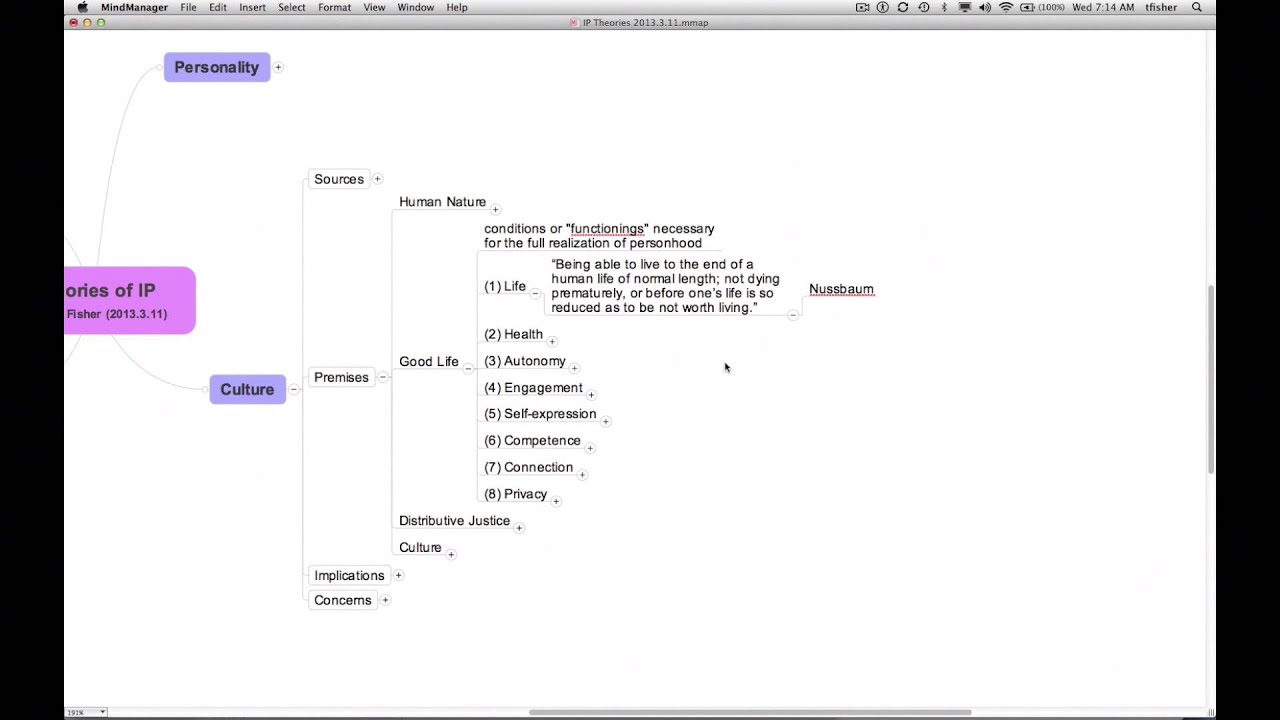
As I did with the fairness approach, I'll begin with a brief review of the underlying theory of real property and then consider its implications for copyright. The heart of personality theory is the proposition that certain kinds of bonds with objects are crucial to human flourishing, and consequently, that the law should respect those bonds by creating and enforcing private property rights. Arguments of this sort come in many flavors.
Put differently, over the centuries, different philosophers have identified a wide variety of ways in which private property rights can contribute to human flourishing. They're listed on the map. The first of these is peace of mind.
This is emphasized by Charles Fried in this book Right and Wrong. Awareness that, by using resources, you are disadvantaging countless other people, some of whom are desperately poor, can be morally exhausting, Fried contends. Private property rights, by assuring you that you own those resources, provides relief from that painful and perhaps disabling emotion.
The second argument, highlighted by Jeremy Waldron in his justly famous book The Right to Private Property, is privacy. One of the functions of a property right is to provide you a place where you can either be alone or enjoy intimacy with others. The home, protected by private property rights, is a haven in a heartless world.
The kind of control over information enabled by copyright can also help shield privacy, as it has done, for example, for the reclusive but litigious author JD Salinger, who aggressively pursues other writers who encroach on his informational and artistic domain, for example, by quoting his letters in a biography, or more recently, writing a sequel to one of his novels. The third theme, explored in detail by John Stuart Mill and Abraham Lincoln, is autonomy. The ability, provided by property rights, to control resources is necessary, so the argument goes, to enable persons to become independent and self-directing.
The fourth, emphasized by the legal scholar Carol Rose, is that property rights facilitate self-realization as a social being. By owning and trading things, people help shape their social environments and establish their places in communities. Commerce, Rose contends, is humanizing, not dehumanizing.
The fifth is perhaps the most famous, and in current scholarship, the most influential of the variants. It contends that property rights are crucial to self-realization as an individual, not as a social being. By owning and thus controlling objects, a person is able to assert his or her will, and thereby, to be recognized as a free agent by others.
Authors who, building on the work of Hegel and Kant, explore this theme in depth, include Margaret Jane Radin, Justin Hughes, and again, Jeremy Waldron. Here's an illustrative passage from Waldron's book. "These philosophical themes form an important part of Hegel's conception of freedom and of the argument for private property that he develops on that basis.
Self-assertion can be understood as a man's assertion of himself against nature. Natural resources by themselves are blankly material with no point or purpose of their own. If they are to have a point or purpose, they must be given one by being occupied by human goals and purposes.
By investing a natural object with purpose, an individual becomes aware of the priority of will in a world composed largely of objects that cannot actively possess it. Thus, he ceases to regard himself as a mere animal part of nature and begins to take seriously the special and distinctive features of rationality, purpose, and will. " The sixth argument is that property rights afford people security and leisure, thereby freeing them from the mind-numbing obsession with obtaining the means of survival and enabling them to pursue artistic and cultural callings.
Waldron and George Fitzhugh fill out this theme. The seventh variant, explored by the British philosopher TH Green, in addition to Mill, emphasizes the importance to human flourishing of responsibility. Ownership and management of property cultivates virtues like prudence and foresight, which, in turn, are tied to full personhood.
The eighth, which figures prominently in the writings of Radin, centers on identity. Selfhood, Radin contends, depends in part upon the ability to project a continuing life plan into the future, which, in turn, is fostered by property rights. You can readily see how this theme might arise with respect to artistic creations, at least unique artistic creations.
Destruction or modification of those creations might well threaten the author's means of maintaining an identity, not just a reputation, but a sense of self. The ninth theme is not prominent in contemporary scholarship, but was once very important. The central idea here is that property rights enable owners to become virtuous citizens, to participate in political deliberation responsibly and selflessly.
Civic virtue, in turn, is central to personhood. This idea loomed large in the writings of classical Republican political theorists, including many of the people who contributed to the founding of the United States. Finally, control over resources, and in particular, control over one's own creative products, may facilitate self-expression, which, in turn, is necessary for self-fulfillment.
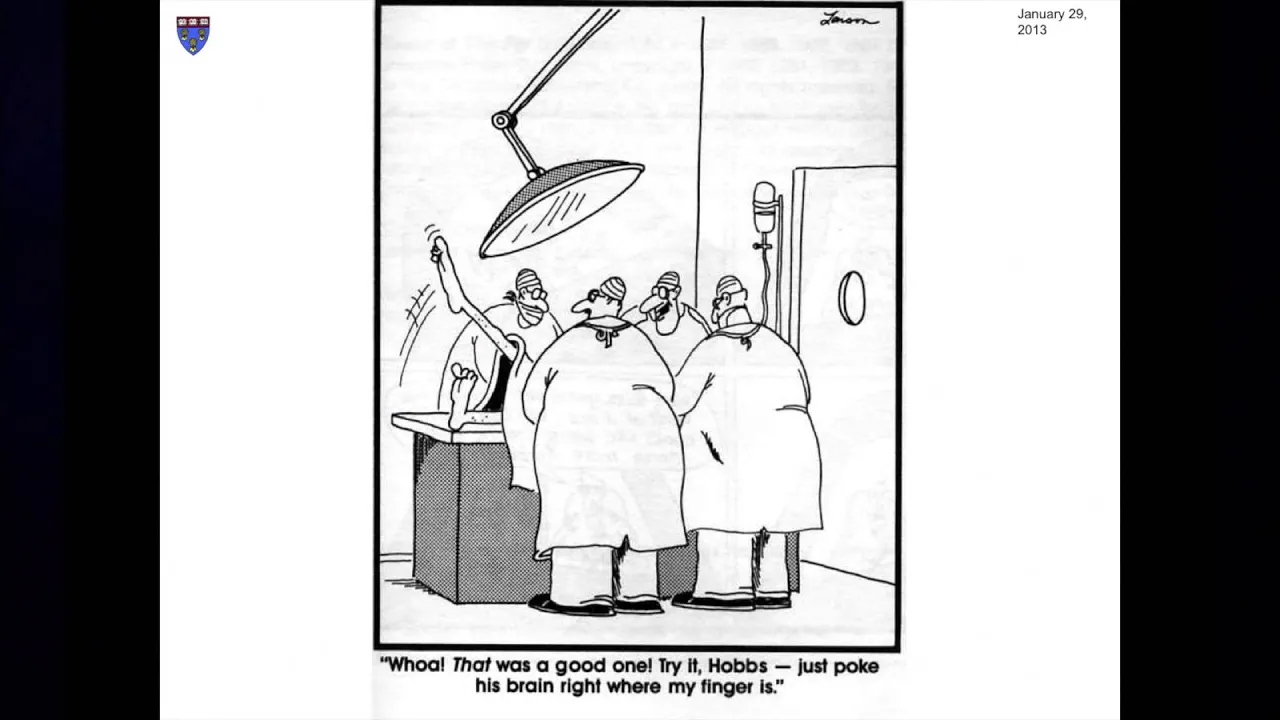
This idea can be found in the writing of some philosophers, like TH Green, and also in the work of many artists themselves. Here's an example. Gary Larson, as many of you know, is a famous cartoonist with a distinctive drawing style and an irreverent, even macabre, sense of humor.
The first major paper to carry his cartoons, the Seattle Times, dropped them because some readers denounced them as sick and offensive. Fortunately, the San Francisco Chronicle picked up the series, and the rest is history. Despite his iconoclasm, Larson was a strong defender of a particular conception or kind of copyright.
His stance is well expressed in an open letter he wrote, criticizing his fans for copying his cartoons and posting them on their home pages. "Years ago, I was having lunch one day with a cartoonist, Richard Guindon. And the subject came up how neither of us ever solicited or accepted ideas from others.
But until Richard summed it up quite neatly, I never really understood my own aversions to doing this. " Quote, "'It's like having someone else write in your diary,'" end quote, "he said. And how true that statement rang with me.
In effect, we drew cartoons that we hoped would be entertaining, or at the very least, not boring. But regardless, they would always come from an intensely personal, and therefore, original perspective. To attempt to be funny is a very scary, risk-laden proposition.
Ask any stand-up comic who's ever bombed on stage. But if there was ever an axiom to follow in this business, it would be this-- be honest to yourself, and most important, respect your audience. So in a nutshell-- probably an unfortunate choice of words for me-- I only ask that this respect be returned.
And the way for anyone to do this is to please, please refrain from putting The Far Side out on the internet. These cartoons are my children of sorts. And like a parent, I'm concerned about where they go at night without telling me.
And seeing them at someone's website is like getting the call at 2:00 in the morning that goes, 'Uh, dad, you're not going to like this much, but guess where I am. '" Two aspects of this letter bear emphasis-- first, the contention that public self-expression is very scary and risky, and the law should help create conditions that enable and encourage it; and second, the conception of one's artistic creations as one's children. The need to control those creations, Larson argues, is like the need to keep track of one's kids.
When we examined Locke's theory of property, we saw that only some of the ways in which he fleshed out his arguments seemed germane to intellectual property. The same is true here. In my tour of the 10 variants of personality theory, I've tried to flag those that seemed most relevant to the interests of artists.
I hope, by now, it's clear that those are numbers 2, 5, 8, and 10. To review, maintenance of artists' ability to control, at least in some ways, their creations is arguably necessary to respect, first, their privacy; next, their capacity to achieve individual self-realization; next, their identities; and finally, their opportunities for self-expression. The countries where belief in these connections had the greatest influence are located in continental Europe.
Not surprisingly, those same countries have the legal systems that are most protective of artists. More specifically, in those countries, artists enjoy a set of entitlements, commonly referred to as moral rights. In its full-blown version, the concept or system of moral rights encompasses six distinct entitlements.
The first is the right of attribution, which is the right to be given credit for things you have created and not to be given credit for works that you did not create. The second is the right of integrity, which is the right to prevent the destruction or mutilation of one's creations. This is the best known and probably most important of the rights.
It underlaid the von Gerkan and Snow cases we discussed at the outset of this section. The right of disclosure is the right to decide if and when to make one's works public. Suppose, for example, that a painter has been commissioned to create a portrait of a particular subject and has already been paid the contract price.
The painter paints the portrait, but is unhappy with it. The subject demands that it be delivered. May the painter refuse?
In jurisdictions that respect the right of disclosure, the answer is yes. The painter will have to indemnify the person who commissioned the painting, perhaps by returning the contract price, but does not have to turn over the painting itself. The right of withdrawal, rarely exercised, is the right in principle to demand that works one has come to regret be returned.
Suppose, for example, that Picasso came to regret his Blue Period. He could demand that their current possessors return all of those paintings. Again, an artist exercising this right would have to indemnify, in advance, the persons obliged to relinquish the works in question.
The right against excessive criticism, also rarely exercised, in principle enables an author or artist to recover against a critic who abuses him or her. Finally, the droit de suite is the right to collect a fee when one's works are resold, for example, when the current owner of one of your paintings resells it to another collector. Now, here's a brief reminder of ground we covered in the first lecture.
As we discussed there, the Berne Convention purports to require member countries to recognize two of these moral rights-- specifically, the right of attribution and the right of integrity. But as we saw, the Berne Convention lacks teeth. And the TRIPS Agreement, which does have teeth, does not incorporate the provision of the Berne Convention pertaining to moral rights.
The net effect is that countries, like the United States, that are reluctant to recognize moral rights are, as a practical matter, free to evade their treaty obligations. Late in this lecture series, we'll examine what's known as the Visual Artists Rights Act, which is the provision of US copyright law that implements a quite truncated version of moral rights. For the time being, we're concerned not with the contours of the law, but with the theory that provides the best support for the moral rights system.
And that theory, as I've suggested, is the personality theory. Scholars who follow this line contend that intellectual products are manifestations or extensions of the personalities of their creators. An artist defines herself in and through her art.
The artist, consequently, is morally entitled to considerable control over her works. Why, exactly? Partly because those injuries result in corresponding impairment of the creator's self, and partly because maintaining a connection to and control over her works is one of the ways in which an artist establishes and sustains an identity.
The classic version of this argument focused on the interests and rights of the lone artist or author. Historically, the strongest version of personality theory was associated with romanticism, which, as you know, celebrated solitary artistic geniuses-- the novelist or painter in the garret projecting his or her vision onto paper or canvas. Nowadays, it is widely, although not universally, recognized that that conception of creativity is unrealistic or at least rare.
Awareness that creativity is more often collaborative and that many artists incorporate not merely the ideas of their predecessors, but some of their predecessors' materials, has prompted some scholars, writing in the vein of personality theory, to argue for important adjustments to its doctrinal implications. Most importantly, if we wish to ensure that all persons have opportunities to engage in self-fulfilling creative activities, we may need to liberalize the rules governing their transformative uses of already existing artistic products. When we discuss the efforts of scholars to adapt Locke's labor-desert theory of real property in the context of intellectual property, I suggested that those scholars confronted serious difficulties, arising out of the ambiguity of key concepts in Locke's approach.
The same is true of personality theory. Listed on the map are a few of the difficulties the scholars working this vein face. At the most primary level, it's not obvious whether an artist who invests herself in a work of visual art should be able to prevent others from imitating her creations.
Some commentators, emphasizing the self-expression inherent in the making of the imitation, argue no. Others disagree. For obvious reasons, this goes to the heart of copyright law.
Assuming that an artist has the right to control copying of her creations, may she alienate that right? For example, may a composer assign to a music publisher all of her rights in her composition? As we'll see, this is conventional in most jurisdictions.
Is it legitimate? Some scholars, purporting to draw on the writings of Kant, argue no. Others, seeking guidance from Hegel, argue yes.
Here's a more specific contemporary question. In many American states, celebrities enjoy the right to control, and therefore, the right to charge for, commercial uses of their identities. Shown on the screen is one of a series of advertisements that provoked a famous application of that principle.
In the late 1980s, the consumer electronics company Samsung introduced a set of what were intended to be humorous ads, ostensibly set into the future, each of which juxtaposed a hypothetical news headline with the depiction of a durable Samsung product. Here's the one that got Samsung into trouble. The hypothetical news story, which appears at the top of the ad, suggested that the game show Wheel of Fortune would still be broadcast in 2012.
However, the letters on the game board would be turned not by Vanna White, the actress who had become famous in this role, but by a robot, which would literally take White's place. Shown on this slide, on the left side is the real Vanna White, and on the right side, a blow-up of the image of the robot that appeared in the Samsung ad. White argued plausibly that the color of the robot's hair, the color and style of its dress, and above all, its pose, was intended to evoke her.
She brought a lawsuit, arguing that the advertisement constituted a commercial appropriation of her identity. And she prevailed. The theoretical question posed by this case and many similar cases is whether a celebrity's persona is a sufficiently important embodiment of personhood that it, like a painting, should be shielded against non-permissive uses.
Some scholars argue yes, indeed regard the answer as self-evident. Others, like Michael Madow, disagree, contending, among other things, that a celebrity's fame typically owes as much to the media and the audience as it does to the creative contributions of the celebrity herself and thus should not be analogized to works like von Gerkan's train station or Snow's geese. These are hard questions.
As I suggested when we were discussing the application of Locke's argument to copyright, it's very unlikely that the answers to such questions can be derived from a careful reading of the canonical texts in this theoretical tradition, namely the writings of Kant, Hegel, and so forth. The value of personality theory, I suggest, is not to provide us determinate answers to modern problems, but rather to sensitize us to and to help us reflect upon the ways in which control over intellectual products can influence opportunities for individual or group self-fulfillment. In that spirit, here are a few additional ways in which personality theory has been or might be applied to suggest ways of thinking about specific issues that arise in contemporary copyright law.
How long should a copyright last? The duration of a patent, as many of you know, is quite short-- 20 years from the date of the patent application. As we'll see in most countries today, copyrights last much longer-- typically for the life of the author plus 70 years.
If the principal function of a copyright is to reflect and protect an author's personhood interests in his or her creations, perhaps that term is too long. Perhaps it should last for no more than the life of the author. Or more narrowly, perhaps moral rights should expire with the death of the author.
Another example-- as we'll discuss in later lectures, many jurisdictions, including the United States, have rules that confer upon employers the copyrights in the works prepared by their employees. These rules are highly controversial. One ground in which they are commonly criticized is that they fail to respect the employee's personhood interests in their creations.
A related criticism of contemporary copyright law that arguably is also fueled by personality theory is that several doctrines in combination inhibit the ability of creative people to remain economically independent and thus in control of their creative activities and products. Copyright law, in other words, is biased toward the interests of companies and fails adequately to support intellectual entrepreneurs. One of the sources of that bias, so it's argued, is the set of procedural rules that govern copyright lawsuits and the remedies available to successful litigants.
Those rules operate, as we'll see, to the advantage of parties with deep pockets and emotional fortitude, neither of which is typically true of the kind of autonomous artists that are celebrated by personality theory. Another example-- it's widely thought that, in general, artists are not good at business and thus tend to sign away their rights too quickly or for too little money. Most copyright systems contain some rules designed to protect artists or their families against the consequences of their folly or ignorance.
Some scholars, drawing in part on personality theory, argue that those protective devices are insufficient and should be strengthened. Finally, as I suggested a minute ago, some scholars contend that, if all persons are to have opportunities for self-fulfillment analogous to those enjoyed by a Picasso or a Wordsworth, copyright law should be amended to increase people's freedom to make derivative uses of existing creative works, such as photographs, films, and sound recordings. This might be achieved through adjustment of one of the major defenses to copyright infringement, namely the doctrine of fair use or fair dealing, which will be considered in detail late in the course.
In countries like the United States that currently provide expansive protection for moral rights, the same adjustment might require some curtailment of the famous right of integrity. This last possibility is perhaps the most counterintuitive and eye-opening of the reform proposals we've considered thus far. It entails invoking personality theory to qualify one of the primary conventional doctrinal embodiments of that same theory.
By the end of this series of lectures, I hope you are in a position to make your own judgment concerning the persuasiveness of this proposal. So that's it. That concludes our examination of the first two of the four theories of copyright, namely fairness and personality-based theories.
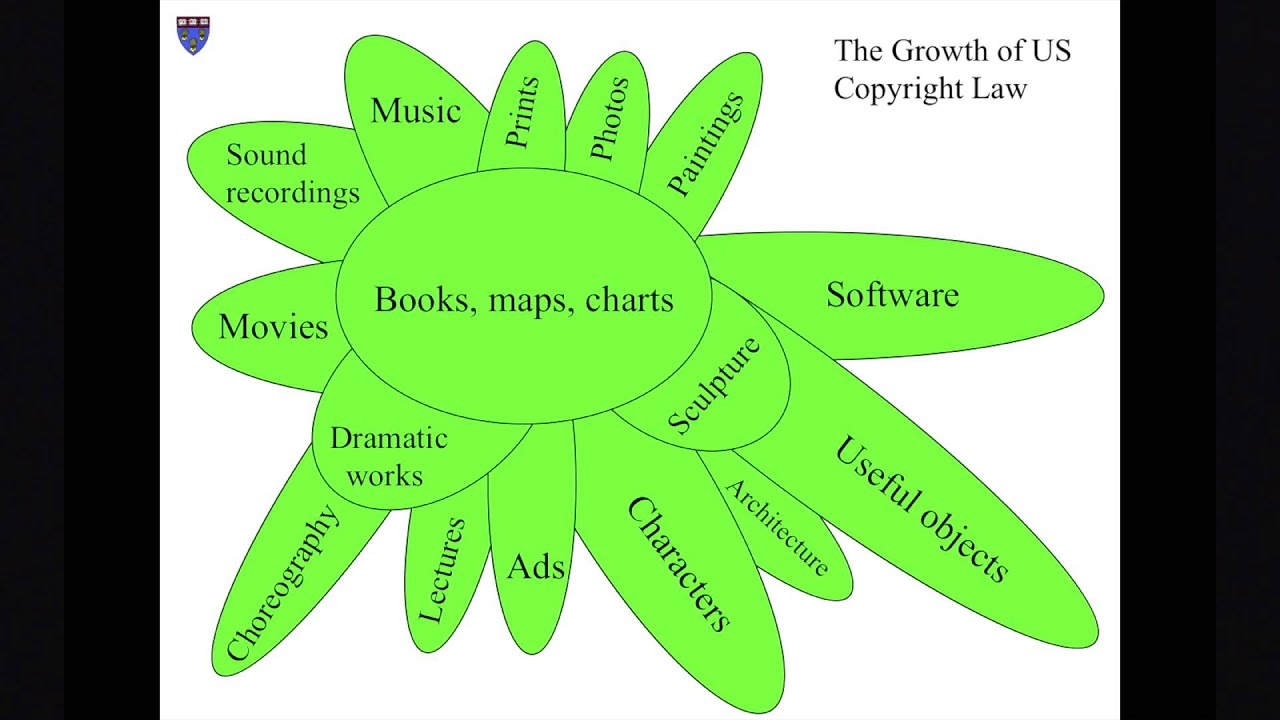
In the next lecture, I'll discuss the subject matter coverage of copyright, what kinds of creations are protectable and what kinds are not. Then, in the lecture after that, I'll return to copyright theory and take up what has become the most influential of the four approaches, namely the utilitarian-based welfare theory. This, as we'll see, looms even larger in policy and law than the arguments we've addressed today.
Thank you.
![Upbeat Lofi - Deep Focus & Energy for Work [R&B, Neo Soul, Lofi Hiphop]](https://img.youtube.com/vi/THh4fT0O7IY/maxresdefault.jpg)