The only three exercises you truly need can transform your strength, balance, and mobility in as little as 15 minutes a day. The common belief that you must spend hours in a gym, doing dozens of exercises, is not just wrong—it's often counterproductive. From a clinical perspective, what most people get wrong about fitness after 50 is the idea that you have to do everything: intense cardio, heavy weights, stretching, balance work.
This information overload is overwhelming and is a primary reason why people fail to remain consistent. However, the biggest mistake people over 50 make has nothing to do with exercise selection. It’s about expectations.
Stiff mornings become accepted as normal. Avoiding the stairs is seen as a smart choice. You start to internalize the idea that, "This is just how it is now.
" Medically speaking, this is a dangerous self-fulfilling prophecy. Every time you lower your physical expectations, your body adapts downward to meet them. When you accept a limitation, you stop challenging the muscles needed to overcome it, which leads to sarcopenia—or age-related muscle loss—and the limitation becomes your physical reality.
You do not have to accept this. This decline is reversible with a targeted approach, using three specific exercises. You don't need a gym, and it’s easy to start even if you've never exercised before.
Today, I will show you the exact three movements that engage every major muscle group essential for your independence. These are scientifically-proven exercises that directly address the biggest physical challenges faced after 50. We will cover the one exercise that is paramount for preventing falls and building total body strength, the movement that maintains upper body power and corrects posture, and the simple exercise that protects your spine.
More than that, I will show you precisely how to modify each one based on your current ability and how to recognize the physical cues that tell you when it's time to progress. Let's begin with the single most important movement for functional longevity. It’s an action you already perform countless times daily, but its proper execution is the cornerstone of physical independence.
I’m talking about the squat. Every time you sit and stand, you perform a squat. The issue is, as sarcopenia progresses, we begin to cheat the movement.
We use momentum or push off with our hands, meaning the primary muscles—the quadriceps, hamstrings, and especially the glutes—are no longer being properly stimulated. This creates a dangerous cycle: the muscles weaken, the movement becomes more difficult, we avoid it or compensate further, and the muscle atrophy accelerates. This is why the squat is non-negotiable.
It directly strengthens the largest muscle groups in your body, which act as the engine for almost everything you do. Beyond just muscle, the squat is a crucial activity for maintaining bone density. As a weight-bearing exercise, it sends a mechanical signal to the cells in your hips and spine to build new bone tissue, which is our most effective natural defense against osteoporosis and fractures.
It also fine-tunes your nervous system, improving the communication between your brain and your muscles. This sense, called proprioception, is what allows you to instantly correct your balance and prevent a simple trip from becoming a serious fall. The beauty of this exercise is its accessibility.
The starting point for most people should be the chair squat. Using a sturdy chair, sit on the edge with your feet planted firmly, about hip-width apart. Lean forward slightly and, without using your hands, drive through your heels to stand up.
Then, with absolute control, slowly lower yourself back down to a seated position. This slow, controlled descent is just as important as the ascent for building strength. Aim for ten repetitions, two to three times per day.
When you can easily perform fifteen chair squats in a row without feeling winded or using your hands, your body is signaling that it has adapted. This usually takes about two to four weeks of consistent practice. The next step is the bodyweight squat.
You will now perform the same movement without the chair. Stand with feet shoulder-width apart. Initiate the movement by pushing your hips back, as if sitting in a chair, keeping your chest up.
Go down as far as is comfortable, then drive through your heels to stand. The goal here is perfect form. When you can perform twelve to fifteen bodyweight squats and feel you could do more, you are ready for the next level.
This is where you can add resistance by holding a light weight at your chest, a variation called the goblet squat. A small dumbbell or even a water bottle will suffice. Remember, the key is progression, not perfection.
Starting with a chair is the intelligent first step in rebuilding your body’s foundation. Having a powerful lower body is the foundation for mobility, but our interaction with the world is often dictated by the strength of our upper body and the integrity of our core. Pushing open a heavy door, lifting groceries, or, most critically, being able to push yourself up from the ground after a fall—these actions all depend on upper body strength.
This is where our second fundamental movement comes in: the push-up. The push-up is perhaps the most scalable exercise in existence, and its benefits for maintaining functional strength after 50 are immense. It is a compound movement, meaning it engages multiple muscle groups simultaneously—your chest, your shoulders, your triceps, and, crucially, your entire core.
From a clinical perspective, the push-up is also a powerful tool for improving posture. With prolonged sitting, many people develop what’s called upper crossed syndrome, characterized by a forward head and rounded shoulders. The push-up strengthens the very muscles that counteract this posture, helping to pull the shoulders back and align the spine, which can alleviate chronic neck and upper back pain.
A proper push-up isn't just an arm exercise; it's a moving plank that teaches the body to remain stable and integrated. Just as with the squat, we begin at a level that is appropriate for you. For most people, this is the wall push-up.
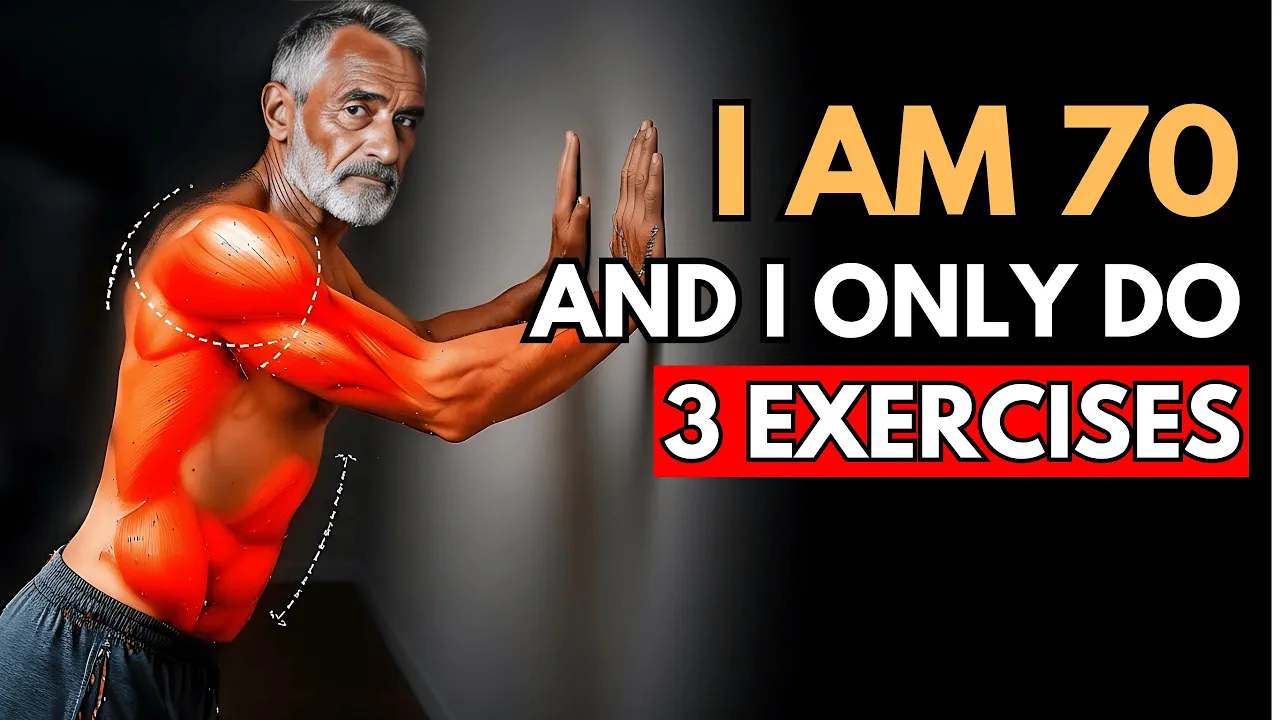
Stand arm’s length from a wall, place your palms flat against it at shoulder height, slightly wider than your shoulders. Keeping your body in a straight line from head to heels, lean in by bending your elbows, and then press back. This builds the movement pattern with minimal load.
When you can easily complete fifteen to twenty wall push-ups without your arms feeling fatigued, it’s time to increase the challenge. We do this by moving to the incline push-up. Find a sturdy table or bench.
The higher the surface, the easier the exercise. Place your hands on the edge and walk your feet back, performing push-ups at this angle. When you can do twelve to fifteen incline push-ups on a surface that's about waist-high, start looking for lower surfaces, gradually working your way down over several weeks.
Eventually, you may progress to the floor. The knee push-up is an incredibly effective version that provides most of the benefits of a full push-up with less stress on the shoulder joints. From your hands and knees, create a straight line from your knees to your head.
Lower your chest toward the floor and press back up. Honestly, for the majority of people over 50, mastering the knee push-up is a monumental achievement and provides all the upper body strength necessary for a high quality of life. Perfect form beats high reps every single time.
The push-up demonstrates how your upper body and core must work together. This brings us to our third and final movement, which isolates that core stability. This brings us to the plank.
This might look simple, but it's an incredibly powerful exercise for building the kind of core strength that protects your spine. Your core isn't just your abs. Medically, we view it as a cylinder of muscles that supports your entire torso.
A strong core is critical for preventing back pain, improving balance, and making every other movement safer and more effective. Unlike crunches, which involve repetitive flexing of the spine, the plank trains the core for its primary function: to resist movement and create stability. This is far more relevant to daily life and much safer for the discs in your lower back.
We begin with the most beginner-friendly version, the wall plank. Stand an arm's length from a wall, place your forearms against it, and hold this position, keeping your body straight. Start with a hold of ten to fifteen seconds.
When you can hold a wall plank for forty-five to sixty seconds without losing form, it's time to move on. Just as with the push-up, we will then do an incline plank. Find a sturdy surface like a couch or bench, place your forearms on it, and hold a straight line from head to heels.
Start with fifteen to twenty seconds. Once you can hold this position for a full minute with rock-solid form, you're ready for the floor. The knee plank is where most people will find the perfect level of challenge.
Drp to your knees and forearms on the floor, creating that straight line from your knees to your head. Holding a perfect knee plank for thirty to forty-five seconds is a sign of excellent, functional core strength. Mastering the knee plank is a massive victory and will give you all the core stability you need for daily life.
The full plank, on your toes and forearms, is the final progression, but it is not a requirement. A rock-solid knee plank is far more beneficial than a full plank with a sagging back. Never sacrifice form for duration.
Now, let's put this all together into a simple, effective routine. Your workout days are Monday, Wednesday, and Friday. On these days, you’ll perform two sets of each exercise.
Start with your squats, doing eight to twelve reps of your current version. Next, move to your push-ups for five to ten reps. Finally, finish with two sets of planks, holding for fifteen to thirty seconds each.
This entire routine is efficient and sustainable. Tuesday and Thursday are your recovery days. This doesn't mean being inactive.
Go for a twenty to thirty-minute walk. This gentle movement aids recovery and is excellent for your cardiovascular health. Weekends are for active recovery—light stretching, gardening, or gentle movement.
The key is consistency over intensity. Your body tells you when to progress. When the top end of the repetition range feels manageable, you are ready to advance.
Trust the process. The goal isn't to reach the most advanced level of every exercise. The goal is to consistently challenge yourself and gradually get stronger over time.
You don't need a gym or expensive equipment. You just need these three exercises and the commitment to start. The best time to start was years ago.
The second-best time is right now.