Hi. It's Mr Andersen and in this podcast I'm going to talk about the skeletal system. Before we get to the human skeletal system you should know that there are two different types of skeleton.
We could have an exoskeleton. In other words we could have our skeleton on the outside, like we find in these beetles. Or we can have an endoskeleton.
That's like us. We have our skeleton on the inside. One great thing about an endoskeleton is it can actually support greater weight.
That's why we can get very big and we're never going to have insects the size of an elephant. And one of the bad things about having an exoskeleton is that as you grow you're going to quickly outgrow your skeleton. So you'll have to molt.
I don't want to say either of these is better because insects rule the world. In fact beetles rule the world. But know that there are two different types.
If we're talking about endoskeletons though it's built on a bone. And if we were to think of, when you think of a bone, you generally think of a bone, like a dried out piece of wood almost. And nothing could be farther from the truth.
And so a bone is live. It's living material. It's filled up with all of these capillaries.
And it's exchanging nutrients with the blood system. And so this is a better picture of what a bone is like. This is actually the ball on the top of a femur that was cut off.
And so around the outside of a bone you have what's called compact bone. And then as we move to inside, you're going to have spongy bone. And then on the inside you're going to have marrow.
And that marrow can be one of two types. It could be red marrow or yellow marrow. Red marrow, just because of its color, red marrow is mostly going to have the building blocks of blood.
And that's one of the important roles of marrow. And then the yellow marrow is going to have way more of this fat. Storing these fatty acids for a time when we actually need it.
And so this is a more intense picture of bone, excuse me, or a diagram of that. And so you can see the spongy bone on the inside. We've got this compact bone on the outside.
But you can see these capillaries are feeding the bone with nutrients. Okay. What's the function of the skeletal system?
We can look at them over here. It's going to be support, movements, storage, blood and then homeostasis. So let's start with the thing that we're all familiar with.
Function of our skeleton is to support us. It holds me up. It also offers protection.
And so I wouldn't be able to stand upright if it weren't for my endoskeleton. And also it protects vital organs. In other words the skull is protecting my brain.
Or this ribcage is protecting my organs in my thoracic cavity. Our skeleton is broken down into two different parts. We have the axial skeleton.
Axial skeleton is going to be made up of the skull, the vertebral column and the ribs. That is really protecting the central nervous system. And a lot of these organs.
And then we have the appendicular skeleton. Appendicular skeleton is made up of everything pretty much out past these joints. And so that's going to be you know your hip, your shoulder blade and your arms and lets.
The appendicular skeleton, the function of that is in locomotion. So speaking of that let's get to the next one which is movement. Bones allow us to move.
But they can't move without muscles. And so one of the big things required for skeletal system are going to be skeletal muscles. They're not directly attached to the bone.
And so they're going to be attached from muscle to bone with a tendon. And that's going to be attached to the bone itself. Now bone can also be attached to bone using what is called a ligament.
But the function of it is to give us movement. In order to get movement, you have to, since bone is static, you have to have a joint between adjoining bones so you can actually get movement. And there are five general types of sockets that you can have.
And they each give us different movement. They are ball and socket, condyloid, saddle, hinge and pivot joint. Let's quickly go through those.
If it's a ball and socket joint, it's basically a ball fitting inside a socket. And so it gives us a huge amount of maneuverability. Two examples in us would be the hip.
So this would be the hip joint. And then the shoulder joint. What's great about these is I have a huge amount maneuverability in my shoulder joint.
What's bad about that? Think of all the ligaments that are holding that in place. And so there's a lot of movement but there can also be a lot of things that go wrong with a ball and socket joint.
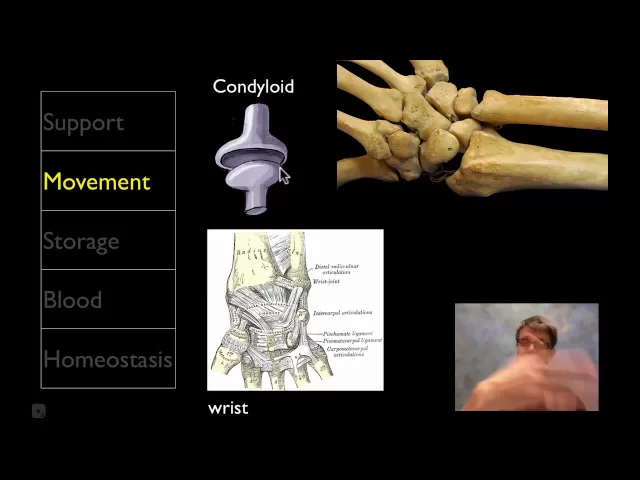
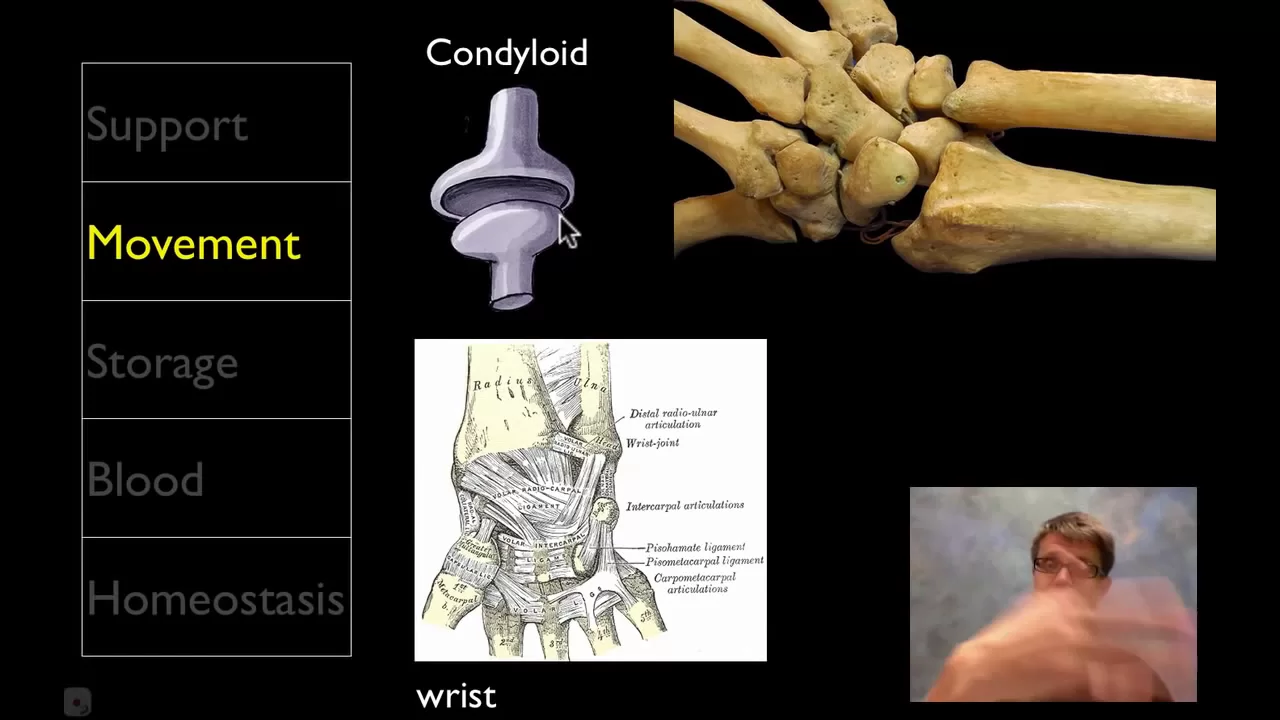
And that's why, especially hip replacement is very common. Next we get to the condyloid. If you look at a condyloid we essentially have this pedestal like this but then we have this going that sits on the top of it.
A perfect example of that would be the wrist bone. And so what that wrist bone gives me is it's going to give me ability to do this flexion, extension and then I'm also going to be adduct and abduct, be able to go either way like that. But I don't have all of the maneuverability that I would get with a all and socket joint.
Next we go to the saddle joint. So saddle joint essentially looks like this. Great example of that would be the thumb.
So the thumb is sitting on one kind of bone sitting on another. And I get a huge amount of maneuverability in my thumb that I just don't have in my fingers. And so we have an opposable thumb.
That basically means you can touch all of the other fingers with your thumb. And that's not super common in the animal world. But you can thank your saddle joint for that.
Next we've got the hinge joint. Just like a door hinge that only moves in one direction. And so your fingers or your phalanges have that.
So basically when you go like this, that's a hinge joint. And you can't move, hopefully you can't move your finger in either direction using a hinge joint. And then the last one we have is a pivot joint.
A great example of that would be where the humerus meets the radius and the ulna. And so my, right here, it's going to be right here at my elbow, basically what I can do is I can move my arm this way and I can move it like that. And so it's just pivoting around that center point.
So all these are joints and they allow movement inside the bones. Now the bones do other things as well. They're going to be a site of storage.
And so it's a living organ. And so if you look inside here, you can see how alive it is. This is actually a diagram of it.
What you'll have are these haversion canals that go through the middle. And that allows blood to flow through it. But then you're going to have these osteocytes which are these cells.
This is a zoomed in version of it. They almost look like a star. And those are laying down new amounts of blood or excuse me, bone.
And that bone is made up of chemicals. So it's a lot of calcium, phosphorus. A number of other chemicals.
But basically it's sitting there. It's giving its structure but it's also storing it. And so when we need calcium or we need phosphorus or when we need fatty acids, when we need fat, then we can grab that from our bone.
Because it's connected right to the circulatory system. It's also super important in blood. And so if we were looking in the marrow, we have what are called pluripotent or excuse me, multi potent stem cells.
So we have these cells that could become any other cell. In fact, look at all the cells that they can become. They can be erythrocytes which are going to be like red blood cells.
But the can also be macrophages and lymphocytes as well. That was the bell. So I've got to hurry up.
Last thing that they do is they help us maintain homeostasis. And so they do that by regulating the amount of blood calcium we have. So a quick example of that.
We have a thyroid and a parathyroid gland. So basically if our blood calcium level goes too high, then our thyroid gland is going to secrete a chemical called calcitonin. And that's going to lower the blood, the blood calcium level.
So it's going to do that by taking in calcium into the bone. That's going to drop our levels. We're also going to secrete calcium in the kidneys.
Likewise, if it goes too low, our parathyroid hormone is going to be secreted by the parathyroid. What's that going to do in the bone? The bone, since it's storing all this calcium, it can now release that into the blood.
We'll hold onto it in the kidney and we'll also get it in the intestines. But all of these things are going to allows us to maintain a stable internal environment. The nice thing about the bone is they're alive and they're connected right to the circulatory system.
So if we need something we can get it really quickly. And so that's the skeletal system. It holds it up.
It holds us up but it does a lot more than that as well. And so I hope that's helpful.