let's say that you would like to build a system to enable a robot like this to pick up objects so this is what the robot sees it sees images from its camera and the goal is to Output uh coordinates in space using some kind of machine that you're going to build that will allow it to pick up objects successfully now this is actually a pretty tricky problem to solve because while you might think that all you have to do is localize where the objects are in the picture and just output their position in reality the
right way to pick up an object is actually actually has a lot of special cases and exceptions that you need to take into account so if you want to really understand the problem and design a solution manually maybe rigid objects are you know fairly straightforward to pick up you just put the fingers on either side but if the object is awkwardly shaped and has a complex Mass distribution then you need to really make sure you pick it up close to the center of mass so it doesn't fall out of the gripper and if the object
is solved in the formable then an entirely different set of strategies might be more appropriate like pinching it so anytime we have a situation that has so many special cases exceptions and little details it makes it very appealing to use machine learning so it'd be really nice to try to set this up as a machine learning problem where instead of having to manual engineer all these little exceptions you could just run uh some kind of a general purpose machine learning procedure maybe with convolutional neural networks to extract suitable grasp locations from the image automatically the
trouble is that the standard tools that we have in supervised learning don't make this very easy because they require us to somehow obtain a data set consisting of pairs of images and suitable grasp locations but the problem is that even people can't necessarily determine grasp locations very well because they're really a property of the physical interaction between the robot and its environment not necessarily something that is very well informed by human intuition to put it simply we don't have a lot of experience picking things up with robot fingers so can we somehow use machine learning
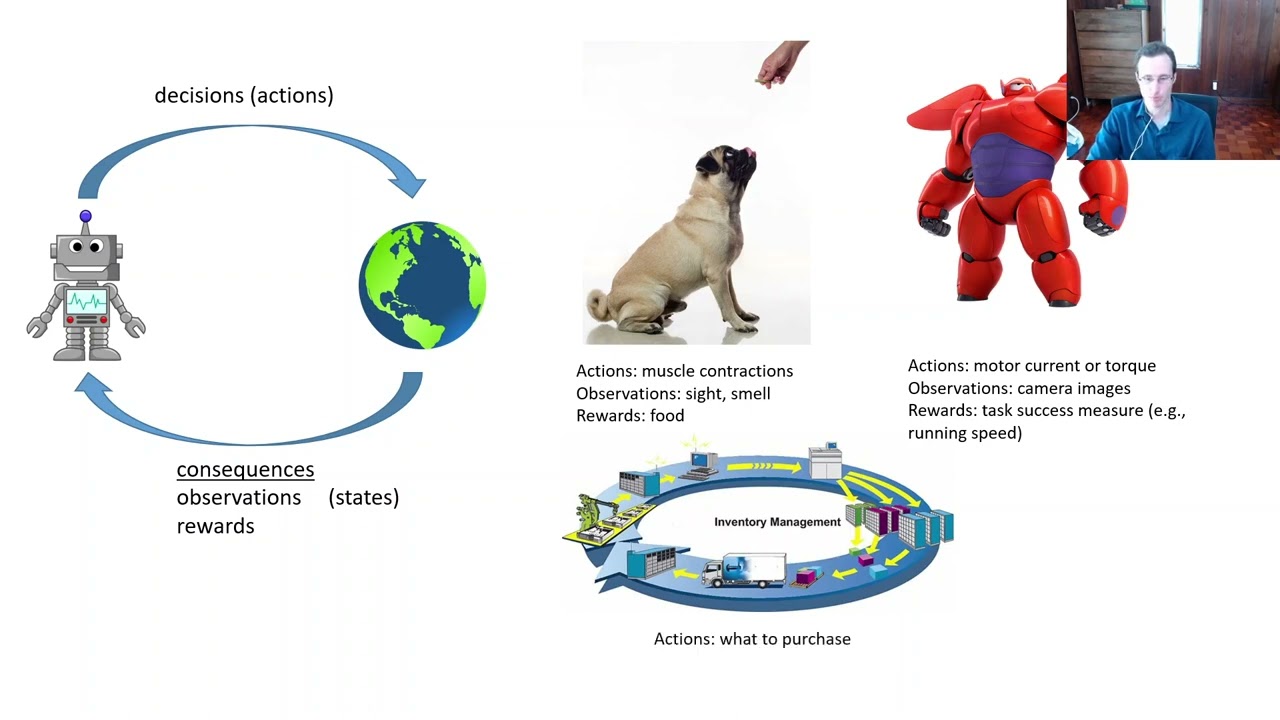
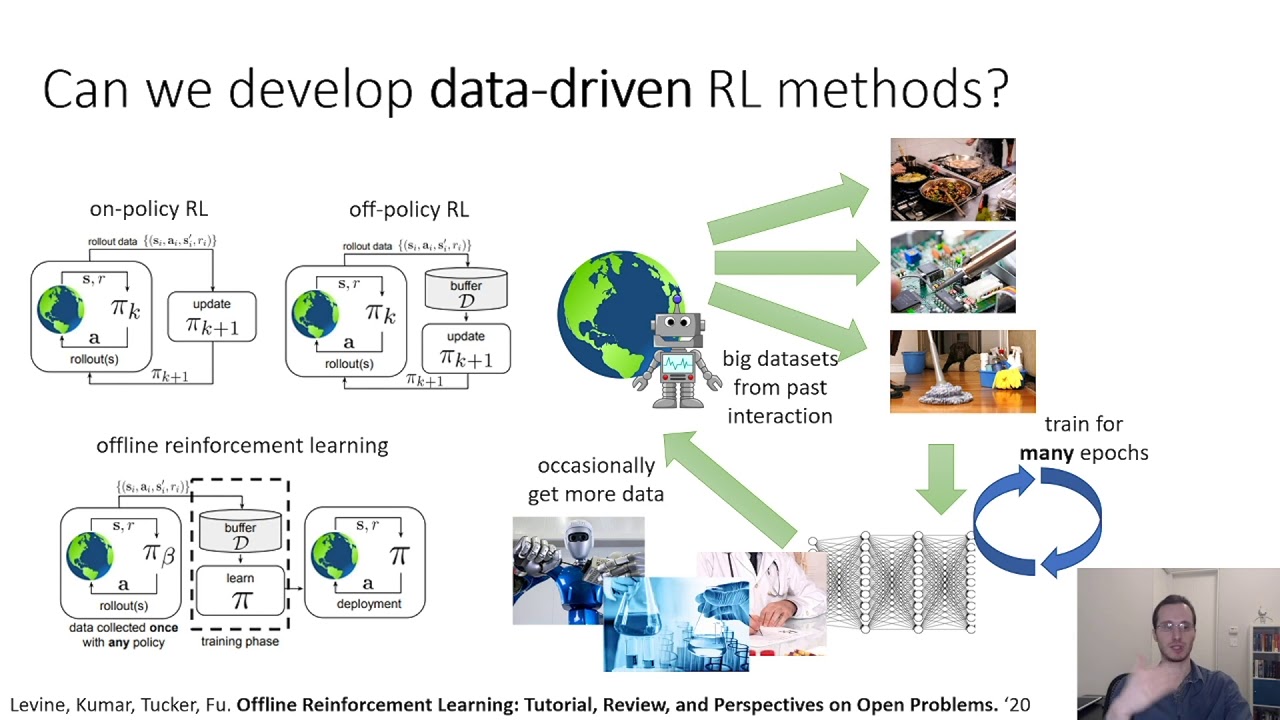
but avoid the need to manually supervise this process well what if we actually get the robots themselves to collect a lot of Trials to attempt different grasps and see what works and what doesn't work that in essence is the main idea behind reinforcement learning and the methods that we'll discuss in this course will in some ways address different uh methods for tackling this type of problem so in a reinforcement learning setting we wouldn't try to manually specify in this case where the robot should grasp objects instead the machines themselves will collect the data set that
doesn't necessarily consist of good examples but examples that are labeled with our outcome so it'll be images what the robot did and whether that led to a failure or success more generally we would refer this as a reward function the robot would be rewarded for success and not for failure and then this will be used in combination with a reinforcement learning algorithm a reinforcement learning algorithm is doing something very different from a supervised learning algorithm it's not just trying to copy everything that's in the data it's trying to use these success failure labels these reward
labels to figure out what it should do in order to maximize the number of successes or to maximize the reward and then perhaps we could get a policy that's actually better than the average behavior that the robot carried out while it's collecting data that actually uses that experience to improve upon what it would typically do Okay so that's kind of the bigger picture but now let's let's put this in the context of what has been happening lately in artificial intelligence what are some recent advances we've seen in AI well the last few years have been
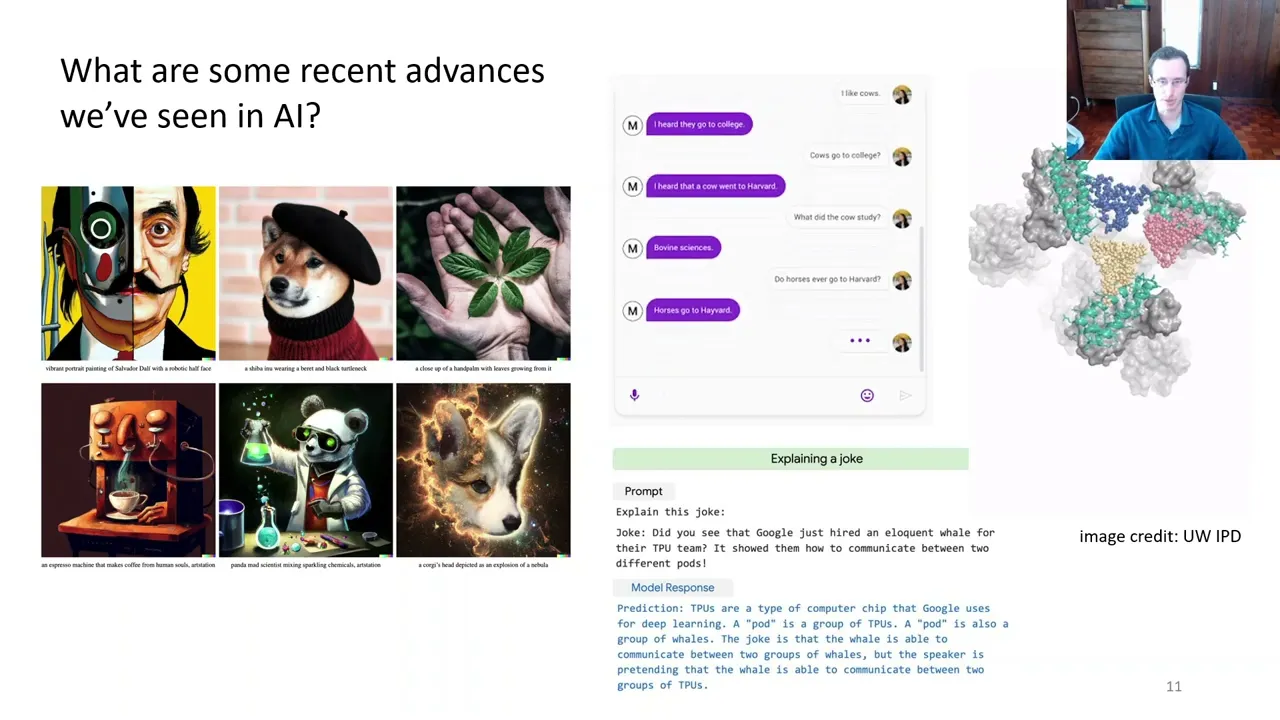
very active in artificial intelligence we've seen pretty impressive advances for example in the ability of AI systems to generate pictures in response in response to a textual prompt you can for example get a diffusion model that where you can tell it please provide a vibrant portrait painting of Salvador to leave a half robot face and will actually generate plausibly looking pictures showing that we could get language models that can carry out conversations that can tell you jokes about cows going to study bowline Sciences at Harvard you can get large language models that act as assistants
that can explain jokes that can even answer complex coding prompts and even outside of the kind of uh standard generative modeling applications we've seen a lot of interesting results for example in biological sciences we can get generative models that will produce uh proteins that will bind to certain kinds of viruses so data driven AI has really Advanced tremendously and we've seen a lot of advances from image generation to text to all sorts of other areas a lot of these advances that have been uh very much in the news in the last few years are based
on in some sense a very similar idea to the supervised learning approach uh that I presented as kind of a straw man in my discussion of the robotic example from before the principle behind the image generation models the language models in many of these other settings is based on essentially a kind of density estimation estimating P of X or conditional that's the estimation would be of Y given X so per language models typically estimate the distribution of natural language sentences the image generation models might be conditional Distributors over images conditioned on that prompt but it's
a very similar kind of idea and in both cases these are really just massively scaled up versions of the kind of density estimation that we learn about in statistics class and of course the a very important thing to remember when you're doing density estimation when you're doing a Centric supervised learning is that what you're learning about is the distribution in the data and that makes it very important to think about where the data actually comes from so if the data consists of large amounts of images mined from the web for example and those images are
labeled as textual problems then what you're really learning about is the kind of images that people put on the web the kind of pictures for example they might photograph in the case of text you're learning about what people tend to type on keyboards now these are very good things to learn from if your goal is to generate content that is similar to what humans would have generated if your goal is to generate the kinds of paintings that humans would have drawn on the kind of text that humans would have written and that can give you
a very powerful capability but of course that's not the only thing that we want from our autonomous systems so what does reinforced learning do differently well before we talk about that we need a little bit of kind of historical background on what modern reinforce learning is and where it came from and really modern reinforcement learning traces this lineage to two previous disciplines the first one which is the one that's actually called reinforcement learning actually has its roots in it's like in Psychology and particular in the study of animal behavior so this is a photograph Skinner
who is a very well-known uh researcher who studied the behavior of animals in response to various kinds of reinforcement and much of the work stemming from that line of research forms the Bedrock of the kind of reinforcement learning that we do today in computer science Which models an agent that's interacting with this environment and adapting to its environment in response to Rewards but there's a different uh kind of pedigree that also heavily influences modern reinforcement learning which has to do with controls optimization and also has its roots and things like evolutionary algorithms this is a
video from 1994 produced by Carl Sims that shows an optimization procedure which Tims did not call reinforcement learning if you refer to it as Evolution but had some more similar principles that was used to optimize both the form and the behavior of these virtual creatures so these virtual creatures would do things like locomote swim run around they would even fight each other and their behaviors would be optimized they would be immersion so this is very different from the kind of machine learning that we think about today where the goal is to reproduce the behavior of
humans hear the behavior the goal was to actually produce behaviors that did not need to be designed by humans and if we fast forward uh a couple decades we can see with more sophisticated algorithms for in this case automated optimization and control this is a result by you will tell so that shows a humanoid kind of simulated robot automatically figure out how to do things like Walk and Run and so on so these two disciplines together actually influence the study of modern deep reinforcement learning which could be thought of as the combination of large-scale optimization
with the kinds of uh algorithmic ideas and Foundations derived from classical reinforcement learning and that's actually very powerful because once we take those classical reinforcement learning ideas and we'll scale them up with the tools of modern computation and optimization then we can get very powerful emerging behaviors so many of you probably know about alphago there was a very traumatic moment in the alphago championship match that was sometimes referred to as move 37 where the alphago system performed a move that experts watching a game are very surprised by and it was surprising because this is not
the kind of move that human players would have likely made in these kind of situations it was an emerging Behavior now the generative AI results that we've seen in recent years are very impressive precisely because they look like something that a person might produce the pictures of pictures that a person might draw the most impressive results of reinforcement learning are actually impressive precisely because no person had thought of it what makes the results in alphago so interesting to us is the emergence the fact that an automated algorithm could discover a solution that goes beyond what
people would do and this is really really important if we're going to take the study of AI seriously because we probably won't get the kinds of flexible intelligence that we associate with humans if we merely copy human behavior we really have to figure out how to get algorithms that discover solutions that are the best solution to the task rather than merely the solution that a person would have taken because then when placed in novel situations the election respond intelligently so this is the the motivational program going to talk about and in the remainder of this
lecture I'll take you through the structure of the course and then describe a little bit more some of the motivations for why we should study deep reinforcement learning today

![[AUTOML23] A Tutorial on MetaReinforcement Learning](https://img.youtube.com/vi/XUQ9jLOZqGc/maxresdefault.jpg)