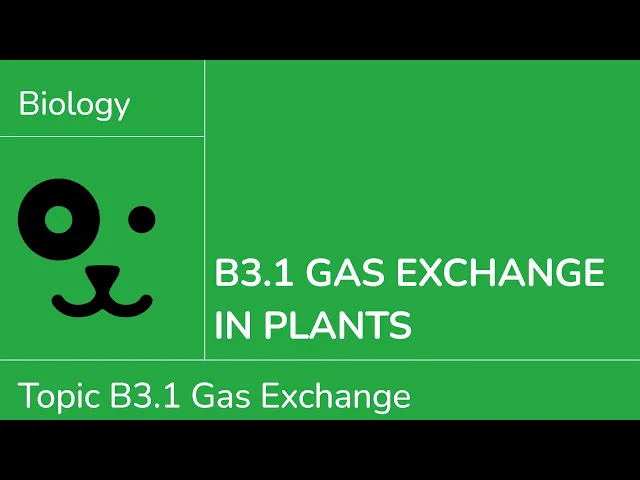
in this video we'll be focusing on gas exchange in plants and this is the standard level or core material on the under side of leaves you'll notice very small openings called stoat so sto singular stomata plural and these are openings that allow air to come in or out and one of the consequences of having that open is that the plant will experience water loss more on that later but we want to keep our eye on the stoat as areas of exchange for those gases and here they are in this side view right here okay so
these sto okay or this sto or these stomata these are openings and they're really helpful for gas exchange let's talk about some of the other structures in this leaf that help with this so on the upper side of the leaf you're going to notice this upper epidermis um on the bottom you'll notice the lower epidermis and the upper epidermis May be covered with a waxy cuticle so these epidermis is just like the epidermis of your skin it's there to help protect the leaf and that waxy cuticle is there to help prevent any excess water loss
you'll also notice that there's a row of very tightly packed cells here this is called the Palisade mesop and this is where we're going to see a lot of photosynthesis okay so these cells are going to be tightly packed with chloroplast they're there to absorb sunlight and that's why they're also at the upper surface of the leaf in the middle here is this area called the spongy mesop and it's spongy because there are holes so you'll see all these air sacks here that is also highly adapted for gas exchange okay so when these Palisade mesophyll
cells are doing lots of photosynthesis they need to be able to get carbon dioxide in so maybe I should write that here these guys need carbon dioxide to go into their cells and they need oxygen to come out so in that gas exchange process we need room for those gases to move and so those gases are going to move through these spaces in the spongy mesop and then in and out of these stomata now gas exchange is great it's necessary to get that carbon dioxide in and that oxygen out but one of the consequences of
having those stomata open is that the plant is going to experience water loss so water is going to move from areas that are very moist to areas where it is dry that's why if we want to set our clothes out to dry we do it in an area that's dry not like a super moist like bathroom or something like that so that water loss is called transpiration the movement of water water or the loss of water vapor from the leaves so when we think about how water moves through plants it's not really helpful to think
about it as being pushed from the bottom up what's happening here is that water is actually evaporating through those stomata and that water vapor that is evaporating pulls the water molecules up through the xylem and the root that's covered in another chapter or another topic on water what we need to understand here is that there are certain factors that make transpiration happen faster or slower so the higher the temperature the more transpiration is going to happen that's because we're going to have more evaporation from the leaf now if I have a very humid area out
here like lots of water content that's going to result in less transpiration because it's a smaller difference in water Vapor content now plants aren't just at the mercy of their environment they can also control the water L by opening or closing those stomata surrounding those stomata are these structures called guard cells okay so guard cells can be found on either side of the stamata the stata is just the opening and they can fill with water and swell and that's going to cause the stamata to open or water can be removed from those guard cells and
then they collapse back together but the opening and closing of the stomata is controlled by those guard cells and it's one of the ways in which the plant can control um that gas exchange so remember those stomata need to stay open for gas exchange to get that carbon dioxide necessary for photosynthesis to come into the plant so controlling that is very very important function for these plants now here's a really fun experiment if you want to try this on your own this apparatus is called a pitometer and they can look different there's some different variations
here but they all have a few things in common so one of the things that I'll um point out here is that I'm going to have some kind of a waterfill tube connected to a leaf and that waterfill tube simulates the xylm or that tube where water is going to move through the plant so as water exits the plant via transpiration okay that's going to happen through the leaf what will happen is that that that movement of water should pull water in this column up through this tube if you have done a good job setting
up this Pomer you've also introduced an air bubble into that line so as water is pulled through this tube the air bubble is is going to be pulled along and we can actually measure that um using something something like a ruler so once you've measured the distance that the air bubble has gone you can multiply that by the um surface area Okay of the diam that involves the diameter of that tube and you can actually calculate the volume of water that has transpired or moved through that plant if you want to do another trial you
use use this Reservoir so you open up this valve and you um open this Reservoir that will push this air bubble back to the starting point okay but Pomers are really great for measuring transporation another great thing to measure about plants is something called the stodal density so when I think about density this isn't mass per volume like in an object stomatal density is going to be the number of stomata in a given area so maybe like per square cm or something like that there's a couple of methods that you can use to investigate this
this is going to be determined by the type of plant you have so if you have a plant where the lower epidermus is easy to peel off you can just peel that off and you can mount it on a slide and what we'll notice is that there are holes in the epidermis each of those holes is a stom or you can alternatively paint the bottom of that epidermis or the bottom that underside of the leaf with clear nail polish and then when it dries you can peel that off and that's being a cast and you
can study it underneath of a microscope and you'll get an image like this so you can count the stamata so once you know the area that you are working with you can then count the stamata and whether or not they're open or closed that's another thing you can take a look at but the stomatal density is just the number and then you can compare this for different species of plants or plants of the same species that grow in different areas there are a lot of variables that you can investigate here all related to adaptations for
gas exchange in these plants
![B3.1 HL Transport of Respiratory Gasses [IB Biology HL]](https://img.youtube.com/vi/F66K2WUlGdA/maxresdefault.jpg)
![B3.1 Gas Exchange in Animals [IB Biology SL/HL]](https://img.youtube.com/vi/1OqMFq43spw/maxresdefault.jpg)
![B3.2 Transport in Plants [IB Biology SL/HL]](https://img.youtube.com/vi/AwgOrrrvGds/maxresdefault.jpg)
![B3.2 Transport in Animals [IB Biology SL/HL]](https://img.youtube.com/vi/wgBvMkybdyo/maxresdefault.jpg)




![B3.2 HL Transport in Animals [IB Biology HL]](https://img.youtube.com/vi/tkv0Z_SUdv4/maxresdefault.jpg)



![B4.1 Adaptations to the Environment [IB Biology SL/HL]](https://img.youtube.com/vi/dcr6HKLvRiM/maxresdefault.jpg)
![B3.2 HL Transport in Plants [IB Biology HL]](https://img.youtube.com/vi/iWLxi9Xh35E/maxresdefault.jpg)
![A1.1 Properties of Water [IB Biology SL/HL]](https://img.youtube.com/vi/1e8mbEeaIGU/maxresdefault.jpg)

![D3.1 Plant Reproduction [IB Biology SL/HL]](https://img.youtube.com/vi/s7fbzKjr7aM/maxresdefault.jpg)
![B1.1 Lipids [IB Biology SL/HL]](https://img.youtube.com/vi/-fzIaXjSrNo/maxresdefault.jpg)