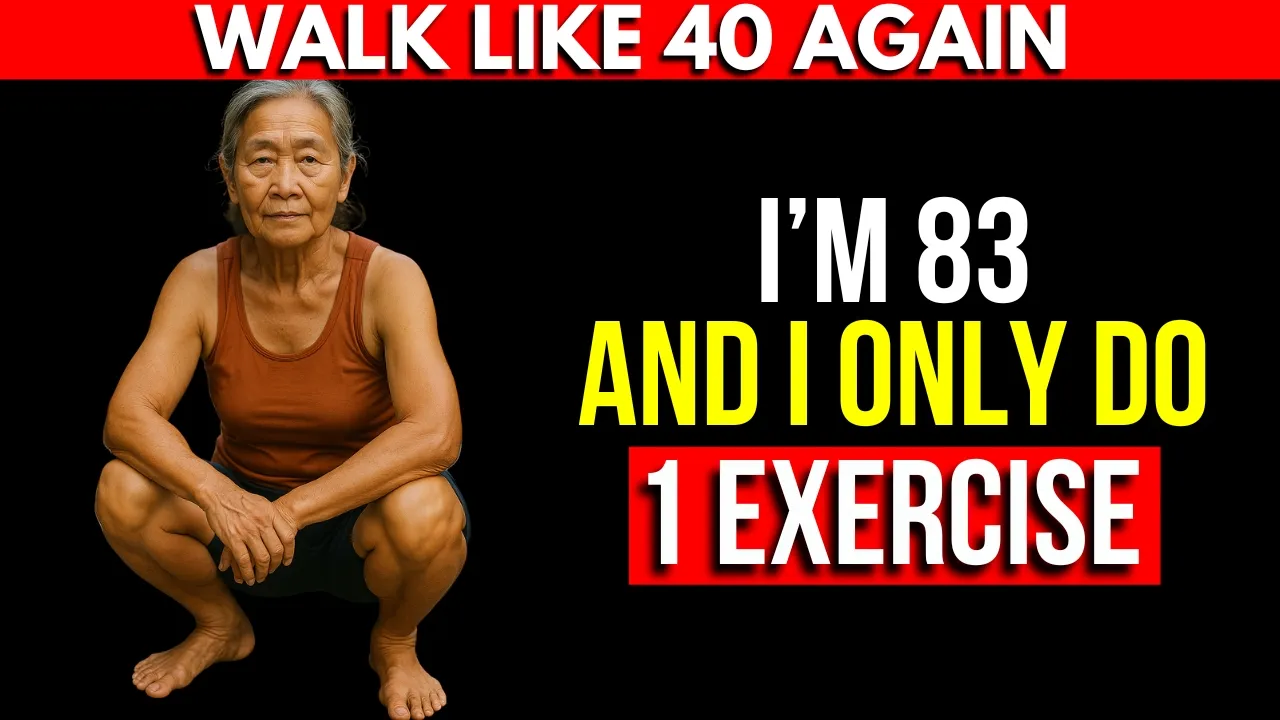
I want you to pay close attention for a moment because what I am about to tell you may challenge something you have believed for years. Many seniors are told that certain movements are simply off limits after 60, especially the deep Asian squat. You may have heard that it destroys your knees, strains your back, or is only possible for people who grew up doing it.
But let me ask you a question. If this movement is truly impossible or dangerous for older adults, why do we see 70 and even 80 year olds around the world settling into that position for long stretches of time as comfortably as sitting in a chair? I have treated older adults for more than 20 25 years and one thing I have learned is that the body does not stop learning just because of age.
What actually changes is how we use it. In many parts of Asia, people grow up moving in ways that keep the hips, ankles, and back strong and adaptable, and that pattern continues naturally into old age. Here in the United States, we spend decades sitting in chairs, cars, couches, and office seats, and the body slowly forgets how to move the way it was designed to.
So, the real question is not whether seniors can squat. The real question is whether we give our bodies the chance to relearn the movement. I want you to imagine me standing here in a full suit, lowering myself into that deep position just to prove a point.
It is not a trick. It is not genetics. It is simply understanding how the body works and how to guide it safely.
And that is why I want you to stay with me today. If you have avoided this movement because of fear, if someone told you that you are too old or too stiff or too fragile to even try, I want to show you a different truth. The problem is not your age.
The problem is the story you have been told about your age. By the time we finish this video, you will understand exactly why older adults around the world can squat comfortably and how you can begin reclaiming that ability one small step at a time. And before we go any further, please comment below with your name and where you are watching from because I always love seeing who is joining me on this journey.
Most people think they cannot do the Asian squat because of age or genetics. But the truth is far simpler and far more hopeful. After more than 25 years working with older adults, I can tell you with confidence that the real problem is not age, it is control.
When you try to lower yourself into a deep squat, your body has to coordinate several big muscle groups all at once. And if those muscles have not been trained for many years, they simply do not know how to support you. Your weight shifts backward, your heels pop up, your hips feel tight, and before you know it, you are falling onto a chair or bracing yourself with your hands.
That is not a failure of age. It is a failure of practice. Your glutes, your hamstrings, your quads, and your hip flexors need to work together like a team.
And [clears throat] when even one of them is too stiff or too weak, your whole body loses balance. This is why so many seniors feel unsteady when they try it. The hips cannot fold deeply enough.
The ankles cannot stay flexible enough. And the core does not hold you forward the way it should. So your body does what bodies always do when they lack control.
It protects itself by tipping backward. What I want you to remember is that none of this means you are broken. It simply means those muscles have been asleep for a long time.
Years of sitting in chairs, lifting your legs only part way, and avoiding deeper movements have taught your body a pattern that makes the squat feel impossible. But the moment you start reawakening those muscles, something changes. The stiff places begin to soften, the weak places begin to strengthen, and the whole movement becomes less frightening.
You do not have to chase perfection, and you do not need the flexibility of a gymnast. You only need to give your body the chance to relearn what it once knew. When you understand that the real barrier is not your age, but the way your muscles have been conditioned over time, the entire movement starts to feel less intimidating and a lot more possible.
I want to share three stories with you today. Stories from people who remind me every single week why I never accept the idea that age limits progress. The first is a 68-year-old Japanese American man who came to me frustrated and discouraged.
He told me that even when he was young, he was never flexible and simple movements like letting his knees drop toward the floor during stretches always felt impossible. Then he moved to Vietnam to retire and suddenly he was surrounded by older adults who could sit on the floor with ease and settle into a deep squat for long stretches of time. He said he felt like the odd one out, the only person who needed his arms behind him just to sit upright.
Instead of giving up, he made a decision. He told me he was tired of watching his body decline, tired of feeling like he could not keep up with the people around him. And he asked me to guide him.
That commitment alone changed everything because the moment he started working at it consistently, his body began responding in ways he never expected. The second story is from a 70-year-old woman who once told me she could barely stand up from her chair without pushing hard on the armrest. She remembered the first time she tried a half squat and said her legs were trembling after just a few seconds.
But she did something powerful. Every week she added a tiny bit more, a little deeper, a little longer, a little more control. One day she told me she had finally lowered herself all the way into a deep squat.
She could not stay there long at first, but it did not matter. What mattered was that she had crossed a line she once believed was impossible. She looked at me and said, "If you think something will help you, just keep trying a little at a time.
" And she was right. The third story still gives me chills. A 79year-old woman who had spent years avoiding movements that felt too difficult watched one of my squat lessons and decided to try.
At first, she could not bend her legs enough to pick something up off the floor without holding on to furniture, but she kept practicing. She kept showing up for herself. A year and a half later, she told me she was not only squatting, she was squatting with a bar on her back and 31 pounds of weight.
She said it without bragging, almost laughing at how far she had come. And then she added something that stayed with me. By the way, I am 79 years old.
These three people are not athletes. They are not exceptions. They are simply older adults who stop believing the story that age means decline.
When you hear their journeys, I want you to imagine your own because if they can discover strength and mobility, they thought they had lost forever. You can too. There is something I see often in my clinic and I want to talk to you about it honestly because it can quietly hold people back for years.
I call it the physically feeble fallacy. It shows up when someone struggles with a movement and instead of saying, "I cannot do this yet," they say, "No one my age should even try that. " I hear it when a friend warns another friend not to bend too low or not to challenge themselves or not to attempt something new because they believe that difficulty is the same as danger.
And I understand where it comes from. When your body feels stiff or unsteady, it is natural to want to protect yourself. But the problem is that this fear can spread from one person to another until it becomes a story that keeps everyone stuck.
What I tell my patients is simple. You do not have to do any movement. you do not want to do.
You never have to force yourself into something that does not feel right for your body. But if you choose not to do it, that choice belongs to you and it does not need to become a warning to everyone around you. When you tell someone else they should not even try, you take away the possibility that their body could get stronger or more capable than you expect.
Improvement at 60 or 70 or 80 is not just possible. I see it every week. So if a movement does not feel right for you, that is perfectly okay.
Honor that. Listen to your body. But do not let your own limitation turn into someone else's ceiling.
The moment we stop assuming that older adults are fragile is the moment we start discovering what the body can still do when it is given the chance. One of the most important things I teach my older patients is that your body will trust a movement only after it becomes familiar with it. And the deep squat asks your hips to move in a way they may not have practiced for decades.
That is why before we dive into the full strength work, I want to give you two simple strategies that start waking up the hips safely. The first one is something you can do right where you are sitting. All you do is take one leg, lift it with your hands, and place your foot up on the seat beside you.
It does not have to be perfect and it does not have to look pretty. What matters is that you create that tight angle between your thigh and your torso, the same angle your hips need in a deep squat. Some of you will lean back a little at first, and that is completely fine.
Others will feel a good stretch deep in the hip, and that is exactly what we want. As you get more comfortable, you can pull the foot a little closer, lean forward a little more, or open the hip slightly to the side. Every one of those small adjustments teaches your joints what it feels like to approach the squat without loading your knees or your legs.
It is a way of telling your body this position is safe. You can breathe here. You can settle here.
And it is incredibly effective. The second strategy is something you can do on your bed even before you get up in the morning. You come onto your hands and knees or onto your forearms if that feels better and gently start shifting your hips back toward your heels.
As you do this, you want to keep a soft arch in your lower back, almost like a gentle U-shape. That part is important because if your hips are tight, your body will want to cheat by rounding your spine. And that is when people start feeling pinching in the front of the hip.
We do not want that. Instead, I want you to move slowly enough that you can feel your glutes and the deep muscles of your hip working and releasing as you slide back. You stop when you feel a barrier.
Breathe into it. Tighten the glutes a little. Relax them.
and see if there is a tiny bit more space. Over time, this motion begins to mirror the bottom of a squat, but without the strain or the fear of losing your balance. What I love about these two strategies is that they reintroduce your hips to a range of motion they were designed for, while keeping your knees and back completely supported.
You can do the first one on your couch while watching television and the second one under the covers before your feet even hit the floor. They are simple, they are gentle, and they build the foundation you need so that when we move into the deeper work, your body already knows the path. Once your hips begin to recognize the position and no longer react with fear or stiffness, that is the perfect moment to start building the strength and control that make the Asian squat truly possible.
The first exercise I teach is a bent knee, hamstring, and glute stretch. And it might surprise you because it does not look like a traditional stretch. You take a sturdy chair, place it against a wall so it will not slide.
And then you keep your knees slightly bent as you push your hips back. Your heels stay lifted so your weight shifts into the balls of your feet. And that one detail makes all the difference.
It sends the stretch directly into your glutes and the high part of your hamstrings, the exact muscles that need to lengthen for a deep squat. You can reach toward the floor if you are able, or simply place your hands on the chair for support. What matters is that you explore the tight spots and breathe until they soften.
When you stand back up, you will feel a deep release that makes the bottom position of the squat more accessible. The second exercise is all about strengthening the muscles that support your knees and keep you from falling backward. You hold on to a stable surface and practice assisted squats, lowering only as far as your body feels safe.
The key here is keeping your weight toward the front of your feet, not in your heels. At first, you may only be able to move a few inches, but those small reps are exactly what teach your quads how to work in deeper angles. Some of my patients find it helpful to pause at the hardest part and hold for a few seconds before rising again.
Others gently bounce in that challenging zone so their muscles begin to wake up and stabilize. Over time, your goal is to reach the point where your hamstrings can actually touch your calves at the bottom. But you never rush this.
You build it inch by inch, rep by rep until the strength shows up naturally. The third exercise focuses on the hip flexors, the muscles at the top of your thigh that control how far forward you can lean in a deep squat. When these muscles are weak, the body has no choice but to fall backward, which is exactly what so many older adults experience.
To fix that, you sit tall in a chair and lift one knee as high as you comfortably can, feeling those top muscles engage. You repeat this for several reps. And if you want to challenge yourself, you can hold the top position for a few seconds or place a light weight on your knee and lift against that resistance.
That simple movement trains the exact strength your body needs to stay upright even when your hips are folded deeply. When you combine these three exercises, something powerful happens. The tight muscles begin to stretch.
The weak muscles begin to strengthen. And your nervous system finally understands how to support you in a deep squat. It is not magic and it is not youth.
It is the result of precise training done with patience, awareness, and the belief that your body is still capable of learning. Now that you understand the movements and how each one supports your hips, knees, and balance, I want to give you a weekly structure that makes this entire routine feels simple and doable. In my clinic, I have seen over and over again that progress does not come from pushing hard once in a while.
It comes from small, consistent practice that your body can actually recover from. That is why the stretching work, especially the bent knee, hamstring, and glute stretch, is something I encourage you to do every single day. It does not need to be long.
Even one minute at a time, repeated throughout the day, teaches those deep tissues to soften and adapt. The strength work is different. Your muscles need time to rebuild after they are challenged, especially after 60.
So, I recommend you choose two or three days each week to practice the assisted squats and the hip flexor lifts. Think of it as Monday and Thursday or Tuesday and Friday or any pair of days that gives your legs at least one day of rest in between. When you follow that rhythm, your body stays strong without feeling worn out or overwhelmed.
But the real secret to mastering the Asian squat is something much simpler. Every single day, once or twice, I want you to check in with your body and see how close you can get to the bottom position. You do not have to force it.
You do not have to hold it. Even lowering yourself a few inches and noticing how it feels teaches your brain and your joints to communicate more clearly. I call this the daily squat challenge, and it is the reason so many of my patients make faster progress than they expect.
These tiny moments of practice act like little reminders to your nervous system, telling it to stay flexible, stay curious, and stay engaged. Over time, these short, gentle attempts build confidence, build control, and suddenly that deep squat that once felt impossible begins to feel like something your body remembers. When you follow this weekly structure consistently, your muscles get stronger, your hips get more mobile, and your balance improves without ever feeling like you are pushing too hard.
It is a routine designed to support your body, not stress it. And it gives you the steady progress that makes long-term change not just possible but inevitable. One thing I want you to keep in mind as you work through all of this is that your body does not respond the way it did when you were 20.
After 30 and especially after 60, the idea of pushing yourself at 110% is not only unnecessary, it is often the fastest way to get hurt. I tell my patients all the time that smart training beats hard training every single day. your joints, your muscles, and even your nervous system.
Make progress through steady, controlled effort, not through maxing out or forcing your way through pain. When you move into a deeper squat or try a new stretch, your goal is not to power through it. Your goal is to listen.
If something feels sharp or pinchy, especially in the front of the hip, that is your body telling you to ease up. If your knees start to feel overloaded after a few repetitions, that is your cue to stop and reset instead of grinding through it. The people who make the best progress at 60 and 70 are never the ones training the hardest.
They are the ones training the smartest, the ones who know how to stay just inside the edge of discomfort without crossing into strain. When you work this way, your body adapts in a way that feels safe, steady, and sustainable. The deep muscles of your hips learn to open.
Your quads and glutes build strength without inflammation, and your balance improves because you are never shocking your system. Think of it as guiding your body forward rather than dragging it. Every time you choose patience over intensity, you are protecting yourself from setbacks and giving your joints the chance to build real resilience.
And that is how seniors make lasting progress. Not with force, but with awareness, consistency, and the confidence that slow and steady truly does win this race. Now that we have walked through every step together, I want you to take a moment and really feel the progress you have made just by understanding your body differently.
Most people go their whole lives believing movements like the deep squat are out of reach after a certain age. But you now know exactly why that is not true and exactly how to rebuild the strength, the control, and the confidence to do it safely. If even one part of this video opened your eyes or gave you hope, I would love to hear it from you.
Let me know what you found most helpful or inspiring in this video by dropping me a comment down below. And to make it easy, just answer this simple question. Did this make you feel more confident about trying the squat yourself?
Yes or no? Your answer matters because it helps other seniors see that they are not alone and that progress is possible at any age. And if you found this video helpful, hit like.
Share it with someone who might need a little encouragement. Subscribe so you never miss the next lesson. And as always, remember that pain sucks, life should not.