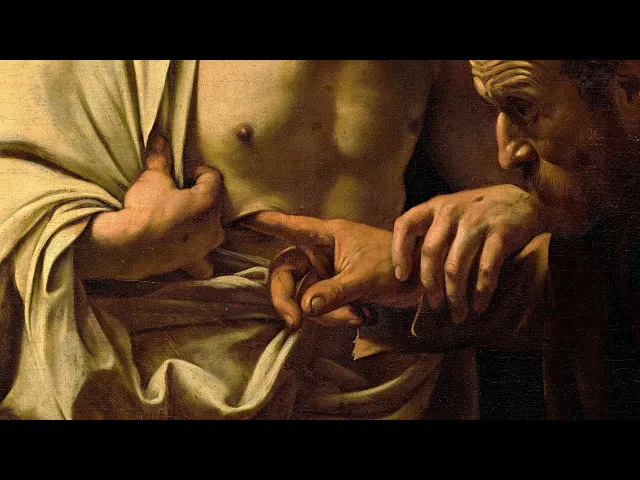
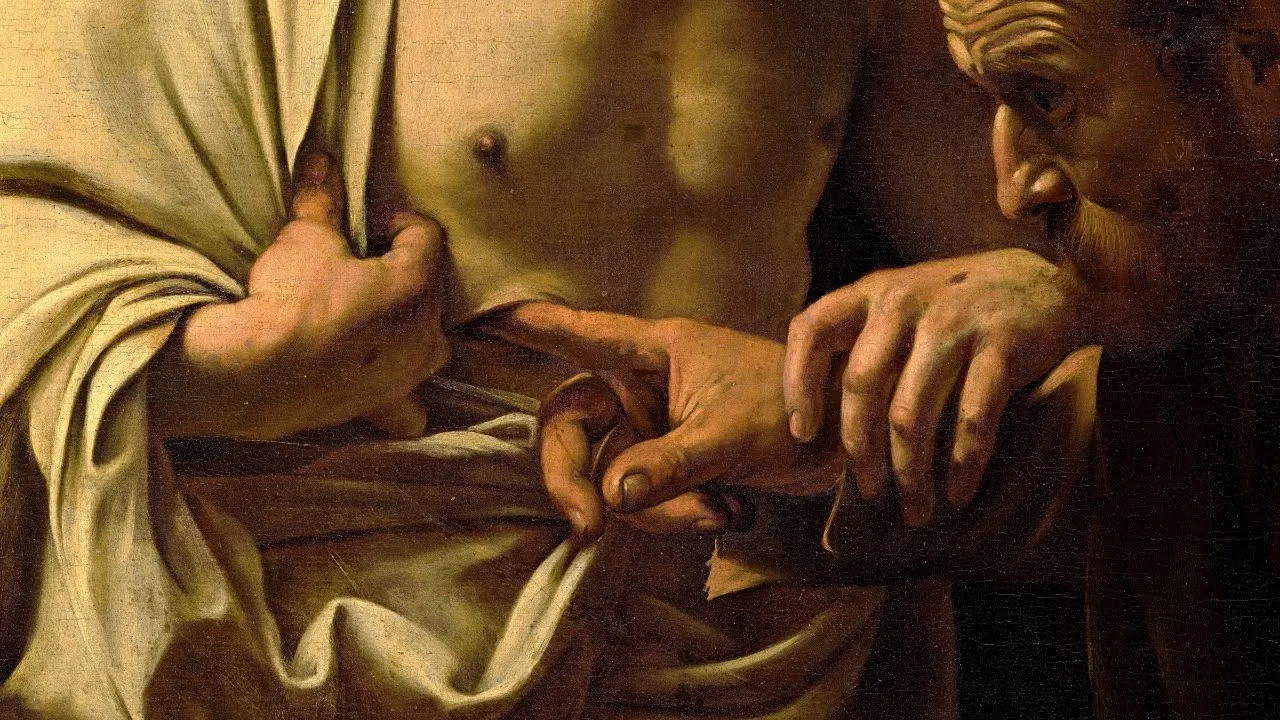
The painting you are about to see was created by Caravaggio in 1602, and it is possibly one of his most extraordinary works. In it, we see three men immersed in darkness, closely observing something unfolding before their eyes. Standing before them is Jesus Christ, who has risen in their presence.
However, Saint Thomas refuses to believe it. Jesus takes his hand and guides it toward the open wound in His side, placing Thomas’s index finger directly inside the gash. The level of detail in this painting is extraordinary, and this, combined with the extreme naturalism of the Baroque master, heightens its impact.
The violence, the realism, and the strong contrast between light and shadow, so characteristic of Caravaggio’s work, come together to create an absolutely fascinating scene. The Incredulity of Saint Thomas was a private commission by Vincenzo Giustiniani, one of the most influential art collectors in Rome at the beginning of the seventeenth century. Giustiniani, in addition to being a powerful banker of his time, was also a highly knowledgeable connoisseur of painting and a passionate art collector.
He asked Caravaggio to represent the biblical moment in which the apostle Thomas doubts the resurrection of Christ, a passage from the Gospel according to Saint John found in chapter 20. In this episode, Thomas declares that he will not believe unless he places his finger into the wound in Jesus’s side. The scene was perfectly suited to Caravaggio’s style, as he was known for his radically realistic and emotional approach.
Unlike other artists who portrayed the divine through symbols, Caravaggio depicted biblical figures as real people, with wrinkles, dirty feet, human gestures, and fully expressed emotions. What sets this work apart from other traditional representations of the same subject is precisely this approach. Caravaggio removes all religious or decorative elements.
As we can see, there are no halos, no celestial architecture, and no golden details, as was customary at the time. Instead, the painting shows only four human figures in a dark, enclosed space, completely focused on the moment when Thomas inserts his finger into Christ’s wound. Over time, the painting passed through several hands.
After remaining in the Giustiniani collection for more than two centuries, it was acquired by the Prussian state in the nineteenth century. Today, it is housed in the Sanssouci Palace in Potsdam, Germany, as part of the art collection of the Prussian Cultural Heritage Foundation. Analyzing the scene, on the left stands Jesus Christ, upright and slightly leaning forward.
His torso is bare, and a white shroud barely covers his waist. With a calm expression, He holds Thomas’s arm with one hand and, with the other, gently pulls the cloth aside to reveal the open wound in His side. There is no gesture of reproach in His face, no sign of judgment toward Thomas’s disbelief, only a patient invitation.
Facing Him is the apostle Thomas, deeply focused, with a furrowed brow and his gaze fixed on the wound. He has extended his hand and, with his index finger, is inserting it directly into the opening. Beside him, the heads of two other disciples emerge.
Their aged faces appear astonished and equally absorbed in what they are witnessing. Neither of them intervenes; they simply observe. Their eyes are also fixed on the wound, and by doing this, Caravaggio creates a circular movement that pulls us in as viewers as well.
When looking at the painting, it becomes almost impossible not to direct our gaze to the exact point where the finger enters the flesh, just as the three apostles do. As mentioned earlier, the scene is inspired by the passage from the Gospel of John, chapter 20, verses 24 to 29. It recounts how, after the Resurrection, Jesus appears to His disciples, but Thomas is not present.
When the others tell him what has happened, he responds skeptically, saying, “Unless I see the mark of the nails in His hands, and put my finger into the mark of the nails, and my hand into His side, I will not believe. ” Eight days later, Jesus appears again and speaks directly to him: “Bring your finger here, and see My hands; and bring your hand here and put it into My side; and do not be unbelieving, but believing. ” What is extraordinary about this painting is that Caravaggio does not depict the moment of faith, but the precise moment of doubt in the process of transformation.
We do not see Thomas kneeling or apologizing to Jesus. We see him still examining, still searching for proof that will allow him to believe. This is the great difference between this work and many other representations of the same scene, where Thomas merely looks.
Caravaggio, going against tradition, paints Thomas explicitly inserting his finger into the wound. The realism of this painting is so intense that it can feel uncomfortable. Christ’s flesh sinks under the pressure of the finger.
The skin opens, and Caravaggio renders the tension of the muscles and the moisture along the edge of the wound with such precision that we can almost imagine the sensation of touch. Nothing is idealized here. Not the bodies, not the gestures, not the moment itself.
Thomas does not even look like an apostle; he resembles an ordinary working man, with rough, hardened hands. Even his fingernails are dirty, and although this may seem like a small detail, it is entirely intentional. It reinforces the idea that this scene does not take place in heaven, but on earth.
Visually, the painting is a perfect example of the style that turned Caravaggio into a revolutionary figure, known as tenebrism. The entire scene is wrapped in darkness, with no recognizable background or landscape. The backdrop is black and opaque.
Only a single light source, coming from outside the frame, sharply illuminates the most important areas: the faces, the hands, and above all, the wound. It is as if a flashlight had been switched on in the middle of the night, suddenly revealing the scene. Now, when The Incredulity of Saint Thomas was completed, not everyone was impressed.
The rawness with which Caravaggio chose to represent this biblical scene made many people uncomfortable, especially within more traditional religious circles, creating a major controversy that is still debated today. But before getting into that, I’d like to remind you that if you’d like to collect this work, you can do so by purchasing a reproduction through the link in the description. On our website, you’ll find a catalog of more than 800 carefully selected historical artworks, perfect for starting your own art collection.
Worldwide shipping is free, and by purchasing from the store, you’re supporting me directly and helping me continue creating videos like this every week. I’ll leave the link in the description so you can place your order once you finish watching the video. Now, let’s continue.
In the seventeenth century, in the heart of Catholic Rome and under the influence of the Counter-Reformation, sacred art was highly regulated. The images created by artists were expected to be clear, pious, and exemplary for the faithful. Showing Christ in such an intimate gesture, exposing His wounds, and doing so without any supernatural elements such as a halo, completely broke with traditional models.
For many, this was not a representation of the divine, but a scene that reduced the miracle to an almost anatomical verification. Moreover, Christ’s body does not appear radiant, but pale, marked by visible signs of suffering. His face does not express majesty, but a deeply human calm.
This, in part, was what proved most controversial. The idea that God could be represented with such a level of humanity, with vulnerable flesh touched by dirty hands, in a dark and enclosed space, clashed directly with the visual canons of Christianity. Although the work was appreciated by its patron, its style has sparked debate among theologians for more than four hundred years.
Some have considered it irreverent, others a masterpiece. Over time, its influence has been immense. But in its own era, The Incredulity of Saint Thomas was an act of rebellion, proving that art could go beyond decorum and dare to represent faith in a completely human way.
Thank you for watching this video until the end. As always, I’d love for you to share your opinion about this painting in the comments. See you in the next video.