welcome to the start a pre-calculus or college algebra if you're in one of those two classes or you just want to study this to get ready for calculus which is awesome this is going to give you a lot of background information on what makes calculus possible and the math behind doing a lot of the calculus that you might have been exposed to or have forgotten frankly because we all forget things and that's okay that's what this course is intended to do is to teach it to you in a way that you remember or remediate you
in a way that you can understand so to start off with pre-calc or college algebra we need to understand what we're going to be dealing with um so the the whole premise of this this class is that we're going to be dealing with functions almost exclusively in in college algebra and therefore pre-calculus so we're going to discuss in this video what a function is what makes a function a function how to determine whether something is a function and then we'll start exploring how to uh how to evaluate functions how to find the domain and the
range of functions in in another couple videos so let's start with that most basic question if we're going to be dealing with functions what what in the world is a function and mathematically it's it's really kind of a our most simple sort of an idea that we can graph a function is something it's this relationship that takes one input and just Maps it mathematically to one output that's it you plug in one number you get one number out that's all a function really means now I always tell my students students face to face that some
sometimes we know just enough information to make it sort of dangerous and we sort of um project other things onto a definition I'm not talking about one toone functions and we're going to explore that a little bit but keep this in mind that a function it's most basic sense and a one toone function are different things um so when we say a function don't add to this definition it's just a relationship that Maps one input to one output that's it so we plug in one number we get out one number now when we when we're
talking about this when we're talking about our inputs and our outputs we're talking about functions for this course our inputs are almost exclusively x x values and our outputs are almost exclusively y values or F ofx the function that's based on that X we're going to talk a little bit about the independent variable and we'll talk about the dependent variable as we move on so so in this the the vocabulary that I want to get you to know is function what that means what are inputs and what are outputs what is the domain in the
range and then this idea of independent and dependent variables so what we've learned right now is that a function is a very basic relationship it takes one number in it gives you one number or one thing one input in and one output out so our inputs are almost always X values they can be different but typically X's while our outputs are y values or F ofx values and we'll talk about that notation in just a bit I guess the biggest note that I want to get to get across right here that you that sticks with
you is this right here in a function relationship a functional relationship an input never gives more than one output so if we uh if we start plugging in numbers and we go all right well let's um let's plug in the number four and sometimes this relationship gives you seven and sometimes it gives you -2 it'd be very hard for us to graph that because it wouldn't be Dependable um the the output wouldn't depend on the input the same way every time it' be really really difficult to to graph and to deal with it'd be difficult
to count on that so can we do we have um these nonf functions that we can graph yeah we do typically we use parametric equations or some other idea to graph them sometimes different coordinates like polar coordinates which we learn about in like a calculus 2 level class but for right now in order for us to graph things well and easily we need functions we need it so that one input gives you one output and an input never gives you more than one output so long story made real short if you plug in One X
you better only get out one y or one output one F ofx value so um a couple notation issues that we're going to deal with number one we typically see functions as either y or F ofx so when you see them when you see y equals something in terms of X or f ofx equals something in terms of X they mean the same thing they both stand for this function notation now we want to talk a little bit about what x means what that is and what Y is or what f ofx is so when
you see that variable X that input value whether it's X or something else the thing that you're plugging into that input it's called your independent variable so in our case when it says y equals some function of X or when we're talking about a function of X that X right there that's what we're inputting that X variable that's an independent variable your input is always your independent variable why what's that what's that mean well independent is kind of like what we want to be we want to be independent people we want to make our own
choices we want to self-actualize we want to determine what we're going to do we want to plug in our own stuff and that's what the independent variable gets to do so we get to plug into the independent variable we say I can put anything I want that makes sense we'll talk about domain the things you can plug in in just a little bit but but really we choose the independent variable first and then the output the Y the dependent variable well it depends on what we've chosen you don't pick your output and then find the
input that works for that not typically typically we choose our x value we choose what we want to plug in we choose our in our input we choose our independent variable X and then our output is based on that so when we look at our functions Y is in terms of X or a function that's based on whatever this variable is that's your independent variable so in our case right here what we're talking about our input values our X values our inputed independent variable is X so X we call that our independent variable because you
get to choose it now once you've chosen or once it's been chosen for you once you've plugged that in put an input or evaluated for that X variable for your independent variable whatever that is that input the function is going to turn something out the function is going to take that one value and it's going to give you one value out we call that value either the Y value or we call it an A F ofx value or a g of X or whatever the function is we call it that value so y or if
we're using function notation F ofx I'm pause right here for a second please extrapolate from this if your function's name isn't F if it's like G or H that's still an output value so if we have a function with a different name and we're going to talk about why we have different names for functions in just a little while this lesson is just to get your your feet wet on what functions are that's why it's introduction um but extrapolate from this so y values and F ofx values they mean the same thing but if our
function is a different name we might use G of X or h of x h of X depending on what that function is named um right there that might give you a clue as to why we have function notation because if everything's called why it'd be like everyone in the world be call being called Jim you go hey Jim and everyone goes yeah you go ah shoot man we need different names that's one reason why we have function notation so you can call one function f and one function G and one function H or whatever
so back to this if x is our independent variable that you're plugging numbers into and your function is churning out an output that's either y or a function name of X depending on your independent variable this depends so this is this is um this is not a chosen value this is what you're given your one output dependent on what you just plugged in so this one you choose this one you don't that's why it's called the dependent variable now what's nice about this is together they make up an ordered pair so when you deal with
a function and and you plug in a number and you get something out well well wait a minute our input values are X's our output values are y or F ofx and this is going to give us an ordered pair something that we can graph almost all of this class I'm going to relate back to graphing and show you that this makes sense graphically so when we're moving forward we know right now hopefully that from what I said before that we're going to be graphing functions and without a functional relationship one gives you one output
it's very difficult to graph so I've already covered the Bas like hey we need functions cuz we can really only graph functions right now so what what's that allow us to do if you have a function relationship your independent variable your X your input is going to be the first piece of information on an ordered pairs it's going to be that first thing that horizontal axis whatever that is X or t something your output is either y or we could have X comma some function notation those are going to be the two standardly accepted um
ordered pairs that we get input output it's all that relates to it so just a little 10-second recap to make sure you got it one input gives you one output in a function if that's not the case you don't have a function an input never gives you more than one output in a function relationship how we write it is either y equals something with x's in it or f ofx equals something with x's in it something with an independent variable something you get to pick to choose in uh to put in there and then your
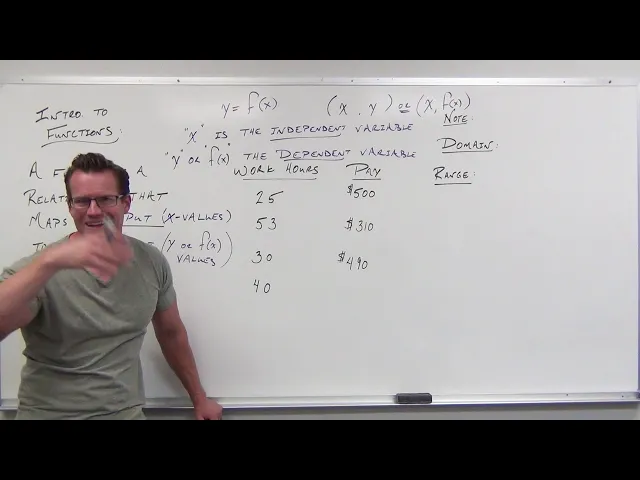
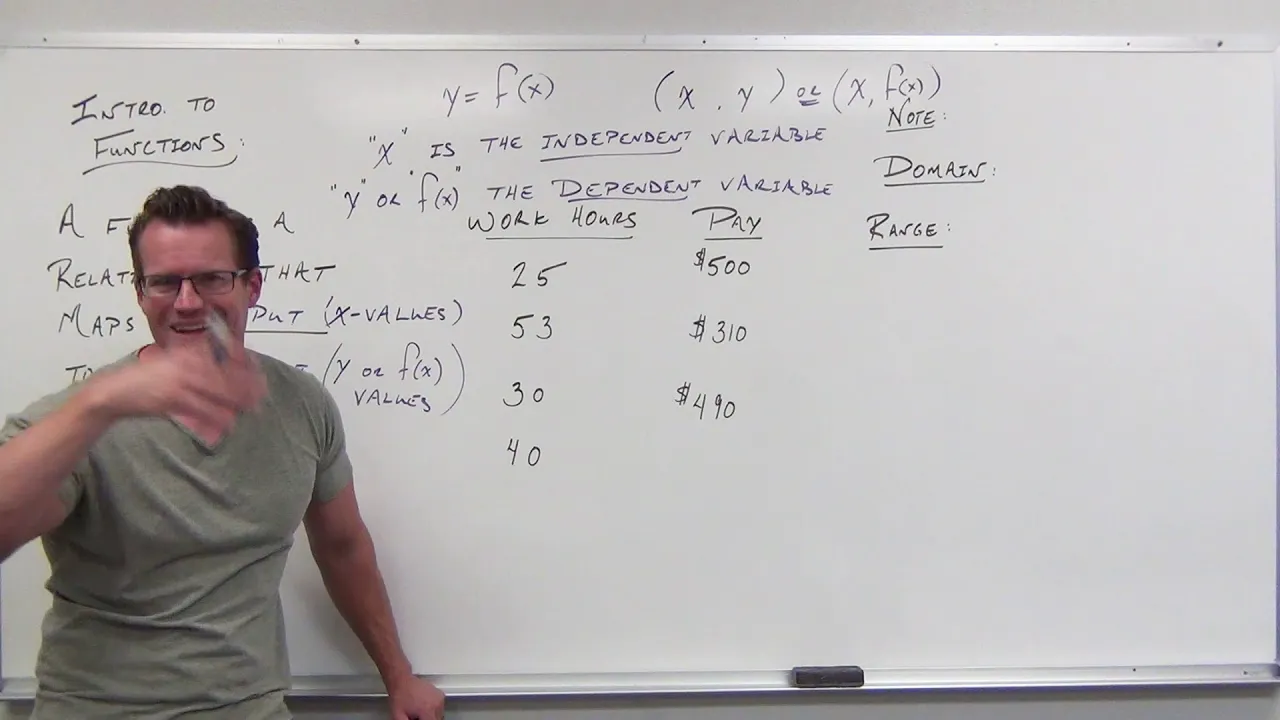
function gives you one output we call the in X our independent variable and y or F ofx the dependent variable because it depends on what you've just chosen let's go through one quick example to make sure that you're you're really seeing it that you're seeing what a function does so you might have a job maybe you don't have a job a lot of our jobs in society work on hours so the hours that you put in determines the pay that you get out you guys know that so if you work more hours you typically hopefully
um get more pay well in this case I want you to think right now that what what are your inputs and what is your output do you input $500 and then get to work 25 hours if that's true come work for me I got a great job for you all right you pay me 500 bucks I'll let you work 25 hours it doesn't work that way you put in the time you get out the money so you put in 25 hours you get out something so I want to make a little relationship here and we're
going to determine whether this is a function or not so some guy works 25 hours and makes $500 another person Works 53 hours and only makes $310 at first glance you might be going well that's not that's not right well do people have different jobs are do you make the same rate as everybody else for doing different jobs well that's no even in the same job sometimes someone might have more seniority and make more money based on whatever whatever the pay structure is so don't be confused that this doesn't make sense because it can make
sense like that someone else Works uh 30 hours and makes $490 and another person Works 40 hours and makes $490 what I want to do right now is number one again determine the inputs and the outputs and you have to do that first because what we're going to check next is does every input give you exactly one output so that's the only things you check here to make sure that you have a function don't add to that definition so first our inputs I mean we be thinking let's see what what what's Happening Here what are
we doing first and then what are we getting out of it we're putting in our hours first our inputs are 25 53 30 and 40 in just a moment because there really should be no suspense in math because you're learning right so in just a moment we're going to call those inputs the set of values that we're inputting into a function we're going to call that the domain the stuff we get out of it is called our range so domain is a set of our inputs I'll Define that in a minute range is a set
of our outputs so so one more time we're looking at what we do first to get out something later our inputs are what we're plugging in first our domain this set of X values right here are our inputs our outputs are 500 310 and 490 that's our range now here's the only thing you got to check to determine whether this thing is a function look at your input and see if it gives you one output so if I work 25 hours do I make one value of money yeah I make 500 bucks if I work
53 hours do I make one value of money yeah I make $310 if I work and remember these can be different people uh that's why they have different rates if I work 30 hours can I make one value of money yeah 490 if I work 40 hours or someone else reach 40 hours do they make one value of money yes 490 this right here is a function relationship please don't get confused with the one: one function like I said sometimes we know just enough to misinterpret things what a one: one function is is when you
plug in one number and you get out one unique number so in this case this wouldn't be one: one because you get 490 twice as two different outputs that's not the same idea as being a non-function all the function needs is I plug in one number I get out what number I don't care if we get the same number out every single time we could plug in uh this like different inputs and get the same number on a horizontal line forever so you plug in five and get out 10 plug in seven and get out
10 plug in 50 and get out 10 plug in a million get out 10 so we can do that in function relationships it's okay in a function to get out the same number twice that's okay the only thing I promise the only thing is one input gives you one output this input one output this input one output this input one output this input one output didn't matter if they're the same think about maybe uh maybe you and somebody else if they're making different rates of money could this guy work 30 hours and make that much
money sure could this guy work more and still make the same amount of money if they have different rates that makes perfect sense that's totally fine this guy's just making a little bit more money per hour than this person is is that making sense you stop right now and think if that makes sense that this is certainly a function one input is giving you one output so right now what we have that's a function relationship and our inputs are 25 53 30 and 40 our outputs are 500 310 490 and we're going to rename those
in just a bit domain and range now I'm going to change it we're going to see if this is still a function so let's say that we do all of this we keep it exactly the same and I add one thing all right tell you what uh I'm going to do this right there and so this guy's pretty happy right he's working 25 hours he's getting 500 bucks that's dependable this guy's working 3 hours making $310 no problem this guy's working 40 hours getting $490 it's he knows what he's going to get imagine being this
person and I'm not talking about overtime I'm talking about where your pay you you've you've not agreed to a pay rate change and so you work 30 hours and your boss comes to you and says hey great great deal man I'm going to give you $490 today you're like woo that's awesome and then uh the next day comes to you or the next week he comes to you tell you what you work 30 hours but um I just feel like giving you 300 $10 and you're like wait wait a minute what he's like I just
feel like it and you're like I'm not I'm not really happy with that why well because you hadn't agreed upon rate right you agreed to work 30 hours to make that much money what if he just feel or she just feels like giving you that much money and what if you can't depend on it and you never know well that's not a very good working relationship is it because you don't know what you're going to get out for your work that's exactly what a function has a problem with if you have more than one output
for the same input it doesn't know what you're going to get out of it it's the same exact thing it's working for you right the functions do some work it needs to know what you're getting out so this right here this is fine this is fine having two different inputs go the same output that's fine this right here having one input go to two different outputs that is a no-o that's a non-starter for a function we're not going to deal with that in this class right here but this is a this would be a problem
this would need something to redefine the scenario um so to make it to make it right and so later on we can do that in higher classes right now you you might say well this is a condition like here you're making whatever per hour and here you're making something different per hour and it depends on the scenario but as it stands right now this would be a nonfunction so we have inputs we have outputs one input gives you one output no problem we kind of went through this and said when do functions happen what do
they look like what's a nonfunction nonfunction is when this case is not met when one one input gives you more than one output that's a big problem for us so with functions we have what's called a domain and AR range our domain is a set of all the inputs or all the values that the independent variable can take and get a real number out let say that again for functions we're not talking about imaginary numbers right now we're not going to be graphing those on a a real coordinate plane okay so what we're talking about
for the domain is the set of these things that give you one of these things out that's a real number in other words the domain is a set of all the inputs that you can have for a function so right here if we just want to relabel this domain the domain is going to be the set of the inputs it's just 25 53 30 and 40 that's what we're choosing to work that's the hours that we put in the range is the set of the outputs for our y's or the whatever dependent variable is in
our case if we just want to relabel this range our outputs are the range so the range of numbers that we get is a 500 390 and sorry 310 490 that's what we're talking about when we have the the idea of a domain and range domain is just a set of inputs that you can put into the function and get a real number out when we start talking about imaginaries we're going to we're not going to be really talking about functions that are graphing for a while but for graphical functions things that we're functions that
we're graphing here and we graph those on a real coordinate plane our inputs is called The Domain the outputs are called the range so inputs X's we gr jump those together jumble those together group those together in the domain idea and all the Y's or f ofx g ofx whatever your function is that's your range I hope that makes sense what we're going to do is we're come going to come back with a few examples I'm going to show you how to determine um when a relationship even an algebraic relationship represents a function and when
it doesn't so we'll be back in just a second all right let's continue so I have a few examples on the board obviously and we're going to determine whether these relationships even algebraic are functions or not and there's some really easy ways to tell sometimes it's I'm going to make it so it's pretty obvious to you so you look at and go yeah that's that's not going to work the key here is that with functions one input gives you one output and not more than that let's look at these two first just get a feel
for it so right now what I want to do is look at the relationship s and look at the relationship R and I want you I need you to be able to pick out all your inputs and all your outputs so when we're looking at s remember inputs values are X values are independent variable values so our inputs here are -21 0 and 1 do any of those repeat at all so -2 1 0 and 1 there's no repetition this can't I don't even care about the outputs not at all because right now checking functions
is does one input give you one output if an input is not repeated Well it can't possibly have a different output so when I say ne -2 what's the output for that it's 16 there's no other case where it's not 161 gives us an output of four zero gives us an output of three one gives us an output of four every input gives us one output now our output values here the 16 4 3 and four oh wait yeah the four is repeated but that doesn't matter this would fail to be a one: one function
but it's certainly a function there's it's just a very basic definition one input gives you one output if we're looking at something that just has a series of points then sorry a sequence of points then if our inputs are all different we can't possibly have the same input mapped to two outputs so for S this is certainly a function how about R think through it on your own so just a little bit think through I need you to be thinking about what the inputs are right now we should be checking those so in your head
you should be reading through those inputs going okay it's this this this and this maybe look at the outputs read through those four outputs and determine what those are and then make a decision whether R represents a function or some other type of relationship you should be thinking of it in your head right now um when I look through this and I see -2 3 5 and -2 but wait a minute -2 here is ma to 5 -2 here is ma to six one input that's the same number is giving us two different outputs that's
a problem this is certainly a nonfunction because of these points right here -25 and -26 now I've been asked the question before what if that was a five would it be a function it'd be very awkward to write the same point twice you you wouldn't see it but yeah that would be because this -25 and if this number was a five -2 would still give you five um so we we'd look at that a little bit but you're really not going to see that U the point here is that every input is not giving you
just one output in these cases these ones are fine these two not so much this would be a non-function I hope that's making sense to you now unfortunately um we don't always get stuff like that we typically get functions that are in algebraic form naturally so man how in the world are we going to determine that well there's a couple ways to go through it and once we make it to this these two examples it's going to be pretty clear so here's the idea if one input is supposed to only give you one output you
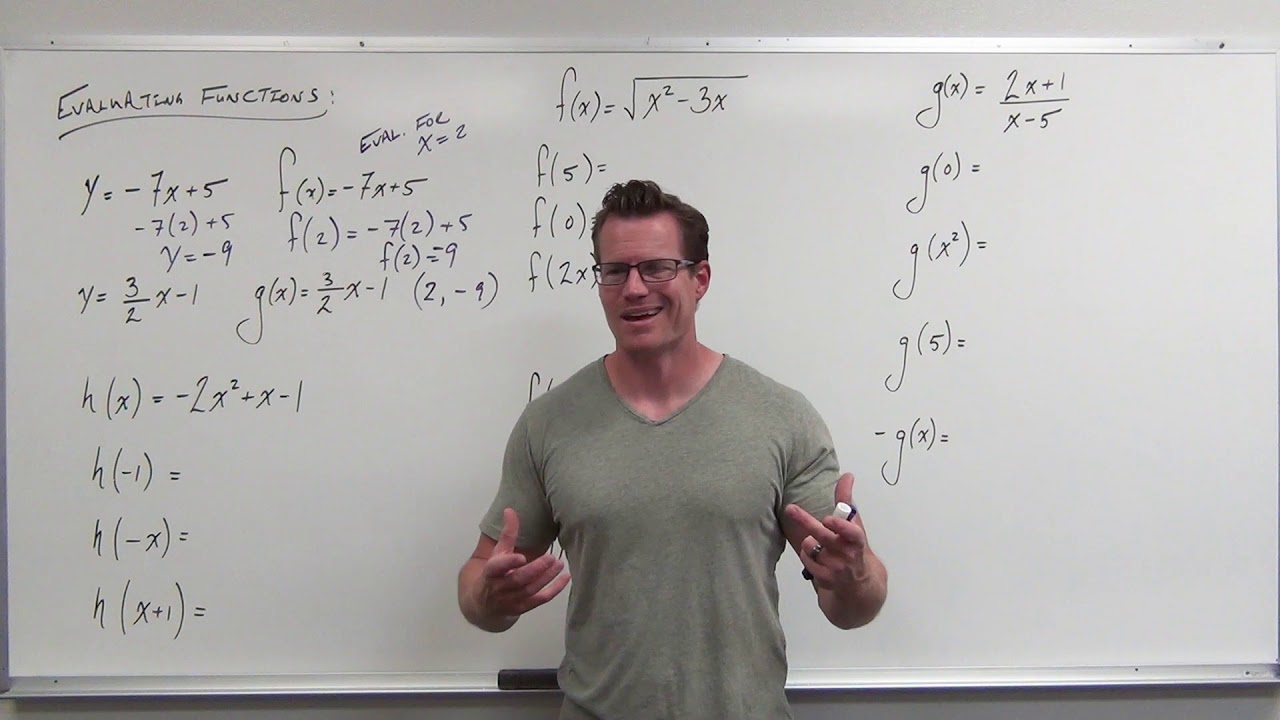
can start by just plugging in a number to your independent variable like X so if you take and plug in something like two7 * 2 is -14 + 5 is9 oh hey that's one number you can try that and that's a really good indicator um that you're going to be plugging in one number all the time and get one number out does it work all the time no it doesn't um because sometimes we can have nonf functions where certain inputs do only give us one output but others give us more than one so it's better
to kind of understand what's going on here there's two things that you really look for and they're really the same thing but they come in two different forms number one if you look at these four examples these three are all solved for Y which looks pretty nice and that's the best way for us to determine whether we have a function or not so normally what we're going to do is choose to solve our algebraic equations for y and we'll have a much better shot of determining whether it's a function function so this one looks really
good this one looks fine this one looks well at least it's Sol for y it looks like crap but it's at least they're Sol for y this one not so much so part of this is reviewing how to solve things for a variable um especially when we get to this one right there I really need you to focus on that one so when we're solving for a variable we're undoing the equation everything that's connected by addition subtraction first and then we're going to undo um anything that's multiplied or divided so we would do things like
subtract 2x now it from both sides and we get -4 y on the right hand side -2x + 8 then to get rid of the -4 notice how it's connected by multiplication we're going to divide you just need to make sure that you divide every single term by4 when you're trying to undo things connected by addition subtraction you're trying to get zeros that's what we did here we subtracted 2x because we wanted to get zero why because 0us 4 y can give us that single term4 y completely eliminates a term when you're dividing or multiplying
you're trying to get ones why because if I get4 /4 giving us 1 1 * y it's an identity that multiplicative identity of one is going to give us back the Y so we're going to be dividing by four actually -4 and we have to do it on all three terms so4 /4 that's POS 1 that's what we're looking for because 1 * Y is y when we adding or subtracting you're trying to make zeros in equations when you're multiplying or dividing you're trying to make positive ones on the right hand side there have some
sign changes a negative over a negative is a positive that's going to be 12 x positive over negative is a negative so we think a negative term we're going to translate that to a minus- 2 so let's see we've subtracted 2x no problem we've / --4 that's going to give us POS 12x - 2 now all four of these equations are solved for why they're in what we we like it's not function notation because we don't have a name of a function but it's it's really close it's how we typically like to see functions written
with the dependent variable equal to Something in terms of the independent variable y equals something in terms of X here's what we're really looking for we're looking for a notation issue that's going to cause us to have two inputs when we plug in one number this doesn't have it there's nothing there that's going to give us two numbers for everything we plug in there's nothing here even though that's a power two that's not what we're looking for if you plug in a number this and you square it isn't that just one number plug in like
three well it's nine okay plug in negative3 notice you're switching inputs it's still positive 9 but that's two different inputs you just plugged in I'm not saying Plug in two numbers and get the same number out out I'm saying if you plug in one number is it giving you one number out and the answer is yes plug in any single number here whether it's three or3 or 7 or positive 84 I don't care it's going to give you one output are you seeing what I'm talking about plug in a number here gives you one thing
plug in a number here gives you one thing there's no notation issues that's uniformally going to give you two outputs for every one input here the same thing you plug in one number you're going to get one number out there's nothing notation that's going to give you two outputs this right here that's a problem and in general man that's what you're looking for something like a plus and minus where when you plug in one number it's saying oh yeah figure all that stuff out yeah how how about zero uh let's see 3 minus 0 is
three of 3 is like 1.7 something so this is a number oh and then I take the positive version and I take the negative version that's two outputs but I only plugged in one number this is what you're looking for a lot of the time to determine whether you have a function or not so function yes function yeah function yeah we solve for y to make sure it was easier to check yes function no this has a notation issue that's going to cause us to have more than one output for every one input that's the
big deal here this is a non-function going pause right there why I have your attention don't miss this sometimes sometimes people like to not understand fully and misinterpret what I'm saying this with the square root is a function it's not the square root that uh that messes us up here it's the plus and minus in front of it so that the square root here the square root of three is the square root of three or if I plug in zero but the square root of three is square of three but then I take a plus
and minus the positive negative that's the notation issue that we're talking about do you guys see the difference in that this is fine this is for sure a function plug in one number you're going to get one number it's the positive and negative that says for every choice you're making I'm taking a positive and I'm taking a negative from that this is the issues that we're generally looking for so everything here is all good except for this one this guy right here is the only nonfunction that we have and I hope that I've made that
really clear for you that because of the plus and minus that's that's a thing that's that's a problem now think think about it think about right now when do you have to put that on your paper do you remember like when you're solving stuff um often times we'll have square roots given to us and if if a square roots given to us it's fine you don't put a plus and minus in front of arbitrarily you just take it for what it is but when you're solving stuff and you get down to here you go all
right um I have y^2 = X and you go how how in the world do I get rid of a power two I'm trying to solve for y and you go oh yeah yeah I match the power to the root so a square power would need a square root and you put a square root around both sides because what you do to one side you have to do the other this is fantastic because a square root cancels a square power they're inverse functions that's a power two that's a root2 I get a y on the
right hand side to get a square root of x and your teacher goes and I go no no you stab me in the heart my little black math heart is hurting right now because that's not right you see in order to maintain the idea that when you square a number whether it's positive or ative you get a positive number out of it we have to have a plus and minus in front of that square root so here's the idea what I always tell my students is is this when you're the one who puts the square
root on the paper which stems from I'm solving something from a power two when you're the one who does that takes a square root on both sides you have to put the plus and minus long story short if the square root is given to you you don't need it if you're solving for a square root or solving something that's squared and you take a square root you have to put that plus and minus that's a big deal not for a cube root not for an odd root but for even Roots yes now can you can
you extrapolate from that can you look through this these last three examples and think about when we're going to have a nonfunction or not so take a look at it remember what we're going to do we're going to look at these and go hey I have it solve for y oh this one I need to solve for y we're going to solve all of them for y and we're going to look at our result so think about it right now if you go through the process of solving this for y are you going to have
to take a square root if the answer is yes then you're going to have to have a plus and minus and right there it's going to tell you yeah that's not a function right here when you solve for y are you going to have to take a square root and answer is no no there's no y squ there I'm not going to have to take a square root therefore I can't have a plus and minus that is going to be a function how about this one think through it for yourself and go through the process
in your head of solving that for what when you get down to the end are you going to have to take a square root the answer is yeah I'm going to so if I'm going to have to take a square root on both sides I'm going to have a plus and minus that's not going to be a function let's go through and see that in action so when we're looking through it we're going all right man now now that I know about square roots and I know that when I take them I have a plus
and minus which is yielding two outputs for every input this is probably not going to work now we're going to practice or fine so that you get good at solving for for a variable but we're going to subtract 2x^2 on both sides by the way the reason why we're doing this right now is to make certain that we're not making little bitty errors when we're solving things for instance we cannot take a square root right now without getting rid of that three in front of the y^ S don't do it I see it all the
time as people try to take a square root it doesn't work because that power two is associated only with the Y and not with power three if there's no parenthesis and therefore you can't distribute that power two onto that coefficient so we divide by three and get something kind of awkward oh really who cares if it's a fraction we're just seeing if it's a function or not and we end with a there it is y^2 -23 x^2 + 13 is that solve for y no no solve for y means I have y by itself no
powers no no coefficients no nothing around it so when we solve for y right now we're going to have to take a square root we have to match the power of the root we have to do it to both sides and as soon as you put a square root on your paper wasn't there before you're the one who did it you needed plus and minus you don't need it on both sides that's redundant because we we would have the ability to get both the positive negative whether we do it once or twice on the left
hand side we need just y on the right hand side we have have a square root we have a whole bunch of garbage inside but right here this that's the problem this right there is telling us that we do not have a function it's not a function because every time we plug in one number it would automatically give us two out systematically that's the issue I hope that's making sense right now I think I'd like you to do this one on your own so if you can if you want to pause the video and try
that give that a try right now so see if you can just look at and tell me it's not a function and then see algebraically what's going to happen when you solve that for y so I'm going to start it now but you should be pausing the video and trying that so for us we're going to subtract X2 no problem you could of course add 4 y^2 and subtract one that's the same thing we're trying to make zeros when you add or subtract so 0 - 4 y^2 is- 4 y^2 on the right hand side
we have x^2 + 1 before we take that square oh wait square root I know I'm going to a plus and minus I know it's not a function right now but before we show that we're going to divide everything by4 when you divide we're trying to get pos1 on the side that we're trying to solve for our variable so4 over4 is pos1 POS 1 * y^2 gives us y^2 on the right hand side a negative / negative is a positive so you can write that as x^2 over 4 or/ 14 x^2 it really doesn't matter
Min -4 so we're adding the negative now lastly we're going to take a square root on both sides because that's not solved for y so when we do that square root both sides the whole thing I have to do a plus and minus it's solve for y that's good but when we do it we have this this expression it's not a function this St statement that's not a function it's a relationship it will give you numbers when you plug something in won't it so if I plug in something like one okay this is a great
example if I plug in one right now or if I plug in negative one do you see how it would only give me one output do you see that so if I plug in 1 1 2 is 1 1 over 4 is 4 1/4 - 1/4 is 0 it's okay to take the square root of 0o it's just 0o and plus and minus 0 well that wait a minute you can't have both positive and negative positive Z and negative Z doesn't make sense it's just zero this is the what I'm talking about how you can
kind of get screwed up if you just pick a number to plug in because if I plug in the number one or even negative one 1 squ is one also then it's going to give me only one output and I might make the um the mistake that this is a function it's not it's systematically taking every other value besides that and giving you two outputs so don't fall into that trap that's why we talked about how you can check a lot of times by plugging a number in but really we want to understand not just
go through some process and plug a number in but really understand what's going on that's a nonfunction because for almost every input it's going to give us two outputs lastly that even though it looks weird is going to be a function it doesn't have a y squ there's no square root up there uh with a plus and minus in front we're not going to get one but I want to go through the process of solving for y to set us up for for a couple things uh when we get to exponentials and when we get
to solving inverses which is much much later we're going to have to solve this sort of stuff for a variable like y so one idea behind doing that when you have y's on multiple terms here's the thought process stick with this because this is a big deal okay what I need you to do is get all of your terms with Y on one side get all of your terms without y on the other side and that's set up right here this has a y this has a y and these two terms don't so out of
the four terms the two that have y's are already grouped the two that don't are already grouped now why would we want to do that well if you group all the terms that have y's and all the terms that you don't have y's are on the other side of an equation you can Factor it so the idea behind solving for something when your variable you're looking for is on more than one term group your terms with that variable on one side and all the ones that don't have it on the other then factor that variable
what factoring does it creates something that's being multiplied you remember that we divide out and create a multiplication problem so if we group our y's factor and then we can divide so we've already grouped our y's since they both have a y as a common factor we're going to factor it that gives us just X plus 2 we're removing that y by division and lastly because that's multiplied because that's what factoring does gives you stuff that's multiplied together by going through the process of division the opposite of distribution because that's multiplication we can divide both
sides by x + 2 and get y = 3x -1/ x + 2 now you can try it plug in a couple numbers if you want to it's going to give you one number out but the main thing to notice is there's nothing awkward going on there's no there's no notation that's going to systematically give us more than one output for every input we plug in I hope that this has made sense for you I hope that right now in your head you have uh the following things down like you understand what a function is
and you could tell me either algebraically with points or with even a real life relationship what what is a function what is not you need to be there you didn't know that there's some notation that systematically causes non functions um the last thing that I want you to do is be able to solve equations for a variable especially stuff where we might need to factor or take a square root with a plus and minus you should have sort of a decent idea of domain so we we need to kind of associate domain with inputs X
values and range with outputs y values F ofx but I'm going to I'm going to explore that more in a couple videos so hope that makes sense hope you're doing well I'll see you for the next video