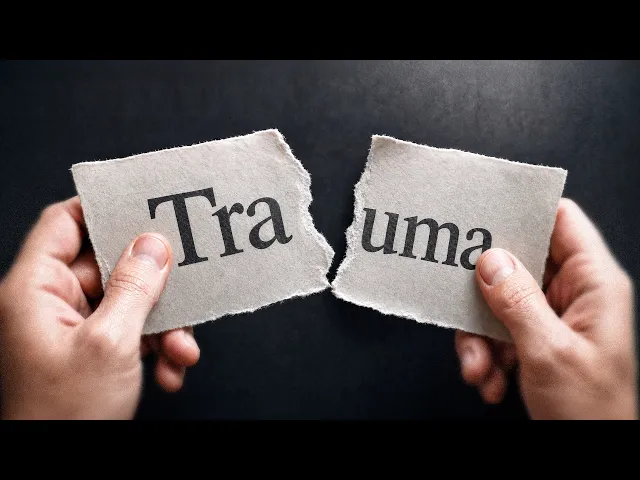
I want you to imagine getting a phone call in the middle of the night. Someone you love has sadly died. In that moment, how would you expect to feel?
Most of us have an answer ready. Devastation, tears, weeks, maybe months of deep, unrelenting grief. We expect the world to stop, for everything to shatter.
But what if the most common response to loss isn't that at all? What if, for most people, the world keeps turning and they turn with it? In this video, I want to take you inside a body of research that has been building for over three decades.
One that challenges nearly everything our culture says about how we humans react to tragedy, loss, and suffering. Let me explain. At Columbia University, there's a psychologist named George Bonano who has spent his career studying how people respond to terrible life events.
But his interest in the subject didn't begin in a lab. It began with his own family. George grew up in a Sicilian immigrant neighborhood in Chicago.
His father was a complicated man, hardworking, but prone to frightening rages. My father would beat us at times. The beatings were not as bad as the anger that he exhibited.
He would go into these rages, and he was a very scary human being. Then, as George watched his father struggle with depression and feeling that life was slipping away from him, he felt a tug of empathy. He would find his father lying in the dark and try and talk to him, but his father would push him away.
When George was 17, he decided to leave home. My father had said quite infamously in my mind, "If you leave now, don't come crawling back. " George traveled widely, sometimes sleeping outside, drifting through his early 20s.
When he was 23 and living in Colorado, the past he had been avoiding caught up with him. The phone rang repeatedly and I was with somebody. After several repeats of the this ringing, I decided there was something very much important.
got up, answered the phone, and it was my older brother telling me that my father had died. George braced himself for the devastation and mental shattering he was about to experience, but it never came. What I experienced was essentially silence.
The silence somehow seemed um it wasn't what I expected, but it seemed like seemed like a natural process. People moved cautiously around George in the days that followed, as if they were afraid that he was going to splinter into tiny shards if they said the wrong thing. He felt grateful that his father's pain was over, but he also felt confused.
He was supposed to feel a certain way, and he didn't. Years later, as George became a researcher studying grief and loss, he encountered story after story of people who didn't follow the expected script. One was a student he called Julia.
Julia was home from college. She was preparing dinner with her mother and the phone rang and she heard her mother cry out in anguish and the news was that the father had been bicycling home from work and was hit by a car and he was in the ICU, the intensive care unit. Julie and her mother drove to the hospital and just as they arrived, he died.
After the shock, Julia returned to school and threw herself into her work. When friends asked if she wanted to talk about her father's death, she said she didn't. She wanted to be with her friends to live her life, not to dwell on the past.
Her mother was quite worried that Julius seemed to have forgotten her father. She was acting essentially as if life had returned to normal. And her mother worried that she had denied her grief.
This was the phrase that Julia used that she denied her grief and suggested that she Julia see a grief counselor to get at the bottom of it. Let's think about that for a moment. Julia's mother didn't send her to therapy because grief was destabilizing her.
She felt her daughter wasn't grieving enough. Isn't that interesting? And then there was Jed, an aspiring musician working at an upscale restaurant in West Greenwich Village.
One freezing December night, he walked to a corner and stepped into an intersection. A garbage truck made an illegal right turn very fast and clipped him and pulled him under the truck. It ran over his left leg and hip and just crushed it to a mass of blood and bone.
Jed was conscious through the entire thing. He remembers hearing them yell, "Put a rush on the bus. First responders speak for get the ambulance here fast.
" The cold weather slowed his bleeding enough to save his life. He spent 6 weeks in a medically induced coma, underwent roughly 20 surgeries, and lost his entire left leg and part of his hip. When he woke up, he braced for the psychological aftermath.
For about a week, vivid memories of the accident played on a loop. But then, to his surprise, and I think to maybe everybody's surprise, it more or less just stopped. It took about a week and then the all of these intrusive memories and intense replaying of the accident simply just stopped.
Jed was confused not by the suffering but by the absence of it. He was wondering his exact words. Why was I doing okay?
And he said, "This is really my question. Why was I doing okay? " Years later, Jed became a university professor.
His question stayed with him. Why was he doing okay? George, Julia, Jed, three people, three very different tragedies and the same haunting question.
What is wrong with me? Why am I not suffering more? Are these people just outliers, lucky exceptions to the rule of human fragility?
Or is it possible the rule itself is wrong? Before I show you what the research says, I want to try something. I want you to make a prediction.
When a person goes through a serious loss, what percentage of people do you think will develop chronic longlasting psychological damage? What if this serious loss is not just a personal tragedy, but a monumental catastrophic national tragedy? 30%, 50%, 80%, whatever the number you have in your head, hold it in your mind for a minute.
This was an exercise that mental health experts went through shortly after the 9/11 attacks in New York City. The general consensus really was that this was going to be a mental health crisis of unprecedented proportions. People were basically arguing that there were simply not enough resources for for the kind of mental health problems that were coming.
And famously, FEMA, the Federal Emergency Management Agency, allocated, I believe, about $130 million, which at the time was a lot more than it is now, um, for emergency funds in New York, mostly to provide free therapy for New Yorkers. I was a reporter at the Washington Post at the time, and I still remember sitting on the edge of my bed one evening, a few days after the attacks. I had spent hour after hour interviewing family members of people who had lost loved ones.
I had pieced together an account of all the calls that one man had made from the burning towers before he died. As I sat on the bed that day, I found it hard to breathe. I remember asking myself if I would ever feel better.
The psychological effects of 9/11 were real, and they were felt not just in New York City, but across the country. Early surveys seem to confirm the worst. Nearly 8% of Manhattan residents met the criteria for post-traumatic stress disorder.
For those near the World Trade Center, 20%. For those directly affected, possibly 30% or even higher. But as time went on, the numbers dropped precipitously and by 6 months they were more or less back to normal.
They were quite low by 6 months for the for the city on the whole. The same pattern repeated itself just a few years ago with CO. Experts predicted a mental health catastrophe of unprecedented scale.
But instead, what happened eventually was that the pandemic did not have nearly the psychological impact that people thought it would have. People thought suicides would would would skyrocket during the pandemic. And in fact, suicides stayed the same or declined globally.
In a landmark 2018 study published in Clinical Psychology Review, researchers analyzed decades of data on how people respond to adversity. Across the studies, they found four distinct trajectories. The first is chronic suffering.
People who cannot move past the loss. This is real. It's painful and it deserves serious attention and care.
But it characterizes at most about 10% of people. The second was recovery. People who struggled significantly at first then gradually get better over a year or two.
The third was a delayed response. People who barely got by then slowly worsened. And the fourth pattern, George calls it the resilience trajectory.
When I first began my career, it was assumed that hardly anybody would show that pattern. And if they did show that pattern, there was something wrong with them. That was the denial idea.
When we began to actually look, we found that the majority, it's almost always the majority that showing that pattern. Most people experience short-term distress, upheaval, and then they continue to function normally after that. It's not that they don't care.
It's not that they're not saddened or upset by by the event, but they move on with their lives. This finding has now been replicated over and over again after mass shootings, spinal cord injuries, divorce, job loss, financial ruin. The resilience trajectory is not the exception, it's the norm.
So, let's go back to the number you were holding in your mind, the percentage of people you expect to suffer chronically after a major loss. If your guess was higher than 10%, you're not alone. Most people dramatically overestimate how fragile human beings are.
One reason we do this is because we know how awful it feels after a tragedy. We know how painful grief can be. But grief is not a disorder.
As the PTSD researcher Patricia Resi put it, "Strong emotions do not equal psychopathology. Being upset after a terrible event isn't a disorder. It's what our stress response system was designed to do.
" The mistake is confusing that initial distress with lasting damage. So if most people are resilient, why does our culture tell such a different story? Part of the answer lies with a theory you've almost certainly heard of.
In the late 1960s, psychiatrist Elizabeth Kubler Ross proposed that people face death through five stages: denial, anger, bargaining, depression, and acceptance. The model was never designed to describe grief. It was about people facing their own mortality.
But over the decades, it was adopted both by professionals and by the public as a map for how all of us are supposed to grieve. There's just one problem with that. It's far too neat and tidy to actually be true.
And the research has never supported it. There's not been really been any evidence that that it's actually what people go through and a lot of research that contradicts it. The theory doesn't merely describe reality.
It prescribes it. If you haven't reached the stage of depression, you must be stuck in denial. If you reach acceptance quickly without a lot of anger, it must be because you are bottling something up.
The mind and the body don't work that way. The their grief and emotions are not dwelling inside us as things. This idea that unprocessed grief is sitting inside us like a time bomb has no scientific basis.
And yet, it's become one of the most deeply held beliefs in modern western culture. So this raises a critical question. If the model is wrong, why does it still exist?
George has a concept he calls the resilience blind spot. When we are in the middle of intense distress, we cannot imagine ever feeling anything different. That initial upset we have tends to blind us to the idea that we'll ever not feel that way.
We have a hard time as humans with that. And when there's a disaster, something large scale, there's a kind of a contagion that happens as well. Other people are upset too.
And so they're upset and I should be upset and I am upset and now you're upset, you know, and that's kind of happens uh uh quite fast. Also, therapists who see patients every day are by definition spending their time with the people who are struggling. They rarely see the resilient majority, the people who never walk through their door.
if they see traumatized people, they see traumatized people in their practice and they see a lot more than is in the normal populations in the base rate. So they're they tend to then overgeneralize that to the general population. It's a very human thing to do.
It's not evil or dumb. It's a it's a very human thing that therapists do because they are humans. And then there's social media.
It's become very common for people to go on TikTok and trauma dump their worst stories. There's also an asymmetry in how we judge predictions. After a mass tragedy, if an expert warns of a mental health disaster and she turns out to be wrong, people shrug and say her heart was in the right place.
But if experts predict people are going to be resilient, they might be seen as heartless. George has experienced this firsthand. For nearly 20 years, other researchers and therapists have dismissed his findings.
therapists would come up to me if I gave a if given a public lecture and tell me, you know, I'm sure you're a good scientist, but you're just wrong about this. It's just wrong. I know and you're wrong.
So, we have a model of human fragility built on a theory that was never supported by evidence, reinforced by therapist availability bias, amplified by social media, and protected by a cultural taboo against sounding insensitive. But does any of this actually matter? If we overestimate our fragility, aren't we just airing on the side of caution?
George says no, because the wrong script has real costs. Think about trigger warnings. Alerts that were designed to protect people with hidden traumas from being ambushed by difficult content.
Trigger warnings were born out of the idea that people have hidden traumas lurking inside them or past traumas that were unresolved and they're kind of somehow raw inside people. And the research on trigger warnings has shown fairly convincingly that they either don't help or they cause harm. People who are given trigger warnings often are more anxious than people who didn't receive them.
Researchers have found that the inability to flexibly adjust your emotional responses to different contexts is one of the strongest predictors of PTSD symptoms. Teaching people to brace for emotional damage before they've encountered it may undermine the very flexibility they need to cope. There's also the harm of walking on eggshells.
When we assume that people are fragile, we create an invisible cage around them. We stop laughing in their presence. We tiptoe.
We treat them as though they might break at any moment. But George's research conducted with a psychologist Daker Kelner suggests a very different picture. Most people, even people who've recently lost a spouse within the last few months, when we did interviews, we found that the majority of people were showing genuine laughter and smiling during the interview.
You might see somebody crying and holding their head and, you know, shaking their head because they're so upset. And then 30 seconds later, they're laughing. They still have tears on their face and they're laughing about something they remembered.
That laughter isn't a sign of denial. It is an evidence of heartlessness. It's a sign of connection with the person listening and the person who was lost.
Genuine laughter and smiling during grief are correlated with better long-term mental health. It turns out the human heart is capable of holding grief and joy at the same time. To be clear, if you are debilitated by a tragedy that happened to you a long time ago, George is not saying it's all in your head.
Get over it. Far from it. There are indeed a group of people who are unable to function long term because of the traumas they have experienced.
They need professional help. They need our compassion. But believing that everyone who suffers a setback is going to be traumatized in this manner does a disservice to the people who are actually traumatized.
It trivializes a serious problem. I want to go back to where all this started. The story of George.
Years after his father's death, George became a parent himself. As he navigated the exhausting, beautiful, terrifying work of raising children, he found himself longing for a relationship with his father, a relationship that he never had. So, he created one.
I began to talk with my father. Being a father, being a parent is not easy. And there were times when I just thought I wish that my father was alive despite the difficulties we had when he was alive.
I felt this would be different now. I'm a different person. He would undoubtedly be a different person as well.
So I began to talk with my father and I found this very comforting to have these conversations with him. What George was doing was deeply human. Building a relationship with his father that death paradoxically had made possible.
A relationship without the rages, without the fear, without the ultimatums. when his children struggled with money or with the weight of parenthood, George would tell his father about it. I would say something, you know, dad, I know you were very concerned about money, you know, this is really hard and obviously he'd never answer back.
But, you know, it was more like I would imagine how he was responding and just be able to tell him this. This is what resilience looks like. Not the absence of sadness, not the denial of loss, but the ability to hold grief and growth in the same hand.
to cry on a Tuesday and laugh on a Wednesday. To miss someone terribly and still build a good life. At the start of this video, I asked you to imagine getting a phone call telling you that someone you love has died.
You probably imagine devastation. And here's the thing, you might be devastated for a while. You might cry or feel like the world has lost its color.
Those feelings are real and they are part of what it means to be alive. But if the science of trauma has taught us anything, it's this. You are almost certainly more resilient than you think you are.
The human mind, shaped by millions of years of evolution, is extraordinarily well equipped to absorb shock, process grief, and find its way back to a life worth living. In fact, your very existence is a testament. You are the descendant of a long line of survivors.
Your ability to get back up after you are knocked down is literally woven into your DNA. The danger isn't that terrible things will happen to us. They inevitably will.
The danger lies in carrying around a script that tells us we're supposed to be destroyed by tragedy. The trauma script tells you that you are easily broken. The science says you are not.
If you want to learn more about the science of the mind and hear about insights that can change your life, check out the Hidden Brain audio podcast on Apple, Spotify, or hidden. org. I'm Shankar Vidant.
See you soon.