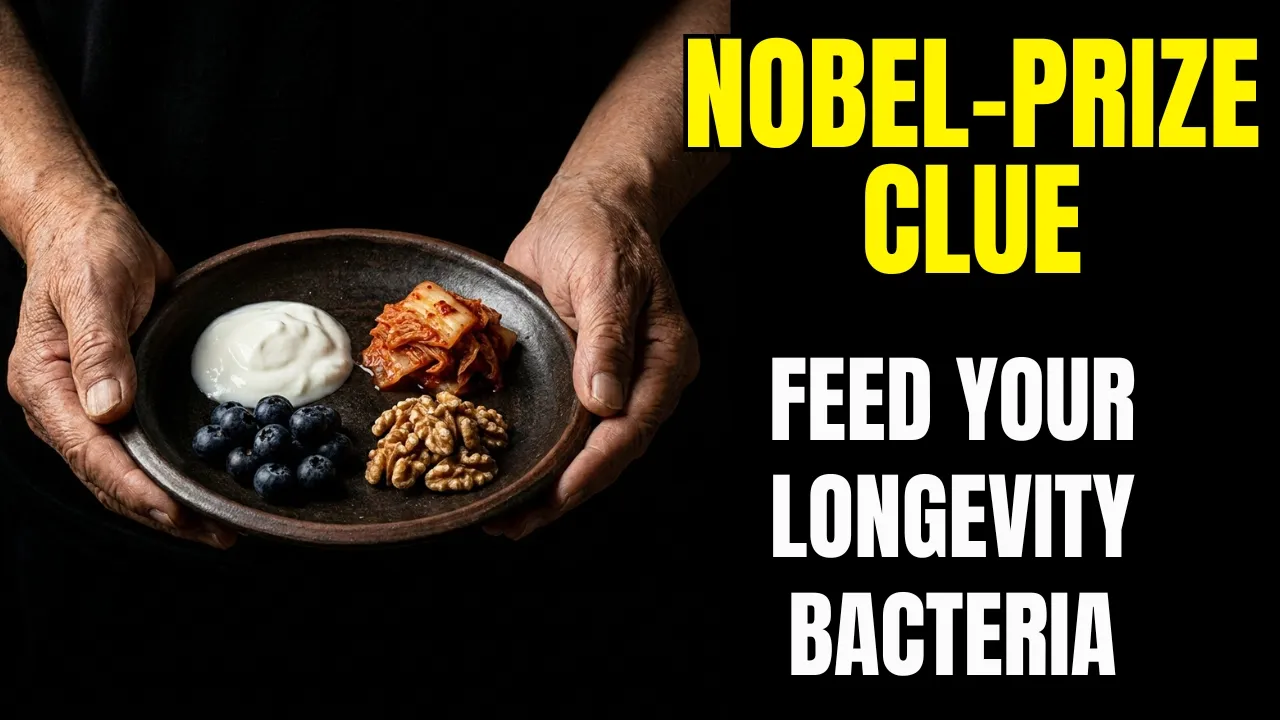
There is something living inside you right now, trillions of microorganisms, and researchers have discovered that the pattern of those organisms predicts how long you will live more accurately than any other biological marker. A Nobel Prize winner first proposed this idea in 1908. It took another 100 years for science to catch up with him.
Here is what that research has found. People who maintain gut microbiome diversity as they age have meaningfully better survival odds. And centenarians, people who live past 100, carry gut microbiomes that look strikingly similar to those of people decades younger.
A randomized controlled trial out of Stanford found that eating fermented foods, actual yogurt and kimchi and kefir, reduced 19 different inflammatory proteins in the blood in just 10 weeks. And when scientists transplanted gut bacteria from young animals into elderly animals, the elderly animals actually reversed measurable cognitive decline. Everything you're about to hear is drawn from peer-reviewed research.
The study links are in the description. One honest note, none of this is a single fix. Your gut microbiome responds to the full picture of how you live.
Sleep, movement, stress, antibiotics, the whole thing. What follows is one real research-supported piece of that picture. One, plain yogurt.
This is where the entire field started. In 1908, Russian biologist Elie Metchnikoff noticed unusually high numbers of centenarians in parts of Eastern Europe and concluded that their fermented food consumption was seeding the gut with bacteria that crowded out the ones slowly poisoning the body. He won the Nobel Prize in Physiology that same year and was largely dismissed for it.
A hundred years later, a randomized controlled trial at Stanford validated the core of what he said with molecular precision. Yogurt was one of the primary fermented foods tested. Look for live and active cultures on the label and skip the heavily sweetened versions.
Two, kefir. Kefir carries 30 or more live microbial strains compared to the handful in most commercial yogurts. Which matters because microbial diversity, the sheer variety of species in your gut, is one of the strongest markers of healthy aging.
A study that tracked over 9,000 people found that healthy aging was consistently characterized by an increasingly unique gut microbiome. People whose guts became more diverse over time had better survival odds. Kefir is one of the most practical ways to drive that diversity.
The taste is tart and slightly effervescent. Drnk it straight or blend it into something. Three, kimchi.
Korean fermented cabbage is rich in lactobacillus plantarum, a bacterial species that has shown measurable effects on gut microbiome composition in randomized controlled trials. A 2022 trial found both microbiome shifts and immune benefit in regular consumers. It was part of Stanford's fermented food protocol, too.
What makes kimchi distinct from other fermented vegetables is the combination of fermentation derived bacteria with the fiber and polyphenols of the cabbage itself. So, you are getting a prebiotic and a probiotic in the same food. A small serving a few times a week is enough.
Four, sauerkraut. Go for the refrigerated kind, not the shelf-stable jar that has been sitting in a pantry. Heat processing kills the live cultures.
Live cultures sauerkraut raises serum short-chain fatty acids in the bloodstream. And a 2025 randomized controlled trial in advances in nutrition confirmed that effect. Short-chain fatty acids are what your gut lining depends on for structural integrity.
When their levels drop, which happens steadily with age as the bacteria that produce them decline, the gut barrier weakens, and that is when things start going wrong elsewhere in the body. Five, kombucha. Fermented tea introduces a distinct mix of acetic acid bacteria and yeast that the other fermented foods on this list don't carry.
The research here is about variety. Different fermented foods introduce different microbes, and diversity is the point. Stanford included kombucha specifically for that reason, and participants who consumed the widest variety of fermented foods showed the largest gains in microbiome diversity.
Go for the lower-sugar varieties, since some commercial kombuchas have more sugar than soda. Six, miso. Most fermented foods give you either live bacteria or prebiotic fiber.
Miso gives you both. Live lactic acid bacteria alongside the fiber from fermented soybeans. Use it as a broth base or stir it into dressings.
Don't boil it, though. Heat kills the live cultures, and you lose half the benefit. Seven, garlic.
Raw garlic is high in inulin-type fructans, a prebiotic fiber that passes through the small intestine completely undigested and reaches the colon, where it selectively feeds bifidobacterium and lactobacillus, the two bacterial genera most consistently found in the guts of people who age well and most elevated in centenarian gut profiles. These fructans do not feed everything indiscriminately. They specifically favor the bacteria associated with longevity.
Crush it and let it rest 10 minutes before cooking to preserve the active compounds, or eat a clove or two raw. Eight, Jerusalem artichoke. This is the highest inulin content vegetable available, roughly 20 g per 100 g of raw weight.
The fermentation products of that inulin have been shown in peer-reviewed models to restore the beneficial saccharolytic bacteria, the fermentation first microbes Metchnikoff originally identified in centenarians, and to improve gut barrier integrity in aged guts. It is one of the more underrated vegetables in this category. Worth knowing up front, it causes real bloating if you eat too much at once.
Start small and work up. Nine. Cooked and cooled rice or potatoes.
When starchy foods are cooked and then cooled, the starch undergoes a structural change that converts a portion of it into resistant starch, a form the small intestine cannot digest. It travels intact to the colon and feeds butyrate-producing bacteria. A 2023 study in Frontiers in Nutrition found this tightened the gut barrier proteins responsible for keeping the gut lining sealed.
You can reheat the food afterward and still keep the resistant starch benefit. Cold pasta works the same way. 10.
Leeks and onions. Both carry fructooligosaccharides, a prebiotic fiber that specifically fuels Bifidobacterium. In Sardinia, one of the regions with the highest concentrations of centenarians on Earth, researchers found Bifidobacterium levels three times higher in people over 100 than in average 70-year-olds.
That is not a small difference. Leeks and onions also carry quercetin, a polyphenol tied to enrichment of Akkermansia muciniphila, a bacterial species that supports the gut lining's mucus layer and tends to drop off as people age. 11.
Lentils and chickpeas. Legumes hit the colon with two things at once, resistant starch and fermentable fiber, both arriving simultaneously and feeding different populations of bacteria at the same time. A 2023 study in Nature Scientific Reports found legume-derived resistant starch increased butyrate-producing bacteria and reduced Enterococcus, a disease-promoting microbe that tends to expand in aged microbiomes.
They are also among the cheapest foods on this entire list. Canned works fine as long as you rinse them. 12, green tea.
The primary active compound in green tea is EGCG, epigallocatechin gallate, and up to 95% of it survives digestion and reaches the colon intact. There it modulates the microbiome and reduces the Firmicutes to Bacteroidetes ratio, a measure researchers use as a marker of gut aging. That ratio shifts unfavorably as people get older, and green tea consumption has been shown to push it back.
A 2023 study in the Journal of Medicinal Biology reported this effect specifically. Two to three cups a day is the range most trials have used. 13, oolong tea.
Oolong is partially oxidized, sitting between green and black tea, which means it carries a mix of catechins from both. That polyphenol variety acts like a prebiotic. Different molecular structures feed different bacterial species.
Research has linked regular oolong consumption to increases in both Bifidobacterium and Akkermansia through what scientists call bidirectional microbiome polyphenol metabolism. The gut bacteria and the polyphenols essentially transform each other. Adding oolong a few times a week gives you a different set of compounds working on a different set of bacteria than green tea does.
14, black tea. The oxidation process that turns tea black creates compounds called theaflavins and thearubigins, unique to the black tea process and not found in green or oolong. And they selectively feed Lactobacillus in the colon.
There is also observational data from a cohort study of participants averaging 69 years old showing a relationship between regular tea consumption and episodic memory. Observational data has its limits, but it lines up with the animal research on the gut-brain connection. 15, ground flaxseeds.
Flaxseeds work through three separate pathways simultaneously. The lignans they contain get converted by gut bacteria into compounds linked to Akkermansia enrichment. The mucilaginous soluble fiber feeds beneficial bacteria directly.
And the ALA omega-3 reduces gut inflammation at the microbial level. Few single foods cover that much ground. The word ground matters here.
Whole flaxseeds pass through largely intact and you lose most of the benefit. A tablespoon stirred into oatmeal or yogurt each day is enough. 16, chia seeds.
Over 30% of chia's weight is fiber. When chia absorbs liquid, it forms a gel. And that gel slows fermentation in the colon, which matters because slower fermentation extends short-chain fatty acid production across the full length of the bowel rather than exhausting it at the top.
Studies have found regular chia consumption increases Bifidobacterium and Faecalibacterium, both butyrate-linked genera that decline measurably with age and whose loss is associated with increased gut permeability. 17, blueberries and dark berries. The anthocyanins that give blueberries and blackberries their color boost butyrate-producing bacteria and have been shown to reduce age-associated microbiome changes in animal studies.
The honest caveat is that most of this research is in rodent models, not large human clinical trials, so the human evidence is still developing. The mechanistic case is solid. Berries are also among the foods most consistently associated with Akkermansia enrichment across multiple lines of research, which adds weight to what the animal studies are pointing toward.
18. Walnuts. Walnuts belong in a slightly different category from most foods on this list.
The ellagitannins in walnuts get converted by gut bacteria into compounds called urolithins. And urolithin A specifically triggers mitophagy, the cellular process by which the body clears out damaged mitochondria. That cleanup process slows with age, and its decline is one of the proposed mechanisms of cellular aging itself, making walnuts one of few foods with a direct line to that mechanism.
They also carry prebiotic fiber and ALA omega-3. A small handful a day is enough. In 2023, a major paper in the journal Cell updated the list of aging hallmarks, the biological mechanisms considered to actively drive the aging process, from nine to 12.
One of the additions was gut dysbiosis, an imbalanced microbiome, now officially recognized as a driver of aging rather than just a symptom of it. The authors noted that dysbiosis increases gut permeability, activates the immune system, and fuels the chronic low-grade inflammation that accelerates all the other hallmarks. That is the scientific consensus now, and it is exactly what Metchnikoff was pointing at in 1908.
If you want a place to start, the fermented foods have the strongest and most direct human clinical evidence behind them. The Stanford trial used yogurt, kefir, kimchi, sauerkraut, kombucha, and fermented cottage cheese together over 10 weeks and produced significant changes in both the microbiome and blood inflammatory markers. Two or three of those foods, eaten consistently, is a realistic place to begin.
All research links are in the description. Take care of yourself from the inside out.