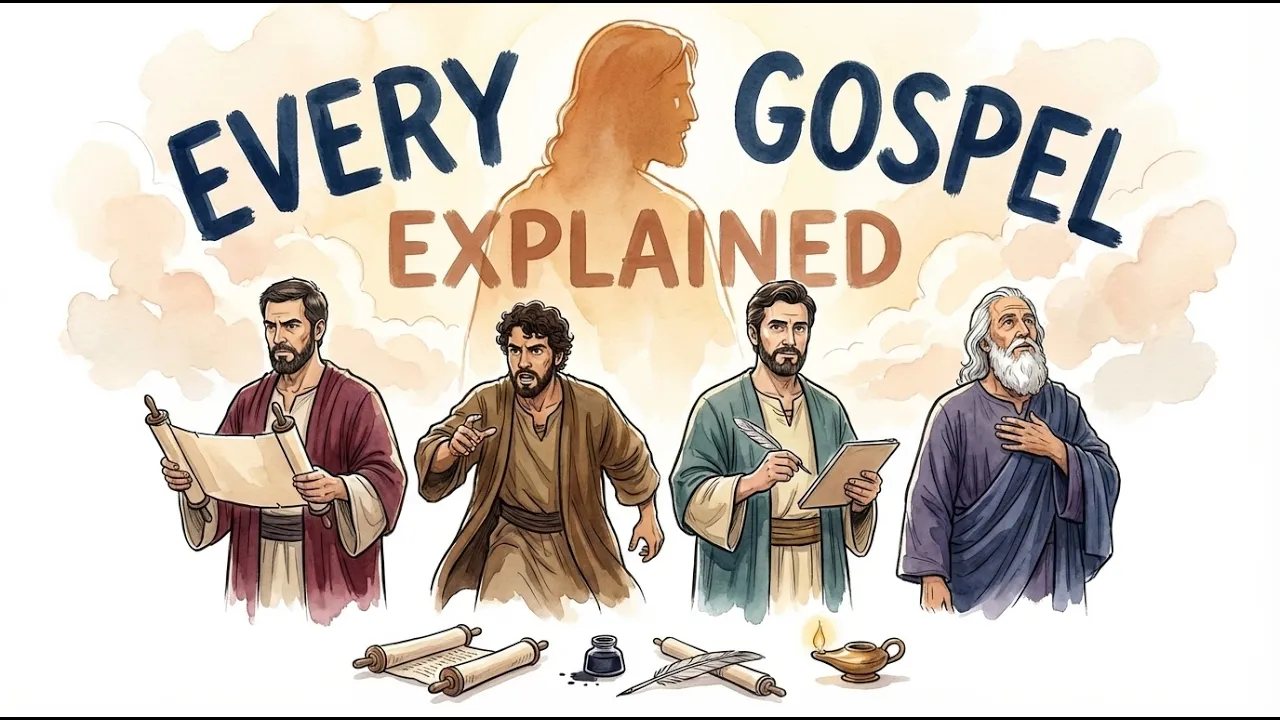
Four books, four men, one life. And the question that should bother you right away is this. Why four?
Why not just one definitive biography of Jesus, one clean, chronological, here is what happened account? Why would God allow four different versions of the same story into his book? The answer is one of the most fascinating things hiding in plain sight in your Bible.
Because these are not four versions of the same story. They are four portraits of the same person painted from four different angles for four different audiences to answer four different questions. And when you lay them side by side, when you see what each one includes and what each one leaves out and why, a picture of Jesus emerges that is more complete, more layered, and more breathtaking than any single account could ever provide.
Matthew writes for Jews and asks, "Is Jesus the promised king? " Mark writes for Gentiles, most likely in Rome, and asks, "What did Jesus do? " Luke writes for the wider Greekeaking world, and asks, "Who is this man really?
" And John, writing last, steps back from the crowd and asks the question that swallows all the others. What if this man is God? Let us walk through each one.
Matthew opens his Gospel the way no Greek or Roman writer would ever begin a book, with a genealogy, a long list of names. Matthew 1:1, the book of the genealogy of Jesus Christ, the son of David, the son of Abraham. That single sentence tells you exactly who Matthew is writing for.
He is writing for Jews. And the two names he leads with are the two names that mattered most to every Jewish reader. Abraham, the father of the nation, the man God made the covenant with, and David, the greatest king Israel ever had, the one God promised would have a descendant on the throne forever.
2 Samuel 7:1 16, "And your house and your kingdom shall be established forever before you. Your throne shall be established forever. " Matthew is saying from the very first line, "This Jesus is the one you've been waiting for.
He is Abraham's seed. He is David's heir. The throne has an occupant.
And then Matthew does something no other gospel writer does as relentlessly. He connects every major event in Jesus' life to a prophecy from the Hebrew scriptures. Over and over you hear the phrase, "So all this was done that it might be fulfilled which was spoken by the Lord through the prophet.
" Matthew uses some form of that phrase more than a dozen times. Born in Bethlehem. Micah 5:2 predicted it.
family flees to Egypt. Hosea 11:1 ministry begins in Galilee. Isaiah 9:es 1 and 2 foretold it.
He enters Jerusalem on a donkey. Zechariah 9:9. Matthew is building a legal case.
He is standing before a jury of his own people and laying out exhibit after exhibit, prophecy after prophecy, and saying, "Look at the evidence. This is not coincidence. This is fulfillment.
And here is the thing that makes Matthew's gospel even more remarkable. Remember who is writing this. Matthew was a tax collector.
He worked for Rome. In the eyes of his own people, he was a traitor. His name would have been spoken with disgust in every synagogue in Capernaum.
And yet here he is writing the most Jewish gospel in the entire New Testament, making the most thorough case in all of scripture that Jesus is the king of Israel. The man his own people had rejected is now writing to them about the king they rejected. There is a gospel inside the gospel there.
Matthew is also the only gospel that records the sermon on the mount in full chapters 5-7. The most famous sermon ever preached. Blessed are the poor in spirit for theirs is the kingdom of heaven.
Blessed are those who mourn for they shall be comforted. Blessed are the meek for they shall inherit the earth. Matthew 5:es 3-5.
In a world obsessed with power, Jesus opens his manifesto by blessing the powerless. That is the kingdom Matthew is introducing. And Matthew is the only gospel writer who records Jesus saying the word church.
Matthew 16:18. And I also say to you that you are Peter, and on this rock I will build my church, and the gates of Hades shall not prevail against it. Matthew cares about what happens after Jesus ascends.
He is writing for a community that needs to know how to organize, how to worship, how to resolve conflict, how to carry the mission forward. That is why Matthew ends where he ends. Not just with the resurrection, but with a commission.
Matthew 28 18-20. And Jesus came and spoke to them, saying, "All authority has been given to me in heaven and on earth. Go therefore and make disciples of all the nations, baptizing them in the name of the Father and of the Son and of the Holy Spirit, teaching them to observe all things that I have commanded you.
And lo, I am with you always, even to the end of the age. The king sends his people out. The gospel that began with a Jewish genealogy ends with a global mission.
The promise made to Abraham that through his seed all nations would be blessed reaches its final expression. Now, if Matthew is the most Jewish gospel, Mark is the most urgent. And the difference hits you immediately.
Matthew opens with a genealogy. Mark opens with a man shouting in the desert. Mark 1:es 1-3.
The beginning of the gospel of Jesus Christ, the son of God. As it is written in the prophets, behold, I send my messenger before your face who will prepare your way before you. The voice of one crying in the wilderness.
Prepare the way of the Lord. Make his paths straight. No birthstory, no wise men, no manger.
Mark drops you straight into the action like a movie that opens midchase. And the reason is his audience. Mark is traditionally understood to have written from Rome, drawing on the eyewitness testimony of the Apostle Peter.
The early church father Papius writing around AD 130 recorded that Mark served as Peter's interpreter and wrote down accurately what Peter remembered of Jesus words and deeds. Mark's audience is primarily gentile probably Roman. These are people who do not care about Old Testament genealogies.
They want to know what Jesus did and why it matters. And Mark tells them fast. One of the signature words of Mark's gospel is the Greek word euthus which means immediately or at once.
It appears over 40 times in 16 chapters. Jesus is baptized and immediately the spirit drives him into the wilderness. He comes out of the wilderness and immediately he begins preaching.
He calls disciples and immediately they follow. Mark's Jesus does not stroll, he moves. Everything is urgent because the mission is urgent.
And Mark is the gospel that most consistently shows Jesus as a servant. Mark 10:45. For even the son of man did not come to be served, but to serve and to give his life a ransom for many.
That single verse is the thesis statement of the entire book. A Roman audience would have understood power. They built an empire on it.
But Mark shows them a different kind of power. A king who kneels, a ruler who washes feet, a conqueror who conquers by dying. Mark is also the most honest about the disciples failures.
Peter, Mark's own source, comes off poorly in this gospel. He rebukes Jesus and gets called Satan. He falls asleep in Gethsemane.
He denies Jesus three times. Mark does not clean it up or soften it. And that is part of the point.
If Peter himself allowed his worst moments to be recorded and circulated, it tells you something about the kind of story this is. This is not propaganda. This is not a hero tale being polished for posterity.
This is a man saying, "I failed completely and Jesus restored me anyway. And if he did it for me, he can do it for you. " Mark is the shortest gospel, 16 chapters and fully a third of the book is devoted to the final week of Jesus life.
Mark spends six chapters on the last 7 days. The cross is not the ending of Mark's story. It is the destination the entire book has been walking toward from page one.
Mark also explains Jewish customs that his readers would not have known. In chapter 7:es 3 and 4, he pauses the narrative to explain the Pharisees practice of ceremonial handwashing. He translates Aramaic words and phrases.
In chapter 5:41, when Jesus raises a dead girl, Mark records the Aramaic words Jesus spoke, tala kumi, and then translates for his readers, little girl, I say to you, arise. These small details tell you he is writing for people outside the Jewish world. He is bringing Jesus to an audience that has never set foot in a synagogue.
So let us pause here and look at the two portraits so far. Matthew paints Jesus as the king promised to Israel, fulfilling every prophecy, teaching with authority, commissioning his people to reach the world. Mark paints Jesus as the servant in motion for a gentile audience.
Powerful in action, relentless in purpose, heading straight for the cross. Two gospels, same Jesus, completely different angles, and we are only halfway through. If this is opening something up for you, subscribe, leave a comment, and share this with someone.
That is how more people find it. Luke is different from both Matthew and Mark and you feel the difference within the first four verses. Luke 1:es 1-4.
In as much as many have taken in hand to set in order a narrative of those things which have been fulfilled among us, just as those who from the beginning were eyewitnesses and ministers of the word delivered them to us. It seemed good to me also, having had perfect understanding of all things from the very first, to write to you an orderly account, most excellent Theophilos, that you may know the certainty of those things in which you were instructed. This is a historian talking.
Luke tells you upfront that he has investigated. He has interviewed eyewitnesses. He has cross- referenced sources.
and he is writing to a specific person, a man named Theophilos, whose title most excellent suggests he was a Roman official of some rank. Luke is not writing from inside the Jewish world like Matthew. He is not writing from a prison cell like Mark's source Peter.
He is a physician, a Greek, a Gentile, a companion of the Apostle Paul, and the only non-Jewish author in the entire New Testament. And his portrait of Jesus reflects that. Luke's Jesus is for everyone.
Luke is the only gospel that tells the story of the shepherds at the birth of Jesus, not wise men from the east. Shepherds, the lowest rung of the social ladder. Luke 2:es 10 and 11.
Then the angel said to them, "Do not be afraid, for behold, I bring you good tidings of great joy, which will be to all people. For there is born to you this day in the city of David a savior who is Christ the Lord. Good news for all people.
Not some people, all. Luke is the only gospel that tells the parable of the good Samaritan. Luke 10, where the hero of the story is a man from the most despised ethnic group in Jewish society.
You will not find the parable of the prodigal son anywhere except Luke 15. the story of a father who runs to embrace his lost child before the child can even finish his apology. And it is Luke alone who gives us the story of Zakius, the rich tax collector who climbed a tree just to see Jesus.
And Jesus stopped, looked up, and invited himself to dinner. Luke 15:es 20- 22. And he arose and came to his father.
But when he was still a great way off, his father saw him and had compassion and ran and fell on his neck and kissed him. And the son said to him, "Father, I have sinned against heaven and in your sight, and am no longer worthy to be called your son. " But the father said to his servants, "Bring out the best robe and put it on him, and put a ring on his hand and sandals on his feet.
" In the ancient near east, a dignified man did not run. Running was considered beneath the honor of an elder. But this father hikes up his robes and sprints down the road toward his son.
That image is not just a parable. It is a portrait of God. And only Luke gives it to us.
Luke pays more attention to women than any other gospel. He records the song of Mary known as the Magnificat in chapter 1. He names women who supported Jesus's ministry financially, including Joanna, the wife of Herod's household manager, and Susanna.
In Luke 8:3, he tells the story of the sinful woman who washes Jesus's feet with her tears. In chapter 7, he tells the story of Mary and Martha in chapter 10. In a culture that treated women as invisible, Luke makes them visible.
Luke also cares about the poor. He records the biatitudes differently from Matthew. Where Matthew writes, "Blessed are the poor in spirit, Luke's version is sharper.
" Luke 6:20, "Blessed are you poor, for yours is the kingdom of God. " And Luke adds the warnings Matthew leaves out. Luke 6:4, "But woe to you who are rich, for you have received your consolation.
" And Luke is the only gospel writer who continues the story beyond the resurrection. He wrote a sequel, the book of Acts. Luke and Acts are two volumes of the same work addressed to the same Theophilus.
Luke shows you who Jesus is. Acts shows you what his spirit does through ordinary people after he ascends. No other gospel writer does this.
Luke is thinking about the long arc of history. Not just the life of one man, but the birth of a movement that will reach the ends of the earth. Luke 24:es 46-48.
Then he said to them, "Thus it is written, and thus it was necessary for the Christ to suffer and to rise from the dead the third day, and that repentance and remission of sins should be preached in his name to all nations, beginning at Jerusalem. And you are witnesses of these things to all nations beginning at Jerusalem. " Luke traces the movement from a manger in Bethlehem to a courtroom in Rome.
His gospel is about a God who cannot be contained by one nation, one language or one social class. And then there is John and John is not like the others. Matthew, Mark and Luke are called the synoptic gospels from a Greek word meaning seeing together because they share a similar structure and many of the same stories.
John stands apart. Over 90% of the material in John's gospel is found nowhere else. He skips the birth.
He skips the temptation in the wilderness. He skips the sermon on the mount. He records no casting out of demons.
He includes no parables. Instead, John opens his gospel with some of the most extraordinary words ever written. John 1:es 1-5.
In the beginning was the word, and the word was with God, and the word was God. He was in the beginning with God. All things were made through him and without him nothing was made that was made.
In him was life and the life was the light of men and the light shines in the darkness and the darkness did not comprehend it in the beginning. Those are the same words that open the book of Genesis. John is not starting with a genealogy or a census or a prophet in the desert.
He is starting before creation, before time, before matter. And he is making a claim so enormous it either changes everything or means nothing. The word was God.
And then verse 14. And the word became flesh and dwelt among us. And we beheld his glory.
The glory as of the only begotten of the father full of grace and truth. God became a human being and as the translator Eugene Peterson once put it, moved into the neighborhood. That is John's thesis statement.
John was one of the 12 disciples. He was part of the inner circle along with Peter and his own brother James. He refers to himself in his gospel not by name but as the disciple whom Jesus loved.
And his gospel reads like a man who has spent decades thinking about what he saw, turning it over in his mind, understanding it more deeply with each passing year, and now writing it down for people who need not just the facts, but the meaning behind the facts. Where the other gospels record dozens of miracles, John selects just seven. And he does not call them miracles.
He calls them signs because each one points beyond itself to something about who Jesus is. And they build one on top of the other like steps climbing toward a single conclusion. Water into wine at a wedding in Kaa.
In chapter 2, Jesus transforms the ordinary into the extraordinary. Healing a nobleman's son from miles away. in chapter 4.
His power is not limited by distance. Healing a man who had been paralyzed for 38 years at the pool of Bethesda in chapter 5. 38 years.
And one word from Jesus ends it. Feeding 5,000 people with five loaves and two fish in chapter 6. He is the bread that never runs out.
Walking on the water during a storm. Also in chapter 6, the waves that terrify the disciples are pavement under his feet. Giving sight to a man born blind in chapter 9, not a man who lost his sight, a man who never had it.
Jesus gives him something he has never experienced. And then the seventh sign, the one that changes everything, raising Lazarus from the dead. John 11 25 and 26.
Jesus said to her, "I am the resurrection and the life. He who believes in me, though he may die, he shall live, and whoever lives and believes in me shall never die. " Do you believe this?
Seven signs and each one escalates from wine to healing to feeding to walking on water to sight to life itself. John is building to a single conclusion. This man is God in human flesh and trusting him is the difference between death and life.
John is also the gospel that records the long intimate conversations Jesus had with individuals. His midnight conversation with Nicodemus in chapter 3 where Jesus tells a respected religious leader, "You must be born again. " His conversation at the well with a Samaritan woman in chapter 4, a woman who had been married five times and was living with a man who was not her husband.
a Jewish rabbi speaking to a Samaritan woman alone at a well. Every part of that scene broke the social rules and Jesus initiated it. John 4:es 13 and 14.
Jesus answered and said to her, "Whoever drinks of this water will thirst again, but whoever drinks of the water that I shall give him will never thirst. But the water that I shall give him will become in him a fountain of water springing up into everlasting life. And John gives us the upper room discourse.
Chapters 13-1 17, the longest recorded teaching of Jesus in any gospel. The night before he dies, Jesus washes his disciples feet, promises them the Holy Spirit, tells them he is the vine and they are the branches, prays for their unity, and speaks some of the most tender words in all of scripture. John 14:es 1-3.
Let not your heart be troubled. You believe in God, believe also in me. In my father's house are many mansions.
If it were not so, I would have told you. I go to prepare a place for you. And if I go and prepare a place for you, I will come again and receive you to myself, that where I am, there you may be also.
He is about to be arrested, beaten, and crucified. and his concern is that his friends not be afraid. John also gives us the clearest purpose statement of any gospel.
John 20 30 and 31. And truly Jesus did many other signs in the presence of his disciples which are not written in this book. But these are written that you may believe that Jesus is the Christ, the son of God, and that believing you may have life in his name.
That is why John wrote not to record history though it is historical, not to win an argument though it is persuasive. He wrote so that you would believe and believing have life. So there they are, four gospels, four portraits.
A tax collector builds a case from prophecy. A young man records the eyewitness testimony of a fisherman who failed and was restored. A physician interviews everyone he can find and writes a careful history.
and an old disciple who leaned on Jesus' chest at supper sits down and tells you what it all meant. So, what do these four books say to you right now? If you are searching for evidence, if you need to know that the story of Jesus is not a myth, but the fulfillment of centuries of promises, read Matthew.
He laid out the receipts. If you are drowning in information and need to see Jesus do something, not just hear about him, read Mark. It is the shortest gospel and the most relentless.
You can read it in one sitting and you will not be the same when you finish. If you have ever looked at your life, your background, your mistakes, your outsider status, and wondered whether God's story has room for someone like you, read Luke. The answer is on every page.
The father is already running. And if you need to know not just what Jesus did, but who he is. If you are ready to stare into the deepest claim ever made and decide what you believe about it, read John.
He will not let you stay neutral. Four books, four angles, one Christ. And the most remarkable thing about all four is that they do not compete with each other.
They complete each other. Take any one away and the picture is incomplete. Keep all four and you see something no single writer could have captured alone.
And maybe that is the deepest lesson the four gospels teach us before we even open them. God does not tell his story through one voice. He tells it through many.
Through a tax collector, a young companion of Peter, a Greek physician, and a fisherman who leaned on Jesus's chest at supper. Through different temperaments, different audiences, different emphases, all held together by the same spirit, all pointing to the same person. John 21:2.
And there are also many other things that Jesus did which if they were written one by one, I even suppose that the world itself could not contain the books that would be written. Four books could not contain him, and neither can the world. But these four are enough to change yours.
If this opens something up for you, the biggest thing you can do is subscribe, leave a comment, and share this video with someone who needs it. That is how people find this content. We depend on you to spread the word.
Please keep us in your prayers.