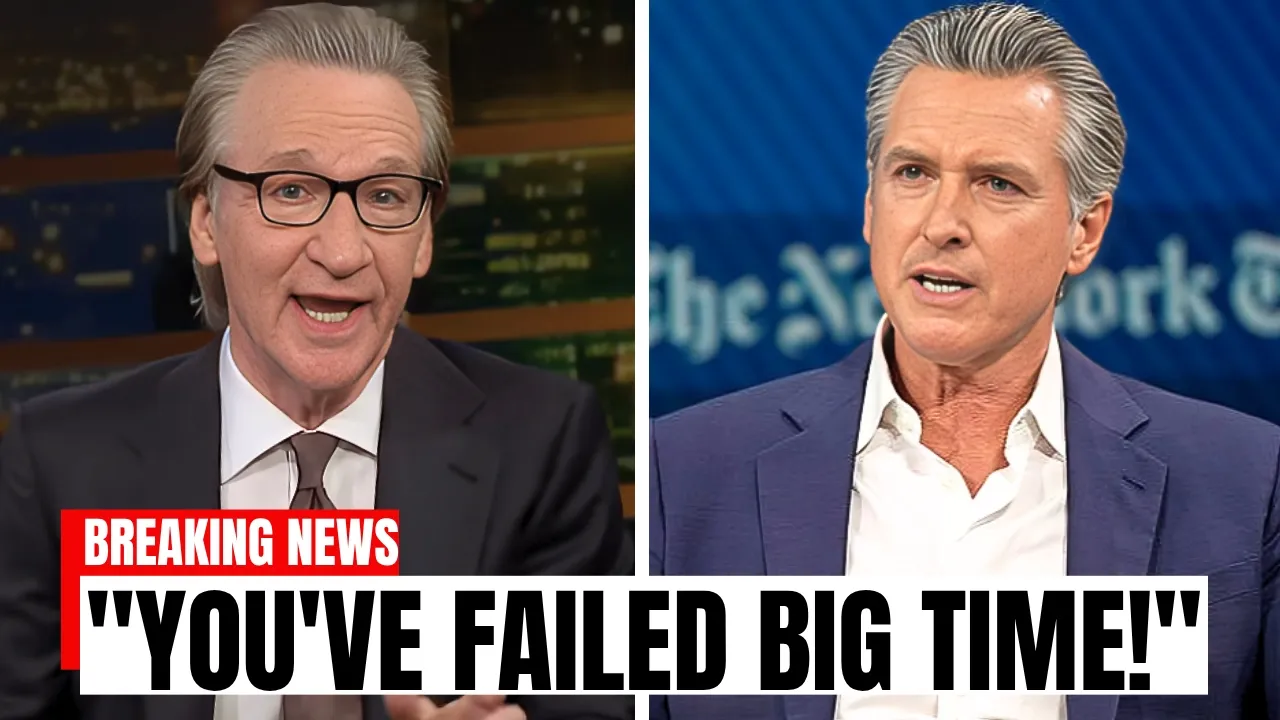
feel like the last couple of years you've like purposely picked this fight with the red states. I mean the des Yeah, but I don't want I don't want to live in the civil war. I agree with that.
You know what? But but you seem like you you California have the highest cost of living in the country. The governor had no answer.
But the answer is obvious. Bill Maher didn't just criticize Gavin Newsome. He took apart the carefully polished image Nuome has spent years building in front of millions of viewers.
Mar challenged the very image Nuome wants people to believe that California is a progressive paradise. But Mar's criticism raised a bigger question about whether that image matches reality. And once those cracks started showing, the whole narrative became much harder to defend.
So buckle up because we're about to look at a side of this political clash that deserves a closer examination. Be good at the job. Not this year.
We know. Um [laughter] no, I know. Um, but he said, uh, I don't think he could win.
I don't think he could win. He's too progressive coming from this state and what he's done in this state to win in any, uh, southern state, any red state. I disagreed, but no, this is a progressive African-Americanowned station, and they I'm sure they like you, but he doesn't think you can win.
What do you say? Mar's criticism of Gavin Newsome comes down to one major problem. the difference between the image Newsome presents and what ordinary Californians are actually dealing with.
And tomorrow, that gap is hard to ignore. For working families, buying a home has become almost impossible. Grocery bills keep rising.
Gas prices make everyday driving more expensive, and the overall cost of living continues to squeeze the middle class. These are not small problems people can simply brush aside. They affect how millions of Californians live, manage their money, plan for the future, and get through each day.
From the sixth largest economy to the fourth largest economy, $4. 1 trillion a year. We have more Fortune 500 companies than we've ever had in the last two decades.
More scientists, engineers, more Nobel laureates, venture capital, over 106 billion this year, finest system of higher education in the world, a conveyor belt for talent like no other. We're the dominant egg state. 62.
1 billion forestry, hunting jobs, egg jobs. You talk about farmers and ranchers. You're talking about my home state.
Meanwhile, Newsome keeps stepping up to the podium, delivering polished speeches and presenting California as an example for the rest of America to follow. But Mah sees a major problem with that message. When people are struggling with rising costs and everyday financial pressure, talking about California success can sound more like a performance than real leadership.
And critics argue that's why Mars criticism hit so hard. The difference between the image Newsome promotes and the reality many Californians face has become increasingly difficult to ignore. I do want to while we're on the economy ask about affordability because yes, people are struggling all across the country.
California has the highest cost of living in the nation. The state's prices are 11% higher than the national average. We were actually out to dinner here in Nashville last night.
We met a couple from California. They moved out of California because they couldn't afford the rent or even to buy a home and also start a family. Mr Speaker, it is undeniably true that many, many Americans continue to struggle with the cost of living in this country.
But what is also true is that those struggles are not felt uniformly throughout the country. That prices are much higher in certain places than others. In my own state of California, we have the highest cost of living in the country.
And our governor, Gavin Newsome, was asked about this recently on CNN. Why does California have the highest cost of living in the country? The governor had no answer.
But the answer is obvious. It is the state's failed policies that have through this laborator. Gavin Newsome says his state is thriving, but the people with the most skin in the game are heading for the exit.
New reporting shows that at least half a dozen billionaires have already left the Golden State. Up to 20 more could be packing their bags as a proposed 5% wealth tax remains on the table. The latest Google co-founder Larry Page is headed to Miami, Florida.
But he's not alone. Peter Theal, Larry Ellison on the move to red states like Texas and Florida. Many of these people that are leaving are lifelong Democrats, supporters of the very people in the process that now is turning on them.
The exodus from California is millionaires, billionaires, but it's also working people who more and more can't find opportunity. Then the conversation turns to an even bigger issue. Mah points to businesses leaving California, cutting investments, and moving operations elsewhere, often without much public attention.
Critics see this as a warning sign for the state's economy, with the effects reaching far beyond corporate offices, workers, small business owners, and families who built their lives in California could end up paying the price. Inception about you and what is the fairest criticism of Gavin Newsome? I don't fairest criticism.
Um, I don't know about the misconception. I think some of this, you know, some of the baitman, the looks, the, you know, the the whole thing, right? The the hair, all that, you know, and so I think people then see that, believe certain things.
It sort of connects. They they they believe that you're a lightweight. Is that what you're saying?
They think you're just They think you're just a little more style. Yeah. Versus the substance.
and and I put the substance in terms of the policym up against it. I mean that and that's not that contrast hits hard because it brings the conversation back to a reality that no amount of political messaging can hide. Critics argue that Newsome's biggest problem is making California sound successful while so many residents continue to struggle.
Running a state this large is certainly not easy, but pretending everything is going according to plan only makes things worse. And when promises don't match people's everyday experiences, public trust can disappear faster than politicians expect. When you're the president, you're representing the whole country.
And people are looking at California and saying, "Well, is it in the best possible state and when we see many millionaires fleeing there when we see and he's against uh these proposed taxes on billionaires, but it's still like how do you make people reel in the homeless population? How do you make people understand that you're trying your best? And what have you done?
Are you messaging to us, explaining how much you've grown over the last five years, 10 years, how how much before it was it's beyond you. He's like blaming back to Reagan times. You have to really justify some of the decisions that you've made under your watch.
I hate when President Trump points to Biden. Now that we're a year in and that's not even a long runway. I don't like when presidents continue to put the blame on past presidents and so I'll ask the governors not continue to point the blame about who else made the city uh good or bad.
If the crown is on your head. Yeah, he's going to have a difficult time, I think, selling that. But Mar doesn't stop at criticizing the results.
He goes after what he sees as the bigger problem. Leadership that focuses too much on appearances. He has challenged Democratic leaders over this for years, and his message remains the same.
When politicians care more about how decisions look on camera than how they affect people's lives, solving real problems takes a backseat. What may have started as smart political messaging in Mars view has slowly turned into a way to manage public perception instead of delivering meaningful results. It's it's it's really been interesting the reaction to the podcast.
I mean, we had some controversial figures on. I'll acknowledge that. And Steve Bannon, Charlie Kirk, uh, and some others.
But you're right. I mean, this idea that we can't even have a conversation with the other side. You have to.
They won. Thank you. Uh, that's it.
The bottom line. and and and and by the way or the notion we just have to continue to talk to ourselves or we're in the same damn echo chamber. These guys are crushing us.
The Democratic brand is toxic right now. Uh we had a high water mark two weeks ago and that was a CNN poll at 29% favorability. It's dropped in the NBC poll down to 27.
That's why concerns coming from within the Democratic party have become part of a much bigger debate. Party strategists aren't necessarily worried about Nuome because they dislike him. They're concerned that his political image could become a problem far beyond California.
A factory worker in Wisconsin, a nurse working extra shifts in Ohio, or a young family in Arizona struggling to afford child care all face real financial pressures. Polished social media posts and carefully staged press conferences won't solve those problems. When the bills arrive, people want real results, not just promises that sound good.
You're not right. You know, Californians have often sometimes thought of themselves in this way. They do in a couple of important terms on technology and innovation, on culture, even to some extent on environmental policy, but less so on things like economic and tax policy, which relates to this, and this will come back to the nation.
Twothirds of Californians tell us they think the cost of living there is unmanageable. One thread you're going to see even in this year's elections in 25 for all states is going to be cost of living is going to be the economy. Mars critics argue that communication is an important part of leadership and that presenting a strong public image doesn't automatically mean someone is being dishonest.
But Mars argument is that problems begin when appearances matter more than results and leaders stop listening to the people they represent. In his view, that damage is becoming visible not just in California, but across the Democratic party. This is no longer just about Gavin Newsome.
Critics see a wider pattern of politicians choosing political narratives over hard numbers and polished promises over real progress. And when that pattern keeps repeating, it becomes a much bigger problem. One that no amount of rebranding can easily solve.
First thing I did was create the Homeless Fraud and Corruption Task Force. California has spent $24 billion in the last 5 years on homelessness and no one can account for where that money has really gone for. Uh so the first thing I did was set up that task force and all we did is follow the money.
We already charged millions of dollars in fraud. I can tell you more charges are coming probably as soon as this month. And that's and this is where the political stakes become much more serious.
Kla Harris is already facing questions about her connection with voters, while other Democratic figures are struggling to hold support in the swing states that often decide elections. If Newsome becomes another example of leadership that it seems out of touch with ordinary people, it could damage more than his own political future. It could reinforce a criticism the party has faced for years, that its leaders are no longer listening to the people they claim to represent.
And once that belief takes hold in voters minds, winning back their trust can become an uphill battle after the 2026 midterms, you're going to give it serious thought. Yeah, I'd be lying otherwise. I I'd just be lying and I'm I can't do that.
Governor, you have long said that if you ever run for the White House, you need a compelling why, a reason. Are you moving close? Mah isn't calling for Newsome to step down or asking Democrats to abandon their values.
His point is simple. Leaders should be judged by their results, not their public image. Voters deserve honesty and real progress, not just polished speeches and promises.
And when appearances matter more than outcomes, public trust suffers. Now, I want to hear from you. Is Gavin Newsome truly governing California?
Or is he more focused on protecting his political image? And if politicians keep choosing presentation over results, who can voters really trust? Share your thoughts in the comments below.