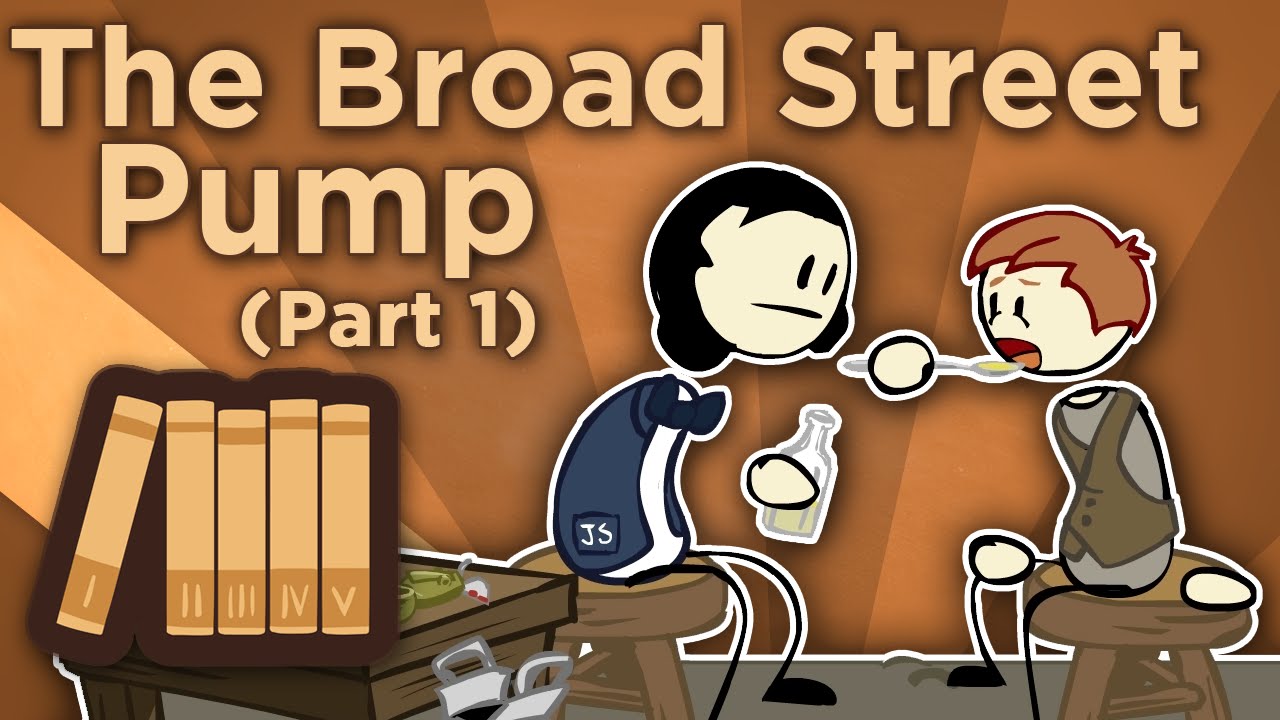
A cholera outbreak had struck Broad Street. The death count mounted and the moans of the sick could be heard through thin tenement walls. It was down this street, that John Snow walked.
Knocking on door after door after door. But many had already fled and the cold blue end of cholera had claimed many of those who had not. Again, John Snow was frustrated in getting the evidence he sought.
But this time, the clock was ticking Every passing minute meant more deaths. And every passing minute decreased his chances of preventing this from ever happening again. And so, by noon on Tuesday the 4th of September, 1854, he realised that there'd be only one place he could quickly and efficiently get the data he so desperately needed; the office of the Registrar General.
He raced from Broad Street to the halls of the Government, demanding a full list of every death and an address for everyone the cholera had taken. And so, he began to establish a pattern of how these things were done. On ground inspection combined with combing government records to get the data needed not just to treat the disease, but to fight it.
And fight it he would. Right there on Broad Street. He returned to the epicenter, with its air of suffering and death so that he could understand what those addresses he now held meant.
His boot heels rang out against the pavers of the abandoned streets as he paced from house to house, trying to see the connection. Then he had it! Of course!
He needed to think of these deaths as a map. And so he began to craft his map. plotting the deaths one by one.
And as his map filled out with tragedy, a pattern began to emerge. It really was an epidemic starting at Broad Street and radiating out, thinning the further it went. But he knew that already.
He needed more. He needed to show that the pump itself was the source. He needed to know not only how these points of mortality were related to each other, but also how they related to the neighbourhood wells.
So he made what we today know as a Voronoi diagram. But to him, it was something he was making up of the top of his head in a desperate attempt to find the fastest way to understand the problem he faced. He marked the wells on the map, then he split the map in to sections according to proximity to the wells.
Any deaths that was closer to one specific well than to any other would be grouped together. The idea being that well water was well water and people were probably getting their water from whatever pump was convenient. So if you broke up the map by proximity to wells and you saw a pattern in where the most deaths occurred, you'd be able to tell if there was a contaminated well.
And there it was clear as day. People who had a shorter walk to the Broad Street pump than to any other well, were inordinately more likely to die. But he had been down this road before.
He knew this wouldn't Ben enough to convince the miasmatists. they would just say that some noxious stench hung around the region of the pump and that the pump itself was coincidental. Nope, he needed something more.
So he poured over his map. There were a few outliers. There, right there!
On Cross Street! There was a clump of deaths that were closer to the Little Marlborough pump than the one on Broad Street. He raced to the tenement to see if he could get some answers, But he was too late.
Those had only been the first deaths marked down in the Registrar General's morning notes. By afternoon, the entire family had been wiped out. Of all the 84 deaths he had on record, only 8 more were outside the area he'd marked as closest to the Broad Street pump.
He needed to follow those leads. 3 were tragically children who went to school near Broad Street and would drink from the well on their way to and from their education. 3 more were workers who also regularly stopped at the well.
The last 2 he couldn't get data for. This still left him with clear connections to the pump, even for those who were outside its range and equally importantly outside the range of any argument about a miasmatic cloud. But he needed to understand the other holes in his data as well.
On Poland Street there was a massive workhouse with 535 inhabitants and yet almost no-one there had died. And it was well within the range of the Broad Street pump. There should be 10 times as many deaths there, at least.
He rushed to the workhouse, feeling the daylight burning as each precious minute slipped away. He had to hurry. Upon questioning the workhouse director, the answer became glaringly obvious: The workhouse had its own private water supply.
Of course! Snow pressed the director further: "Where do you get your water from? " and the director replied: "Grand Junction water works.
" Snow already knew that Grand Junction water was safe based on his earlier research. It was all starting to make sense. Next he had to go to the local brewery.
There they told him (teetotaler that he was) that their men drank nothing but beer. All the pieces fit, he had his case. Now he just had to convince the local health board to shut down the well.
Now this had all happened within the first 48 hours of Snow's finding out about the outbreak. For 48 hours, he had trudged through the streets that others had fled. He'd visited the sick, he'd recorded the statements of the bereaved, for 48 hours he had mapped, made statistical plots, studied and chased down data.
And now on Thursday night, after a brief rest, he prepared for what might be an even greater challenge: the meeting of the local health commission. He addressed them with all of the vigor and certainty of his data. He showed them his maps and his charts.
He let them know the egregious mortality rate of those who had drunk from the well and the remarkable clemency granted to those who had not. And in the end after much deliberation they said: "Hmpf, you might know something, John Snow! " And they agreed to remove the handle from the pump the following morning.
Now, whether or not the outbreak would have burned itself out over the next few days on its own is up for debate. But what IS certain is that by Monday, the epidemic had practically passed. But after the epidemic had ended, the pump handle was returned and life went on.
Investigations into the outbreak began. And most minds of the time went right back to thinking of things in terms of the miasma theory of disease. But a young curate who was the Minister to the people of Broad Street and had sat with many of them during their final hours went further.
This man (Henry Whitehead) began doing a serious investigation of his own to make sense of the whole thing. Deeply disturbed by why this had happened to his parish, he began writing monographs on his results and debunking the theories that so many had offered. Especially about this outbreak being the result of the lax morals of the poor.
One of the theories he thought he would debunk along the way was that silly notion John Snow had about the pump having something to do with the outbreak. But he never got around to it. Then, in November, a committee was formed to really look into the outbreak and both Whitehead and Snow were invited to be on it.
And here, Whitehead really began to test Snow's results. After all, sure Snow had shown that people who had drunk from the pump suffered. But what of those who survived?
If they had drunk from the pump and never gotten cholera, would that not put into question the water as a cause? And as a local prelate, Whitehead could do what Snow could not; reach out to all of those in the local area that hadn't fallen ill. His knowledge of the people of the area and their intimate trust of him as their priest actually allowed him to get the last pieces of data that Snow had needed.
And as that data came in, his doubts about Snow's ideas began to melt away. But there was one final piece to the puzzle: Why now? The Broad Street pump had served the people well for years.
It was groundwater not water from one of the contaminated vendors. And when the city had studied it, they'd find no cracks that might have connected it to a sewage system. He was looking for a reason, flipping through the records of the office of the Registrar General, and that's when he found it.
The index case, patient zero. An infant - one who he remembered well - had died in the outbreak. But unlike most patients, this tiny child had - according to the records in the Registrar's office - held out for 4 days.
That would put her case as predating the epidemic. Immediately he went to the house of this child's mother, a woman who knew him well from the community. He asked about those days and she talked about how she had tossed child's diapers into a cesspool at the bottom of the house.
The committee immediately authorized an examination of the cesspit and a new examination of the well. Sure enough, the cesspool was poorly built and was seeping as much into the soil around it as into the sewer to which it was supposed to drain. Two feet away, through that soil, lay the Broad Street well.
With that final piece of data they had all they needed. The committee would release its report and that report would be dismissed or ignored by many at the time, but today we know as a report that changed the world. But perhaps Snow himself put it best.
Talking to Whitehead he said: "You and I may not live to see the day and my name may be forgotten when it comes, but the time will arrive when great outbreaks of cholera will be things of the past. And it is knowledge of the way in which the disease is propagated which will cause them to disappear. " And it is because of the tireless sleuthing of John Snow that that day is here.
History has not forgotten you. You do know something John Snow.