Just a few years ago, Hamburg was the natural gateway to the world for a large part of Central Europe. Goods from China, Korea, or the USA arrived at German ports and only then traveled to Poland, the Czech Republic, or Slovakia. Now, Poland wants to change this arrangement.
>> We are starting the implementation of the largest port investment in Poland's modern history. >> It is precisely on this land that a new deep-water port will be built. The construction of the Pomerania Cape has begun.
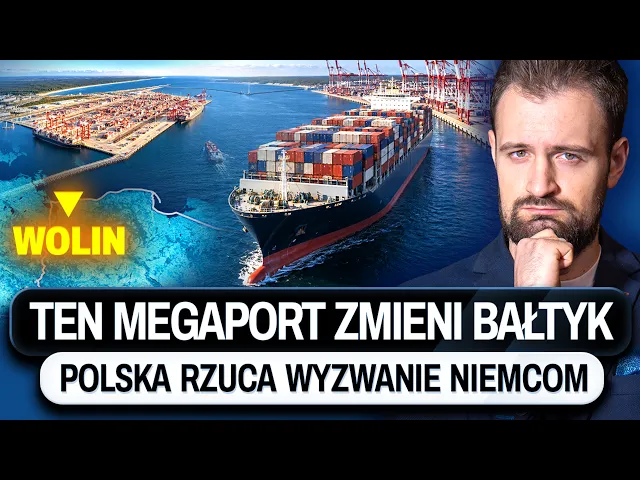
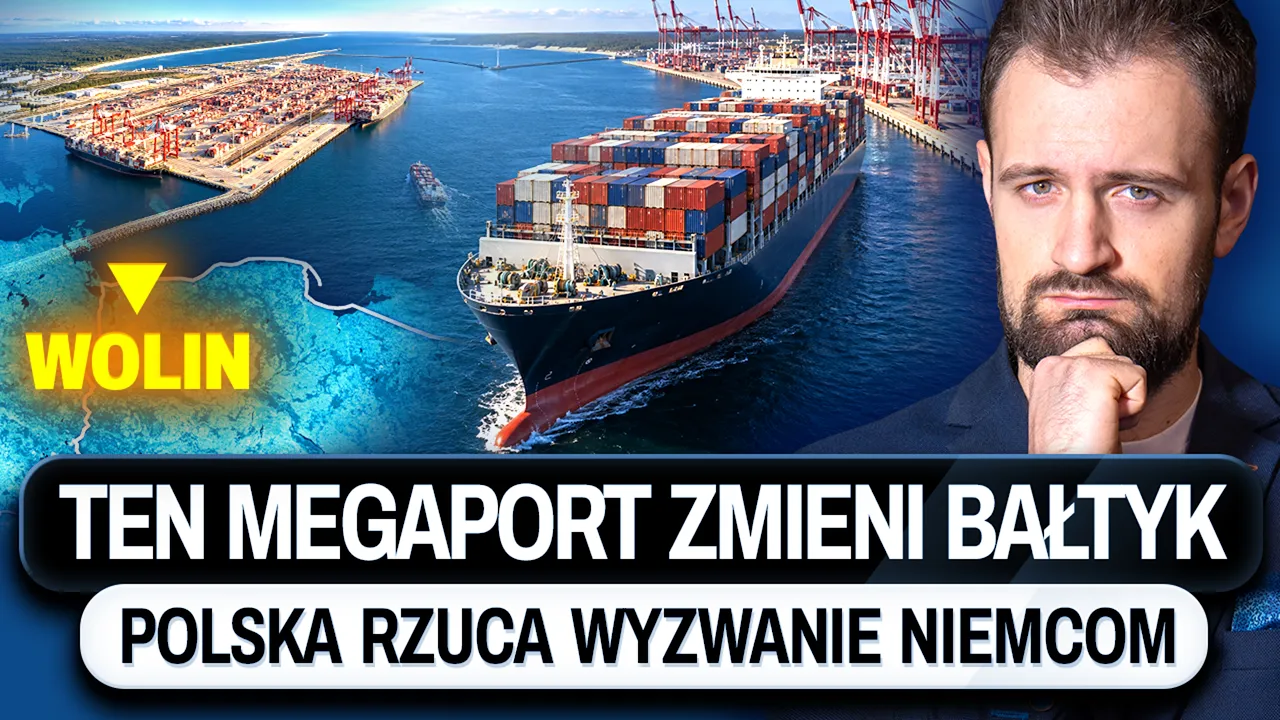
>> The Pomerania Cape is being built in Świnoujście. Practically a brand new port on the Baltic Sea. Approximately 186 hectares of new land are to be created at sea.
Nearly 3 km of quays, a port basin about 17 m deep, and a terminal capable of handling the world's largest container ships, up to 400 m long. The target capacity is about 2 million TEUs per year. For comparison, the entire Port of Gdańsk handled about 2.
77 in 2025. million TEUs. This means the new terminal in Świnoujście alone is set to have a scale corresponding to over 70%of Gdańsk's current container traffic.
We are carrying out this project in an ambitious way, the best way possible, because we have great ambitions, and Poland is a country with great sea-related potential, and we want to utilize these opportunities. That is why we are investing record amounts of money in the development of the maritime economy. Here in Świnoujście , 186 hectares of new land, of new Poland, will be created.
It is precisely on this land that a new deep-water port will be built. Thanks to this, the port city of Świnoujście will enter a new league in global logistics chains and become a pillar for the development of the Polish maritime economy, logistics, and international trade. >> And that is precisely why this investment stirs up such strong emotions on the other side of the border.
German organizations and local governments have tried to challenge, among other things, the environmental decisions for this project, citing threats to the Baltic Sea. beaches and tourism. However, on September 29, 2026 , the Supreme Administrative Court finally dismissed the German association's complaint.
Officially, the dispute concerns the environment. Economically, however, the stakes are much higher, because Świnoujście is perfectly situated not only for western Poland but also for Berlin, Eastern Germany, the Czech Republic, Austria, and Slovakia. In addition, there is the S3 expressway, the railway, and the Baltic-Adriatic corridor.
Poland, therefore, does not need to surpass Hamburg in terms of total cargo handling. It is enough to capture a portion of the goods that have flowed through German ports for decades. And that is exactly why the Pomerania Cape can become one of the most important infrastructure projects in this part of Europe, and ultimately perhaps the most important port in Central Europe alongside Gdańsk.
Therefore, in today's video, we will discuss this project in detail for you and the opportunities it gives us. I invite you to watch the video. The sponsor of the Globalista channel is the sports store Sportano.
With the code "Globalista10," you get a 10%discount on all purchases in the Sportano app until the end of October. You can find the link to download the app in the description. As you know and can probably see outside your window, the autumn and winter season is coming on in full swing.
And do you know what is best for autumn and winter? A sip of good, warm tea. And we have been running our tea brand, Tuncia , for you for over two years now.
The flavors are diverse, and the teas come from different parts of the world. Check out our teas right now by visiting tuncia. pl.
You can find the link to our teas in the video description. I wish you a tasty "tuncia . " In financial markets, speed is what counts.
That is why I invest using the XTB app, which allows me to react to changes immediately. If you don't know how to start investing, be sure to use the code "bednarski. " Details can be found in the description.
And one thing needs to be understood here. Poland is not just building a container terminal in Świnoujście. It is building an entire economic hub, the individual parts of which are just starting to connect.
According to the latest government data, the Pomerania terminal alone is to cost nearly 13. 9 billion PLN. That is a gigantic amount.
But the real question is, how much can Poland earn from such a port later? And here, the scale gets really interesting. In 2025, the entire Szczecin-Świnoujście port complex handled approximately 34.
8 million tons of cargo, achieving about 144. 6 million PLN in net profit. At the same time, Szczecin exceeded 100,000 TEU of containers for the first time.
Meanwhile, the new terminal in Świnoujście is expected to have the capacity to handle up to 2 million per year. So we are talking about a potential capacity roughly 20 times greater than the current container traffic of this entire port region. >> This is our dream, our vision for the future, but also a facility of strategic importance for the development of the Szczecin and Świnoujście Seaports Authority.
The project we want to implement could be compared to the project of building the port in Gdynia during the interwar period. What we will be creating is the potential for the development of the Szczecin and Świnoujście port complex for the coming years, so that the maritime economy, and especially the economy in Western Pomerania, can develop and meet current competitive expectations. Of course, this does not mean that the port's profits will automatically increase twentyfold, but a container doesn't just leave money at the quay itself.
It needs to be unloaded, stored, cleared through customs, insured, and transported by rail or simply by truck. Freight forwarders, customs agencies, warehouses, logistics centers, and much , much more are needed. To show the scale, as of October 2026, Maersk set the base terminal handling charge for a standard dry container in Poland at € 215, while for Germany it is € 300.
This is obviously not the entire revenue of the terminal nor the total cost of transport, but it shows the scale of the market and one of Poland's price advantages. With millions per year, the handling of containers alone represents a service market potentially counted in hundreds of millions of euros annually, and even more money can appear indirectly. The Port of Gdańsk shows the scale of the significance a large port can have for the entire economy.
According to a PWC analysis, the activity of the Port of Gdańsk in 2024 was associated with as much as 44. 6 billion PLN in tax revenue and about 83,700 jobs in the economy. We managed to reach 4 million 200 thousand tons, which I consider a good result in terms of the fact that competitors, competing terminals, terminals and ports, well, they actually had There is definitely a lot to be said here regarding price competitiveness, meaning there was simply a smaller mass and volume of cargo available on the market.
In this volume of 4. 2 million, the Coal and Coke group essentially has the largest share. >> These numbers cannot be applied one-to-one to Świnoujście, because Gdańsk is much larger and handles, for example, huge quantities of fuel that generate VAT and excise tax.
They do, however, show why countries fight so fiercely for port traffic. A container cleared in Poland instead of Hamburg means that part of the money from its entire logistics chain stays right here , and Poland prepared for this much earlier. In 2025, the entire S3 route from Świnoujście to the Czech border was completed.
This is an express North-South axis of about 470 km. You can reach the Czech border from Świnoujście in just over 4 hours. And when the Czechs finish their D11 motorway, a very convenient connection to Prague will also be created.
From there, goods can reach Austria, Slovakia, Hungary, or Southern Europe. This is no coincidence, as Świnoujście is located on the European Baltic-Adriatic corridor, leading all the way to Vienna, Bratislava, Budapest, and the ports of Croatia, Slovenia, and Northern Italy. This means a ship arriving from Asia can unload a container in Poland that will then go to Southern Europe instead of using Hamburg or Rotterdam.
>> This clearly shows that we can be an important hub, a component of a logistics hub, not only for Poland but for this entire part of Europe. And Świnoujście will also benefit from this, because for every job created in the port, new jobs will be generated in the surrounding area. And we are looking at this matter comprehensively.
We know, and analyses today show, that the port in Świnoujście could serve not only Poland, the Czechs, or the Hungarians, but also the eastern German market. >> Alongside roads, the railway is being developed. The project to improve rail access to Świnoujście and Szczecin alone cost about 1.
5 billion PLN. Thanks to it, trains up to 750 meters long with a higher permissible axle load can enter the ports. This is crucial because, without rail, a terminal with a capacity of 2 million TEU would very quickly clog local roads , but Świnoujście is becoming something even more important.
The energy center of Poland. Already today, there is an LNG terminal here which, after expansion, can regasify 8. 3 billion cubic meters of gas annually.
This amount corresponds to nearly half of Poland's annual demand. In 2025 alone, the terminal received 81 LNG deliveries, and since the facility's launch, the number of deliveries has exceeded 400. On top of that, there is the Baltic Pipe.
The pipeline itself does not make landfall exactly in Świnoujście, but in the Niechorze and Pogorzelica region. And then it connects via the Niechorze-Płoty gas pipeline to the national system. Its capacity in the direction of Poland is about 10 billion cubic meters per year.
So, the entire West Pomerania region has become one of the main places through which energy reaches Poland from the north and the sea. Because when the Russians turned off our gas tap in '22, we were fully prepared and simply accelerated a process that we had planned anyway. With the Baltic Pipe, a pipeline from Norway, also available since '22, we have successfully and seamlessly supplied non-Russian gas to ourselves, but we also supply it to Ukraine or Moldova, meaning we are an intermediary of such security without Russian gas for the entire region, and this potential can only grow.
Will we be a gas hub for the region? >> We have the potential to be a gas hub. >> And that is still not the end of it.
In 2025, Poland's first installation terminal for offshore wind farms was opened in Świnoujście. The facility is intended to handle the assembly of even several dozen turbines annually and has already gained foreign clients. In 2026, preparations began for its further expansion.
This is of huge significance, because Poland plans for about 5. 9 GW of offshore wind energy by 2030 and even 18 GW by 2040. Świnoujście is therefore starting to concentrate containers, LNG, offshore, ferry transport, rail, and one of the most important north-south roads in Central Europe in one place.
This is strategic infrastructure today that guarantees our security, because this is infrastructure that shows how Poland is developing in the offshore wind sector. That today we will not only be able to use this port in the future, but we also guarantee other countries the opportunity to develop this sector. It shows Poland's ambitions.
It shows how today Poland, which is becoming a gas hub, and how Poland, which is becoming a logistics hub thanks to the Pomerania project, can also become a hub for offshore wind energy in this region. And this may be the greatest advantage of this project, because Hamburg has a giant port, Rotterdam has a giant port, but Poland is building something here that it has lacked for decades. Its own western gateway to the world, located practically on the border with Europe's largest economy, while simultaneously opening up an alternative route to the ocean for the Czech Republic, Slovakia, or Hungary.
If the planned 2 million TEU is actually met, the stake will no longer be just the development of Świnoujście. The stake will be through which country future Central European trade routes will run— through Germany or increasingly through Poland. And this is exactly where we come to the German protests.
For several years, the municipality of Heringsdorf and the Lebensraum association, among others, have been opposing the terminal. Officially, their arguments concern primarily the environment, tourism, and coastal safety. The Germans are concerned about , among other things, the effects of deepening the approximately 70 km waterway, the possible release of pollutants and ammunition remnants from the Baltic seabed, and the impact of the investment on the Natura 2000 area and the tourist character of the island .
Usedom. The dispute was serious enough that it went to Polish administrative courts. On September 29, 2026, the Supreme Administrative Court finally dismissed the cassation complaint of the German association regarding the environmental decision for the terminal.
The court pointed out , among other things, that subsequent environmental decisions tightened, rather than eased, the requirements for the investor. A completely new, very large approach channel will be built here in shallow coastal waters. It is to be 70 km long, 500 m wide, and 17 m deep.
The amount of dredged material will reach 140 million cubic meters. After all, it has to be stored somewhere. We will need to use it to build islands somewhere off the coast.
In this context, such an undertaking is obviously a disaster. So, one cannot say that Germany is officially protesting because they fear Polish competition. They do not raise such arguments in the proceedings.
However, it is hard not to notice that across the border, a port is being built to compete for the exact same economic hinterland: Berlin, Brandenburg, the Czech Republic, and Central Europe. And that is why the significance of this investment goes far beyond Świnoujście itself. The terminal we are about to put into operation will be managed according to the latest trends.
Low-emission equipment, noise reduction , limiting road transport, and utilizing intermodal transport. And all this to ensure this port appears as the most modern on the Baltic Sea when it comes to a green environment. If Poland connects a port with a capacity of 2 million TEUs with the S3 expressway, the railway, the LNG terminal, the West Pomeranian energy infrastructure, and offshore support, it will become one of the most important transport and energy hubs in the entire Baltic region, if not Europe.
This does not mean that Świnoujście will suddenly replace Hamburg or Rotterdam, but it may cause more and more goods that currently flow to Central Europe through Germany to enter Europe through Poland in a few years 'time. Let us know what you think about this investment. And that is all from me for today.
See you in the next video. Take care. Bye.
Yeah.