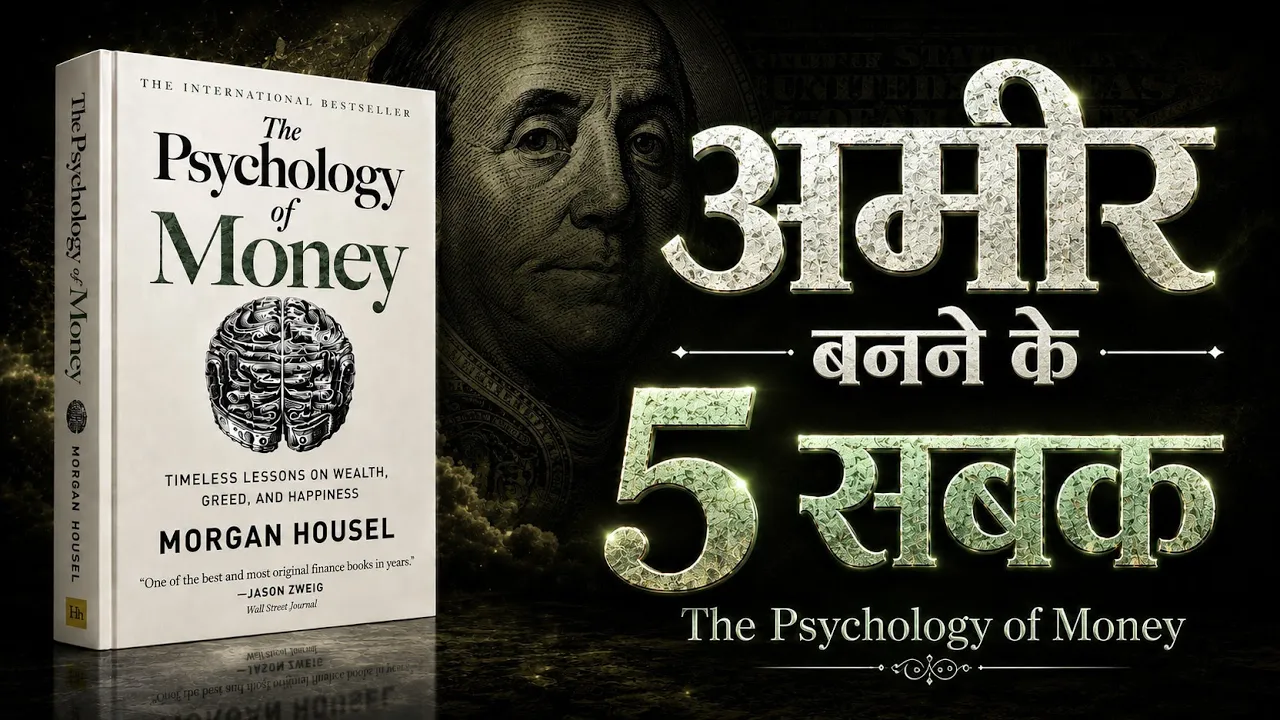
Friends, today we'll discuss the five most brutal, bitter, and eye -opening lessons from The Psychology of Money. If you understand them today, they will transform both your coffers and your destiny. But if you lack the courage to admit your mistakes and face this harsh truth, then stop watching this video right now.
This video is not for the faint-hearted, who lament their fate daily but lack the courage to change their thinking. But if you have the yearning to change your life, let each lesson sink deep into your heart. Lesson number one: being rich versus being wealthy.
There's a difference between being rich and being wealthy. Answer this question: If someone owns a 20 million-dollar BMW, an expensive mansion, and branded clothing, is that truly rich? Most people will say, "Yes, absolutely.
" But this is where 99% of people make the biggest mistake: being rich and being wealthy are not the same thing. Let's understand this with a very simple example. Let's say there are two friends, Rahul and Mohan.
Rahul earns ₹5 lakh per month. He owns an expensive car and a luxury home. He travels abroad every year.
But as soon as Rahul quits his job, all his EMIs, expenses, and lifestyle come to a halt the following month. Meaning, if the money stops coming in, so does his wealth. Mohan, on the other hand, earns just ₹80,000 per month.
But over the years, he's built assets that generate ₹1 lakh per month even without working . Such as rent, dividends from good stocks, business profits, or other sources of income. Now, imagine if Mohan didn't work for a year, would his life stop?
Absolutely not. Because his money is working for him. This is wealth.
Now, let's understand it in a simple way: Rich is someone who works for their money. But wealthy is someone for whom money works . Now, let's understand it in simpler terms.
If you go to the market every day and buy mangoes , you have them. But once the money runs out, the mangoes run out. This is like being rich.
But if you have a mango tree planted at home, you'll keep getting mangoes year after year without buying them. This is wealth. Being rich means buying fruit.
Wealth means planting a tree that bears fruit. And the same applies to money. Cars, mobile phones, clothes, and expensive watches are all fruits.
But the assets that put money in your pocket every month are trees. And remember, fruit always runs out, but trees bear fruit again and again. That's why the world 's most successful people plant money-making trees before buying expensive things.
And this is the first and most powerful lesson of this book. It's easy to look rich, but being wealthy is an art. Remember, being rich may earn you momentary false praise, but being wealthy gives you lifelong freedom.
If you want to be truly free in your youth, stop showing off your status to the world and start growing your wealth quietly, hiding it. Lesson: Never Enough. Never enough.
That quagmire of jealousy and greed that can reduce even a king to a pauper. I want to ask you a simple question . If you were to receive ₹10 crore today, would you say, "I don't want anything else.
" Probably not, because our minds are very strange. When we have 1 million , we want 1 crore. When we get 1 crore, we want 10 crore.
Then 100 crore, and then 1000 crore, and when we see someone else's chocolate, we feel like we have nothing. This is "Never Enough. " It means never feeling like what we have is enough.
Understand this with the story of a child. Suppose a child has 10 chocolates. He is happily playing.
Then his friend comes along with 20. What happens next? Suddenly, the child who previously had 10 chocolates will feel that his chocolates are less.
Notice that his chocolates haven't decreased, his happiness has diminished. Why? Because he compared his happiness to someone else's chocolates.
This is a person's greatest weakness. Now connect it to money. Suppose your annual income is ₹1 lakh.
You're comfortably managing your household . Living a good life. But someone in your office earns ₹50 lakh .
Suddenly, your income seems small. Whereas until yesterday, you were happy with that income. What changed?
Not the money, but the comparison. Morgan Housel says the most dangerous game in the world is comparing yourself to others, because this race has no finish line. There will always be someone richer, more successful, more famous than you.
If your happiness depends on surpassing others, you'll never have the chance to be happy. Now listen to a true story. There have been many billionaires in the world who possessed so much wealth that generations to come could live without working .
But they thought a little and took a bigger risk than before. And in just a few months, they lost billions of rupees, fame, and respect—everything. Why?
They were defeated. Never Enough. When a person forgets to say, "Enough is enough," greed clouds their reason.
A simple example: Imagine a glass in front of you. It's already full. What happens if you pour more water into it?
The water will start spilling out. The problem isn't the water; it's that you haven't learned to stop in time. The same thing happens with money.
Earning money isn't wrong. Earning a lot of money isn't wrong either. But when to stop?
When to say, "This is enough for me. " This understanding is true wealth. The biggest message of this lesson is that poverty hurts people.
But the thought of "never enough" doesn't let even a billionaire sleep peacefully. So, don't set your course based on others . Set your course based on your needs, your dreams, and your goals.
Because the day you understand the meaning of "enough," money will cease to be your master. Money will become your servant . Remember, the poorest person in the world isn't the one with the least money, but the one who constantly feels they still have less.
This is the second and most profound lesson from The Psychology of Money: "Never Enough. " It teaches us not to earn less, but to avoid comparison and endless greed. Lesson number three: the magic of compounding and patience.
The money tree that bears fruit doesn't come overnight, but over years. I want to ask you a question . If I give you a mango seed today and you plant it outside your house, will it bear mangoes the moment you wake up tomorrow?
Absolutely not. Not in a week, not even in a month. Does that mean the seed was bad?
No. The seed is doing its job, it's just not visible. And the same applies to money.
This is compounding. Compounding means that a small action taken today can, over time, become something bigger than you ever imagined. It's called magic because in the beginning, nothing is visible.
Listen to the story of a child. Imagine two children, Aarav and Vivaan. Every day, Aarav's father gives him ₹10.
But Aarav puts that ₹10 in his piggy bank. Vivaan, on the other hand, also gets ₹10, but he buys chocolate every day. On the first day, they're the same.
After a month, there's not much difference. Even after six months, the difference doesn't seem significant. But after a year, Aarav's piggy bank is full, and Vivaan has memories but no money.
Now imagine what would happen if this habit continued for 20 years? One would have money, and the other would have only regret. This is the magic of compounding.
In the beginning, it moves at a snail's pace, so slowly that people start making fun of it. But at a point, that same compounding reaches rocket speed. Now, listen to a true story.
Warren Buffett is one of the world's most successful investors. Today, his wealth is in the billions of dollars. But did you know that most of their wealth wasn't built in their 20s or 30s, but rather, their wealth grew most rapidly after the age of 60?
Why? Did they suddenly perform some magic? No.
They gave time to compounding. They didn't repeatedly uproot their money to see if it grew. Just as a farmer doesn't pull a sapling every other day to see if it grew taller, he knows that a plant grows by giving it time, not by pulling .
Money is the same. What's the biggest mistake? Today's people sow seeds today and expect fruit by next Monday.
When they don't, they say there's no point in it and give up midway. Remember, compounding doesn't reward those who quit; it rewards those who persist. Remember, compounding's best friend is time, and its worst enemy is impatience.
So, after sowing a seed, don't dig a hole every day to see if it grows. Water it, give it sunlight, and give it time. One day, that small seed will become a huge tree.
The biggest message of this lesson is that people think big money is made from big decisions. But Morgan Hussell says no. Big money is made by repeating small, right decisions over a long period of time.
That means investing a little every month, learning a little every day, and becoming a little better every day. These small things can one day change your entire life. Remember, friends, no tree grows overnight, and no one becomes rich overnight.
Those who trust time, time one day makes them different from the world. This is the third and most inspiring lesson of The Psychology of Money. The magic of compounding is hidden not just in money but in habits, knowledge, relationships, and every good deed in life.
But this magic is visible only to those who have the patience to wait. Lesson number four: Freedom is the ultimate dividend. Freedom is true wealth.
I want to ask you a question. If I were to give you two options: the first, a job paying ₹1 lakh per month, but working 16 hours a day. You'd have to be there immediately when the boss calls.
You 'd have to ask permission if you wanted to take leave. You'd have very little time to spend with your family, and you wouldn't be able to live your life the way you want. The second, an income of ₹1 lakh per month.
But you decide when to work, where to work, and how much to work. If your mother falls ill, you can go to her without asking anyone. If your child has an event at school, you can go without asking for leave.
If you want to travel for a month, you can go. Now, tell me honestly, which life would you choose? This is where it all begins.
Freedom is the ultimate dividend. Understand it in a child's terms. Imagine two children each have a bicycle.
The first child's bicycle is very expensive, but his father says he can ride it only on Sundays and only with his permission. The second child's bicycle is simple, but he can ride it whenever and wherever he wants. Now tell me, who is truly happier?
The one with the expensive bicycle or the one who has the freedom to ride it . Remember, happiness lies not in the thing itself, but in the freedom to use it as one wishes . The same applies to money.
Many people spend their entire lives earning money, but they never have time to live it. They have earned money but lost their freedom. Morgan Housel says that the greatest advantage of money is not what you can buy, but what you can say no to .
A true story: Warren Buffett is one of the world's most successful investors. He has billions of dollars. But if you ask him what his greatest wealth is, his answer would be, "I can live every day as I wish.
" He doesn't have a boss telling him when to get up, where to go, whom to meet, or what to do. This is his greatest wealth. Money buys him time, and time is real life.
An example you'll probably never forget. Imagine a golden cage, with every luxury. Expensive food, comfort, security, everything, but the door is closed.
Now there 's another bird. It doesn't have a golden cage, but the whole sky is its own. Now tell me, who is richer: the one with the golden cage or the one with the freedom to fly ?
Life is exactly like that. Many people live in golden cages of expensive cars, big houses, and high salaries. Everything shines on the outside, but inside, they can't live the way they want.
Remember the biggest message of this lesson. The real purpose of money isn't to buy an expensive watch, an expensive car, or an expensive house. The biggest purpose of money is to give you control over your time.
The day you can decide what to do today, who to spend time with, and what to say no to, that day you become truly rich. Remember, friends, the one who has the most money isn't the richest . The one who has the most control over their time is the richest.
Remember, no one becomes rich by buying an expensive watch. Rich is the one who has the freedom to live the time shown on the clock as they wish. This is the fourth and most beautiful lesson of The Psychology of Money.
Lesson number five: No one is crazy. No one is crazy when it comes to money. Each person makes decisions based on their own story.
Let me ask you a simple question. If one man spent his entire salary buying gold, what would you say? What a strange person he is.
If another man invested his entire salary in the stock market, some would say he was very wise. But wait , is one of these really right and the other wrong? Probably not.
Understand this with the story of a child. There were two children in a school: Aarav and Vivaan. The teacher gave them both ₹100 and told them to buy whatever they wanted.
Aarav bought a book for the full ₹100. Vivaan bought a chocolate for the full ₹100 . Now the whole class started laughing.
Hey, who buys books? Some children said, " Why did you buy chocolate? You should have bought a book.
" But the teacher smiled and said, "You both don't know their story. Aarav already had a lot of chocolates at home. But he didn't have money to buy a book.
So he bought one. Vivaan, on the other hand, hadn't eaten a single chocolate in months . For him, that chocolate wasn't just a sweet; it was a small pleasure .
Now tell me, who was wrong? No one. Both made the right decision for their lives.
The same thing happens in life. You must have seen some people spend every penny they earn on buying land. Some make fixed deposits.
Some buy gold. Some invest in the stock market, and some let the money sit in the bank. We often say that they don't understand money.
But have you ever considered that maybe they did? " You may have witnessed something you've never seen before. Consider a true example.
There are two people. The first grew up in a family where, as a child, he witnessed a bank collapse one day, wiping out all the family's savings. The second grew up in a family where his parents earned millions by investing in the stock market.
Now, when they're both older, the first person will probably distrust banks and the stock market. He'll buy gold or keep cash. The second will invest fearlessly.
Now, tell me, is the first person crazy? No. He's making the right decision based on his own experience.
Morgan Housel says , "Every person makes decisions based on their entire life's experience, and your experience isn't the entire world's. That means you only know your own story, not the other person's. " Imagine an example that will last forever.
Imagine two people standing on the bank of the same river. The first man jumps into the river without thinking. The second, terrified, doesn't take a step forward.
People call the first one brave and the second one cowardly. But if you learned that another man had lost his brother in this same river as a child, would you call him a coward? Absolutely not.
His fear isn't madness, it's his experience. The same applies to money. The biggest message of this lesson is to not label someone foolish, cowardly, or greedy based on their financial decisions.
They may be the result of their entire life's experiences, fears, hopes, and responsibilities. You can't make the right decision based on a story you don't know . Remember, people make decisions based on their memories, fears, hopes, and experiences, not money.
So, don't judge someone's financial decisions until you know their full story. Remember, friends, behind every person's bank account lies a story hidden, unseen by the world . Therefore, no one is crazy when it comes to money.
Everyone is the hero of their own story . This is the fifth and most human lesson of The Psychology of Money: financial decisions are not shaped solely by mathematics, but by a person's experiences, fears, upbringing, and circumstances. Therefore, before judging others, try to understand their story.
If you enjoyed this video, please give it a big like and comment. Share this video immediately with every friend, sibling, and relative you want to free from this mental slavery. And if you want to change the story of your life with your own hands, and want to learn mind-blowing lessons like this every week, then without wasting a second, subscribe now by clicking the red button below and join our mission by pressing the bell icon.
And finally, just one thing: keep dreaming, because dreams do come true.