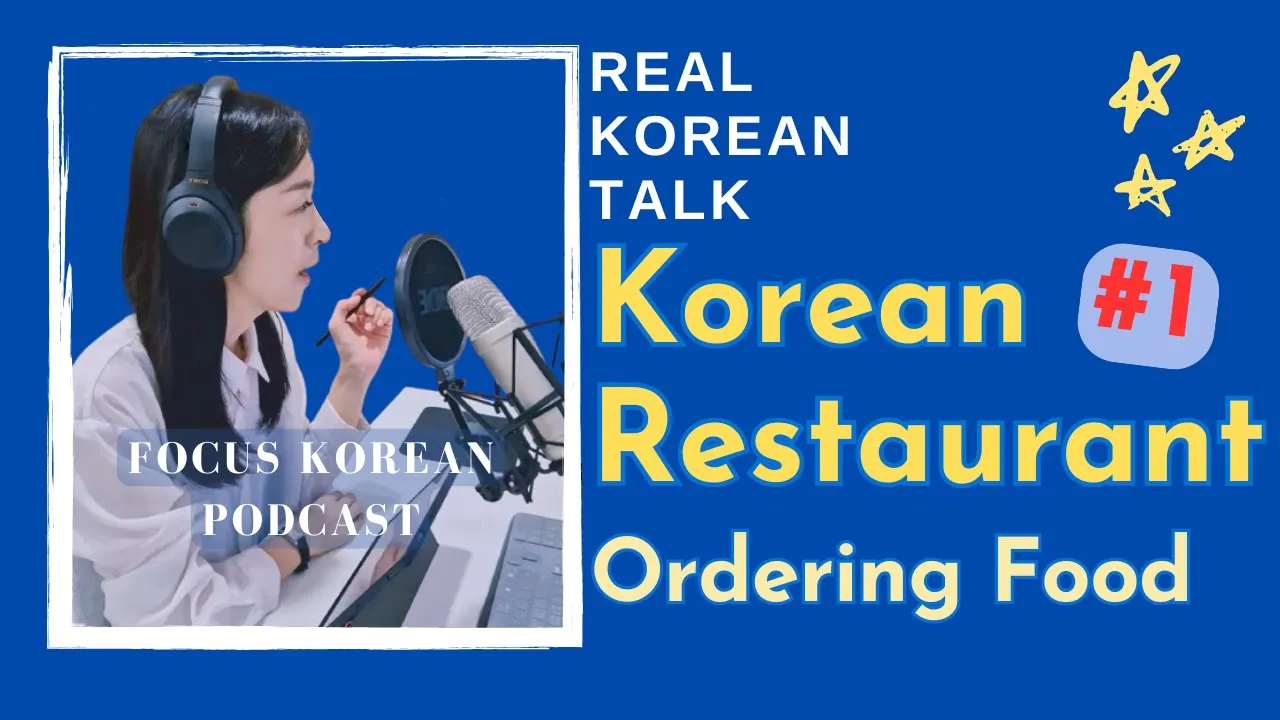
Hello, everyone. This is Professor Jeong from Focus Korean. Starting today, I’m launching a new series.
It’s called “Real Korean Talk. ” As many of you know, I teach Korean, Korean education, and Korean studies at a university. Many of my students are advanced Korean learners.
Some of them have studied for several years, including language school, university, and even grad school. But one thing I’ve noticed is that even though they know a lot of vocabulary and grammar, they still use many awkward expressions that Koreans don’t actually use. So in this series, I’ll show you how real Koreans speak in everyday places.
In this episode, we’ll learn useful expressions at a restaurant. Let’s start with entering a restaurant and ordering food. Listen carefully to the dialogue.
Staff: Welcome! Staff: How many people? Customer: Three.
Staff: Okay, sit wherever you’d like. (A little later) Customer: Excuse me, we’re ready to order. Staff: Sure, what would you like?
Customer: Two bibimbaps and one soft tofu stew, please. Customer: Please make the stew a bit spicy, and leave out the egg in one of the bibimbaps. Staff: Got it.
Water and side dishes are self-serve. Staff: You can get them over there. This kind of conversation is very common in Korean restaurants.
Let’s go over some key expressions one by one. When you first enter a restaurant, the staff usually asks, “How many people? ” Just answer with the number in your group.
If there are three people, you can say “3명이에요” — but more commonly, we just say “3명이요. ” When we describe something, we often say “책이에요" or “모자예요” using the pattern “Noun + 이에요/예요. ” You probably learned this back in beginner level.
But in real conversations, Koreans often just say “이요” or “요” after the noun. It’s a short way to sound polite. So you can say “책이요” or “모자요.
” In the restaurant, instead of saying “다섯 명이에요,” it’s totally fine to say “다섯 명이요. ” If there are lots of seats, the staff might say, “Sit wherever you like. ” Here, “데” is a bound noun meaning “place” It’s a type of noun that needs a descriptive word before it.
So you’ll hear things like “편하신 데” (comfortable place), “맛있는 데” (delicious place), or “사람이 많은 데” (crowded place). “편하신 데” just means “a place you’re comfortable with. ” If someone says, “Let’s eat somewhere tasty,” they might say “맛있는 데 가자.
” If you say, “저는 사람이 많은 데에 잘 안 가요,” it means “a place with a lot of people. ” So when the staff says “편하신 데 앉으세요,” it means you can sit anywhere that’s comfortable. But if it’s crowded, the staff will usually assign you a seat — like “Please sit at the window” or “Sit here at this table for four.
” And at slightly more upscale restaurants, the staff will sometimes guide you to your seat. They might say, “This way, please,” or “Would you follow me? ” In that case, you just follow the staff member.
So, how do you order food at a restaurant? It depends on the restaurant. Some places have a bell on the table to call the staff, while in others, you have to call them directly.
How do you usually call the staff when you eat out? Most Koreans just say “여기요. ” For example: “여기요, 저희 물 좀 갖다 주세요 (Excuse me, can we get some water?
),” “여기요, 저희 주문할게요 (Excuse me, we’d like to order). ” You can use it to ask for anything you need at your table. Some people also say “사장님” (boss) or “이모님” (auntie) to call staff.
It doesn’t mean the person is actually the owner. If you’re not sure what to call someone, “사장님” is a safe and respectful choice. Older women are sometimes called “이모님” — it’s a friendly and casual way to address them.
It’s something people with a friendly or outgoing personality tend to use. Personally, I don’t really use those expressions, but I do have people around me who do. I usually say “여기요” or “사장님.
” When you're ready to order, just say “주문할게요. ” The grammar “-(으)ㄹ게요” can be tricky for learners. Many students confuse it with “-(으)ㄹ 거예요” or “-(으)려고 해요.
” Compared to other grammar forms, “-(으)ㄹ게요” is often used when the listener is involved in the action. It’s not just something I’m doing alone — it also affects the person I’m speaking to. Ordering food isn’t something I’m doing alone — the staff has to hear it and send it to the kitchen.
So “주문할게요” sounds more natural than “주문할 거예요. ” Here’s another example: If someone asks, “What are you doing this weekend? ” you’d say, “영화 볼 거예요.
” Saying “영화 볼게요” sounds unnatural here, because watching a movie is your personal plan. In this case, it has nothing to do with the person I’m talking to. So using “-(으)ㄹ게요” here would sound unnatural.
Also, “-(으)ㄹ게요” is commonly used when something wasn’t planned in advance. Like when I decide to order food “right now. ” I’ve looked through the menu at the restaurant and I’m deciding now, so using “-(으)ㄹ게요” fits well here.
But when you’re talking about something you’ve already planned, it’s better to use “-(으)ㄹ 거예요” or “-(으)려고 해요. ” For example, I’m on a diet and I plan to eat only yogurt for dinner. That’s something I planned ahead of time.
So I can say, “저는 저녁에 요거트를 먹을 거예요” or 저는 저녁에 요거트를 먹으려고 해요. ” But if I say, "저는 저녁에 요거트를 먹을게요,” it sounds like I just decided on the spot what I’m going to eat. You can say “비빔밥 하나 주세요,” “비빔밥 1개 주세요,” or “비빔밥 한 그릇 주세요.
” All are fine. You probably learned to count food using “그릇” (bowl) or “접시” (plate), but in real life, people often just use “-개” (counting unit for things). So you might hear: “국수 한 개 주세요,” “비빔밥 두 개 주세요.
” If you have any special requests, you can say “~해주세요. ” I like spicy food, so I often say, “좀 맵게 해주세요. ” One of my friends doesn’t like cilantro, so at pho restaurants, she says, “고수는 빼 주세요.
” You can also say things like, “덜 맵게 해주세요(Please make it less spicy)” or “국물 많이 주세요(More broth, please). ” You’ll see the word “셀프” (self) a lot in Korean restaurants. Especially signs that say “물은 셀프입니다.
” It’s from the English word “self. ” You might also hear “반찬은 셀프입니다(Side dishes are self-serve)” or “앞접시는 셀프 코너에 있습니다(Small plates are at the self-serve station). ” It means customers should get these items themselves.
So “물은 셀프입니다” means you have to go get your own water. In this episode, we learned how to order food at a restaurant. These expressions are short and simple, but very commonly used.
In the next episode, we’ll continue exploring expressions used in restaurants. Have you ever been to a Korean restaurant? Are there any expressions you’d like to learn more about?
Leave a comment below!
![[SUB/PDF] Real Korean Talk | 편의점 At a Convenience Store #1 – Buying & Paying | Korean Podcast](https://img.youtube.com/vi/1UCSAdL-wLs/maxresdefault.jpg)
![[SUB/PDF] Real Korean Talk | At a Restaurant #2 - Asking for Things | Korean Podcast](https://img.youtube.com/vi/GxdGlTPPgTU/maxresdefault.jpg)

![[SUB/PDF] S1 E48 | Intermediate | Korean Podcast | At a Convenience Store 편의점 |](https://img.youtube.com/vi/kdzBYfAZgPw/maxresdefault.jpg)
![🌏 외국어 공부[🇰🇷Korean Podcast for Beginners🌿] (SUB/PDF)](https://img.youtube.com/vi/wokW1du6AT4/maxresdefault.jpg)
![[SUB/PDF] S1 E47 | Intermediate | Korean Podcast | My Favorite Cafes 카페 |](https://img.youtube.com/vi/itaA9my-2ZU/maxresdefault.jpg)
![[SUB/PDF] Real Korean Talk | At a Restaurant #3 - Waiting for a Table | Korean Podcast](https://img.youtube.com/vi/HiAtNuqRW1U/maxresdefault.jpg)

![[SUB/PDF] S1 E42 | Intermediate | Korean Podcast | At the Supermarket 마트 |](https://img.youtube.com/vi/t93P6IbwPmA/maxresdefault.jpg)
![[SUB/PDF] S1 E45 | Intermediate | Korean Podcast | Books I Like 내가 좋아하는 책 |](https://img.youtube.com/vi/7r8H5D6tYKw/maxresdefault.jpg)
![[SUB/PDF] S1 E41 | Intermediate | Korean Podcast | At the Hair Salon 미용실](https://img.youtube.com/vi/lcr9nbUPAz4/maxresdefault.jpg)

![[SUB/PDF] S1 E40 | Intermediate | Focus Korean Podcast | What's in My Bag 내 가방](https://img.youtube.com/vi/e5Yv0FkHVek/maxresdefault.jpg)