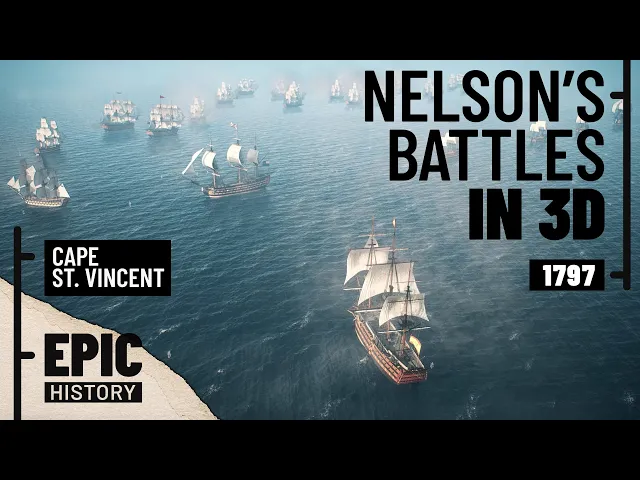
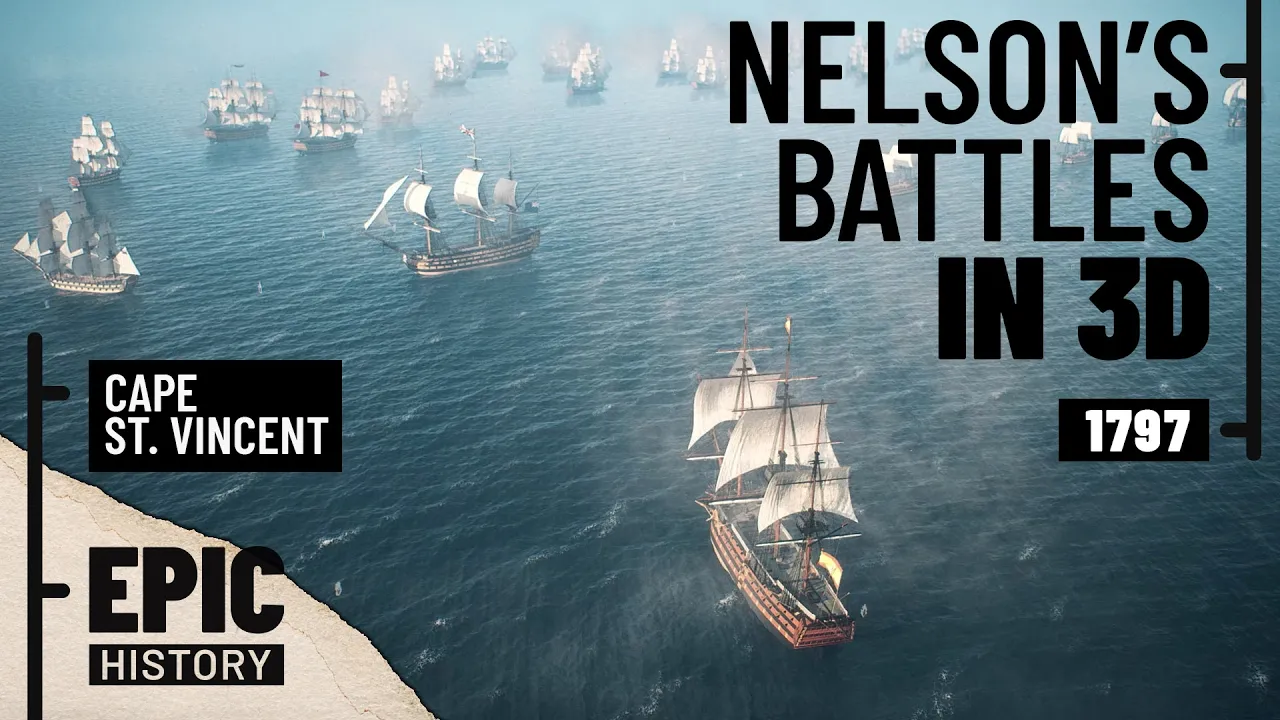
An Epic History / Drchinifel collaboration. In 1792, the French Revolution sparked a European conflict that would last a generation. A struggle for mastery of Europe, and the world.
A contest fought on land, and sea. In this war of shifting alliances, the most enduring rivalry was between France and Britain. Britain could not challenge France on land.
But at sea, it was a different matter. Britain’s Royal Navy was as dominant on the waves, as Napoleon was to prove on land. And in an age when Britain had many skilled naval commanders, one stood out above the rest… Horatio Nelson.
Bold, inspiring, and brilliant… For the British, he’d become a national hero. These are the stories of his greatest battles. 1797.
The Revolutionary War is in its fifth year. . .
And the French Republic dominates on land. It has conquered the Low Countries. .
and northern Italy. . and now its armies advance on Austria.
At sea, the British navy rules supreme, having won a series of victories over the French. But a new alliance between France and Spain poses a major threat to British naval power. Ship for ship, the British navy is superior to any enemy.
Its crews are experienced and well-led, while the French have lost many naval officers during the Revolution, and the Spanish lack money and training. Britain also has the most ships – around 144 ships-of-the-line – the largest vessels of the age, and the only ones that take part in major fleet actions. France has just 69.
But the new alliance with Spain adds 84 Spanish ships to that number. If these allies can join forces at sea, they will outnumber the British – and could force a naval victory that will change the course of the war. Britain’s largest naval force is the Channel Fleet, 16 ships-of-the-line guarding the homeland.
Detachments watch France’s Atlantic ports, where the French have several powerful squadrons, with the largest at Brest. Britain’s Mediterranean Fleet – 10 ships of the line – had been operating from bases in Corsica, Elba and Naples. But now Spain’s joined the war, the British are heavily outnumbered in the Med, and decide to make a strategic withdrawal to Portugal.
Here, the fleet is reinforced to 15 ships-of-the-line, and its commander, Admiral Sir John Jervis, is ordered to keep close watch on the Spanish. In February 1797, five Spanish merchant ships sail from Malaga, on Spain’s south coast, bound for Cadiz. They carry a cargo of mercury, vital for refining the silver and gold which arrives in Cadiz from Spain’s New World empire.
The convoy is considered so important that it receives a powerful escort – the entire Spanish battlefleet: 27 ships-of-the-line, and several frigates. After escorting the merchant ships to Cadiz, the Spanish commander, Admiral Córdoba, will continue to Brest, to join forces with the French. If he is successful, the British will face a giant ‘combined fleet’ - their greatest strategic fear.
With the help of a strong Levanter wind, the Spanish pass swiftly through the Straits of Gibraltar. But the wind blows them too far out into the Atlantic. As they struggle back towards Cadiz, a thick fog descends on the sea.
Meanwhile, British frigate HMS Minerve is returning from a diplomatic mission to Italy. Aboard, an emerging star of the Royal Navy, Commodore Horatio Nelson. He plans to rejoin Admiral Jervis’s fleet off Cape St.
Vincent. HMS Minerve first survives a dramatic chase off Gibraltar. Then, on the dark, foggy night of 11th February, she suddenly finds herself in the midst of the main Spanish fleet.
The British are so close they can hear Spanish voices in the fog. Minerve remains undetected, and is able to slip away. Two days later Nelson reaches the British fleet.
His report confirms others that Jervis has received, that the enemy are near – though he still does not know their strength. Jervis orders his fleet to prepare for battle, and sets sail to intercept. Admiral Sir John Jervis, commander of the Mediterranean Fleet, was from a prosperous middle-class background, but ran away to join the navy aged 13.
Now aged 62, he has 40 years’ experience at sea – much of it fighting the French and Spanish. He’s faced battle many times, but this will be the first time he’s led a major fleet into action. He’s fortunate to have several outstanding captains under him, including Collingwood.
. Troubridge. .
Saumarez. . and Nelson, all of whom will have their own illustrious careers.
Jervis’s flagship is HMS Victory, an ageing but powerful 100-gun ship-of-the-line. The commander of the Spanish fleet is Admiral José de Córdoba y Ramos, a Spanish aristocrat, 65 years old. He’d also gone to sea at 13, and also has a record of long service, including several scientific voyages to the New World.
He’s only just been appointed commander of the Spanish fleet, on the basis of seniority rather than merit, and has no fewer than six other admirals serving under him. Córdoba’s flagship is the mighty Santísima Trinidad. Carrying 130 guns, she’s the most heavily-armed warship in the world.
Santísima Trinidad leads a powerful fleet of 27 Spanish ships-of-the-line… although four of these will miss the battle. Seven are classed as ‘first rate’ ships of the line, meaning they carry 100 guns or more. Jervis has just 15 ships-of-the-line, and only two of them are first-rates.
On paper, the Spanish advantage in firepower is massive. But the number of guns isn’t everything – the speed and efficiency with which they’re handled can be decisive. Moreover, Córdoba’s crews are not at full strength, and many of his sailors are inexperienced.
Both fleets are accompanied by several frigates and other small ships, which did not usually fight in fleet actions, but were used for scouting and messages. At dawn, the British are sailing south in two columns. They hear Spanish signal guns in the fog, and know the enemy is close.
But while the British fleet sails with purpose, expecting to engage the enemy, the Spanish have become dispersed in their efforts to reach Cadiz. They are now in two groups: a smaller group of five ships to the east, led by Admiral Moreno… and the main group to the west, commanded by Admiral Córdoba, both heading East-South-East. On their current courses, the British ships are set to pass between them.
As the fog lifts, the Spanish fleet comes into view. . and Jervis learns for the first time, that he is massively outnumbered.
Lookouts at the mast-tops pass a steady stream of updates down to the deck - eight Spanish ships sighted; twenty ships sighted; twenty-seven ships sighted. Finally, Jervis snaps. "Enough, sir!
The die is cast and if there are fifty sail, I will go through them! " The Spanish have also spotted the British. The larger formation turns north, looking to pass the British going in the opposite direction.
The smaller Spanish force turns north-west, attempting to close up with the rest of the fleet. The British may be outnumbered – but if Jervis can get between the two Spanish groups, and fight half the enemy at a time, his odds will significantly improve. As the range closes, Jervis orders his ships to form a single line of battle, to cut between the two Spanish formations.
The manoeuvre is carried out rapidly and efficiently, with HMS Culloden taking the lead. Admiral Córdoba, however, is struggling to form his ships into a line of battle following their turn. They continue to sail in a ragged group, with ships blocking each other’s line of fire.
The battle is joined at 11. 30am, as the British vanguard opens fire. At 12.
08, Jervis orders his ships to turn 180 degrees in succession, to maintain contact with the main enemy force. But now the smaller Spanish force is coming up, threatening to break the British line near the point of its turn. If they can pull off this manoeuvre, they’ll split the British fleet, making it vulnerable.
Experienced British captains keep in tight formation, denying the Spanish any gap to exploit. But it is a determined attack. HMS Colossus takes heavy sail damage, and veers out of control.
Her neighbours, Orion and Irresistible, provide covering fire. The Spanish finally receive such a terrible series of broadsides, that they abandon their attempt to get through the British line, and turn away. For the British, every moment now counts.
Admiral Córdoba’s force is getting away. He plans to slip around the British, and rejoin with the rest of his fleet. If the British are to prevent him, someone will have to do something drastic.
Commodore Nelson commands HMS Captain, a 74-gun ship towards the rear of the British line. In this age, it was considered crucial to maintain the line of battle, for the safe and effective manoeuvring of the fleet. But Nelson sees that in their current formation, the Spanish will soon slip out of reach.
Just after 1pm, he decides he must do something about it. On his own initiative, disregarding Admiral Jervis’s clear instructions, Nelson gives the order to wear ship… and heads, alone, straight towards the main Spanish formation. HMS Captain is about to take on half a dozen Spanish ships single-handed, including Córdoba’s gigantic flagship, Trinidad.
In these winds, it will take Nelson 45 minutes to close with the enemy. All the while, his ship is under heavy fire from the Spanish. It’s neither fast, nor accurate, but steadily, much of her rigging and yards are shot away.
It looks like Nelson's gambit might fail. But help is on the way. When Jervis, aboard Victory, sees Nelson break formation, he signals to other ships to turn in support.
HMS Excellent, commanded by Captain Collingwood, is quickest to respond. HMS Culloden is also now close enough to engage the rear Spanish ships. Several of these have now suffered heavy damage: Salvador del Mundo is effectively disabled.
San Isidro has been battered. As HMS Excellent moves up the line to support Nelson, she fires broadsides into them at close range. Both Spanish ships haul down their colours – the signal of surrender.
HMS Excellent’s bold advance causes San Nicolas to take evasive action, and she collides with San José. Nelson spots his chance. His own ship is crippled, but has just enough way on her to ram San Nicolas, and attempt to take her by boarding.
Nelson leads the boarding party himself, climbing aboard San Nicolas through a smashed window in the captain’s cabin. After a short, sharp fight and close-range discharge of pistols, the crew of San Nicolas surrender. They’ve suffered more than 200 casualties, about a third of their strength.
Nelson’s not finished. His men come under musket fire from San José, which is alongside San Nicholas. Gathering more men, Nelson launches a second boarding action from the deck of San Nicolas, onto the San José.
This Spanish crew, bewildered by the sudden onslaught, also surrender. This extraordinary feat, of using one captured ship as a springboard to take another, is soon dubbed, ‘Nelson’s patent bridge for boarding first-rates’. He is presented with so many swords by surrendering Spanish officers, that he has to pass them to his coxswain to hold.
Córdoba’s flagship, the giant Santísima Trinidad, is now being hammered by three British ships. Her crew has suffered more than 300 casualties. Around 4pm, there are rumours she’s struck her colours, but it’s difficult to tell amid the smoke, din and confusion.
Before she can be secured, two undamaged Spanish ships arrive, and help tow her to safety. The British ships are too battered to pursue the enemy, who have begun to regroup, and may yet pose a threat. Jervis signals to his fleet to form up, and secure the four Spanish ships they’ve already captured.
As Córdoba and his remaining fleet sail for Cadiz, the British begin to cheer a remarkable victory. Against the odds, the Battle of Cape St. Vincent ended in a significant British victory.
Four Spanish ships-of-the-line were captured, including two first-rates. Around 800 Spanish sailors were killed or wounded, and 3,000 taken prisoner. British losses were just 73 dead, and 227 wounded.
Nelson’s brilliant success meant his disregard for orders was overlooked. Instead, he was knighted, becoming a Knight Companion of the Order of the Bath. Admiral Sir John Jervis was made the Earl of St Vincent, and received a generous pension and other honours.
In 1801, he was appointed First Lord of the Admiralty – the political head of the Royal Navy. He lived to the age of 88, and is remembered as one of Britain’s greatest admirals. Admiral Córdoba, in contrast, was disgraced.
Historians and his officers agree that he behaved with courage during the battle, but his ineffective manoeuvres were blamed for defeat. He was dismissed from the navy and forbidden to appear at the Spanish court. He died in 1815.
The Battle of Cape St. Vincent was no battle of annihilation. But it had major strategic consequences.
After their defeat, the demoralised Spanish fleet returned to Cadiz, where it was blockaded by the British… meaning the threat of the Spanish and French navies joining forces had been neutralised. And so the next year, 1798, a British squadron, commanded by Rear Admiral Nelson, returned to the Mediterranean. He was soon in pursuit of a French fleet, carrying General Bonaparte’s army to Egypt.
In the age of Nelson, a young Englishman wondering how to make a positive difference in the world had an easy answer: Join the Royal Navy, smash the French! But - those were simpler times. Today, many people want to know how they can make a positive difference in the world, and find a fulfilling career - without having to face cannonballs and grapeshot.
Our sponsor, 80,000 Hours, is here to help. 80,000 is the number of hours in an average career - 40 hours a week times 50 weeks a year times 40 years. That’s a lot of time.
It’s probably your greatest opportunity to make an impact on the world – and so why finding a career that is both fulfilling, and makes a positive difference, is so important. That’s what 80,000 Hours wants to help you do. They offer free research and support to help identify a career taking on one of the world's most pressing problem.
. . Such as the risks of AI; catastrophic pandemics; nuclear weapons; war; and climate change.
Even if you don’t know it yet, these are areas where your skills could really make a difference. Their information and advice is based on more than ten years’ research alongside Oxford University academics – and some of the results may surprise you. Start off by visiting 80000hours.
org/epichistory, or clicking the link in our video description, to receive the 80,000 Hours’ free in-depth career guide, exploring – what makes for a high-impact career. . .
new ideas for impactful paths. . .
and how to build a career plan based on what you’ve learned, and put it into action. 80,000 Hours also hosts a job board with nearly 1,000 high-impact career opportunities, searchable by location, requirements and the problem they’re tackling. Or, if you’ve got some ideas already, they provide free one-to-one advice to help you implement them.
There’s also an 80,000 Hours podcast, featuring in-depth conversations with experts on all of these topics. So whether you’re still working out what you want to do, or looking to change direction mid-career, or want to help solve pressing global problems from your current job, 80,000 Hours can help. And a reminder, 80,000 Hours is a non-profit – which means all their advice and services are completely free.
To start planning a career that is meaningful, fulfilling, and helps solve one of the world’s most pressing problems, sign up now at 80000hours. org/epichistory Big thanks to Drchinifel, for expert research and advice throughout our series on Nelson's battles. For anyone with an interest in naval history, his own YouTube channel is essential viewing, packed with profiles of historic warships and expert discussion of naval technology and operations.
Thank you to Royal Museums Greenwich, for kind permission to use a selection of their images in this video. Royal Museums Greenwich comprises London’s most famous maritime attractions, including the clipper ship Cutty Sark, and Britain’s National Maritime Museum, where you can find many, fascinating objects, including uniforms and personal items that belonged to Nelson himself. We highly recommend a visit if you’re ever in London.
Thanks as always to the Patreon supporters who help to make this channel possible – from builders, such as repsaj, Roberto Schoeneman and Dustin Smith. . .
To citizens like Erwin Chong, Marley B and Alessandro Basile. . .
And heroes, like Michael Smith. Join their ranks by joining us on Patreon, where you’ll get early, ad-free access to new videos, exclusive updates, and votes on future video topics.