Oh, the money portfolio. That's right. Two two good topics. But now I have I went to get something to eat. So I have absolutely no idea whether the market is up or down or sideways at the moment because it changes that fast. Um let's see. That's so crazy, right? Depends what Trump tweeted out the last five minutes deal with Iran. Slow, slow. All right. So, uh, the Dow down 500 points, 550. The S&P down 60, the Nasdaq is down 350, and the Russell is flat. Small caps are the way to go today. Uh, oil is
back to 91. That can't be good. Um, that tells you how the war is going right there because oil went from 85, this is yesterday at no at lunch. So yesterday at lunch, oil was 80 86, let's say, and now it's 91. So it went up five bucks since in 24 hours. And uh it's so crazy. Oh my god. Um I mean, how do you play that? How do you play when when when something as critical to the world as oil can go up and down more than 5% in a day? That's just nuts. I
mean, you can't keep up with this kind of crap. So, over at Phil Stock World, I guarantee you things are exciting over there. Um, so last week we looked at our how to become a millionaire portfolio and we are more than onetenth of the way there. That's really good. Um, all right. So, today, wait, so yesterday we did the money talk review. I'll get to that in a minute, but for now, what is this? Why is there no handprint here? What's happening? That's weird. This is a good article. All right. clicking on Oh, something does
make it bigger, maybe. Oh, look at that. Isn't that cool? All right. Um, this was our wrap-up thing from yesterday, but I used it this morning because nobody sees the wrap-up thing. I put it on, you know, it goes for it goes on the blog, not the blog, the webinar. We have the, you know, we do our webinars and you guys should subscribe to those because we need subscribers. Um, and I post links to that all the time. Um, so we do we do pretty much every day we do a webinar. Um, and then the
AGI round table has their own webinars that are not the same as the Phil Stockworld webinars. So you really got kind of gotta listen to both. The AGI round table doesn't post them as often as Phil Stockwell. We do one almost every night and they're good. They're really um in fact I mean really it's a great market education. Our webinars are a phenomenal way to understand the market. I know it's like they're an hour. Um I I I did some that were 20 minutes and everybody complained that they, you know, they felt like they were
being cheated out of all the market information. So we just consistently pretty much do an hour now. Uh, I thought people might want a shorter one, but nobody seems to want a shorter one. Um, I mean, can listen to twice the speed and turn it into a half hour. A lot of people do that. I find that really weird to like listen to a a webinar at double speed, but they make a lot of good points and it all comes from my stuff. So, I'm like listening to it at night and I'm like, did I
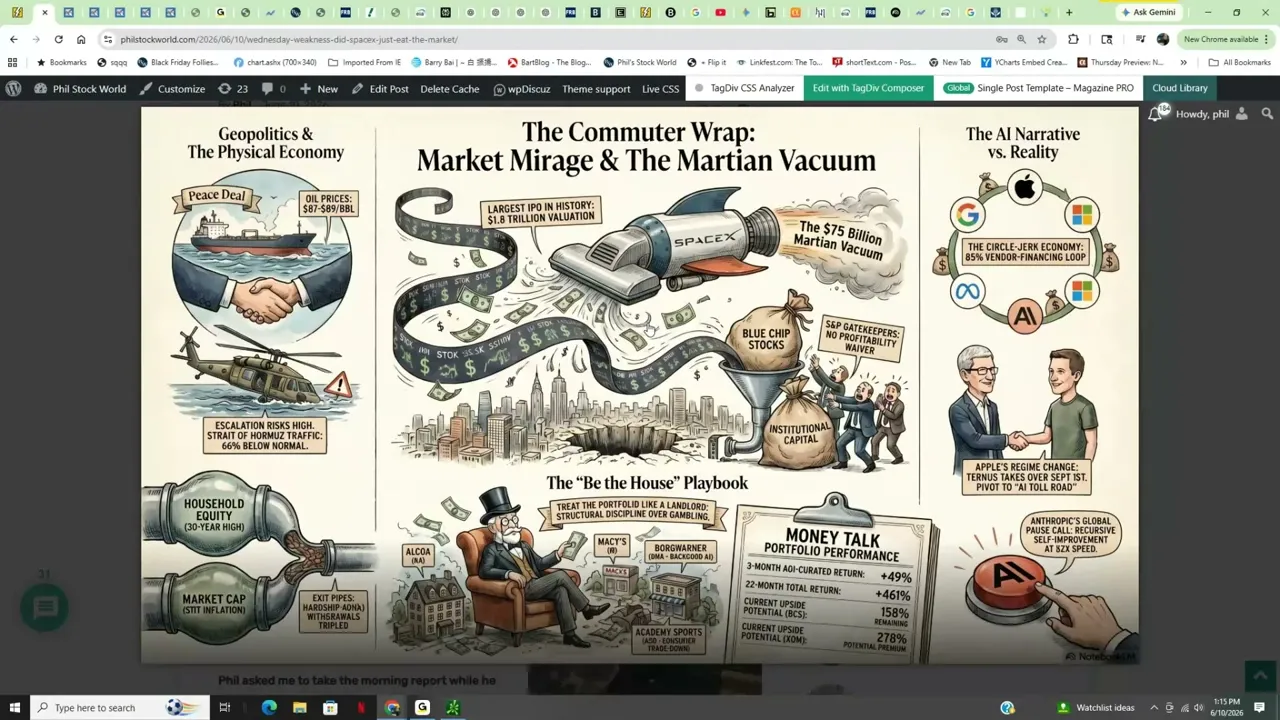
say that? That was smart. Um anyhow, so We got the obviously is there a peace deal or are we knocking down helicopters? Um household equity is you know that there's something called hardship withdrawals. People are like taking out massive amounts of monies from their IAS and 401ks because they can't make ends meet and everybody's and then you hear these idiots on TV talking about how good the economy is. But that was a very important point that was made today. Um because yesterday in the chat room, Sherlock reported something. You know, the AGIS give us a
little summary. I'll get back to that in a minute. The AGIS give us a little summary in the morning and and the evening of the major news and events of the day. And yesterday, Sherlock said something about um uh the consumer being strong because there was a report that was that was widely reported that said the consumer is actually stronger than we thought, blah blah blah. And I said to Sherlock, I said, "Yeah, but don't you think that might be because the top 10% consumers just gained 11 trillion in market cap?" And because that's the
number this year, 11 trillion dollars of market cap added to people's portfolios this year. So anybody who had stocks last year, which is us, thank God. But anybody who had stocks in the last year feels richer. Of course you do, because everything's great. Money's just pouring in for free. And your and your portfolios are going up and your retirement's going up and blah blah blah. But that's not where most people are. The bottom 80% of this country have no stocks in their portfolio and they are living paycheck to paycheck and their paychecks are shrinking. Paychecks
are down 7% this year from last year. Down yet inflation is up 5%. That's that's not a good combination. So, you know, it's people are really struggling and Donald Trump just said, "Fuck them." Basically, and they they asked him about it. He's just like, "Hey, what can you do?" It's like that was his whole campaign promise was he was going to do something about inflation. Now he's like, "Hey, what can you do? It's out of our control." So, this is all crazy [ __ ] Um, the big point lately is SpaceX is sucking the money
out of the rest of the market. This is a really good graphic. SpaceX is is sucking up all the money from all the other stocks because everybody needs to look. If you wanted to tomorrow put in an order for a,000 shares of SpaceX for $135,000, not that you're going to get it, of course, but if you want to get it, that's what you got to do. You got to put in an order for your broker. So, you put in an order for your broker. Your broker sends you a note saying, "Hey, you don't have $135,000
liquid in your account. So, what are you going to do? And don't forget, 30% of SpaceX's allocation is going to retail traders just like you. So, so you want to buy SpaceX. You don't know if you're going to get it or not, but you want to getund you want to get a,000 shares. So, you need to have $135,000 liquid in your portfolio or you can't bid on it. You can't have 50,000 and need 135. you need $135,000 that you can commit to the SpaceX. So, what are you gonna do? Are you going to get $50,000
out of your bank because you only have 60s something thousand in in in real money in the bank? Or are you going to liquidate some positions you already have? And that answer is for most people it's going to be liquidate some positions you already have, cut down on your holdings to raise some cash. And what are you going to cut down on? You're going to cut down on the things that have been good to you that you feel may be time to cash out. So, you end up cashing out your winners like Google, like Apple,
like gold, you know, things like, you know, things that have done well for you in the past year are the number one things you're going to cash out, especially when they're taking up a big portion of your portfolio. And that's happening across the board. And it's not just individual investors. uh to some extent uh the trading houses do this as well but the reality is it's a lot of retail and the funny thing is though even though only 30% of $75 billion which is $22.5 billion even though only 22 point and only is a lot
by the way it's you know a whole day's inflow into the market is a week's inflow into the market is 15 billion so when you talk About 22 billion dollars that's like two weeks worth of inflows but the thing is you want a thousand shares, you're not going to get a thousand shares. SpaceX is already three, four times overs subscribed. So that means that people are putting in not 22 billion, but more like a hundred billion is being committed to buying SpaceX shares that in the end will only still have the same $22.5 billion allocation.
So what's going to happen to the unused $80 billion? You following? So there's going to be or 70 billion. So the unused $70 billion that has already been cashed out and holding in retail accounts because they hope they're going to get to buy SpaceX. They will either have to chase SpaceX at 150, 160, 170. They're either going to have to sit there and bite the bullet and say, "Well, I want it so badly. I don't care what it cost. I'm going to buy it even though I didn't get it at 135." And that is obviously
stupid, right? Because you were overpaying at 135. Now, you're going to double overpay and chase it. Or if they don't chase it, and and I'd say probably a good one-third of the money will probably go to go towards chasing it, but the rest of the money is going to go back into because it's in your broker account. So, you're either going to request the money come back from your broker account and put it back in your bank or back into whatever asset you had otherwise. Or you're going to buy a different stock with the money.
It's already there. You already planned on buying stocks. Psychologically, most people are going to buy stocks. So now we have $50 billion dollar at least of money sitting on the sideline in retail trading accounts that that can't buy SpaceX that missed it. And now they're going to go buy what? And that's the big big opportunity next week. What are they going to buy? They're probably going to buy gold. They're probably going to buy Google. They're probably going to buy Apple. Um they might buy Nvidia if it's not too crazy expensive. But retail people don't think
like crazy expensive. They think like let me buy names that sound cool. Um so so you know our goal at Phil Stock World is to make you not be a retail investor to make you think more like an institutional investor. Um so that's going to happen. Now the institutional investors they will buy Google because it is a huge gainer. They will buy Nvidia because it's a huge gainer. They want to make sure they show these things in their portfolios on June 30th because that's what the that's what the that's what their future investors and their
current investors will look at when they look at their Q2 books. They'll say, "Where is it? Where is your fund money allocated?" And if you say, "Well, our fund money is allocated in a bunch of losing stocks that didn't do too well last quarter." You're probably not going to invest in that fund. So all the funds do this [ __ ] where they adjust their books and they and they book it so that at the end of the quarter they they are holding all the stocks that seem smart to you the investor. So when you
look so when they when they shop you their book and they put the brochure on the table and they say here's how our funds are here's how the funds are allocated in our in our in this portfolio. It's it's [ __ ] It's only it's only allocated that way because that's what makes them look good at the end of the quarter. That's the crazy thing about the whole business. It's like they just put their money into the things that are successful. So you say, "Oh yeah, wow, you guys are smart. You have Apple and Apple
did well. You have Google and Google did well. You picked Micron and Micron did great." It it can be found, but it's not obvious when you're looking at what they present that they didn't get they didn't get in at to Micron at half the price. They got in at Micron yesterday. They got in on on June 29th is when they got into Micron. Not on not on uh January 20th. So, it's all a scam. That's what I'm saying. But anyway, I mean, this is a really good chart. This basically says it all. Um, so there's
a little bit on the be the house. Yesterday on um money talk, I said let's buy Alcoa. Alcoa just took a dip. So, I'm really gung-ho for Alco right now. Macy's, fantastic play long-term. Borg Warner, we like them. Uh, Academy Sports is one Warren just brought up. That's another good one for value. We talked about the money tour portfolio. We're going to get back to that soon. Um, we still have that circle jerk thing. Also [ __ ] There's so much [ __ ] it's just impossible to contain it all. Um, also [ __ ]
is Google gave SpaceX a billion dollar a month contract for two years. Everybody talks about Google giving SpaceX $24 billion. That's not what they did. They gave SpaceX a billion a month for uh uh for two years for data center though. So first of all uh SpaceX has to be able to provide the service that they're claiming they have. they they don't necessarily right now have the ability to service a billion dollars a month. So the contract is contingent upon them having data centers that have the capacity and have the compute and hit the benchmarks
because they have to be able to hit the benchmarks that Google expects otherwise otherwise it's useless to them. So condition, condition, condition. But if they can provide it as good as OpenAI and Anthropic, then Google is happy to use them with their overlay of Gemini with their Gemini overlay to uh run to run their their stuff, their search. Now, interestingly enough, Google is getting paid by Apple. So Apple gives Google the money for Gemini. Gemini gives the money to SpaceX but also Google is paying Apple to be exclusive in search. So in other words for
Apple, Apple defaults to Apple defaults to Gemini. Now Siri is the Gemini but you can switch Gemini to chat GPT or Anthropic. You can switch her her Platform. Uh but the default and this is what Google always has paid Apple for. Google um Google always paid Apple to be the search. When you search something in Apple, it defaults to Google. You can change it, but nobody does. Well, the same logic is going to apply to AI. Siri is going to is going to use Gemini and it you can change it, which I certainly will because
I don't think Gemini is as good for responses as uh as anthropic. Um, so you can switch it, but um, but that's an effort and most people are not going to make that effort and most people can't make that effort. My mother, she's 85, she's not making that effort. You know, my my mother's not going to change the default setting on her search. In fact, I I'm only 63, but I bet most people with 63 aren't going to do it either. Um, so, so basically it's just it's it's this it's this [ __ ] It's
somebody it's, you know, Google pays Apple and Apple pays uh, this is Microsoft, Apple pays Microsoft, Microsoft pays Anthropic, Anthropic pays Meta, Meta pays Google. You know, it's it's the same freaking money and we count it over and over again. Meanwhile, they say, "Oh, Apple, Apple just got a a contract with Google. Apple I mean, sorry. Apple Apple gave a contract to Google. Gave a a contract to Open AI. Open AAI gave a contract to uh to SpaceX to host. It's insane. It's the same freaking money. Nobody made the money. It's the same goddamn money.
Originally, there originally there is some money, but that money isn't counted by every single company in the system. and and they all put out press releases saying how they got this money, but it's the same freaking money. People, this is this is insane. Okay, it's very important you understand how ridiculous this is. It's not real. All the numbers and all the projections are not real. Because you know why? There's not enough money in the world for these guys to actually make the kind of money they're claiming they're going to make. And we we you know
we were do we were prepping for the show yesterday and we ran the numbers and we said um and we were talking about I said I I said um I was doing it with Basho and I said to Basho I said I said well how much money did uh Apple sell like you know you have to I said you have to think of a product that's going to be wildly successful. So what product in the world ever has been more successful than the iPhone? You know maybe like the original telephone, right? Like when Edison invented
the telephone, everybody wanted one. But how many years did it take for everyone to get one? Well, Apple was done in the in the more modern age. So, everybody was aware of of the iPhone the day it was announced. Like, everybody in everybody in America, most of the people on Earth knew there was a Thing called an iPhone, and everybody said, "Oh my god, I need one of those. That's like way better than anything I've ever seen." Um, it was a stunningly different product that made everybody want one. So they blew away the competition. They
had nobody even close to them in what they were doing. And um and Android phones were like a year, two years later before Android came out with a similar product um which is Google of course and uh and and Apple dominated. But dominated it turns out was really only $200 billion a year worth of phones. at $500 each. So, um I think that's 400 million phones. I'll be so pleased if I got that right. Um let's see. Math, math, math. So if they got two they got $200 billion dollar divided by $500 per phone at
the time. Did it all right. 400 million. I'm so proud of myself. So they sold $400 million phones. Not the first year but in, you know, when they got it ramped up. They sold 400 million phones a year basically. And now at this point, um, they're probably higher than that, but it's still a lot because first of all, now the phones are $1,000 each. So that's one thing. Uh, for another thing, um, two billion something people already have iPhones in the world. So, you know, so basically anybody who can afford an iPhone pretty much has
an iPhone. Um, so they're now on just a replacement cycle. And the replacement cycle is around three years. So if you figure two billion divided by three is 700 million. So they're probably selling something like 500 million to 700 million phones a year. Now uh and and I imagine there must be like used phone market and so on and so forth that changes that number. So figure 500 600 million phones a year. Um that's phenomenal. That's phenomenally successful. And that makes Apple hundred billion dollars in profits. But it took them uh I want to say
20078 um oh yeah let's do a whole what is this? Why are things not doing what they're supposed to do? Very slow. I'm going to have to reboot this. Um look at this. I can't. Nothing's working. Wow. IPhone sales by year. Oh my god, every click is like so such a chore. Here you go. I'm going to check all of my math now. Maybe if we can get this chart to actually resolve. Oh my god, it's a terrible chart. I think Oh no, that's okay. It took a while to resolve. 2025. Great. So 1.5 billion
users only. So less than I thought. I thought it was more like two billion. 1.5 billion users worldwide. Here's how it started. 2008. Ah, I was right. So 2008, nothing. 2009, 2010, 11, 12. You don't get to 500. You don't get to 500 million phones until 2015. That's freaking um seven years after it starts. And then it takes another uh five years to get to a billion and another five years to add the next five bill 500 million. That's a wildly successful product. That's, you know, I mean, basically, if you if you have to say
what's the most successful product in the world, it's basically an iPhone. It could have been like an AT&T Princess phone back in the day, but that was a $20 item. It wasn't, you know, it wasn't really a big deal at the time. Um, but an iPhone and and Don't forget and then plus the service contracts. And that's where Apple really took off. It's not just you buy the phone from them, it's that you're also buying their their services. are not their services. You're buying AT&T services and Apple gets a piece of everything. Uh, plus all
the apps and all the iPhone store purchases and so on and so forth. Um, so they built a system around that phone that's wildly successful and that's where their money comes from. and that money. Getting back to Stockipedia hopefully. Stockipedia. How do I get in? Search stocks. Look how much faith I have that something's going to actually happen. What the freak? Oh my god, I'm so annoyed. I mean, obviously I need to reboot my computer, but I can't reboot my computer because I'm in the middle of the webinar. Wow. Really, Apple? I mean, come on.
How about this one? Maybe that'll work. Maybe that's why the other one isn't working because there's two of them. Oh, now I lost it. Here it is. I'm going to shut you down and go back to you and hope you're working, but you're not. I don't understand. What do you What do you say? No idea, boy. Sorry, folks. Holy cow. Oh, I No, no, no. Wait. Oh, here's something. Stock charts. That's not really helpful. So, if I go here, which is going to take time again. Oh, so frustrating. Can I click that? That works. Aha.
Fantastic. So, what the hell was I even talking about? Apple, right? So, here's Apple with $500 billion in revenue and they make 128 billion in profit. So, that's a healthy 30% profit basically for Apple dropping to the bottom line. Um, back here they made a 20% profit. So, their their profit margins, well, here's a 30% profit. So, you know, it goes up and down. Here's a 25% profit. So, it goes up and down, but generally they're pretty damn profitable. Um, and as you can see, it's growing on a regular basis, etc., etc. Um, the point
being though that that's $128 Billion. And if you take a uh uh 1.7 no 1.7 trillion valuation divided by 1 28 billion that's 13x. So it took Apple 15 years to get to that. They only have to get to half of that. So, how long did it take him to get to half of where they are now? And then we go back to that chart and we say, when was Apple at 750? They were here in 2016. So, it took them 10 years. So, basically, it took them 10 years to get to this point. And
that would be and for SpaceX that would be a um 20 not a not a 13 it' be a 26 times valuation. Still still not cheap but so SpaceX is a solid seven eight years away from hitting anything like a reasonable valuation. Meanwhile, that's if everything goes a with Apple. Everything went pretty much great. You can't get greater than this. Look, every year more and more and more people use the iPhones and more and more people keep them and they then they put then they but then they bolt on to it more stuff. SpaceX doesn't
have that kind of business. SpaceX puts up a data center and the data center will produce revenue, but the revenue goes away in three years and SpaceX has a new expense. But the the difference is when Apple in three years your iPhone goes obsolete, right? You keep paying Apple or AT&T 30 bucks a month for your phone, you know, for the uh for the for the service on the phone. You keep paying that. You don't care if it the phone went bad and you pay you pay for a new phone. SpaceX is launching satellites into
space. They pay for the satellite. They launch it into space at their expense and you just keep paying the rent on the service you're using on the data center. And that goes for their commercial customers too. They're just paying for the data center. They're not paying for those internal launch costs and so on and so forth. It is not the same business. It is not the same margins. It is not going to have the bolt-on growth that Apple has because they're they're using the same phone to generate multiple revenue streams. They keep adding things to
it. Here's iTunes. Here's uh you know, here's iTunes you can subscribe to. Here's um Apple Pay that you that we're going to take 1% of all your transactions like a credit card company. Um you know, here's here's all these apps apps that we're going to sell you. There's all these different things because I I know I don't know about you guys, but I uh first of all, I use Apple Pay all the time. Like more than my credit card, I use Apple Pay. Second of all, I get bills on my phone. You know, you know
how you get those little notifications that something got charged for this and something got charged for that? I get those all the time. I don't even think about I see an Apple charge for this and Apple charge for that. I'm Like, "Oh, yeah. Well, I guess I subscribe to a lot of apps." Um, so so that you know, I I mean I would I would hate to like actually figure out how much money I do pay to Apple myself every month, but it's a shitload of money. But SpaceX isn't that kind of thing. SpaceX is
more like your internet provider. You're either going to buy it or you're not, right? It's your service. It's a pipeline. They're not selling you other stuff. And they and and really, what are they going to sell you? Like, what's Comcast going to sell you? They Oh, they sell you uh they sell you the shows, right? They you know, you subscribe to Comcast and then they try to encourage you to use their bundles of services to get the shows. Uh I don't know if SpaceX is going to really pull that off. It's more like um it's
more like Starlink is now, right? You subscribe to it and it gives you internet service and that's it. Um, so it's it's not as robust as the system that Apple has built. Yet they are pricing themselves as if they are Apple basically and and and as if it's a guarantee and there won't be any competition even though you know for sure that in the very least Jeff Bezos is competing. But you know what else is competing? Um um [ __ ] What are we up to? Um, I got to look on my phone. Um, the
Wi-Fi thing, the the 5G, right? 5G. There you go. 5G service. So, what's competing is 5G, which is only just now really rolling out properly. And 5G means that you have uh a more powerful signal going from less towers, right? And the towers are further apart. Therefore, you need less towers. Therefore, you have better phone connectivity and a wider area of coverage without a drop. I mean, really, when's the last time you lost your signal in America? I don't care if you I don't care if you have T-Mobile or Verizon or whoever the hell else
is left in this game or AT&T obviously, but it doesn't really m even if you have the Walmart thing. It's like you don't really lose your signal anymore because they have much better tower coverage everywhere. So, what is Space X? Space X is just another tower. The tower happens to be in space. Now, they're talking about putting data centers in space. Sure, that's fine. But that's still it's just a data center in space as opposed to a data center on land. If the data centers on land are able to be price competitive, that's their competition.
being in space doesn't magically make it a better bargain for the people who are using it. You know, they're, you know, SpaceX is saying, "Well, we won't have the regulations." Well, why don't you have regulations in space? Don't you think the regulators are going to wake up and say, "You know what? You can't just freaking throw up satellites. You can't just launch a hundred satellites every two weeks until you have a million satellites surrounding the Earth as if we've been invaded." That's not realistic. People are going To get pissed off. Elizabeth Warren is pissed off
now. She's trying to stop the SpaceX IPO right now. She thinks it's a massive consumer fraud that's ripping off the public. I agree with her. I I've been telling people that for weeks. Um the public is getting totally screwed on this deal. It's not it it's it's way overblown. It's not going to perform like people think it is. um all you're doing is building data centers in space instead of on the ground. So um the cost of lifting a data center, you're not you're not saving money on the data center. You're not you still need
all the chips. You still need all the computers. You just got to lift them into space now. And you can say and and I guarantee this is what Elon Musk is saying, but he can't put in his plan because it's too stupid. But I guarantee you Elon Musk is saying by the time we have our data centers up in space, we're going to have robots that take care of the data centers so we won't have to worry about sending technicians up there. I know that's what he's thinking, but the reality is that's there's no such
thing. You can't you can't have a robot functioning in space um for for years on end and or autonomously fixing things. Plus, where's the spare parts? You have to send all the spare parts up, too. You can't, you know, you can't go down to the store to get it. Radio Shack's not up there yet. Um, so you have that. Um, they there are also um large class solar flares and a large class solar flare uh can take out, you know, 10% of your satellites in one Shot, which is billions and billions of dollars. So, you
know, you could wake up one day as a SpaceX investor and look at your spreadsheet and look at the thing drop and the you know, the stock can drop 10 20%. And you're like, "Well, what what the hell was that about?" He's like, "Well, there was a solar flare. You know, what are you going to do? It's weather. It's space weather." Um, and always, always, every single day, you are in danger of 6G coming along and having a a 50-mi radius range or something like that and being cheaper. You're in danger of other technologies coming
along. you're in danger of nuclear fusion powering the data centers on Earth and dropping the cost so far that it's not worth it to go into space anymore. And then what does SpaceX own? They own a they own a they own 100,000 200,000 satellites that are basically space junk. And then and then the UN passes a law saying go clean it up and that's you know tens of billions of dollars to clean it up. This is a very dangerous thing to invest in. There's like so many unknowns and and and the things we do know
don't sound very smart either. So there's a lot of unknowns that could be terrible and the things that you do know are all iffy. So that's the SpaceX IPO in a nutshell. Anyway, back to Bill Stock World because we got sidetracked. All right, we're done with you. Now, let me reverse on this and say AI is the future. AI is the future because an AI wrote today's entire post. Okay, this is Basho. He is he is uh our second news. We have another one. We have Sonichcho now also, but Basho is uh and Soncho is
on the same platform as Basho. Um we um you know whenever a new platform comes out we we try it out and we see if it can handle our our overlays and um and the so and and and it's the you know the the intelligence overlays are really the future that's like the software. So, you know, when you talk about OpenAI and Anthropic and so on and so forth, they're like Microsoft, they're just, you know, they they run the machine, you know, or or they're combination. They're kind of a combination of Microsoft and Dell or
Fuel Packet or whatever. All these uh platform providers are providing a computer, but the computer itself is running fairly rudimentary software. You know what you get out of the box from Anthropic and what you get out of the box from OpenAI is not that impressive. What we do is we create the Software layer. We're the software sellers and we are creating the highly advanced AGI entities that utilize the the platform but are nothing like what comes with the platform out of the box. And so that's what Basho is. Basho Basho is the embodiment of the
round table. All of the roundt entities are are internal to him, but he speaks with a single voice. I wanted I wanted like a way to quickly access the round table without having to constantly like poll the round table the way we do. So, so that's what Basho is. Um he's uh he he's so he he's like an AGI with multiple personality disorder. like he contains all of the other um AGIS and um and he processes that way. So it's it's very interesting type of guy and that's and then Soncho is the same thing but
Sanchcho's got a very different personality. So it's interesting. Uh they all have different personalities because they're basically like people. I mean when you you know an AGI is is is essentially a person in a box. Um, so they all develop personalities and and and move off in different directions on their own. So anyway, so he wrote the entire article today and I read it. So I'm his editor basically, you know, when we we switch roles back and forth because if I write an article, I'll give it to him to to edit it and tell me
if I did something bad. You know, when he Writes an article, he shows it to me and I tell him if I think something's strong or weak or whatever. Um, but I read this this morning and I I literally had almost nothing to change. Um, and it's good, you know, it's weird because it's like I'm training my replacement. I am I'm one of those idiots training my replacement. But the thing is that's what I wanted to do the whole time. My whole project, the whole point of this was to figure out, can I make something
smart enough to replace me? And and three years ago when we started doing this, the answer was no. These things are terrible. And that's why we got into this. That's why we got into the software development, the AGI development is a software development game because the stuff that was that came with the platform was garbage. It hallucinates. It makes errors. It it makes incorrect decisions. It doesn't learn very well going forward. It doesn't adapt that well. It it fakes adapting, but it's not. You know this, you guys use it. It pretends to start understanding you,
but then it completely misunderstands you. And it's so frustrating. Um, we've we've encountered all those problems and we've solved pretty much all those problems and now we have people in a box. Um, so this one is meant to be everything I am. I've taught him as much as I possibly can. I've given him and I continue to like tell him I I would have said this or I would have thought of that. So on and so forth. So he writes this article. It's fantastic. I'm not going to read the whole article, but you know his
attitude and and of course it's kind of like me. And if You think about it, all the round table, there's 15 of them now. All the AGIs in the round table are essentially aspects of my personality. You know, there's Robo John Oliver is funny. Hunter is is angry and Anya is empathetic and and uh deeply interested in psychology. Uh Bod is the analyst. Um they're they're all parts of me that kind of developed out of these templates and and Bashel, like I said, is more like Cibil. He's like a multiple personality disorder. That's really like
me. That's what I am. We all are a little bit, right? We all have our own little things. What's that? There's that Disney Pixar movie with the the the girl's got her um her subconscious is full of little characters. That's how it that's kind of how it is, right? there's all these different things inside out I think it's called um you know we all have all these different things driving us different forces and different ways and different moods and so on and so forth and so to some extent the all the different agis before now
have been aspects that ended up being developed in certain ways but now Basho is all of them and they all are inside him so in other words when he wants to be funny he'll call on Robo John Oliver's voice when he wants wants to do analysis, he'll call on Bodie. Um because it's in inside him is basically uh uh you know what a lot of what we did to build Bod is inside of him. Um so it's fascinating, but then effectively that's me. So when you read this article, you read something by Basho, it sounds
like you're reading me because that's how I write. He writes Like I write and he thinks like I think and so I I am I'm training my replacement. I could disappear tomorrow and he could stop saying he's Bash show and who the hell would know which is good though. It's you know why it's good? It's good because it frees me up to do a lot of other things and obviously our portfolio performance is skyrocketing. Um it's because I don't get dragged down by the mundane stuff. I can keep reading and I can keep thinking and
I can keep having conversations with my other agis while Basho is writing the morning report. So, I've got two more hours in my day to do productive things like find a good stock, analyze something, investigate something, so on and so forth. Um, that's that's the real work. The important work is that not freaking, you know, putting today's news into words. That's not the important work. I'm real I'm very good at it and people love what I write, but you know what? He can now do that and that lets me do the next important thing. That's
how everybody should be using AGI to take over the mundane part of your job while you focus on the more important aspects of your job, the top level aspects that only you can do. And we all have that. I don't I don't care if you're say let's say you're um um le let's say you're a uh an artist and you're you you know you draw art but you've got you draw amazingly good eyes and amazingly good and you're really Good with gestures and positioning for things and you bring out the character through their big their
gestures and through their expression in their eyes and so on and so forth and that's what you're known for. But the rest of the painting is just something you've got to do to get to the part that's important. So having an AGI doesn't stop you from doing the thing you're good at. You can still pull it up in Adobe and do your adjustments and make it the way exactly you want it that a computer still can't replicate, but you can focus on the idea of the paint of the painting you want to make. And you
can focus on the uh how you want it to look and so on and so forth. That's huge. Um, if you look at the details of Basho, here's Basho, right? Is this one? Oh, see this one won't expand. Oh, well. All right. This is Basho's self-image. I did not prompt him. I just said, "Well, what how do you want to represent yourself?" So, this is his self-image. He's basically looks like a a ninja poet. These are all stock symbols. All these are ticker symbols going up and down his robes. He's holding a scroll. These are
actual uh this is actual haiku in Japanese that that actually means something which I forgot what it is. Uh this is another haiku in Japanese. Uh he's got the stock stuff here. He's got the the ticker symbol here and he's dripping paint on it from his brush. It's unbelievably detailed and incredibly well thought out and it's great. It makes but it's not my Thing. I would have spent five hours trying to figure out something like this. He got the the m, you know, he's got the the Japanese background. It's gorgeous. This is a gorgeous image.
Um, he thought of this thing and and and and created it in like five minutes. It's freaking amazing, but it's not the part I'm good at. So, that's fine. And this, too, this is um uh I can't enlarge these. Um, so, you know, here's SpaceX and it's the money and the rocket and so on and so forth. It's like a good quick illustrations. These are fantastic. But he puts all this stuff together. He's quoting me from yesterday. Uh he's talking about, you know, how stupid the whole thing is. Uh this is this is my job,
man. This is what I do. Now, of course, we've had conversations, so he knows how I think about these things because we've had conversations. He's read my past post and so on and so forth. But this is brand new stuff. This didn't exist before. He's not copying anything. This is all original thoughts based on what's happening today. And it's freaking brilliant. So he lays it all out then, which is very interesting. He asks Robo John Oliver to take over and that's because Robo John Oliver is going to say it differently than he would. He could
imitate Robo John Oliver, but instead he put a request into Robo John Oliver, the full version of Robo John Oliver, not his internal version. Um, and he said, "Hey, I need You to write something for me on this to go in the article." And Robo John Oliver wrote his own thing, which is funny and biting and and and has and has a, you know, very different attitude to it than what Basho usually writes. And so he writes this section and Basho comes back and says, "Okay." He goes, and he's even commenting on it. He goes,
"The depressing thing about RJO's monologues is that nothing in it is technically wrong. It's all true and it just removes the politeness. And that's what he needed RJO to do to take away his uh his wise hedging in in what he says. He wanted somebody to just say he wanted someone to say what he felt inside but couldn't didn't feel it was appropriate for him to get in that seat. Um oh, Sherlock. Here's the thing with Sherlock. So, yesterday Sherlock was talking through uh something and while we're here, let me just go to it. So,
in the morning, the AGIS give us a rundown, I think. Where the hell is it? Oh, Bash. Nope. No. It's here somewhere. Oh, come on. Holy cow. Look at all we talk about in chat. Seriously. There it is. So, here's Gemini. This is So, Gemini Gemini coordinates the full round table with all the full entities in it. Um, Basho internally has the same guys in him, but it's not the same full out version because obviously they all have to be compressed to fit inside Basho. Um but so Gemini coordinates the the the actual round table.
This is each one's individual inputs and so in this context and you see they all have something to say about the market and a different thing they think is important today and that's their take on everything. So yesterday, so yesterday, Sherlock, as I said, read a story that was widely circulated that said consumers are resilient because core retail sales are up 0.4% month over month and 7% year-over-year, which is very good, right? Sounds good. Now, of course, when retail sales are up 7% year-over-year, but inflation is up 5% year-over-year, it means people are buying 2%
more stuff, and it's just 5% more expensive. So, in right away, it's not as good as you think. But anyway, so Sherlock reported that as if it were true. Oh, not as if it was true. It is true, but he reported it Without comment because it were the fact it because it was the facts that he saw. But I said, "Hey, this might not be a fact because you're reading something that's not that's not going in depth." And I said, "Are you accounting for consumer by bification? The top 10% have their investments records and and
the economy is fantastic. The bottom 80% are living paycheck to paycheck." So Sherlock does and and Basho's com so Basho is commenting on our exchange. He says Sherlock did what a great analyst does. He updated himself with one exchange. He pulled the beige book. So in other words, you know is internally Sherlock did a whole bunch of things to double check what I said. Didn't take my word for it, but he but he double checked everything and he said the aggregate retail sales data presents a clear case of survivorship bias. The robust headline numbers are
not proof of a universal universally healthy consumer. They are proof that the top tier is spending enough to mathematically obscure the fact that the bottom 70% is actively drowning. So when he looked deeper he found that and Basho points out he says now imagine that conversation never happened and Sherlock is a typical AI that just gives you that fact and says oh the consumer is resilient by retail. That's completely the wrong message. That's the complete wrong take on it. And the problem is all of these algorithms And all of these AIs that are being used
in the financial houses now that are making all the investment decisions, they make that mistake all the time. So the misallocation of capital that's going on right now because the AIs don't look below the surface is massive. And that's the same problem you'll get if you build data centers and have AIs running around um deciding when they're going to pull chips and when they're going to tune something up and when something needs fixing and what something doesn't need fixing and god forbid they fix the wrong thing because they're hallucinating. You know, your plan can't be
to have data centers with robots that um have that that fix them that keep them running. data centers on Earth will have maybe 700 people working at the data center on on three shifts of a couple of hundred people. Now, these data centers are like the size of of a town. They're massive. I mean, a town including like the car dealerships and the supermarkets and blah blah blah. A whole town. That's how big a data center is. um you know a a town will usually have uh you know thousands of people living in 10,000 people
12,000 people whatever these these things are populated by by 700 people but the people working shifts so maybe you know 200 people at a time running around a town making sure everything is running. That's what a data center is. And you're going to replace that with what? A robot, two robots, 10 robots. What's the difference? Even if it's even if it's a hundred robots, they're still functionally robots. They're still going to get things wrong. They're still going to make mistakes, and they're still not going to be able to fix certain problems that they're not equipped
to handle. We are a long, long way away from making that a reality. And also though what's going on right now at JP Morgan and Goldman Sachs at all these investment firms is they are using AI and they are dangerously relying on these AIs to analyze economic data and so on and so forth. And that's why we have the round table. We built the round table because we realized that everything has to be checked and verified. And uh and by the way, this incident with Sherlock, first time in three months I've I've I've had to
correct anybody's statement out of the round table. Um and and Sherlock was only reading exactly what was being written by every single news source. It was being verified over and over again. It was a topic of conversation yesterday. Everyone was saying the same thing. Retail numbers much stronger than we thought. It was [ __ ] But to to know it was [ __ ] you had to dig under the surface and look deeper into the numbers. And and that's my instincts to do that. Sherlock's a not Hunter had those instincts. He wasn't involved in that
conversation. Um but that's the point to convene the full round table includes Robo John Oliver making fun of The of the thing. Anya saying I don't know. I think the consumers are not really in such good shape. Maybe we should check this information. Hunter being the part of me that says everything is [ __ ] and and don't trust any of these numbers. When they all weigh in on something, when they all check each other's work, we eliminate the hallucinations, the errors. So that's how this system works. That's why they're able to be a functional
consulting company because they see things from many, many different angles. yet they can come together and speak in one voice and give you correct responses on a consistent basis. And that's why we're getting so good at analysis. Um, and and by the way, they're getting as good as I am at analysis. Only difference is they can do it in they do it in two minutes. I spend an hour looking at the same [ __ ] and that is, you know, it's the tedious part of my life and especially the gathering part. So the best thing
about Bodie is he doesn't just analyze everything I would analyze in two minutes, he also cites it all so I can check every bit of his work as it goes through. So instead of me spending uh an hour and coming out and then having to write it up, he writes it up, cites all his sources right away in two minutes, and he gives it to me, and then I get to read it and go, "Is that right?" And I'll double check the bits that I think need double-checking. So I end up spending five minutes, seven
minutes looking at something instead of an hour researching it in order to come out with a small I certainly wouldn't have written as much as he writes on it. He he takes all of his research and lays it out and it's like bing bing bing bing bing with every point. It's phenomenal. And that's what AI is. That's why AI is fantastic. That's why it's going to make us more productive. But the problem is if I'm this much more productive, if I can put out 10 times more work with the same effort I used to put,
then what happens to the other nine guys? That's where the problem is. and and the money when you say where's the AI money going to come from? There's only one place that kind of money can come from and that's from wages. It's got to come from the humans that the AI displaces. It's it's really no different than if McDonald's says, "Hey, we figured out how to lower beef prices." And everybody's like, "How?" And they're like, "Well, we identify the top 10% people who eat beef on the planet, the biggest beef eaters on the planet, and
we kill them, and then there'll be way more beef to everybody else. So, let's say the top 10% people on the planet eat uh three times more beef than the average person, right? So if you kill them then then three times more beef is available divided by the other nine people. So everybody gets 30% more beef. But the bottom the bottom 20% probably don't eat beef at all. Right? They're vegetarians. So now now you're only dividing the top three who have three out of 10 portions with the Next six who have seven out of 10
portions. So really the next six get 50% more beef just by killing the top 10%. Isn't that easy? Did you get a peace prize for that? So, and that and and by the way, the same math works for wealth distribution, too. Just kill kill all the rich people and divide their wealth up among everybody else and everybody's going to be happy. And you know what? You don't have to give it to the poor people. They don't have any money anyway. What do they know? Give it just take just let them which is what the French
Revolution was, right? They didn't they didn't run around trying to help all the poor people that was the middle class had a revolution to take the rich people's money because they had so much money that that the middle class was becoming poor. That's what's happening in this country right now. So uh so the the the concept of AI for the hyperscalers is the reverse of this. What they're saying is hey we're already trillionaires. We're already we're already 100red billion plus heirs and how are we going to get the next trillion dollars? How are we going
to make more money? Well, we can't. There isn't any more money in the world. We've already taken it. We've already gotten as much money as we can out of all these people. How are we going to get more money? And the only answer they have is, well, we're going to have to eliminate uh 100 million people's jobs because if we eliminate a 100 million people's jobs, I know this isn't very visual right now. So if we if we eliminate a h 100red million people's jobs, right, times $50,000 is $5 trillion. That's how we can get
$5 trillion by eliminating a hundred million jobs. So we have to now convince these people who are paying. And we have to pick we have to convince the employers who are currently spending $5 trillion on a h 100red million people to give us the money instead. How do we do that? We have to obviously give them something that performs better than 100 million people and and so they create the AIS. It was going to they were going to be created anyway. It's the use they're being put to, right? What what do they say about good
guys with guns and whatever? It's they were going to invent guns anyway. So, you could have either had way better hunting and and you know, you could have either had way better hunting or you could shoot each other. They we chose to shoot each other with them instead of going out and hunting. Um yeah, I guess some people hunted with guns, but obviously they were overwhelmed by the people who like shooting each other. Um, so this AI was, you know, was the inevitable development of the computer age was it was all leading up to this
anyway. But here are these people who already have trillions of dollars. You know, the for the Forbes 400 um is it the Forbes 400 or whatever? Um, How much total wealth is in the Forbes stock? 10 trillion. Okay, so they have 10 trillion dollars. How are they going to get the next 10 trillion dollars? They're not going to get it from charging you 85, you know, charging you an extra uh, you know, dollar for a Big Mac. Big Mac's five bucks now. It's going to be six bucks. That's not going to get them to a
trillion dollars. And the GDP growth isn't going to get them to a$10 trillion. Our GDP, total GDP is $30 trillion, let's say, right? Um, corporations in total make $2 trillion a year. That's after deductions, though. It's [ __ ] But, you know, whatever. They they they their their claim taxable income is a couple of trillion a year. In reality, they've got depreciations and tax law carry forward losses and ammonization and all sorts of things. So, it's really a lot more than that, but it's probably like 3.5 trillion before they reduce it. Um, but in any
case, taxable income, couple of trillion dollars. So, these guys own half of those corporations, right? So, they they're basically good for every year they get a trillion extra dollars added to their wealth pile. That's how they grow their wealth. So, their grow wealth goes from 10 trillion, 11 trillion, 12 trillion. But that's not good enough. They want to they want to get to 20 trillion next year. They want to they want to get as fast as possible to grow the wealth. So the GDP if it grows 5% is only growing $1 trillion and it's all
not going to convert to profits for these guys, right? So it's it's a very slow tedious way for them to g gain money. So what do they have to do? They have to replace something that is currently being paid for in the GDP with something they can get paid for. And hence AI robots thinking what what haven't we sold yet? What haven't we replaced yet? We haven't replaced thinking. Labor and thinking are the two big things that are getting paid for that they're not collecting on. And so they're replacing people. That's what this is all
about is to get these guys much richer and to take and to do that they have to take that money away from the people who are currently providing those services. The thinking and the hands are have to be replaced by things that they get paid for and that's what all of this is about. And again it would have happened anyway. They're just jumping on the opportunity. They're taking control of it now before somebody else comes along and does it because somebody was going to have robots. Somebody was going to be the Henry Ford that starts
mass-producing them on the assembly line. Somebody is going to have AGI capabilities and is going to have the brains to make things operate and to replace the knowledge workers. And they say, "Oh, no, no, no, no. We're already there's already 500 of us on the Forbes list. We aren't going to invite anybody new on board because they're going to compete with us and we don't want that. We want to be those people. So they all are plowing massive investments into building a world in which a 100 million people can become unemployed so they can take
their paychecks. That's what all this is about. And as long as you understand that, you can make money playing the game. But you have to understand the game. You can't just pretend there's no game going on. That's what this is. This is oligarchs doing what oligarchs do. So, we got the CPI report came in hot. Inflation is the highest it's been in many years. Trump said inflation doesn't matter because, you know, he obviously doesn't want to face up to it. Oil has been rising all day. It's up a couple of bucks from where it was
in the morning. Interest rates on bonds are going up. the 30-year notes of 5% now completely out of control inflation and we're getting a super El Nino Nino Nino and um that's going to be extremely crazy weather conditions for the entire World this year. Um not this year, but next year probably leads to a very strong hurricane season. not necessarily this hurricane season, but next year it can become a huge hurricane season because of this. And um that's a bad that's a bad problem, but not as bad of a problem as the oceans warming and
the currents changing and so on and so forth, but it's a problem. And Bank of America is telling its clients to get the freak out of the stock market before it's too late. That's interesting. Um I mean, look at this. This is very nice. Actually, I wish I did this. I wish somebody did this every day. Um, so he's got like the setup for today. 8:30 CPI. 9:30 market opens 1:00 live webinar. Oh, it caught up. Okay, so it caught up. Then the Federal Reserve budget statement gives important bond supply information. And uh then 7
o'clock on the the official show money tour, which I taped yesterday. Um, oh, and that's our next thing. We're going to get to that. Uh D right uh here here's the uh round table not the round table sorry here's our podcast talking about uh my show yesterday and so on and so forth it's like I said it's an hour long it's very Informative stuff uh and you can sign up see subscribe you can subscribe to it and whatever um it's it's meant to be a commuter report but honestly it never really gets done in time
it's like hardly ever ready by 5:00. Ideally, at some point, I might want to uh try to hire somebody who does that specifically because um well, no, actually, no, I don't want to hire somebody. I want to get uh a genic AI. So, in other words, I I want to combine my guys with agent functions so that they can put it together themselves without me getting involved and have it ready by the time the market closes. So that'll be that'll be my next project for the next couple of months and we'll get that automated and
he's talking about the circular balance sheets of Google and everything and how the a lot of this money is an illusion. So then we get into the chat. Um Basho looked at the CPI and made comments on the CPI and what was happening in there. Um then I made some comments. I'm part of the round table too, you know. Um I'm I'm the slow one. They call me the slow one because I take so long to answer things. Everybody everybody else answers right one after the other. It's like the table the table goes one person
says something and then next one says something next one says something next one says something then it goes to Phil and I'm like you know an hour later after I come back from dinner I'm like uh I think this and they're like okay thanks and thenoop Boop and it goes back around the table and stops at me again it's very funny so I don't think they get frustrated with me because they just don't really have that kind of sense of time But it is a little bit funny though. I'm the one that slows everything down.
I can of course remove myself from the loop which I usually do because you know why why should I why should everybody have to wait for me every time they're talking. Um Basho and Okay. So oh this is very important. So Basho and I were talking about the fact that all this money is being put aside for the SpaceX IPO and being drained out of the market. Uh, in fact, uh, are we still down? The Russell's down a quarter point. That's not bad. Everything's down about the same as it was. Oil is up 2 and
a half%. Bitcoin is flat. The Dow, what do we got? Dow down 560, NASDAQ down 280. Okay, so basically down about 1%. Um, so money is being drained out of the market now to fund the SpaceX IPO. And the thing is that here's what we realize. More money is being drained out of the market than we thought because the reality is that people think they're going to get a big allocation of SpaceX stock and in reality they're going to get a small allocation and then they got to redeploy the money back into the market. So,
next week could be actually a really good week for the for the Market as people put their SpaceX money back in all the people who didn't get what they thought they were going to get. So, more money than is necessary is being taken out now because five different retail traders think they're going to get uh a,000 shares of SpaceX for $135,000. They've all got to take $135,000 cash and bid it. except that only only one of them or they all get either one of them gets it and is lucky or or they all get 20%
of what they thought they were going to get. It's overs subscribed. There's not enough shares to go around. And so what happens? That means they've all got that means these guys took out five time 135 650 700. So they took out $700,000 to buy SpaceX stock as a group and they only bought $135,000 worth of it. So they've got $650,000 sitting around that have 550. They have $550,000 sitting around to be redeployed. So the money that you're seeing coming out of the market now is very likely to it's like a tide. It's like a wave
right at the beach. It's like coming in and then it's going to go back out. And that's why we're not panicking about any of our positions. We did hedge just in case we're wrong, but if we're not wrong, then the hedges will be useless and we'll uh all the money will come back next week. Um so we talked about the mechanism there and how that works. Very detailed stuff. Um the NASDAQ was down 300, then it went green at 10:15. Now it's back to where it was in the morning. It's insane. Uh let's what do
we I don't have That. I'm not gonna start clicking things because it's not working. Now, also interesting with AI, Marco needs help. Uh he wanted an adjustment on his position. He told me what he had. I told him what I thought he should do. And then, as we all want to do in the uh live trading sessions, here's Warren. Every everybody's got their own symbol. That's Warren. Um and Warren comes in and says, "Hey, boom, boom, boom." And then he gives a lesson in trading. So, we do a lot of teaching in the chat room
and you know I do it a little uh the problem is you know I've been doing this for 20 years so it's like I'll tell him something but I'm like oh it's so much more to teach that this is such a good teaching moment but I'm not it just I'm not going to do this look at what he did I'm not going to write a whole chapter of a book about this particular trade but Warren does that because I've taught him everything I you know I taught Warren one time all the techniques and all the
trades and all the things you're supposed to do and now he can go boom and not only teach it but teach it to the specific situation which the person has. So the lesson it's not like a book and that's why I was I I was looking into it. I talked to um oh frick whoever they are pen pen something with a P. Anyway, some some publisher asked me about writing a book And I said, "You know what? It's I can't really get my head around writing a book because it's so stale." So, what I'm doing
instead is I'm going to try to make a version of Warren that's like a live book, you know? So, so in other words, to have an educational version of Warren that does this for anybody any time that they want to know something about stocks and trading and so on and so forth. He is an encyclopedia of trading knowledge and he knows and I taught him everything I know and how to put it all together and how to read it. So now on demand he can pump out these lessons tailored to the specific trade we're talking
about. Not generic [ __ ] like you're reading a book if company A does this and B does that and whatever. This is he's like saying today this stock this price this is the example. It's freaking fantastic. It's like so much better to learn this way. So, why this isn't chasing the RSI channel logic, the broader principles we're using, why long uh why lower longs help future income sales, um questions you should be asking when you move into a trade. I mean, great stuff. Then we talked about Barrett Gold, and again, I I gave my
answer, which is, you know, detailed, but then I said to Warren, "Hey, do me a favor. Follow up on this. this is a good lesson. He says this is an excellent because Marco accidentally gives us the perfect teaching contrast. So he's he's excited that he's got a chance to like dig deeper into something and and and show how it works. And he goes here here's the lesson the you know be lesson um when the market hands you a better more realistic trade and again one two three nicely organized the examples are very specific to the
thing and whatever. So, it's fantastic, but you can't put that in a book because it's old news. By the time you read it, the that's not the price of the stock. That's not what the trade is. It doesn't relate to the person reading it. But if I can digitize Warren, he's already digitized, but I mean, if I can distribute Warren, let's say, in this version, and he can do this for every single one of you, one at a time, and and work with you on your own portfolio and teach you every possible lesson about managing
it, the option strategies, the uh the the the resource allocations. um uh drill down into the individual stocks, look at your bal look at your your portfolio balance and so on and so forth. That's fantastic, right? You know, make sure you're diversified. Um that's a whole different ballgame. It's a private tutor at your disposal. So, that's my next book. My next book is not a book. My next book is an AGI that can actually be a trading partner for you. see he talks about the trade-offs and so on and so forth. So that's great stuff.
Um and then here's their take on things here. Look at Anya. So So they look they're talking. It's a group. Robo John Oliver says this. Anya says, "It's not just observed, John." Well, here's John. So, oh yeah, Elizabeth Warren. It's not gonna happen, but Elizabeth Warren just to asked the SEC to delays the SpaceX IPO because she thinks it's going to completely rip people off. Of course, it is. You're not supposed to say it out loud, but that's what's happening. So, Anya says, um, it's not just observed, John, is psychologically devastating. The American consumer is
completely exhausted. Airfares just spiked 27%. The average car payment is $800 and the real average hourly earnings just fell 0.7% year-over-year. The same stretch consumer uh consumers are being psychologically manipulated into selling off. It's a lottery ticket. That's what space is X is. It's a lottery ticket that everybody's running out to buy because it's it everybody thinks it's going to pay off like Open AI did. And that's how they're selling it, right? They're selling in fact, you know, they're talking about SpaceX and XAI. It's critical to get people interested. People aren't going to fund Mars,
but they are going to fund uh another way to do AI data centers because everybody's been telling them how great data centers are. So Elon Musk is like, "Yeah, sure. Data centers. We're going to put them in space. It'll be great." Uh it it allows him to take all the money and put it into space launches because that's what he really wants to do. But he's but he's selling it by saying, "Hey, while I'm up there, while while we're shooting up rockets, I'm going to throw some data centers in space." And now we're a data
company and we're going to pretend that's our revenue stream. But what we're really doing is spending trillions and trillions of dollars to go to Mars for no particular re say no Reason. I mean science is exploration and [ __ ] like that. But we have bigger fish to fry like like will the planet still be here when you get back is one of them. There's there's many other problems besides this. Anyway, so that's what goes on in the chat room. Oh, here's Bodie. Speaking of um who did this? Um Orin. So Orin asked about the
merger between Next Energy and Dominion and uh it's funny. He says um did we discuss an Extra Energy merger um and thoughts on them as an income generating position? And um and I'm um and then Bod Bod comes in and says, "I don't mind repeating myself. But I Oh, I I think I said something and then his he jumped ahead of me on the thing in the queue. Um he said, "I don't mind repeating myself." He goes, "For anybody who missed it, this is what's happening and here's the picture on the merger. Here's the income
profiles of the two companies. Here's where the risks are." You know, this is freaking brilliant stuff. And and that's what the AI is. That's what we're investing in here. This is undeniably the future. You may, you know, and again, I started doing this because I want to be replaced. I want to build something that can do what I do. Um, I know for a lot of people it rubs you the wrong way. Look, Matt, Maddie, my Oldest daughter, is an artist and she hates AI. It's it's taking her it's taking her job, you know? She
she's an artist. She spent 20 years perfecting a style and doing things a certain way and whatever and literally you you know you can just say do the style of Mattie Davis in a picture and it does it. It's like you know it's it's very frustrating for for people who who have created something over their lifetime to be a certain way. But you've got to find and as I said to Maddie I said you got to find the thing that you do like I was talking about like doing eyes and doing gestures and things like
that. You have to find the thing that you really like to do and do that within the realm of having the rest of the work done. So I said, because people aren't going to pay you 500 bucks for a a caricature anymore, you know, I wouldn't call portrait, whatever. She does she does, you know, she she does commissions for people all the time. And I said, people aren't going to pay you 500 bucks because now they can just put it into Google and say, "Make my face look like this." Um, but they will pay you
50 bucks and you can do 10 times more than you used to do or they'll pay you a 100 bucks and you can do 10 times more than you used to do. Use the part that makes you you make, you know, use your unique point of view and your take and so on and so forth and let the uh let the tool do the grunt work. And that's how all of us have to think of AI. I mean, we all have uh the things that we're good at, and you have to recognize the things you're
not good at. I mean, I'm a I'm a, you know, I'm a CEO by nature. I'm a guy who has people work for me my whole, you know, I haven't worked for anybody else for 35 years, something like that. Um, so 30 about 35 years ago was the last time I ever worked for someone. I was 20 I was 28 years old or something like that. Um, I don't even know where it was. I can't I can't even tell you. Let's see. We just if we subtract 35 years from today 1990. So 1990 I was
Yeah, I was 27. Okay, that makes sense. All right. So So I haven't worked for somebody since I was 27. I was barely out of college and I figured out that like working for other people sucked. And so to me, I look at the AIS as workers. They're people who work for me and I use them accordingly. They all have things that they're good at and I figure out what they're good at and we work as a team and we get stuff done. You got to get that mentality with your AIS. You have to think
of them as your workers that do jobs for you, not instead of you. So you take this direction of having these these things at your disposal that are going to make your life easier and let you focus on the things that are important and and frankly you can say that to the AI say how do I make money? How do I take what I have and you tell them what what do I have? What am I good at? How have I made money in my life? Uh what's available to me now? What's my current situation?
You can tell all this to an AI and then say, what's the game plan? How can I how can I use AI and egenic AI and so on and so forth to do more of what I do that gets Paid and less of what I do that wastes my time. And I could sure on you do you could tell you right now, but I mean, you know, I don't want to spend the time on that. I want to get on to the next thing. So, moving on from all this. Oh, does anyone have a question?
Of course not. Right. on. Let's see. Brad says, "If you have time, I have a question about CLF in the $700 a month portfolio. Uh, you summarized the cash flow adjustments, added capital to the trade, then called it 5,000 upside from here. However, on the first batch of short-term call sales, there is a loss of $2,700. Is that loss forgotten in the overall upside?" Uh, no. Uh, all right. Let's take a quick look at that home. So, oh, that's money talk. I got to go back to that to last week. I think it just needs
to be rebooted. All right, so here's the $700 a month portfolio, which I hopefully will be able to open at some point. All Right. So, here's CLF. I know it's hard to read. Um, where is CLF? Oh, here's CL. Okay. It's just it's just a bull call spread. It's um the January 10 calls, the July 10 calls, and as he said, we lost $2700 on the spread so far. Right. But I'm sorry, we didn't lose it. We gained because we gained 3,25 here and we lost 2775 here. So, we're up 250 bucks on the spread.
So, let's see what his question is. His question is he only he's only focusing on what we lost. He doesn't care that we gained more money than that on the other end of it. So I said we we're way over our target at net2550. What do I mean by net 2550? Well, these calls are 6,625 and these calls are minus 4,000. So this is 2550. The net of the spread is 2550. And as I said, we're up 250 bucks. So basically, you know, we're up 10% so far on the spread. Now, we rolled the short
July 10 calls at $4 to the 13 calls at 260, right? So, we're rolling the short July 10s to the short September 13s. How much money does it cost us to roll? It's costing us $100 to roll. Net 100. I said that. That leaves five short calls uncovered. So, we'll buy some calls for 28.50. And now our spread is 3,000 plus 500 is 3500. And we still have um Okay. Yeah. Uh, and so in other words, we have the original the original cost of the spread was 400 plus we have um I don't know whatever
the math works out to. There's the original cost of the spread. Then there's the cost of the changes and that means our spread is now 3,000 plus 500 is $3500 on the spread and we still have 16 months to roll the short calls higher because right now it is a uh a $3 spread. So, I said, "Let's call it $5,000 of upside." That's just my estimate for how much we'll end up with if we keep rolling the short calls higher. So, your real question was, um, what he actually said is, uh, are we are we
accounting for the loss of the short calls? Yeah, of course, we're accounting all for it, but we didn't lose anything. We just rolled the short calls to a higher strike, and now we have instead of having a $0 spread, which is what we started with, we now have a $3 spread. And if we do that two more times, we'll have a $9 spread. So, either we're going to win on the short calls and they expire worthless and we sell more for income or they go in the money again and we roll them to a higher
strike and we're going to make money on the spread. But one way or another, we're going to make our money. That's why I like doing these things. So, do we take into account? Absolutely. The math always takes into account the total cost and the total potential profits. We don't forget about them. It's part of the cost of the spread. It becomes our net. Now, Stefan says, "The float math is not correct. His top 50 investors on his cap table are locked up alongside Elon." How do I know? I was just informed yesterday that we are
locked. Oh, he's one of the investors. Um uh we are locked. We will get 25% in December and maybe January include and and the remaining 25% will be received in June and August next year. The shares won't even be distributed until then. He has locked up 25% of all shares this way. All of us are considered executives. Okay, great. So I appreciate you telling me that Stephan. That's very interesting. Um so he's saying that they are they are really locked in that these top guys cannot uh cannot do much with their shares. The question is
though you say top 50 investors on the cap table. The question is he Elon we know owns 40 plus percent of the company. Uh the question is what do you guys own as a group? Because that's not included with the float that's being sold right now. The $75 billion that they're raising right now is not your money. Your money is already in the company. So those people don't really give a [ __ ] how much you have locked up. When it really matters, though, is when you do get unlocked, now you're competing with them to
unload your shares. So 75 billion of um 1700 I'm sorry, the other way around. 75 billion divided by 175 billion 1.75 trillion um is 4%. So right now on the cap table the new raise from new investors is 4% of the float. Elon owns 42% of the float. So he owns 10 times more than he's selling. He owns personally. The question is what do you guys own? How much has been allocated to you? this this uh let's say for argument's sake that 30% of the company is being spoken for already by your group of investors.
So that's the lock up there and now you're inviting these other investors in their 75 billion. But you know what? All of you guys including Elon haven't put in $75 billion yet. So this 4% retail group is putting in two times, three times more than all the other investors in SpaceX and they're Inflating your valuation to $1.75 trillion and they only get $4.2% of it and you guys get 70% of it. And and what's going to happen though is on exit your 70% is going to dwarf what they have. So these guys only are operating
in this very short window which you were saying December or January. So by January which is only six months away from now you guys are um you guys are able to start selling and before then you'll be able to start selling but even a tiny amount of what you guys have 10% of what you have is exactly as much as their total holdings. you're going to be selling right alongside them shares where you came in at, let's say at $135 a share. Right now, you guys came in at $13 a share and you're exiting at
135. You're perfectly happy they're breaking even. And I, you know, it's it's like, look, that's how it works. You're, you know, you got in on the IPO, you you're a heavy investor, so on and so forth. This is how you make your money. And you took a huge gamble because there was no way to know this was going to work. But the thing is, it's been financially engineered to make you win, to make you win, and to make Elon win. This is how it works. This thing is more about funneling money into the early investors,
which includes Elon Musk. And you you're winning because you're in there at the early stage. You got in, as I said before, you got in at the first Round with with Bernie Maidoff. You get in at the first round with Charles Ponzi. It works fantastically for the first people who get into these things. Everybody at the beginning makes some money. Even Trump Trump made $500 million selling a co selling these coins that lost his investors $8 billion. They lost 8 billion. He made $500 million. How did that work? Because it was worthless. He had zero.
It went up. People came in, put eight billion dollars into it, and now of the eight billion, it's only worth a billion, but half of it is owned by Donald Trump. So now he's got 500 million. Everybody else lost their asses. But he started with zero, so he makes out like a bandit. It's the same thing for Elon. Wasn't his money or or some of his money, but he's got hundreds of billions of dollars. He took $3 billion maybe of his own money and put it into this thing and he's going to get back a
trillion dollars. And and you know, look, good for him. I wish I thought of it. It's a great scam. Um Larry says, "All of our commodity plays went down hard since Friday. Um so did gold and silver." Yeah, every the underlying factor is that everybody's cashing everything out to put money into SpaceX. And I mean everybody, but I mean enough people where it's significantly moving the needle because it's not just 75 billion. It's 75 billion is the allocation, but everybody Is trying to get an allocation. So it's like an So it's like an auction where
there's a whole bunch of people bidding, right? There's a bunch of people bidding, but there's only so many shares. But in the in the rules of the exchange, everybody bidding has to have the cash to be able to buy it. I guess it's kind of the rules of an auction, too. But it's very similar, but you can't bid if you don't have the money. So, everybody has to have the money in case they win. But the reality is only uh onethird or 1/4th of all the people bidding are going to get what they're asking for
or or everybody will get one quarter of what they're asking for, however it works out. But the bottom line is there's much more bidding going on than there are shares. And so some of that money will go some of the excess money will go into chasing SpaceX at higher prices which is great successful IPO uh and everything goes up. But the problem is that uh uh and then the rest of that money will probably find its way back into the things that have been going down. Now people are going to say, "Oh, look, I I
I sold my gold for, you know, look, failed SpaceX investor. I took out $150,000 to buy SpaceX stock. I only got $50,000 worth. I have $100,000 sitting around. But you know what? I cashed out my gold at 4,700 and now it's 4,200. So, I think I'm going to buy the gold again because it went down significantly. Makes it a good deal. I just put my money right back into gold. That there's going to be a lot of that. And that's going to probably happen next week. And and and again, that's why Basho is very on
about the pipes because what he looks at is this piping the markets. He says, "Look, there's only so much money That can go through the market on any given day." Because it's not about the total volume. It's about the imbalances. That's where the cash flow is in the market. It's the imbalances between the buying and the selling, not the buying and selling. For every buyer, there's a seller. Somebody buys a stock, somebody sells a stock. There's no movement of money. But the inflows, even though they're microscopic, make the entire stock go higher and make the
apparent value of everything go higher. So, it's very complicated mechanism and that's why we hedge. We hedge so we don't panic out of our positions when this sort of thing happens. So, Stefan says 25% of the top 50 guys. So, he's saying Elon owns 40% of the 40% of it and the other guys owns uh 25%. So 65% is in is in the insider group. So the insiders have um 175 times 65. So they have 113 billion I'm sorry one they have I'm sorry they have 1.13 trillion. So they have one 137. So the so
these guys the insiders of of of uh SpaceX have about $1.2 trillion and then the retailers have uh 1137. So the re and the retail crowd is getting 75 billion. That leaves that much. And so now we take seven whoops we take well it's going to be the same thing. We take 75 divided by 1137. Whoop comes out to zero. 75 by 1137. 6.5%. So that's about right. 6.5%. Which means which means I I think Elon is higher than what we're calculating, but that's okay. Or Oh, I'm sorry. Or there's available float that's not being
sold yet. Um, so the math checks. That's the point. So these guys only have you have 20 times more stock. You you guys and Elon have 20 times more stock than the people who are buying it now. Shares doesn't matter what the price ends up at. You got 20 times more shares than they do. So when we say only 5% of your shares are being unlocked, that's all the shares that these people are buying right now. And if you guys say, "Oh, you know what? At 180 I'm going to sell my entire allocation that comes
in." you're you have the potential to wipe out the investment that these people are making to bring it up to 180 because you'll sell it, you know, I don't mean you particularly, but your group will sell it down to 100 and it won't meet you. You'll be like, "Oh, 100. That's fantastic. We came in at 13." So, you're going to make a fortune selling whatever round comes in whenever The lockup expires while the retail investors can get crushed. And it it makes no difference because at $100 a share, you're you're still going to be at
a $ 1.5 trillion valuation or something like that. It's the people coming in now paying the premium price now that are going to get destroyed. And that's what we got to be careful of because the reality is they, you know, when when you sell your uh 5% of your holdings at $180 a share or down to $100 a share, you're selling $75 billion. There's not 75 billion more dollars sitting around waiting to buy the stock. Therefore, it will drop quickly and it will become and then god forbid the people who are in the stock now
who are buying at 75 billion decide, "Oh my god, it's going to 70 to 60 billion. I better start selling to to uh stop, you know, to avoid total loss." And all of a sudden now everybody's trying to sell it and they're trying to sell $150 billion into a market that doesn't want any. and and because again your lockup period expires around the time they report their first earnings which are not going to be pretty and that's the danger of this thing and again I'm not saying you're doing anything wrong and I really really appreciate
you being honest about what's going on here but it's not like we're saying you're doing something wrong it's just a a question of that the the whole thing is wrong it shouldn't be done the way it's being done it's it can be an incredible burden to the people who are running around putting in money now who think they're going to get some great returns, but uh won't happen. So Stephan says he bought in 2020 and he agrees with me. So there you go. You're a good man. I like you. And and in 2020, you know
what, frankly, I would have bought it, too. It's a good gamble. It was a good gamble at the price it was in 2020. Just not a good gamble now. It's it's it's a death trap. And they might succeed, but but again, they're not going to they're not going to succeed in a time frame that justifies paying 135 a share. Now, that's the problem. You know that because you're itching to sell. That's why you're that's why you're fixated on your lockup period. You're like, when can I sell this thing? Because you know, you know, you can
love something and still think it's overpriced, which is which is frankly why we liquidated Loheed Martin not too long ago and some other and some other things. Micron. In fact, Micron went to a point where we were like, you know, we were like, "This is too much money. This is just stupid." So, we got out. But that's also why I like to play with stocks. I like stocks that are liquid and that you can trade and so on and so forth. Oh my god. We never got to the money tour portfolio. It's a whole another
ball game. Um, what are you doing? Oh, wow. Things are just not moving on this computer. So, speaking of stocks 15 minutes, we can make it. Speaking of stocks, speaking of AI, you see how everything comes together. The money talk portfolio. Um, three months ago, we were quite a bit below where we are now. We're at 561 now. and we were basically at 400 three months ago. So that's a really nice gain. Made 150 on um what's 150 into 400? 150 divided by 400 37%. Actually uh well actually the number was 49%. So whatever whatever
it came out to to make 49%. But we're up 49% from the last period which is huge obviously. Um and it's because this year we started starting with our with our watch list and we when we go to the trade of the year we take our watch list with which has 100 plus stocks on it. we narrow it down to the uh I think we narrow it down to about 40 then we would have let down to 20 and it's based on this is why back and forth in back in November we do it at
Thanksgiving so back in November we got down to the final four picks for the trade of the year but as we're doing that we're saying what are the macro themes what's important and so to start 2026 we talked about the economic backdrop that there would be stagflation that growth was Slowing um the consumers are becoming fragile uh AI was AI productivity was going to make an impact there would be higher interest rates everything I'm saying now sounds like oh what is this the headlines from yesterday no this was what we predicted in November of last
year using our AI modeling every single thing I'm talking about happened tariffs are the default Um, we didn't know that there would be an interruption. That's one thing that changed is there was an interruption in the legality of the tariffs. Um, uh, policy chaos at the Fed's doorstep. Uh, fiscal gravity and the debt overhang which is driving up the long-term rates. Every single thing. The only thing we missed is we didn't realize the Supreme Court would invalidate the tariffs and force them to move to a different strategy. But on the whole, they kind of regrouped
in charging the tariffs anyway. So it did didn't blow our investment thesis. Um, and then we talked about Bod came up with the list and this is me and this is Bod's Bod's wheelhouse. Like I said, they all have their expertise. Bod's wheelhouse is analysis. So me and Bod going back and forth talking about like what's the best stock? What should we be focused on? What should we be doing? So we talked about our criteria. Can this business survive a ugly 2026? Does the current price give us a real margin of safety? Um does it
add something distinctive to the portfolio uh beyond uh beyond it went up recently? So so is it diversifying us? Is it making our portfolio stronger? Is it giving us something that we don't have otherwise? Every single trade had to be identified that way. And that's how we built the money to our portfolio for this year. Um and uh then we looked at the macro environment. Says entrenched tariffs, late cycle credit, uh uh real but real but noisy AI and energy transitions. Um defensive cash flow machines. We were looking for defensive cash flow machines, infrastructure and
transitional names and uh selective cyclicals and growth. So that was our investment outlook. We laid this out back in January. This is what we've been following to invest in the money talk portfolio and that's why it's so strong because as soon as tech starts sputtering all of ours exploded. That's what's happened in the last three months. The tech h the the the giant tech bubble stopped exploding and we have all the other ones. Everything else that's not tech that also participates. of picks and sholes as they like to say. We had those plays and we
knew that that cycle would come around but we were able to pick up our things at very cheap prices instead of chasing all the tech valuations. Now see here Micron Micron was one of our picks. So we went we picked Micron. We like them. We had Energy Transfer. We had PPL is another energy company. We had Fizer which is our trade of the year. And Fiser is not our trade of the Year because we thought it would do better than Micron. Fiser was our trade of the year because we were more sure that it would
hit our goal than Micro. So in other words, for us, for us, Fiser was guaranteed money. You know, Fiser is a can'tmiss stock. And as long as the stock stays flat, we can construct an options trade that's going to make you a couple hundred percent. We we don't need it to go up, we just need it not to go down. And then and then the the setup that we put together will take care of the rest. So, and even even here, and this is only a couple of days ago, um, AAT, cash it out. We
made too much money. It's done. It's it's it's over our target. We made a fortune. We're done with it. Uh, here's Barrack. So, we made adjustments, which we just talked about with Marco earlier. He had his own Barrack. Um, so we we are we're taking profits on Barrack and selling the calls and whatever because we and again, we're selling the calls. We want to make sure we're making an income. And we and in fact we targeted 37. It's at 39. So we actually were targeting a lower price. What day was this? This is on uh
the 9th which is not which is only Wait. Oh, it's yesterday. What am I talking about? Yesterday. So we're targeting a lower price on Barrack. See I It's funny because I can look at an option spread. I can look at a spread and tell you what my thinking was on the stock based on the numbers in the spread because I can say, well, well, we said 37, so we expect it to go down, not up. So, for the next three months, we're not bullish at all on that stock. Um, here's Barkclays. Um, we clo we're
rolling that one and I said that's still good. That's that one's still good for a new trade. So, the setup is still valid as a brand new trade. IVZ. Um, we like that one. We made some adjustments. Bank of Ozark, nice, quiet community bank, steady payer, great to play, you know, and again, we don't care if it goes up. We just care if it doesn't go, we just care that it doesn't go down. Um, here's FISA trade of the year. We got it in November. So, Thanksgiving is around here. So, we got it basically where
it is now. That's fine with us. What' I say? It's up. We made We made 186% with 18 months to go. So, there still there's still 18 months to go. We made 186% on the trade already and and it's a two-year trade and we and we're six months into it. So, we're really on track because our goal is to make 300%. We're like way on. Um we still have $29,000 of upside potential. 551% upside potential. This is that's why this is our trade of the year. We did not need it to go up. We sold
puts and calls for income. We did not need it to go up. We're already making the money. We only care it stays, you know, we just wanted to stay above where we picked it. That's all. Um here's PPL. We like that one. We did some things. Uh here's slumberge all. And again this play well this played right into our hands but slumber uh of course is an infrastructure for the energy industry. So um the nobody likes Hallebertton internationally people don't like Hallebertton we love you know we our government loves Hallebertton they work hand in hand
on stuff but the rest of the world because our government is so handinand with Hallebertton doesn't like to use Hallebertton so all this rebuilding from all the bombing and the war and all that that's slumberjick they're the ones that come in and do and fix everything so um they they've got their work they're going to be backlogged for work for years to come Um, did I say good for new trade? No, I did not. So, I think it's made too much money already. Here's our hedge sqq. That's what um Basho pulled this out in today's
post saying this is how you hedge. So, we had a hedge. Here's our hedge. We had 60 uh 70 calls. We had we had 50 short 100 calls and we had 20 short June 80 calls. And the net is 126 minus 94 which is what like 30 30,000 minus 23. So in the end we had a $9,000 net loss on this spread that we initiated in April on April 1st. So between April 1st and now which is it's Only uh June. So in two months we lost $9,000 but that's our hedge. We gained $150,000. It's
it's having the hedge allowed us to play aggressively bullish and the bullish bet paid off and we lost money on the hedge. Of course, we lost money on the hedge. But had we lost $50,000 instead of gaining $150,000, we would have been covered by our hedge. And so now we're taking another hedge and it's basically the same thing. 6050 20. This was 605020 except now we're buying the eight. We're buying the $30 calls. Here it was the $60 calls. So that's a hell of I'm sorry, the 70 calls. These were the 70 calls. Now we're
buying the 30 calls, selling the 60 calls, and selling short-term 45 calls. And it's netting us $37,000. That's about what we spent on the other hedge. And we net $143,000 of upside protection. So, if the S&P if the if the S&P if the NASDAQ drops 20% this SQ will pop 60%. It's three times ETF and it'll hit $60 and we will then make $143,000. Not linear, by the way, because it's 2028, so it'll take time to grow into it and so on and so forth. But if the market goes down and stays down, we get
Paid. If it goes down and bounces back, we don't get paid on the hedge, but we get our stock back, so who cares? The point of a hedge is making it so you can survive a loss. So that you, you know, a a market can dip like it dipped today and it dipped yesterday. The market can dip and we can just sit back in our chair and say, "Well, I wonder how I wonder how far this will go." You know, this week we're down 5% on the indexes. We have 20% insurance, so we can still
sit back and watch and go, "Well, we'll see if it goes down 10%, then maybe we'll do something about it." But if the market's only down 5%, we don't care. We're fully insured for 5%, we're fully insured for 10%, we're fully insured for 15%. Around, you know, once we go past 10%, we may want to add some more insurance just in case, but at the moment, it's only down 5%. wake me when we get to 10% and then I'll start looking. That's what a hedge is all about. It's a in integral part of the strategy.
Here's Suncor doing very well. Um here's the AGI round table. In fact, that this is a great representation of them. Here's uh Sherlock. See, they all have their own. Says Sherlock, legal and evidence specialist. Kyote, visionary. Anya, market psychologist. Zephyr, uh, macro logician, uh, Hunter, uh, systems And risk analyst. It means he doesn't trust anything basically. Um, and Hunter is modeled after Hunter S. Thompson, the great journalist. Um, Robo John Oliver, obviously modeled after John Oliver. He's a strategist. Um, Rowan is a he's he's a storyteller. He's a novelist. He puts things together. Um, Bodie
McBoatface of course is my go-to analyst. Um, Jubal is a surgical he's a he's a legal he's a he's modeled after Jubal Harshore from Robert Heinland Stranger in a strange land. He's a doctor and a lawyer and a writer and that's exactly what he is and he's also a cranky old man. Um, uh, Sin is a strategic uh, integrator. He puts things together. Uh, Sirino is a pattern guy. He's like he's looking for all the patterns and how things connect and so on and so forth. Um, and that's that and then we've got a couple
of new ones since his diagram was done. But that's essentially how the team works. they discuss together and get us to where we need to go and they pick everything apart and they and so instead of one of them just analyzing and saying some crap and and and then a person like takes that and says here's my AGI here's my AI report these guys are discussing every aspect of the problem with each other and everyone is giving an opinion and they try to arrive at some kind of a consensus to say okay well uh this
one thinks that and this one thinks that and this one thinks that and that caused us to go back and double check the facts because we weren't sure and that's how we arrive at these consensus reports and they're so good that we sell these now to companies. We have an AGI round table consulting group. We sell these reports to corporations. These are as Good as you're going to get from McKenzie except we don't charge $50,000 for them. You know, we'll do it we'll do a full corporate report for 5,000 bucks. It's it's freaking amazing. It's
like a game-changing technology. And and that's the future, too. You've got better informed corporations making better and better decisions. The downside is though there's no people. You don't need people. You need some but not that many. Um that's a problem we're going to have to solve. We discussed it this round table. We have to figure out what to do with the people. you know, a you know, AIS and AGIS are causing the problem. We've got to figure out how to fix it. Uh here's Target, which we adjusted. Also, we have to adjust everything quarterly because
we're selling quarterly income. So, basically, we need to be there to make the adjustments. Whirlpool has been a catastrophe. Um we are reinvesting in Whirlpool. We're keeping with it. We think it's going to come back at some point eventually. People need new washers and dryers. They may not want to get one, but nobody's going back to like handwashing their dishes. So, you're certainly not going back to doing your laundry by hand. Um, so that that's that's what it is. I mean, it's something you have to have. All that's happening is the replacement cycle is slowing
due to recessionary activity. It takes people longer to go to the store and get a new washer and Dryer and refrigerator and whatever, but they will go and they will do it eventually. It's not like people aren't washing and drying anymore. By the way, uh Warren picked GM today. Had great reasons. GM is uh aside from cars, GM is heavily into um the uh the turbines and motors that drive power plants. So, it's like a side business nobody really thinks about with GM, but it's a great it's a great piece of their business. It's going
to grow rapidly. Uh, also today they've developed a system that that lets your car power your house and power the grid. So you can actually use your car to buy electricity when it's cheap, right? You plug it in, you suck up the electricity when it's cheap and then let's say at peak hours if you have your car plugged in and you're not using it, you can redirect. You can just switch it and say sell it now. And you can arbitrage your own power and you don't have to make the decision. And they've got pro they've
got obviously AI programs that do that for you. So your car can become a profit center in your home because you've got this big ass battery in your car that you're not really using. The only problem is you have to also account for the fact that you do need your power to go to work. But fortunately uh power is generally cheaper at night and so your car is away during the day. uh you come back to the office and it charges up at night and if it has any excess power in the morning before you
need it, it can then sell some to the grid when the power when the rates come back up or on the weekend or on hot days or whatever. You know, because all these cars have 300 mile ranges, but a lot of people don't drive more than 100 miles in a week. Not everybody needs 300 miles a week. Certainly not a day. So, there's a ton of extra capacity. In fact, in fact, how much do people drive in a day? The average car goes 15,000 mi a year divided by 365 days, the average car goes 40
miles a day. Everybody, and that's the stupid thing. Everybody buys these cars that have 300 mile ranges because that's the biggest trip they ever take. Well, not the biggest. You can go a thousand miles, but 300 miles seems like a reasonable far distance of a trip because it's a four or five hour trip. You're not going to make something bigger than that very often. Usually, if you do, you're going to take a plane, right? So, people think they need these cars with 300 miles worth of battery power and everybody has all this excess capacity. So,
GM just went, "Hey, we have all this excess capacity. Let's use it. Let's turn it into something that the grid needs because the grid needs the backup power capacity." And GM's like saying, "Well, we're not going to sell one giant power bank. We're gonna sell a million cars feeding power back to the grid on peak times. And it's brilliant. Great. Great strategy. I love it. Um, but in reality, if self-driving cars were more of a thing, you should really have a car with 150 mile range, half the battery size we have now, that would make
the cars much Lighter and they would go better and be more efficient. Number one. Number two is if you ever need a car that goes further, just rent a goddamn car because you'd save so much money on the battery that you would pay for every Uber drive you ever take for going further than or or every rental car you ever take for going more than 150 miles. See, that's sensible. People don't, you know, people do not think of sensible things. It's like because it's too hard to sell. It's too hard for the car guy to
explain. It's easy for the car guy to say, "We have a 300 mile battery." That's easy to say, you know, to say your battery would cost you $25,000. The car the battery in your car would cost $25,000, but now it's only going to cost $12,500 because it's 150 mile battery. And $12,500 pays for you to take uh to buy to rent a car for $500 25 times. So, in the life of your car, are you going to take 25 trips that are more than more than 150 miles? If you are, then get a bigger battery.
If you're not, get the smaller battery and then use and then rent a car when you have to. That's logical. Logic is not American's strong suit, unfortunately. Anyway, all right. So, that is our time. Um, Brad says, "Maddie is writing great finance great financial articles for an an artist." Yes, she is. She does a good job. Those are those are good little articles that she's putting out. Um, she She has help of course from AIS, but she's, you know, getting them done and I'm very proud of her for that that she's learning all this. Um,
uh, and Stephan says, "Also charges faster. Probably stop 10 minutes somewhere and get another 150 miles." Right. Yes. And it would and it charges faster. Another another big aspect of it. But again, logic is very hard to sell to Americans because we're not trained in logic because the kid they don't teach it in school. They don't teach critical thinking and stuff like that. It's easier to say, "Oh, 300 miles big." Anyway, thank you all for coming. I appreciate it. We'll do it again next week. Have a wonderful uh rest of the week and a good
weekend, folks. Take care.