hello I am Malcolm Shaw in this lecture I aim to address generally the nature of international law the role it plays in the International System and the differences between it and domestic law in in the sense of agreed binding rules within a distinct group or Society has long accompanied the evolution of civilization it is on the whole instinctive that order is necessary and Chaos inimical to adjust and stable existence every society whether it be large or small powerful or weak has created for itself a framework of principles within which to develop what can be done
what cannot be done permissible acts forbidden acts have all been spelled out within the consciousness of that community civilization has always been based upon the group as men and women combine to pursue commonly accepted goals whether these be hunting animals growing food or simply making money law is that element which binds the members of the community together in their adherence to recognized values and standards it is both permissive in allowing individuals to establish their own legal relations with rights and duties as in the creation of contracts and coercive as it punishes those who infringe its
regulations law consists of a series of rules regulating regulating behavior and reflecting to some extent the ideas and preoccupations of the society within which it functions and so it is with what is termed international law with the important difference that the principal subjects of international law are nation states not individual citizens there are many contrasts between the law within a country domestic law and the law that operates outside and between States international organizations and in certain cases individuals these are reflected primarily in structure characteristic of domestic law is the following a clear executive Authority hierarchy
of Courts with Comprehensive jurisdiction law creating Authority Parliament or National Assembly and an enforcement mechanism the police indeed it is hard to envisage a functioning legal system without these characteristics however this is not the situation with regard to international law first there is no executive Authority capable of making decisions based on law there is the security Council of the United Nations which can adopt binding decisions under chapters 7 of the charter but only after having determined that there exists a threat to or breach of the peace or act of aggression and only in order to
maintain or restore International Peace and security further a majority of 9 out of 15 members of the council must be achieved and each of the permanent members of the council the U.S UK France China and Russia has a veto secondly there does not exist a hierarchy of Courts with Comprehensive jurisdiction in international law there are indeed a number of international courts but all of them are highly specific and operate only within closely defined areas such as human rights international criminal law the law of the sea or trade law or all within Regional organizations such as
the European Union The Only Exception is the international court of justice which has a wide ranging jurisdiction but like all the other courts depends upon the consent of the states that are to be bound by it this is the opposite of domestic courts which operate irrespective of the consent of those subject to it thirdly there is no legislature in international law there is no permanent body which has the authority to lay down laws binding on all states and other subjects of international law there is indeed only one comprehensive assembly of states and that is the
UN General Assembly which is comprised of 193 States members of the organization but apart from certain administrative and budgetary matters it cannot adopt binding resolutions still less create law fourthly there is no police force in the International Community it is true that the security Council can act acting under chapter seven take enforcement action but this is extraordinarily rare and there is no permanent Force the U.N and Regional organizations in particular circumstances May establish peacekeeping forces but these are by definition not police actions and again there is no permanent Force or arrangement recent events in Ukraine
have reminded us again that the result to force is ever present and that the International Community struggles with controlling this there is no unified system of sanctions in international law in the sense that there is in domestic law but there are circumstances in which the use of force is regarded as Justified and legal within the UN system sanctions may be imposed by the security Council upon the determination of a threat to the peace breach of the peace or act of aggression such such sanctions may be economic for example those proclaimed in 1966 against Rhodesia and
in 2022 against Russia or military as in the Korean War in 1950 or indeed both as in 1990 against Iraq and of course sanctions may be imposed by individual states or groups of States particularly the European Union coercive action within the framework of the UN is rare because it requires coordination amongst the five permanent members of the security Council and this obviously needs an issue not regarded by any of the great Powers as a threat to their vital interests career was an exception and Joint action could only be undertaken because of the fortuitous absence of
the USSR from the council as a protest at the seating of the Nationalist Chinese Representatives apart from such institutional sanctions States may use force in self-defense if the object of aggression and may take action in response to the illegal acts of others in such cases the states themselves decide whether to take action and if so the extent of their measures and there is no Supreme body to rule on their legality or otherwise in the absence of an examination by the international court of justice acceptable to both parties although international law does indeed lay down relevant
rules accordingly those writers who put the element of force to the Forefront of the theories faced many difficulties in describing the nature or rather the legal nature of international law with this lack of a coherent recognized and comprehensive framework of sanctions to see the sanctions of international law in the states rights of self-defense and countermeasures is to misunderstand the role of sanctions within a system because they are at the disposal of the states not the system itself since Warren cannot discover the nature of international law by reference to a definition of law predicated upon sanctions
the character of the international legal order has to be examined in order to seek to discover whether in fact States feel obliged to bathe the rules of international law and if so why if indeed the answer to the first question is negative that states do not feel the necessity to act in accordance with such rules then that does not exist any system of international law worthy of the name the key to the search lies within the unique attributes of the International System in the sense of the network of relationships existing primarily if not exclusively between
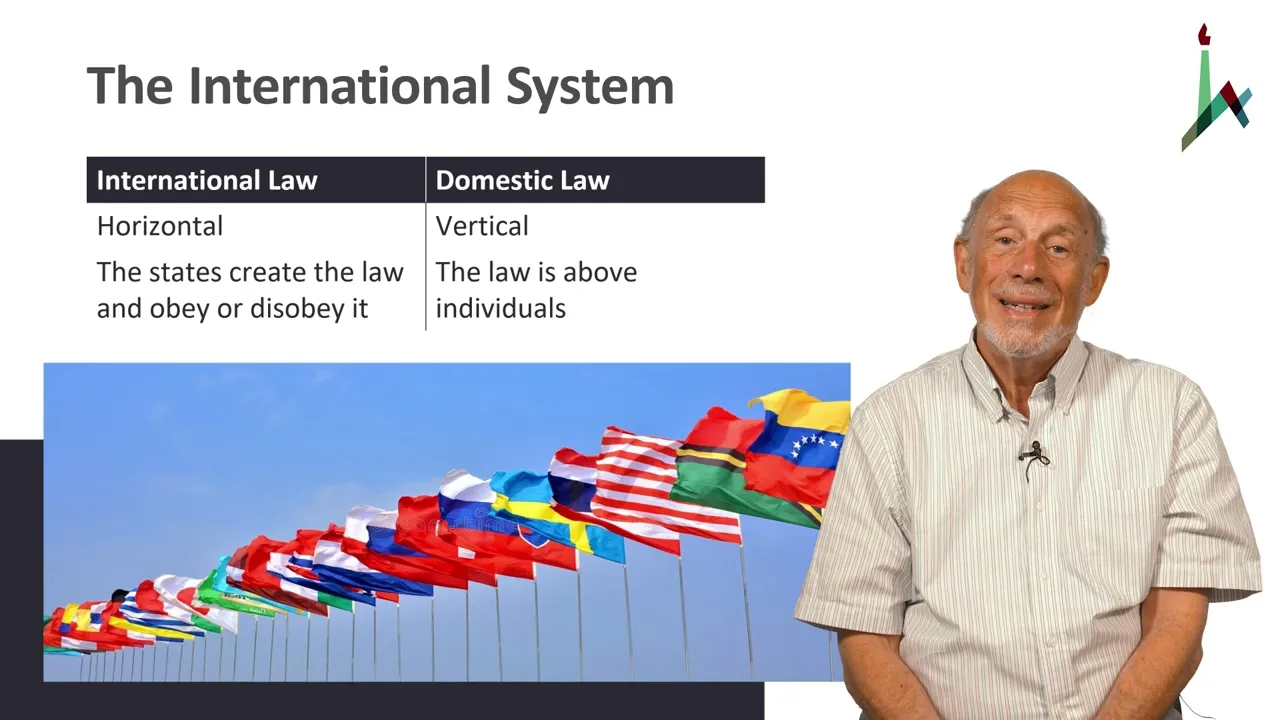
states recognizing certain common principles and ways of doing things while the legal structure within all but the most primitive societies is hierarchical and Authority is vertical the International System is horizontal consisting of over 190 independent states all equal in legal theory in that they all possess the characteristics of sovereignty and recognizing no one in authority over them the law is above individuals in domestic systems but international law only exists as between the states individuals only have the choice as to whether to obey the law or not they do not create the law that is done
by specific institutions an international law on the other hand it is the states themselves that create the law and Obey or disobey it this of course has profound repercussions as regard the source of law as well as the means for enforcing accepted legal rules international law as will be shown in a later lecture is primarily formulated by International agreements which create rules binding upon the signatories and customary rules which are basically State practices recognized by the community as at large as laying down patterns of conduct that have to be complied with however it may be
argued that since States themselves sign treaties and engage in action that they may or may not regard as legally obligatory international law would appear to consist of a series of Rules from which states May pick and choose contrary to popular belief states do observe international law and violations are comparatively rare however such violations like armed attacks and racial oppression are well publicized and strike at the heart of the system the creation and preservation of International Peace and justice but just as incidents of murder robbery and rape do occur within National legal orders without destroying the
system as such so analogously assaults upon International legal rules point up the weaknesses of the system without denigrating their validity or their necessity thus despite the occasional growth violation the vast majority of the provisions of international law are followed in the daily routine of international life large numbers of agreements and Customs are complied with however the need is felt for some kind of regulatory framework or rules Network within which the game can be played and international law fulfills that requirement States feel this necessity because it Imports an element of stability and predictability into the situation
worst worst states are involved in a disagreement or a dispute it is Handy to have recourse to the rules of international law even if there are conflicting interpretations since at least there is a common frame of reference on one state we'll be aware of how the other state will develop its argument they will both be talking a Common Language and this factor of communication is vital since misunderstanding standings occur so easily and often with tragic consequences were the antagonists dispute the understanding of a particular Rule and adopt opposing stands as regards its implementation there are
at least on the same wavelength and communicate by means of the same phrases that is something it is not everything for it is a mistake as well as inaccurate to claim for international law more than it can possibly deliver it can constitute a mutually understandable vocabulary book and suggest possible solutions which follow from a study of its principles but what it cannot do is solve every problem no matter how dangerous or complex merely by being there international law has not yet developed if it ever will to that particular stage and one should not exaggerate its
capabilities but what is the stopper state from simply ignoring international law when proceeding upon its chosen policy can a legal rule against aggression for example of itself Prevail over political Temptations there is no International police force to prevent such an action but there are a series of other considerations closely bound up with the character of international law Mitch white which which might well cause a potential aggressor to Farber although this is far from being guaranteed there's the element of reciprocity at work and this can be a powerful weapon States quite often do not pursue one
particular course of action which might bring them short-term gains because it could disrupt the mesh of reciprocal tolerance which could well bring them long-term disadvantages for example States everywhere protect the immunity of foreign diplomats for not to do so would Place their own officials abroad at risk this constitutes an inducement to states to act reasonably and moderate demands in the expectation that this will similarly encourage other states to act reasonably and so avoid confrontations because the rules can ultimately be changed by States altering their patterns of behavior and causing one custom to supersede another or
by mutual agreement a certain definite reference to political life is retained but the point must be made that a state after weighing up all possible Alternatives might very well feel that the only method to protect its vital interests would involve a violation of international law and that responsibility would just have to be taken where survival is involved international law may take second place and other significant factor is the advantages or rewards that may occur in certain situations from an observance of international law it may encourage friendly or neutral States decide with one country involved in
a conflict rather than its opponent and even take a more active role that might otherwise have been the case in many ways it is an appeal to public opinion for support and all states employ this tactic a further element to be mentioned here is the constant formulation of international business in legal terms points of view and disputes in particular are framed legally with references to precedent International agreements and even the opinions of juristic authors claims are pursued with regard to the rules of international law and not in terms of for example morality or ethics this
is brought into being a class of officials throughout governmental departments in addition to those working in international institutions first in international law and carrying on the everyday functions of governments in a law oriented way many writers have in fact emphasized the role of officials in the actual functioning of law and the influence they have upon the legal process to this one may add more generally the role of those actively working in the field academically and professionally having come to the conclusion that states generally do observe international law and will usually only violate it on an
issue regarded as vital to their interests the question arises as to the basis of this sense of obligation the 19th century with its business oriented philosophy stressed the importance of the contract as the legal basis of an agreement freely entered into by both or all sides and this has influenced the theory of consent in international law states were independent and free agents and accordingly they could only be bound with their own consent that was no Authority in existence able theoretically or practically to impose rules upon the various nation states nevertheless this theory is most unsatisfactory
as an account of why international law is regarded as binding or even as an explanation of the international legal system to give one example there are over 100 states that have come into existence since the end of the second world war and by no stretch of the imagination can it be said that such states have consented to all the rules of international law formed prior to their establishment it could be argued that by accepting Independence States consent to all existing rules but to take this few relegates consent to the role of a mere fiction this
Theory also fails as an adequate explanation of the international legal system because it does not take into account the tremendous growth in international institutions and the network of rules and regulations that have emerged from them within the last generation one needs also to refer to the doctrine of consensus this reflects the influence of the majority in creating new Norms of international law and the acceptance by other states of such new rules it attempts to put into Focus the change of emphasis that has been taking place from exclusive concentration upon the nation state to a consideration
of the developing forms of international cooperation whereas such Concepts as consent and sanction are themselves inadequate to explain what is happening of course one cannot ignore the role of consent in international law to recognize its limitations is not to neglect its significance much of international law is constituted by States expressly agreeing to specific normative standards most obviously by entering into treaties this cannot be minimized nevertheless it is preferable to consider consent as important not only with regard to specifically specific rules specifically accepted which is not the sum total of international law of course but in
the light of the approach of State generally to the totality of rules understandings patterns of behavior and structures done depending and depending and constituting the International System in a broad sense states accept or consent to the general system of international law for in reality without that no such system could possibly operate it is this approach which may be characterized as consensus or the essential framework within which the demand for individual State consent is transmuted into Community acceptance it is important to note that while States from time to time object to particular rules of international law
and seek to change them no state has sought to maintain that it is free to object to the system as a whole each individual state of course has the right to seek to influence by word or deed the development of specific rules of international law but the creation of new customary rules is not dependent upon the express consent of each particular state it is clear that there can never be a complete separation between law and policy no matter what theory of law or political philosophy is professed the inextricable bounds linking law and politics must be
recognized within developed societies a distinction is made between the formulation of policy and the method of its enforcement in the United Kingdom Parliament legislates while the courts adjudicate and a similar division is maintained in the United States for example between the Congress and the Court's system this is familiar to other Democratic countries such as Israel for example the purpose of such divisions of course is to prevent a concentration of too much power within one branch of government nevertheless it is the political branch which makes laws and in the first place creates the legal system even
within the hierarchy of course the judges have leeway in interpreting the law and in The Last Resort make decisions from amongst a number of alternatives this position however should not be exaggerated because a number of factors operate to conceal and lessen the impact of politics upon the legal process foremost amongst these is the psychological element of tradition and the development of the so-called law habit a particular legal atmosphere has been created which is buttressed by the by the political system unrecognizes the independent existence of law institutions and methods of operation characterized as just or legal
in most countries overt interference with the judicial process would be regarded as an attack upon basic principles and hotly contested the use of legal language and accepted procedures together with the pride of the legal profession reinforce the system and emphasize the degree of distance maintained between the legislative executive organs and the judicial structure however when one looks at the international legal scene the situation changes the Arbiters of the world order are in The Last Resort the states and may both make the rules ignoring the moment the secondary if growing field of international organizations and interpret
and enforce them while it is possible to discern an international legal habit amongst governmental and international officials the Machinery necessary to enshrine this does not exist politics is therefore much closer to the heart of the system than is perceived within National legal orders and power much more in evidence the interplay of Law and politics in world affairs is much more complex and difficult to unravel and signals are returned to the earlier discussion as to why States comply with International rules power politics stressors competition conflict and Supremacy and adopt as its core the struggle for survival
and influence international law aims for Harmony and the regulation of disputes it attempts to create a framework no matter how rudimentary which can act as a kind of shock absorber clarifying and moderating claims and endeavoring to balance interests in addition it sets out a series of principles declaring how States should behave just as any domestic Community must have a background of ideas and hopes to aim at even if few can be or ever or are ever attained so the International Community too must bear in mind its ultimate values however these ultimate values are in a
formal sense kept at arm's length from the legal process as the international court of justice noted in the southwest Africa case in 1966 it is a court of law and can take account of moral principles only insofar as they are given sufficient expression in legal form nor exists it is said to serve a social need but precisely for that reason it can do so only through and within the limits of its own discipline otherwise it is not a legal service that would be rendered international law cannot be a source of instant solutions to problems of
conflict and confrontation because of its own inherent weaknesses in structure and content to fail to recognize this encourages a utopian approach which when faced with the reality will fail on the other hand the cynical approach with its obsession with brute power is equally inaccurate if more depressing it is the medium Road recognizing the strength and weakness of international law and pointing out what it can achieve and what it cannot which offers the best hope man seeks order welfare and justice not only within the state in which he or she lives but also within the international
system in which he or she lives there will now be a short break


![Postmodernism Is DEAD — Douglas Murray Declares a NEW ERA [ARC 2025]](https://img.youtube.com/vi/J_DOKRDRJzA/maxresdefault.jpg)