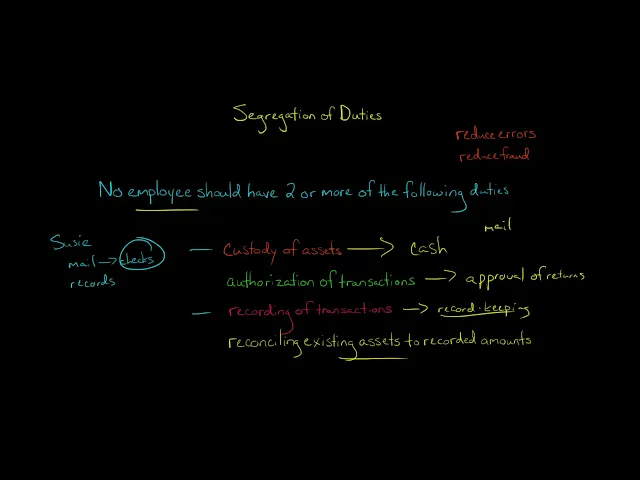
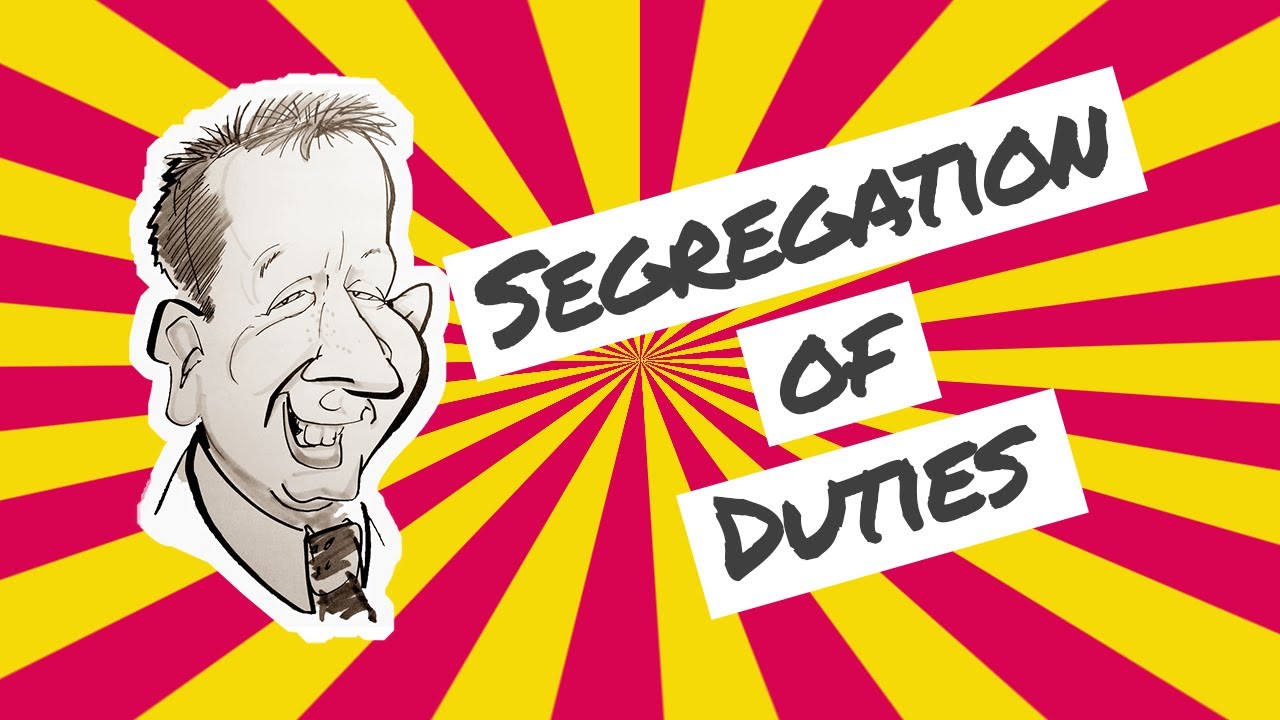
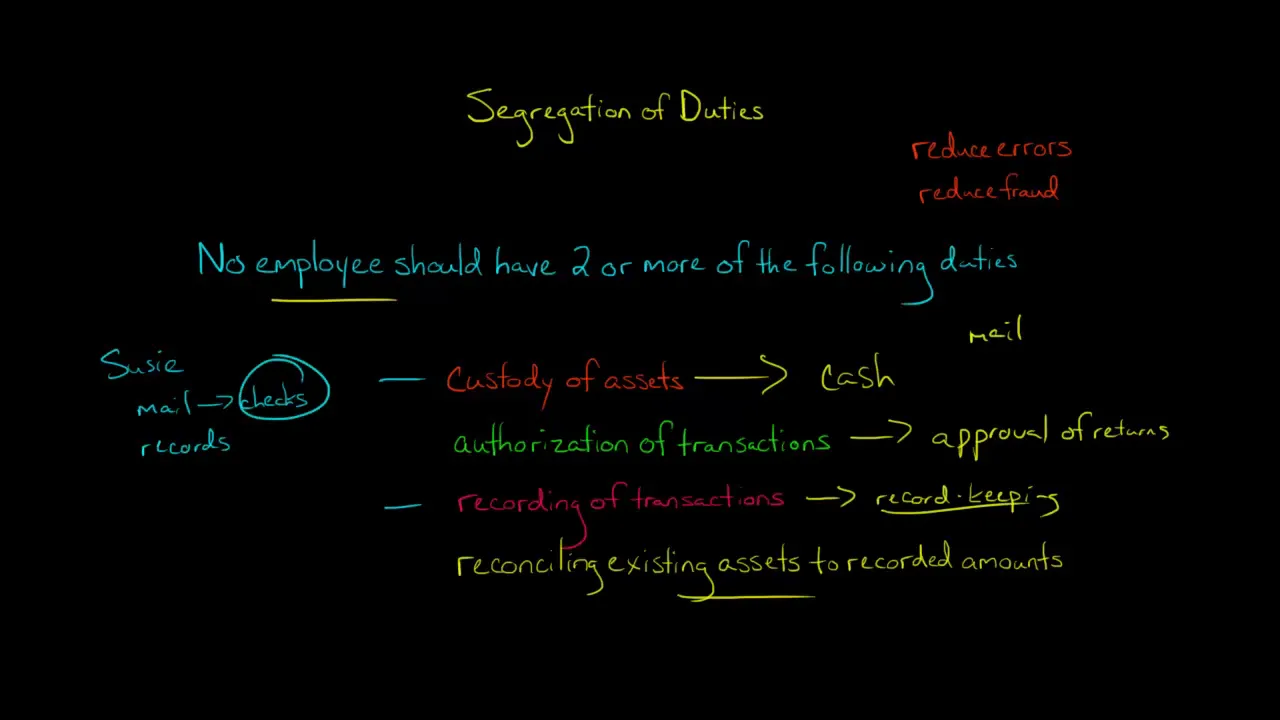
segregation of duties is an example of an internal control that a company would implement to reduce the amount of accounting mistakes but more commonly to reduce the incidence of fraud and so all segregation of duties is saying is this no employee at the company should have two or more of the following duties okay so let's go through these in turn we've got custody of assets so if we take cash for example cash is an asset we're talking about physically handling the cash how would that happen well let's say the employee opens the mail they might
receive physical cash they might receive a check from a customer and so forth so another Duty is the authorization of transactions that has to do with approval of certain transactions for example maybe there it requires a managers approval for a return of merchandise that has a value more than $500 okay so if we're talking about reproval of customer returns that would be an example of authorization of transaction Duty recording of transactions has to do with the record-keeping aspect of who is actually making the journal entry or if we're talking about cash again who is the
one that when we receive a check in the mail actually records in our accounting system that okay customer a has paid their bill we just received $10,000 from them and then the final Duty is reconciling existing assets to recorded amounts so periodically going and say okay let me count the assets and see if that matches what we have on the books so we do not want any employee at the company to be able to do more than one of these at the same time so for example let me show you what could happen if you
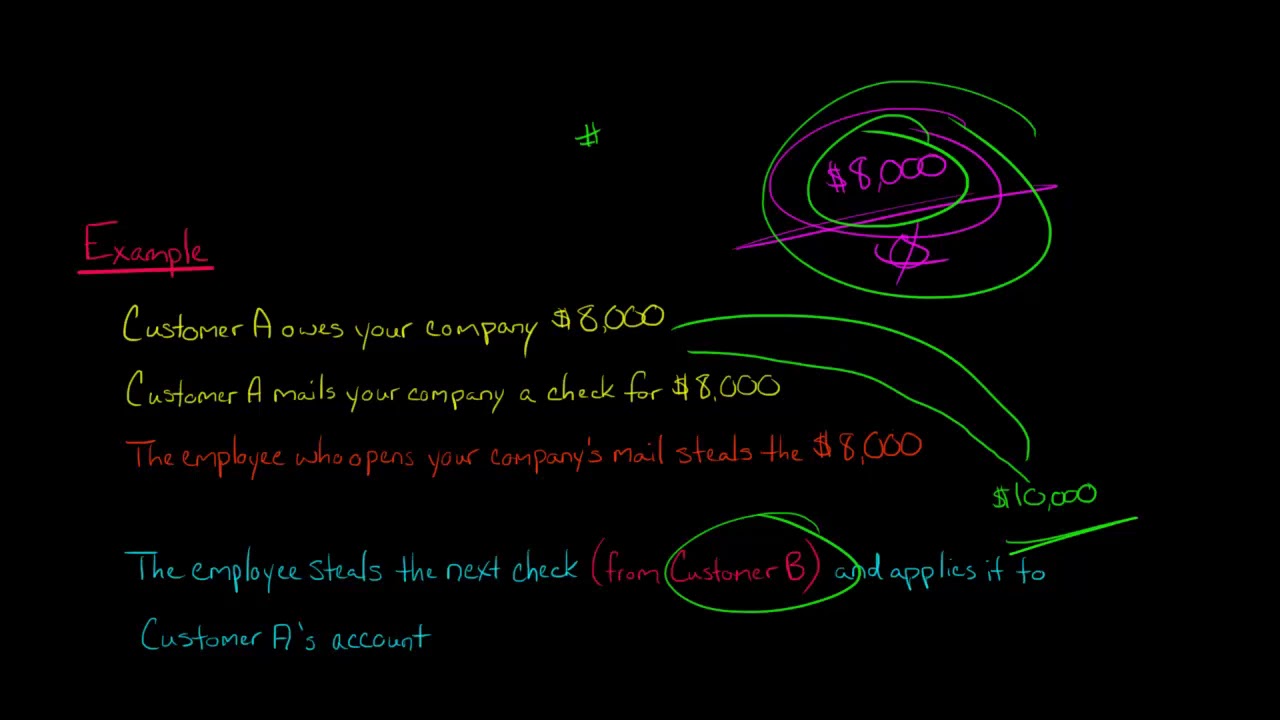
didn't have segregation of duties let's say that you have an employee named Suzy and Suzy has both custody of assets and recording of transactions she has two duties with respect to cash because Suzy opens the mail and she risks associations the mail for the company and then she's also the one who records that have received this check from the customer so let's say customer a so customer a sends a check of $20,000 to the company and Suzy is the one who opens the mail so she receives a check for $20,000 and let's say that Susie
doesn't have the best ethics so Suzy takes the $20,000 for herself she takes that check and she's able to get a cashed and she keeps the $20,000 now what is gonna happen so this $20,000 is not gonna be applied to customer a's balance so what is gonna happen is eventually customer a is gonna receive a notification that hey you still owe us $20,000 what is customer a gonna do they're gonna call the company and say hey I sent the check here's the check number and Susie's gonna be in trouble so Suzy is going to be
aware of this and Suzy is going to say okay well in a little bit maybe maybe the very next week we have where customer B sends a check customer B sends a check and let's just say it's $20,000 it could be more than that it could be but to make it simple let's just say it's 20,000 as well so this customer sends a check for 20,000 well I'm also the one who records in the transactions in the account so I'm gonna take this $20,000 I just got from customer B and I'm gonna apply it to
customer a's account to show that customer a paid $20,000 so the customer eight doesn't call up angry and say hey I already paid $20,000 so this 20,000 this 20,000 here went to Suzy but then the 20,000 customer B Suzy applies that amount toward customer a's balance so it looked looks like in the accounting record-keeping system the customer a has paved the $20,000 so customer a is not going to call and complain now in a few weeks customer b who just had their 20,000 applied to customer a is gonna say hey where i paid this money
what and so forth so what's gonna happen well Susy is gonna go to customers see when customer C sends a check Susy is gonna apply that amount toward customer B and so forth so this is called lapping so this is a fraud scheme where Susie's gonna continue like she's basically gonna she's gonna steal money from the first customer and so to basically steal the cash because she has she has custody of the assets she's gonna steal a check and deposit it for herself and then she's gonna manipulate the accounting records when this customer so that
this customer doesn't say hey I paid my bill she's gonna take the new checks that she gets from from future customers and apply it to the previous customer and she has to keep doing this and doing this that's why it's called a lapping scheme now if Susie if we have segregation of duties where Susie is she opens the mail and and receives the the cash and checks but somebody else is in charge of the record-keeping somebody else is the one who actually goes and records that okay this causes customer a they paid there were twenty
thousand dollars and so forth if these duties have been separated then Susie will not be able to perpetuate this scheme okay then basically what she would have to do is to carry out the scheme she would have to find the person who is in charge of recording the transaction so if Susie opens the mail and there's someone else recording the transactions then Susie would have to find that person and they would have to collude okay so you can get around segregation of duties when you have multiple people participating in the fraud through collusion but segregation
of duties makes it much harder for any one person to commit fraud