[Music] foreign [Music] so what is digital technology that all this bus is about the driving force of current societal Evolution well another name for it is ICT information communication technology but information communication technology not necessarily is digital and actually has an extremely long trajectory and also in its social construction in the social construction the role it has played for example 350 years before Christ so that's like what 2 400 years ago almost Aristotle famously in Greek argued that democracy could impossibly go beyond a distance of 70 kilometers that's about 45 miles because information couldn't travel
any faster so how could you have democracy that's a communication exchange Beyond a city so Athens that that was it democracy could impossibly go beyond that because I mean that's like 45 miles it's 70 that's almost two marathons right this thing it's called an ultra marathon that is pretty much exhausting and how could you have a vibrant democracy beyond that obviously that changed with the evolution of information and communication technology in 1860 information was traveling at the speed of a horse's breath where the Pony Express we crossed our big country here the United States of
America and when Abraham Lincoln was elected president in 1860 we here in California didn't know who was president for seven days and 17 hours that was when the newspapers on the East Coast had published to his president and it took another 70 say more than a week for a young skinny wiry fellow not over 18 to jump on a horse and and cross the entire leg that's I was fastest information could travel then but democracy was implemented Way Beyond what Aristotle could ever imagine that just didn't imagine and then during the same time with the
telegraph uh the imagination grew Wings the world of matter has become a great nerve vibrating thousands of miles in a breathless point of time rather the round Globe is a vast head a brain Instinct with intelligence because of a telegraph I was like Morse code you know like that that's okay that's how how far they are or their men Graham Bell 1876 added the first phrases through his telephone the Scientific American still are very popular science publication was so excited that it said they scattered members of civilized communities will be as closely United as far
as instant communication is concerned as the various members of the body are now by the nervous system so wow that was again that was the telephone of Graham Bell that you could hardly understand but if we look at today's digital communication landscape and that started in the 1940s 1950s and then yes this this analogies are quite apt actually and it has progressed over the last hundred years and it has progressed almost to that very well actually beyond that point in quantitative measures so if you go to the three basic things that you can do with
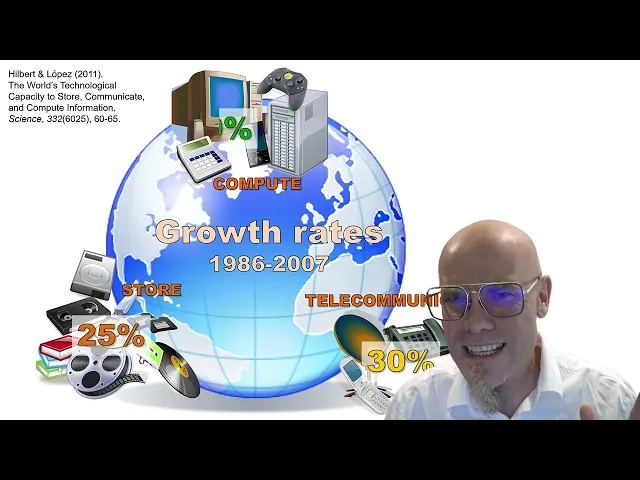
information store communicate and compute we can see that all the world storage devices combined can store more information than the cells the 60 trillion cells of the human body can store more like right now maybe 2 000 human bodies and similar to the brain all general purpose computers combined can do more instructions per second as the brain of about one or two thousand couple of thousand people can do nerve impulses per second at least quantitatively and the Global Communication networks shuffler sent more bits around per second as the human circulatory system sends blood cells around
per second actually of several thousand people combined and and that just happened in the last 15 or 20 years that our technology our information technology has caught up to these mind-boggling orders of magnitude with which Mother Nature processes information in order to create life and we can see these great headlines that I just showed you from several hundred years ago still you know still being published nowadays and you know we worked on it for the last hundred years and digital technology really had a big impact on that now I never said that that the world's
total CPU power is is a human brain but we are getting to these orders of magnitude and digital technology certainly has done that in a historical blink of an eye so if you go back here to to the last century this is still the analog information in the world all the info Nation that's stored in the little green here is the digital and you can see even in the 1990s it was nothing after the year 2000 it started to explode it doesn't mean that there's less analog information in the world there's still a lot of
technologically stored information on paper and the paperless office never came to become a reality as we all know with our printers addiction to printers and so forth but the vast majority of information nowadays is just digital has grown has grown so much so and that really happened in in a blink of an eye this technology was conceptualized in the 19 late 1940s early 1950s and we estimate the beginning of the digital age to be 2002 when for the first time the world could store more digital information had more capacities to additional information and analog information
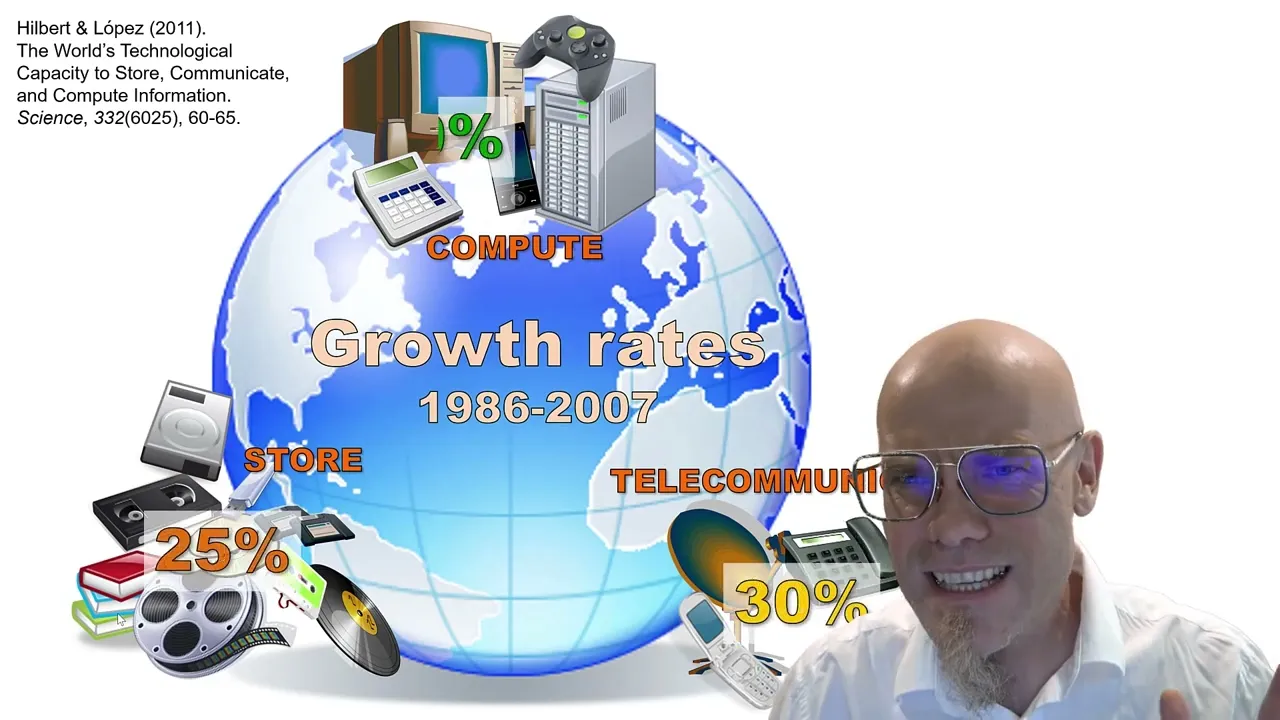
and by now it's way over 99 I mean I would have really liked it to be the year 2000 the beginning of the digital age but hey that's how science work that's what we found in 2002 is also good to remember right so that's that's where that's maybe the Germany so that's not too long ago it's historical blink of an eye from a very young technology that really grew at an impressive rate so over these let's say the 20 years around the change of the Millennia storage and communication and computation has grown at double-digit rates
25 30 60 per year usually social change population grows at you know one but less than one percent a year and we say that is goes very very fast because the exponential you've got to be careful with that the economy what does it grow 1.5 on average if it grows sometimes it doesn't grow we call it recession and some they grow two three percent oh well wow three four percent like that is where and this has been growing over 20 years this was the decisive time where we basically did utilize the world's information and communication
stockpile and that started very recently Claude Shannon a mathematician and engineer single-handedly invented the digital age and that is one of these crazy science story where one person basically in a in one paper actually it's a two-part paper in 1948 he published it and he called it very humbly mathematical theory of communication actually it's the mathematics theory of communicate but it was a very humble guy any singularly single-handedly conceptualized a bit and with the bit basically conceptualized the unit of information and with that all other information conversion on there there's a very interesting book that
if you're interested in this really amazing science and crazy science story around Clarkson and I invite you to to check it out from from click the information a history a theory a flood very nicely written and and extremely interesting to understand how the digital age came about so recently not not very not very many decades ago now the bid is so convincing so so useful as a unit of information that all previous information communication technology converged on it we call we call it the digital convergence on the bit so communication for example starting with smoke
signals I mean when when was that and a newspaper the telegraph of course any kind of telephony radio television broadcasting was a lot of one-way communication uh and then mobile telephony as well same as storage and that goes all the way back to cave paintings I mean that was the first information storages that we had technological information storages and that goes to the origin of humanity printing press of course really changed the course of history talking about social construction of of reality and then all the different tapes that we had and computation too the Abacus
I mean that's more than 5 000 years old that computer uh basically and and then all kind of different calculating devices that we have used also converged on the bit so computation communication storage so communication is the transmission of data of information through space storage is the transmission of information Through Time and since Einstein we actually know space and time are you know pretty some physicists just interchange them so the engineering aspect has some similarities and computation is the transformation of information in Space in Time the turing machine and we will talk more about how
that works now the theoretical conceptualization of how the bit is used in computation comes from another mathematician during the Cold War they didn't really talk to each other because it's a Russian mathematician called Andrei koimogorov and is known as kolmogorov complexity and of course then this continues here this Evolution has continued and is still continuing and it's converging and evolving but still these three information through space through time in the transformation is keeping going on in this exploration we will talk about these Innovations just pick these three just to show you that this is still
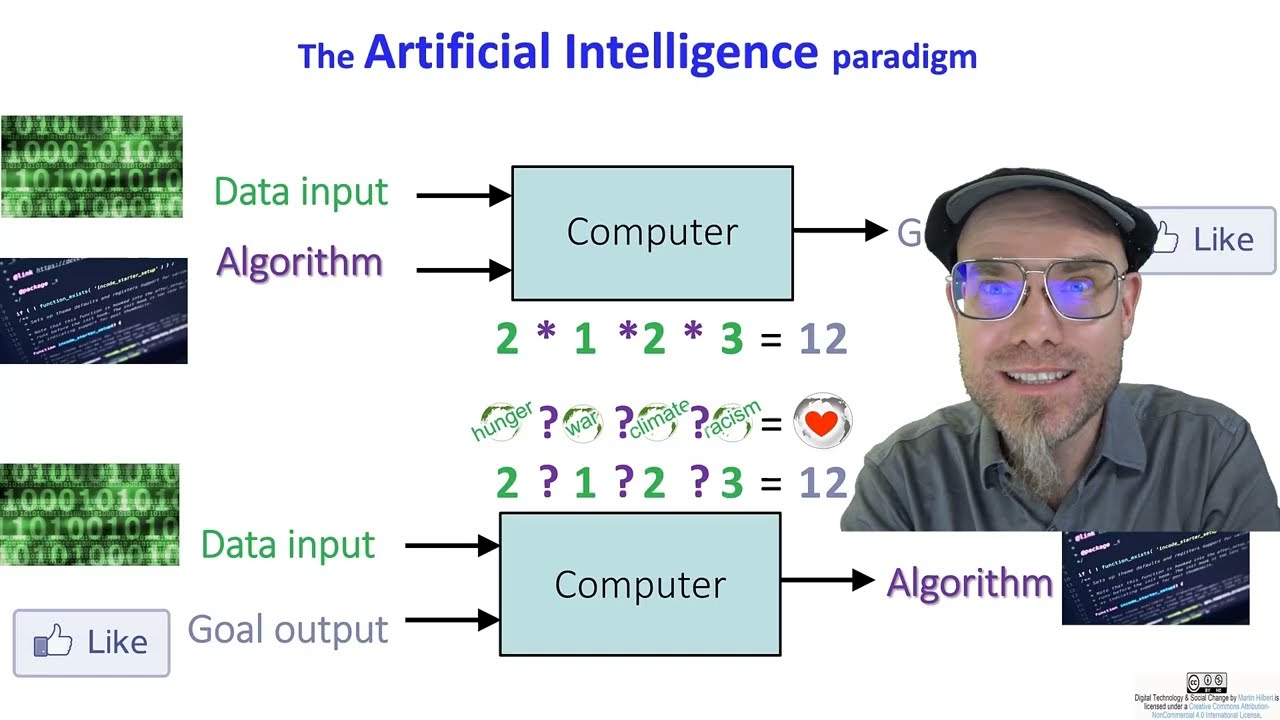
ongoing the blockchain the metaverse and of course generative artificial intelligence but it's very important for me to unders for you to understand that it works both with information and with computation the bit is the key of the digital age so if we go to our application of this Paradigm to social Evolution and I said that digital technology is the driving force of our current social evolution of progress whatever we call it I said we're already in the second meta Paradigm same as you know steam came after water and the Iron Age came after the Bronze
Age came after the Stone Age also here we first focused on communication and data that's the transformation of information through space communication and time storage so we digitalized the world's information stockpile and communicated it created an infrastructure and now we're transforming it we are learning how to transform it with technology this is often known as artificial intelligence which mainly is driven by Machine learning we'll get we'll get to to all of that but it's important for me to communicate to you that this is both based on the bit the bit of the digital Age and
and this is how these two gentlemen conceptualize it this is now a little theoretical Excursion but and it's very like this is my mathematical Workhorse that's the theory I work with as a scientist I work with information Theory obviously that the mathematical theory of no of information and communication is conceptualized by Claude Shannon and and with many Innovations afterwards and what Claude Shannon basically said is that information is the opposite of uncertainty I mean that that makes sense you don't have to be a mathematician for that right I mean if you have uncertainty you don't
have information and if I give you information what happens to uncertainty well it gets reduced right I mean I give you a lot give you a lot of information then you don't have uncertainty anymore so he said well if we can we can measure on we can measure uncertainty with probabilities and so we can measure the other side of the coin which is information so basically it's a probabilistic theory where he measures information as the reduction of uncertainty how much uncertainty do you reduce and if you reduce uncertainty by half he said well that's that's
one bit so one bit it also depends you know you have probably a different uncertainty than I have it's a very subjective it's a genius a genius Theory information Theory as conceptualized by Cloud Channel now what kolmogorov came up with a few years later it says well the same bit can actually help to create algorithmic information an algorithm is basically a recipe and we will talk much more about algorithms which are extremely important the base is also of computer science that your basic algorithm is a recipe that describes something and I can for example now
say well I have something here I have some information and I can compute this information or I can communicate this information for you and Shannon always referred to the game of 20 questions so I say I think about a city in the United States and I think about it now I have two ways of communicating to you or Computing to you what that city is I can reveal it to you by reducing uncertainty and if you play that game well you always reduce uncertainty by half that's the most efficient way that means you communicate one
bit so you can say well is it on this side or that side of the Mississippi right is it North and then you reduce uncertainty by half and at the end I tell you well this city is I don't know it's Los Angeles or San Francisco or it's New York or whatever City I had in mind and I reduced the uncertainty by half many times so Shannon called it a game of 20 questions I mean with 20 questions if you choose uncertainty by half you can pick out one out of a list than more than
a million different cities so you can in the United States you can get to to every city you want to be but I could also compute the answer how do I do that well I give you a recipe of how to drive to the city and it turns out that the number of bits I need on average to describe how to drive to that City that I have in mind let's say I have San Francisco in mind is on average asymptotically the same number of bits I need to communicate the city to you and that
also kind of like makes sense if you think about it so in the words of coven Thomas the authors of the standard textbook and information Theory they say it is an amazing fact that the expected length of the shortest binary computer description a random variable is approximately equal to its entropy entropy is the measure of probabilistic information and in the words of Lee and vitanji the authors of the leading textbook on Commodore complexity they say it's a beautiful fact that these two Notions turn out to be much the same that means that informational bids and
knowledge bits are on average you need you know the same you can reveal it or you can describe it but it's kind of like the same amount that you need two two sides of a coin then and and think about it just to give you another example so for example I can say like okay I have information here I have this animal and what I have in mind is an elephant now I have two options I can reveal it I can identify this animal from all non elephants most animals are known elephants and I can
communicate it to you like that or I can describe the elephant bit by bit and the amazing and beautiful fact is that they turn out to be the same notion so but first we had to learn as Humanity how to deal with information how to communicate to reveal it and now we're learning how to compute how to describe how to generate create these things and look when hardcore mathematicians like these textbook authors and these are really mathematical I mean there are more equations in there than sentences probably and when they get almost like teary-eyed and
use words like amazing and beautiful then the rest of us have to listen you know this is really I mean this is a really amazing uh theorem that they come together and it's currently I wanted to show you as well the science behind it it's not very old so I'm not very old it's from the 1940s 1960s when these these fundamental theories have been worked out and these are the mathematical results that we build the Information Society and the knowledge Society on so if you're up for it in your free time I of course strongly
invite you to to study that or maybe in grad school because this is the scientific language that also I use and that that is the scientific language the mathematical description of what the digital Paradigm is actually based on it is a very concrete theoretical background now we will not go through that in this course in this course we will talk about the social construction of these theoretic results but I wanted to start also to say that yes both information and knowledge have mathematical theories behind them really serious one I mean these textbooks they are really
big and these are the standard textbooks only