welcome back we're on module number three I've actually just refinished recording number one and then I cut myself off at the end but I I'm not recording that whole thing over again I've skipped number two for now because it's kind of a long one I kind of want to pound this one out we'll see how long this lasts number one lasted uh about twice as long as I expected okay so enough small talk economic goals so this is really fundamental to how you view the world and what you expect our government to do is it
just to let you do what you want is to provide for a broad prosperity for everybody or you know is it something else so there are like seven economic goals we're going to go over all of them these goals can vary importance from one society to the next so often people will say why don't we have free college I'd only have universal health care and stuff like that things that seem to be pretty reasonable from my perspective and the reason we don't just because people don't vote for candidates that want that in other countries where
they do have those things they vote for candidates that want that if it's a democratic system and most of them where they have those things are if you identify what your priorities are or your goals that can be used to guide your decision-making just like it is for you as individual you have a goal you want to own your own business you want to be a doctor you want to be an engineer you want to be rich whatever okay so you set your goal and then the decisions you make should be leading to that end
goal for your career or whatever goal you have so if that's your goal and it's guiding your decision-making you need to add some it at points along the way check to see how you're doing and so you measure up you compare it to whatever your goal is and whether or not you're making progress certainly within the country there may not be universal agreement of which are the most important goals I'm pretty sure if you're Bernie Sanders voter or Elizabeth Warren voter you would have one set of goals if you were a Donald Trump supporter you
would probably have some different goals so it does vary and like I said earlier those goals that we do have well I know what people prioritize in part because how we vote so the first goal would be economic freedom and who doesn't like $3 mm-hmm anybody anybody yeah we all like freedom okay so economic freedom is really important and even the most liberal the most left the most socialist people would agree that the ability to choose your own occupation choose who you get to work for and how you use your own money pretty fundamental important
things I think there's a lot of consensus on those things now that's in contrast to in a command system in the Soviet Union people were told what their career or profession is going to be now I don't know whether or not they had input even but if you're really good at math you're doing something with math if you're really athletic you're gonna be doing something I'm very athletic for the state for the government etc so they have less economic freedom there it's not important just for our own gratification that we get to choose how to
spend our money and who we work for and what we're gonna do for a living it's also good for the system and good for the country because businesses get to make those choices too they get to choose what products to offer and they try to come up with a new product mix and better products cheaper products hype more high quality products etc etc and they have the freedom to do those things now they have the freedom to do whatever they want you know can you like your Breaking Bad the TV show yeah they don't have
economic freedom they don't have the ability to make a whole bunch of crystal meth no they don't so we do have limits just like their limits to free speech limits to freedom of religion etc so there are limits to this economic freedom but they get to decide in 99.999% of things how much to charge for their products other than the minimum wage they can they can pay their workers as much as they want they don't have to offer health insurance that they don't want they don't have to hire as specific individual if they don't want
necessarily now there are also rules however to protect against discrimination so what might happen is the way somebody might win a discrimination lawsuit is a business is hiring obviously less well-qualified people and not you and if you're a person who is part of a group that his his store has historically been discriminated against then you have a case maybe but I'm not a lawyer I don't know economic freedom again there are some rules but there are a lot fewer rules or regulations taxes tend to be lower so how is that freedom related well that means
you have more money that you can spend in the way that you think is important the government does can support entrepreneurs and this is you know I was thinking about this when I was typing it up I was thinking you know it's it's tough to start a business it takes money and it's really easy to make money if you already have money no doubt about it how do you get started if you're low income well the government does offer small business loans but there is widely used as or norm as well-known as people think and
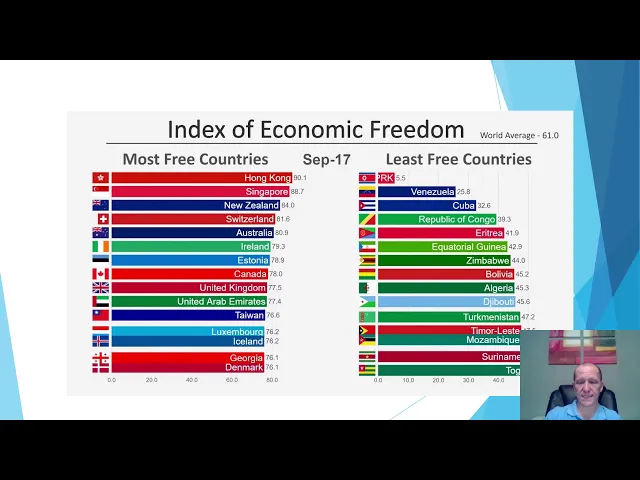
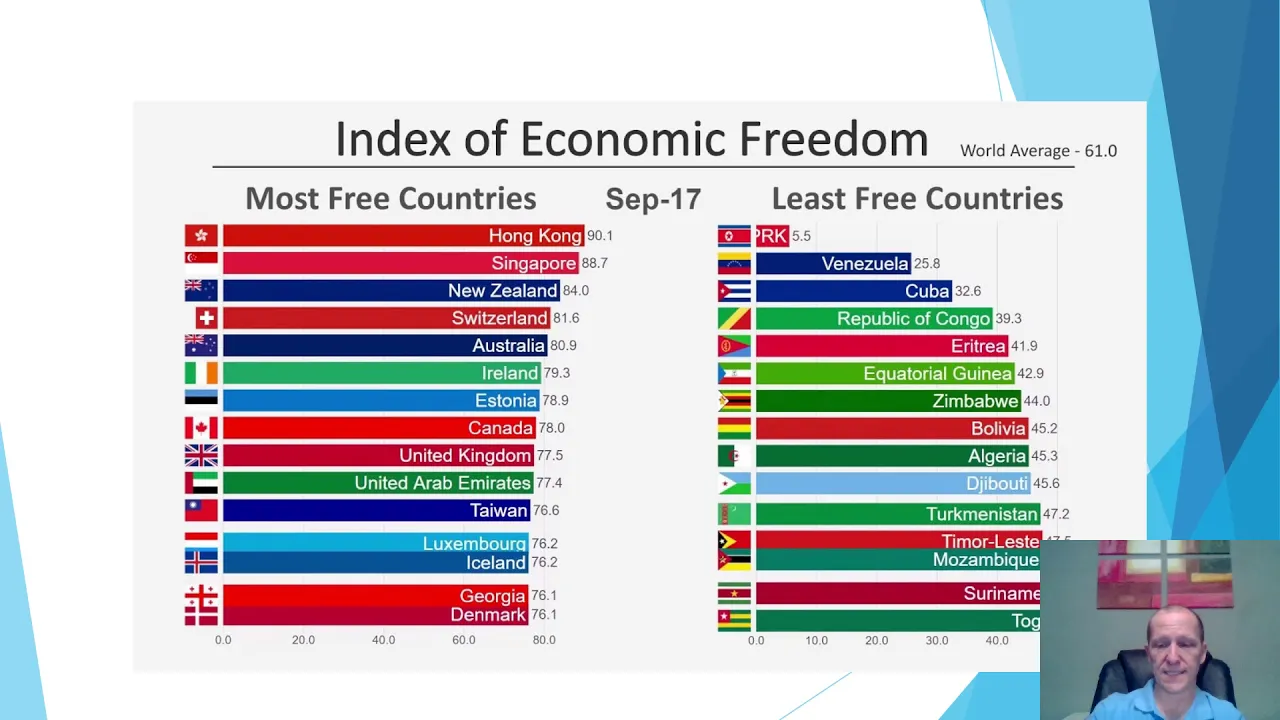
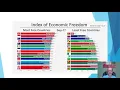
so but there is some government support for entrepreneurship the government doesn't say well you have to make something society values know you could be like I'm gonna make hockey sticks or baseball bats not really that important for society but the government's cannot gonna say that's not that important for society you know we're only going to subsidize you if you do something really meaningful and beneficial to society overall they don't do that so look at this index of economic freedom on top on the Left excuse me and so this is a couple of years old are
the most free countries all of them are wealthy except Georgia that's not the state that's the country they're former Soviet state they've been independent for 25 years for thirty years almost and I don't know how well their economy is performed but it's not a backward economy like some of the other former Soviet states are on the right side we have the least free countries in terms economics and the top one is North Korea the People's Republic of Korea Venezuela Cuba those are three hardcore communist countries and actually as it suggests there North Korea is a
whole different level of hardcore communism our or command economy Venezuela has some but they haven't been that way for 50 or 60 years they had an election revolution or something like that 20 years ago and they made some big changes Cuba as we know they had their revolution in the late 50s trying to snuff it out we failed and they're still around but they actually have opened up and allowed people to engage in entrepreneurial activities for the others I don't know anything about their individual circumstances except Zimbabwe who has had a lot of problems with
the value of its currency so you look at those countries about their economic greed and you can see that the more free the country is the wealthier it is it kind of makes some sense the second economic goal would be economic efficiency and so the nerdy e-commerce and median views that is pretty important so making the best use of scarce resources is important if government gets in the way too much and we can measure this and we'll do it in microeconomics if the government gets involved it can lead to less efficiency and less overall benefit
to society and so that's one thing even though I am liberal needs to be acknowledged when we talk about government intervention in the economy with rules regulations taxes whatever it may be those things have consequences and everybody in the political spectrum means to sort of recognize that and you know we don't have enough of this but there should be some things about which we can agree because they're just factually true we don't have enough of that in this country okay I am a my view so we want the economy to be relatively efficient now do
we always do should we always do the most efficient thing no matter what I wouldn't say so because depends upon situation depends upon what our values are and what objective we're trying to be if we calm like just a little bit less efficient yet we managed to provide fundamental services to everybody to me that would be worth it maybe you have a different call on that so goods and services if it's being efficient are being produced with minimal waste and those resources are being used to make things that consumers actually want and the people who
have the money are actually able to get them because if people have money and who want them can't get them something's not efficient there if consumers want green jackets and they only make yellow jackets that's problem that's not efficient the market isn't recognizing what consumers want now with this economic efficiency if we are at our most efficient we have maximized our total surplus or benefit this is the thing I said that we're going to measure in microeconomics consumer surplus is the benefit that consumers get from competition in the marketplace in a marketplace being efficient producer
surplus is sort of the benefit or profit sort of sort of profit that producers get when they participate in the market and then you add those two together to get the total surplus but when government gets involved or other things occur sometimes that total surplus can be diminished and again we call that a deadweight loss and that can be measured which the third time or fourth time we'll look at in microeconomics economic equity also called economic justice this is really values based if you go back to module number one this is really a normative thing
so what is a fair distribution of wealth one thing that has absolutely occurred maybe I'll assign this video is that the distribution of wealth in this country has dramatically over the last few decades been skewed towards a tiny fraction of the country now that's not me as a liberal just like us that must then those rich people what about the poor people that's not that remember I'm gonna Thomas I teach economics so I'm not just talking about these things from the bit on the basis of what's fair what is is that there is a dramatic
redistribution of wealth going on and wealth is being created but only for a small fraction of the country and that's been going on for years and that will be a problem for everybody else and actually eventually probably those that are disproportionately benefiting from the current system so what can we do to deal with that well they have progressive taxes which there's a module on that that when your income goes up the government takes a larger percentage of it okay and then that money that extra money they take and then be redistributed to programs that benefit
people who are wealthy like college like improve public education in general like health care etc think of how much easier unless stressful life might be if you didn't have to pay for college and you didn't have to worry about one of the doctor what would have to happen for that to occur however is that taxes would have to go up and it probably you know really it probably wouldn't be just the rich people it could be disproportionately towards them but is that fair enough reasonable enough to satisfy enough people that they did that so that's
economic equity that's justice the government couple other examples the government has laws that ban false advertising so that's not fair when they tell you it does this but it actually doesn't do this oh yeah your car's a DS is a diesel Volkswagen says it's not polluted it's not polluting at all it's it's got a lot of power and and great gas mileage or diesel mileage it's the best of both worlds well they cheated and so they got in trouble and actually in Germany their executives are going to jail from what I understand some of them
are lemon laws are another example that's where if you buy a used vehicle lots of states have this if you buy a used vehicle sometimes it applies to other things well and it doesn't work within three days or there's something wrong you can return it okay so those things make sure that the common person person doesn't maybe have much economic power political party power has a bare minimum can can be protected in some way so there's a couple of graphics here I've seen both of these only recently like in the last year or two and
so this is a bit of a judgement call remember I said you know it's really easy to make money if you already have it for sure please don't challenge that even it's so easy give me a million dollars I'll make 40,000 dollars every year from that mint that 1 million dollars easy now that might not be the best use for the million dollars but I mean that that minimum I mean 40 grand a year it's pretty alright not having to go to work right anyways so this person on the left side on all those coins
obviously has an advantage compared to the other four people including the person sticking his head up from that hole now should the government do should they equal it out so each person has success based upon their or failure based upon their own merits I don't know a judgment call I figure on the Left might be where the government puts things in place to help people have success which is getting the Apple so some individuals don't need much help some need more help the third one needs lots of additional help maybe it's through here isn't it
here's a good example maybe that person on the BAA on the far right you know next to the tree trunk is from a group that's historically a victim of discrimination they're low-income maybe in this instance they have a significant learning disability so what can the government do well one thing they can do is they could have anti-discrimination laws in place that might be one of the boxes that person standing on another one might be quality public education and in particular additional resources because they have a significant learning disability or maybe there are immigrant and so
they need a language server that would be another box that made me the person the far-left didn't eat and then the third box might be you know what they have an idea they don't have any money to start the idea maybe a little bit of seed money as they call it give them a little bit of money or lend them a little bit of money to start their business because they don't have money to start it in the first place so they can have success so that's sort of what the left figure is showing but
again this is a values thing this is a normative thing where you decide whether or not that should be done now that might support those boxes remember all those boxes cost money by that I mean taxes so it ain't three I think as a human being you would like people to have that support but there is a tax thing there too economic security is the next economic goal and so what that basically is is a safety net and I saw this graphic as I was putting this together look at the poverty rate so for all
ages the poverty rate with no government assistance or tax adjustments is 25% in this country after all of that stuff it drops to by ten percentage points so that's pretty significant and there is a similar change for those that are under 18 Social Security is a good one it used to be when you got old you spent your money and then you hope your kids like you so they would take care of you and then they put Social Security in place and now elderly people don't go deep into poverty as they get older Temporary Assistance
for Needy Families that's bill these are the old welfare program money for poor people you have more kids you get more money we'll talk about that at greater length in a module in one of the two classes unemployment insurance there's that safety net thing so you lost your job sort of fell and so that net caught you with unemployment insurance Medicaid that's health care government health care for low-income people you could be working as well then food stamps as they're generally known would be a snap so the government gives you money that you can only
use on food they do some other things that help with our Economic Security that don't go into people directly necessarily and one example of that would be FDIC so the federal government Federal Reserve as a program a place where all all banks have to pay insurance premiums to this FDIC and so then if a bank goes out of business people who had money they're like you and me we get money back we get our money back through this insurance program it's very very useful and that's something we'll definitely talk about in macroeconomics as an FHA
law and stand for Federal Housing Authority I think anyways in the those sorts of loans government loans make it easier to qualify for a mortgage basically I think what it is and you investigate on your own if you want to follow up with this and you're on the housing market revver I think the government sort of kind of cosines along what they do is I mean they're gonna pay it for you but they buy there by getting an FHA loan they're reducing the risk I think to the lenders so that's something that they do to
enhance her economic security full employment so what that means is everybody who wants a job can get a job so before the Great Depression the rule of thumb was that people didn't expect the government to do any of this stuff and the Great Depression came around and it didn't go away it didn't get better and that's why FDR Franklin Delano Roosevelt was elected he promised to do stuff and so he had a New Deal program that was meant to help people get jobs we don't you know who knows maybe maybe the new Green Deal they'll
do something like that but we also have an expansionary fiscal policy in general to boost the economy when we're in a recession and unemployment is up the Federal Reserve has some tools to boost the economy when unemployment goes up as well so this is definitely a very important goal there's consensus on this goal but I want to caution you also just because we have low unemployment doesn't mean we have broad prosperity because he's not just that you want a job you want a job that pays well stability so this in this goal obviously they don't
want what's called inflation which is the generally increase in prices overall inflation is bad because your money doesn't go as far your wages don't keep up with it perhaps it makes it very difficult to plan for the future so if inflation is three four five six or higher percent per year how you get ahead how do you save money for that down payment for a house it's really tough to do it does redistribute wealth from savers to borrowers so if I borrow money for a house like $200,000 and I pay four percent the bank is
assuming that inflation is going to be below four percent so when they hit the money back it will not have decline in value by that much if it is unexpectedly high like six seven eight ten percent the bank's getting money back that is less valuable than they had anticipated and so they are worse off inflation particularly hurts people who aren't fixed income so if you're 70 years old and you're retired you're getting a Social Security check maybe you're lucky enough to get a pension from your employer etc often those do not keep up with inflation
now Social Security they raise it every year based upon the previous year's inflation but pensions often don't do that and other things don't do that so it really doesn't rewrote or reduce your ability to buy stop economic growth what that leads to is a higher standard of living and it's not about getting more TVs and cars and stuff like that what it is is it gives that society more resources to do things that improve their lives sure some of that can be material but it also might be that last bullet point to fight disease to
pay for health care and education etc more parks set aside more land from industrial development and so forth and we know that this matters because think of the next figure yep in the next figure we look at GDP per capita and life expectancy and as the GDP per capita gets higher or we get a good economic role you want to move that direction you look more likely to live longer it's not really rocket science there kind of makes sense so in conclusion some of these goals are in conflict with one another if we want economic
freedom it's difficult to have economic equity because you're taking from some people and giving to other people if you want economic security that may not be the most efficient way to do things but it does provide a safer way to do things price stability and full employment will learn in macroeconomics if you're taking that class that as on as unemployment gets lower and lower and lower it can lead to higher and higher prices so there's a balance that needs to be done just like that picture shows and then what it can also happen is these
goals can change over time so they before the Great Depression they didn't expect the government to do anything about it the private sector would it'll fix itself don't worry Great Depression rolls around gets worse then the expectations of the public change there are people who grew up in that era they grew old and for years and years they said they would always vote for a Democrat because of FDR and what he did during the Great Depression now almost all those people are dead now so that thought isn't there but that was a powerful experience for
them and they expect the government to do something about these things now I do wonder moving forward with the changing demographics with more more people who oppose economic justice or equity and are mistrustful of the government frankly passing away younger people are more inclined to have the government do things and I really began to think that unfortunately if you're conservative sorry I'm sure some of you are who are watching this I really feel that the country is going to become more more liberal because it's now mainstream really part of the debate talking about forgiving student
loans making college free having a wealth tax not a high income tax they put a wealth tax something we haven't had in this country before although ironically get this Donald Trump in the late 90s I think it was proposed a wealth tax on anybody who had assets or was worth over ten million dollars a year and in his mind he said or what he says basically I pay off the national debt in a few years if we did this now Elizabeth Warren is not doing it for 50 million dollars a year or not for ten
million dollars here but it's like 50 or a hundred or something like that it's much higher there a lot I already there though Donald Trump wanted to do this will be interesting to see how he opposes this if if he's a candidate in November and if the Democratic candidate at that time supports it so these things are always in flux they're always changing they vary from one society to another they vary from one state to another because we in Minnesota had more in the past a real strong consensus towards government being a powerful force for
good with public education and support for businesses and stuff like that whereas an other kind of other states in the country government is frankly nothing but a problem and what an economist would do is they would look at data to try to figure out what works best so that's it for economic goals after economic goals the next year or the next module is economic systems which connects obviously with goals different economic systems have different economic goals we'll see you that