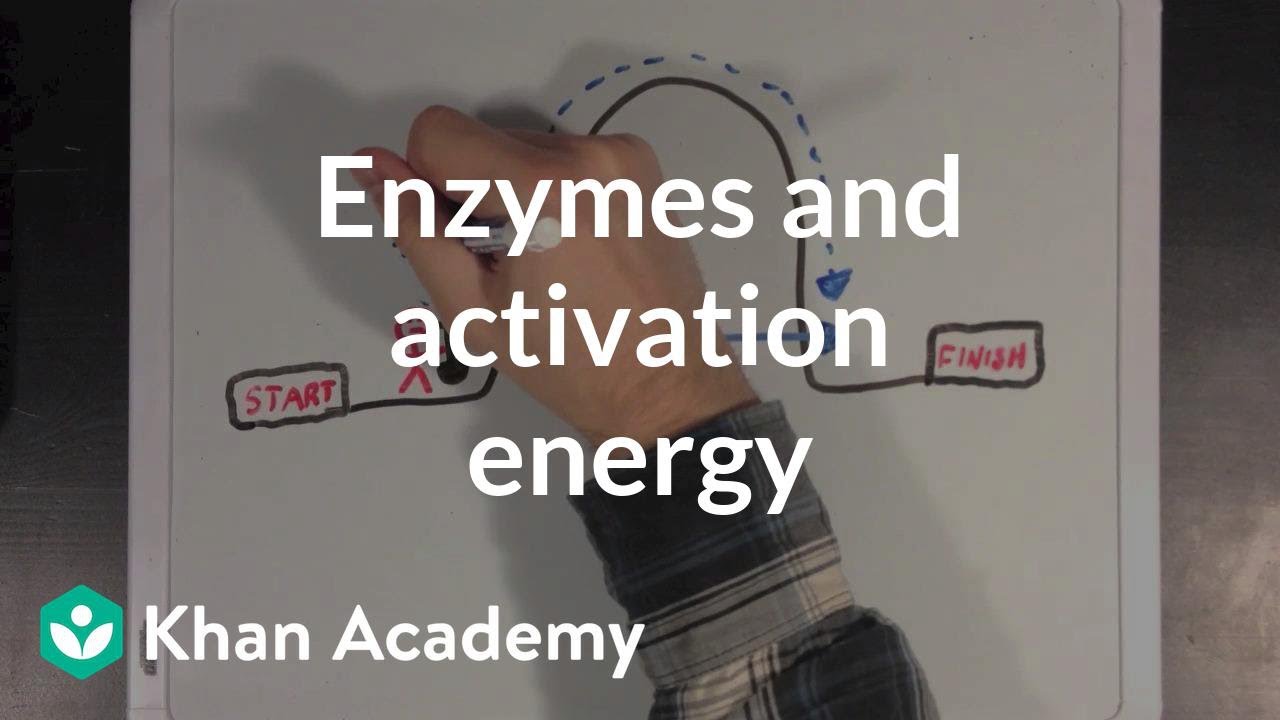
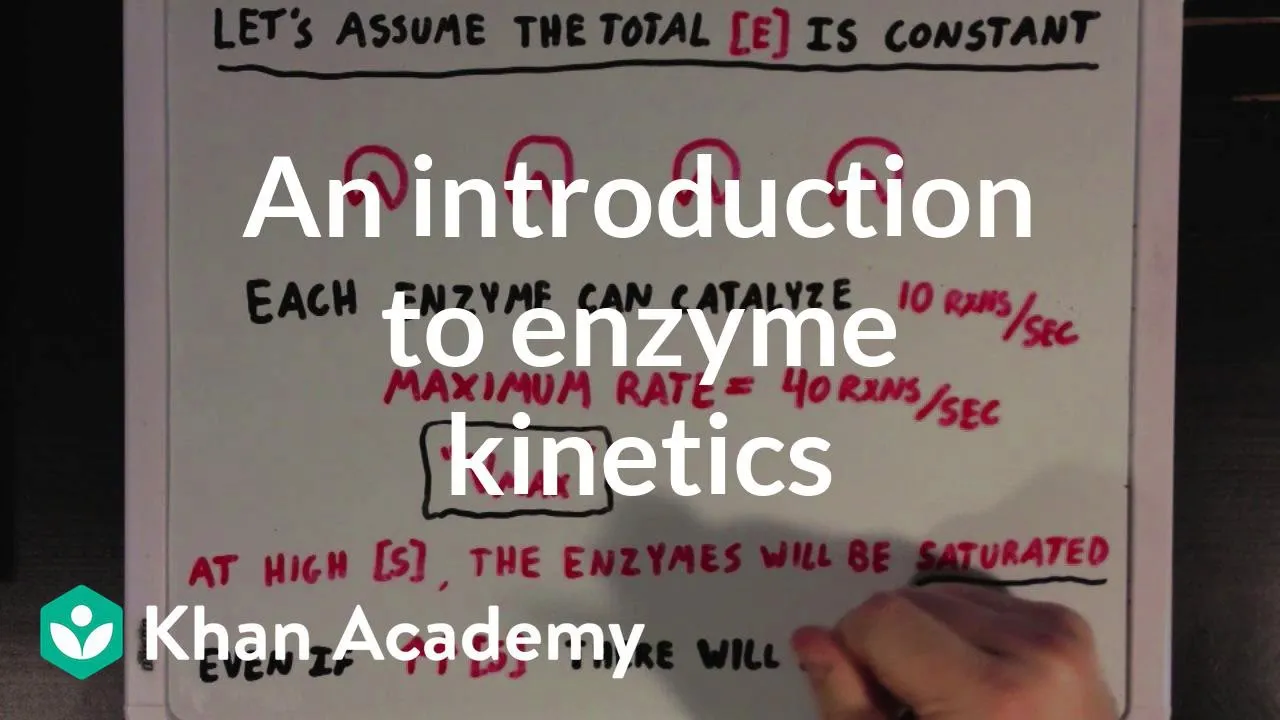
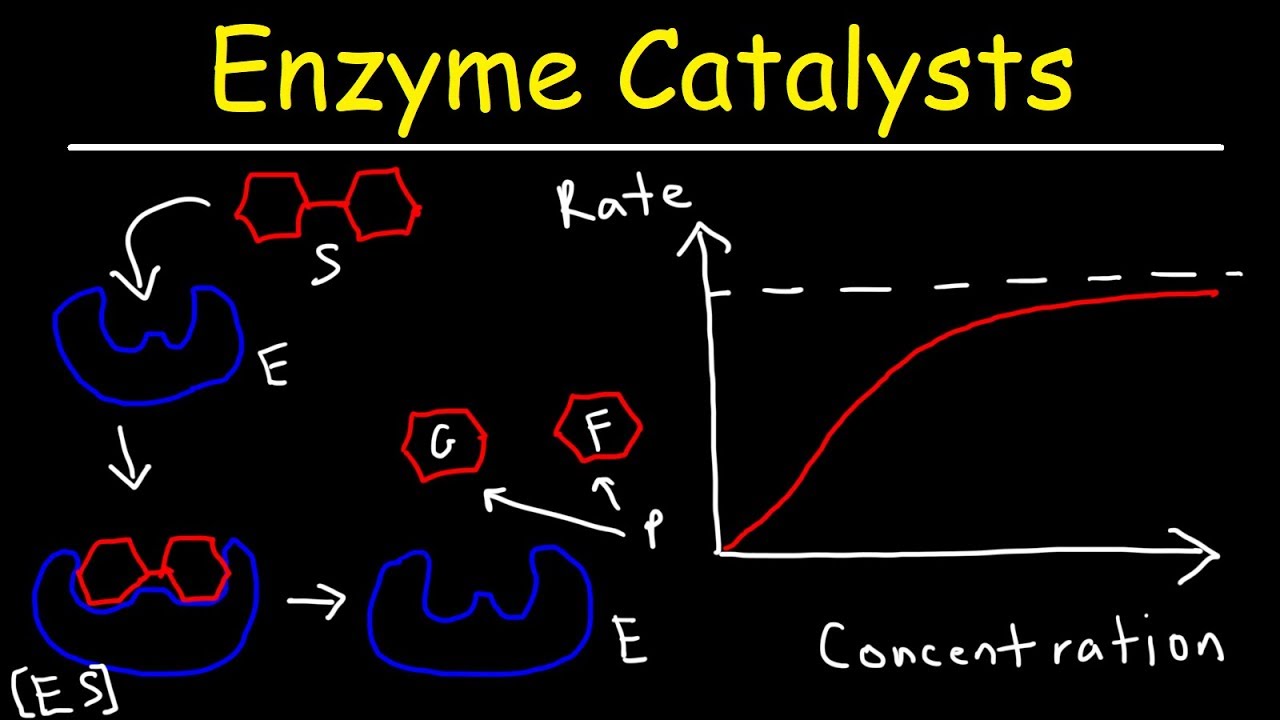
Voiceover: So we're going to talk about enzyme kinetics today, but first let's review the idea that enzymes speed up reactions by lowering the delta G of the transition state, or lowering the activation energy of a reaction. And also remember that for this to happen the reacting substrate, which I called S, will bind to the enzyme E to form the enzyme substrate complex ES before being turned into product P. Also remember that enzymes aren't used up when they catalyze reactions, and that's why we have this E at the end of the equation.
Now, there's a general method of thinking that we want to use when talking about enzyme kinetics, and that's what I want to talk about today. Now, when we think about kinetics, we want to simplify a reaction as a change from A to B. And you may remember that the rate of this change from A to B would be equal to sub rate constant K which is dependent on the environment of the reaction, multiplied by the concentration of our starting material A.
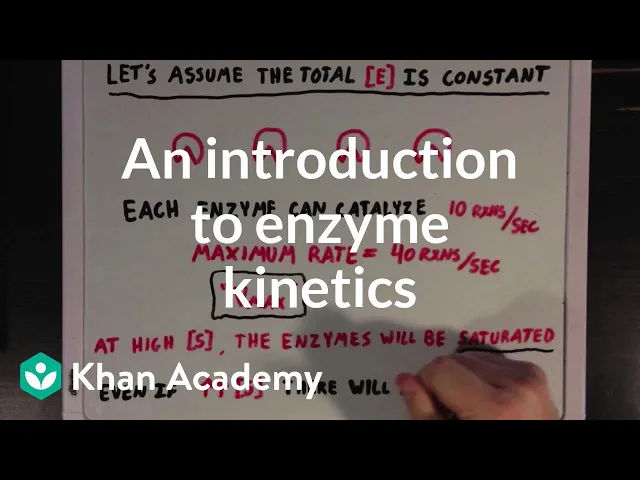
So for our sequence that I mentioned before, E plus S going to ES going to E plus P we have two reactions going on, one and two, which would each have their own rate equation. Rate one would be equal to rate constant K1 times the two starting material concentrations, which are E and S, while rate two would be equal to K2 times the concentration of one starting material ES. Notice that the reaction one has two reactants, E and S, while reaction two only has one, which is the ES complex.
So what do we mean when we say "rate"? Well, the rate of a reaction is the speed that the reaction goes at, and we could also call it V, which is the symbol for speed. And for our entire reaction of transitioning S to P, our product, the speed would be equal to the rate of change of our concentration of product with respect to time, or for those of you who aren't really big fans of calculus, the change in P, delta P, over a change in time, delta T.
So to increase the rate that we get new product, we could do this by either increasing the substrate concentration or by increasing the enzyme concentration, since we're going to assume that the K value is constant and can't be changed. Now when we think about enzyme kinetics we like to assume that we're in a situation where the total concentration of enzyme is constant. And this is generally the case when we're looking at enzymes working in different cells.
Now if we say that we only have four enzymes here, and each enzyme can work at a speed of about 10 reactions per second, that would mean that the absolute maximum rate or our reaction would be 40 reactions per second. And this rate we would call "Vmax" or "max speed". And the idea here is that at really high concentrations of substrate the enzymes will be saturated and full up with substrate, and won't be able to react any more quickly.
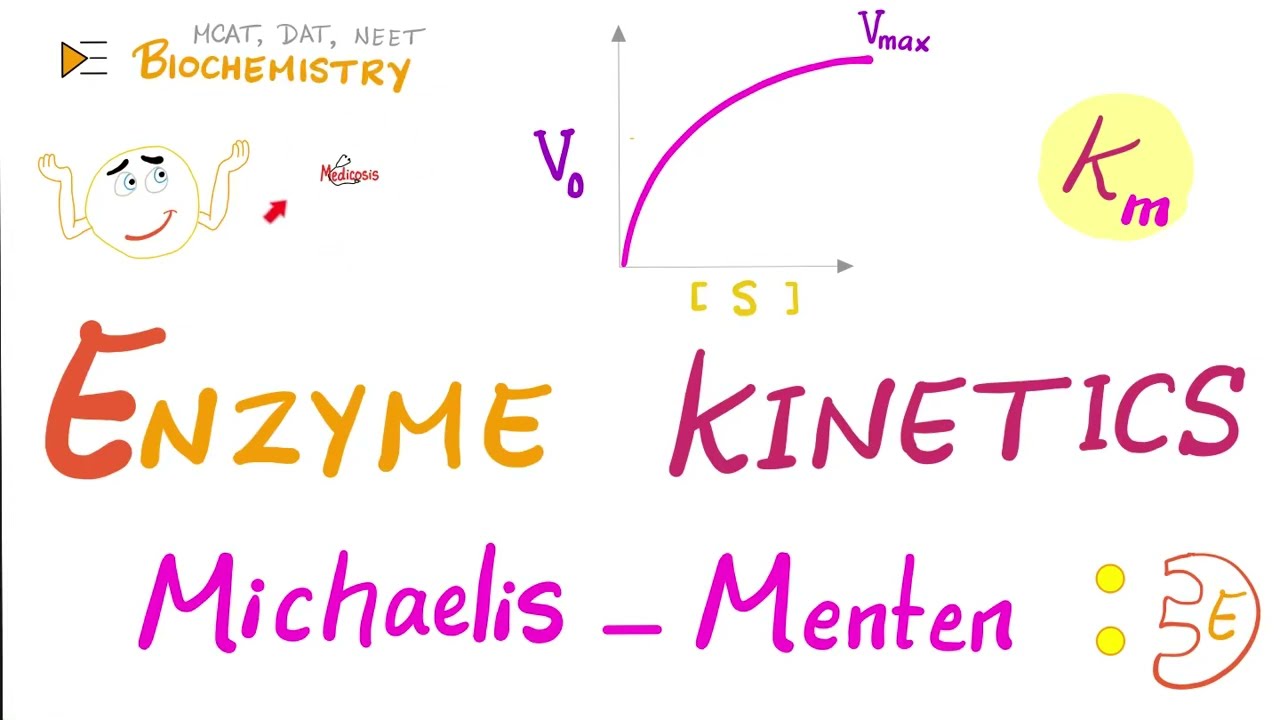
And even if we were to really increase the concentrations of substrate a lot, there will still be a Vmax. There's only so much that we can increase the rate of a reaction by increasing the substrate concentration. If we were to look at a graph and plotted the reaction rate V versus our concentration of substrate, we would see that as our substrate concentration got really, really high, the rate would level off as it approached our Vmax value.
So when we think about enzymes and their kinetics this way we have made a couple of assumptions about how our enzymes and substrates are behaving, and I want to talk about these for a moment. The first assumption we have made is that our solutions are behaving ideally, and that we can actually classify our enzymes reaction into two distinct snaps, the first being the binding of substrate to enzymes, and the second being the transitions from substrate to product with the enzymes help. And by assuming that our solutions are behaving ideally and that we don't have any external factors messing things up, we can simplify our discussion of kinetics quite a bit.
Our second assumption is that our two big constants stay constant. We're assuming that our enzyme concentration isn't changing from things like protein synthesis and degradation, and we're also assuming that our rate constant K isn't changing from environmental factors like changes in temperature. Our final assumption is that for our reaction substrate isn't forming product without the help of enzyme at a big enough rate for us to consider, and that it's negligible.
Remember that enzymes only speed up reactions, so while it's possible for the substrate to form product without enzyme, we're going to assume that it's not really happening when we're talking about enzyme kinetics. So what did we learn? Well first we learned that we can classify enzyme catalysis into two important steps.
The first is that the enzymes bind the substrate, and then second the formation of product, and we talked about how each of these steps has a distinct rate. Second, we learned that if we keep the enzyme concentration constant, then there will be a maximum speed, Vmax, for that reaction.
![Enzyme Kinetics with Michaelis-Menten Curve | V, [s], Vmax, and Km Relationships](https://img.youtube.com/vi/kmyR1cYxRL4/maxresdefault.jpg)