hi welcome to this e-lecture on category sourcing strategies my name is finn winstra and i'm a professor of purchasing and supply management at rotterdam school of management erasmus university in this part one of this e-lecture i will talk about the fundamentals of category sourcing category sourcing basically is the process by which firms and other organizations develop and implement their strategies for particular groups of services and products that they buy there's also part two to this presentation which you can watch after this first part or can be watched uh independently i will give you some more
of the items of the agenda of that second lecture at the end of this session in this session i will address the following topics first of all i will talk about what is a category sourcing strategy and what is its meaning or relevance in the overall purchasing process secondly i will talk you through the elements of a category sourcing strategy what do you actually take decisions on when you develop a category sourcing strategy thirdly i will take you to a couple of models how to determine the scope of a sourcing category okay i'll talk you
through the situation where you want to have more detailed sourcing categories more narrowly defined ones or more broadly defined ones then i'll come to kind of the meat the the core of category sourcing strategies and that is where i will talk about four ideal types of categories and category strategies and i'll specifically refer to a very popular and commonly used model the so-called college purchasing portfolio subsequently i'll talk you through uh the operationalization of the axes of this portfolio because i think that is one very important aspect in setting up these strategies which sometimes tends
to be overlooked first of all let me give you one or two definitions on category sourcing strategies here you can see that the category strategy defines the sourcing objectives and the way a company or any organization will select and interact with the given supply base for that particular category to achieve certain outcomes whether it's related to innovation cost savings quality etc and in essence it is a continuous process where it's not just the purchasing department but also other functions such as marketing r d production collaborate to continuously identify and improve and implement improvement actions if
you like to place it into context it's helpful to look at the model such as this one by ibm which is a popular reference model a so-called purchasing process model which identifies at the upper half the so-called sourcing cycle and at the bottom half of the circle the so-called purchase to pay processes and in the upper half you see a total of five core more strategic processes if you like one of which is sourcing strategies and that's exactly the topic of this lecture now if you take a closer look on how category sourcing is actually
placed in the overall purchasing process in the different types of strategic decisions that purchasing managers and related functions need to make you could see it as a sort of a strategic alignment a cascading process and it starts at the upper left with business goals which should inform the performance objectives for the purchasing function as a whole for instance in certain firms the emphasis for the purchasing function should perhaps be more on innovation whereas other functions in other organizations are perhaps predominantly focused towards cost savings now that should be typically broken down to or specified into
objectives per sorting category so we as a university for instance we buy i.t equipment we buy software we buy paper we buy toilet paper for each of these different categories we probably need to define different objectives okay having defined those objectives we can develop so-called category sourcing strategies which then should inform our supplier selection criteria and subsequently contract performance terms and supplier performance criteria so you can see that category sourcing strategies are a fundamental step or hinge in this process going from business goals to supplier performance criteria and obviously supply performance in the very end
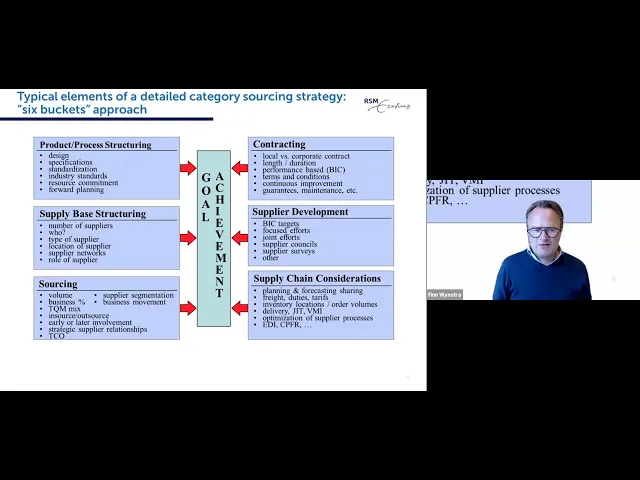
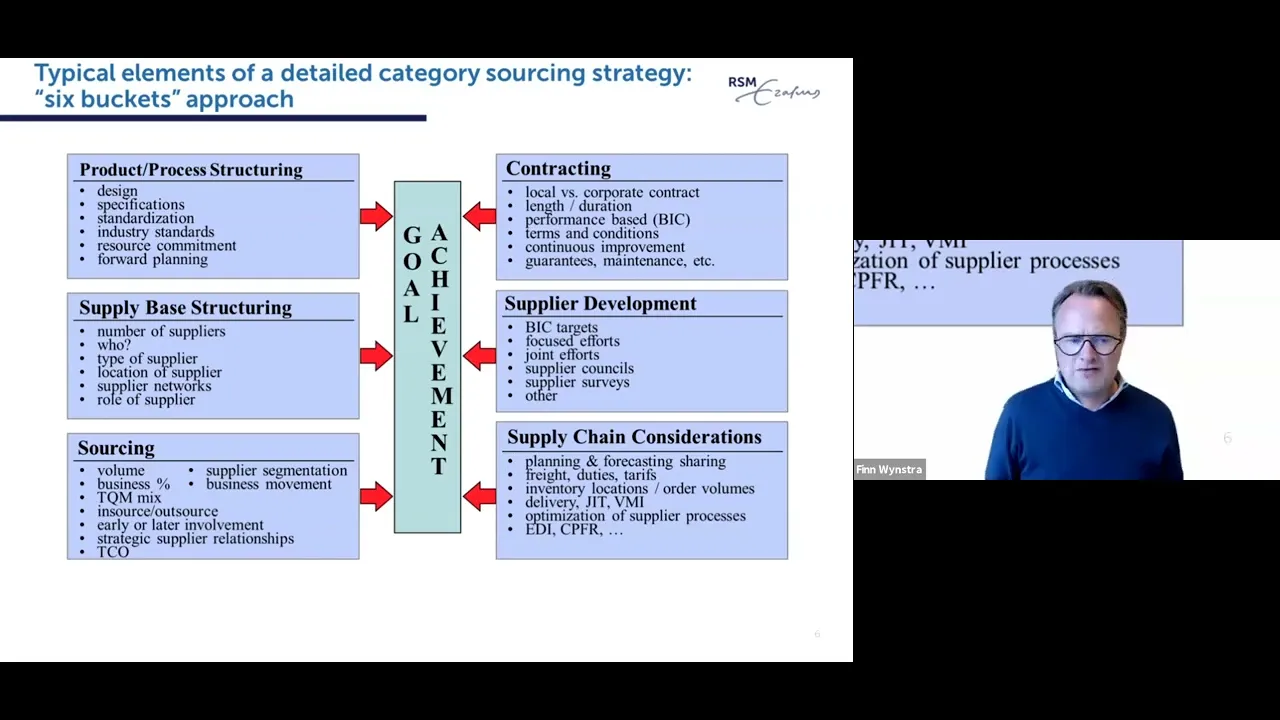
now if you look at the category sourcing strategies there's different templates different organizations use them in more or less detailed ways but the typical kind of structure of a category sourcing strategy is formed by the so-called six buckets approach and i'll briefly take you through the different pockets it starts actually with defining what kind of products it services or physical goods that we want to buy okay what is the design what are the type of specifications do we want to use a certain standards available in the supplier market second aspect is supply-based structuring this is
more the outcome of the decision-making process for the strategy how many suppliers do we want to have for this category what type of suppliers do we want large firms small firms firms that invest a lot in r d or that are more lean and mean the sourcing bucket looks at how much we want to buy or we need to or anticipate to buy of a certain product or service we want to define perhaps how how we're going to allocate the volumes across multiple suppliers if we've decided to work with multiple suppliers and we're also going
to set some objectives around for instance the influence of suppliers on the specifications of the products and services and the early or late involvement in innovation or development on the upper right hand you see the fourth bucket contracting so then we are entering the decisions as to how our contracts will look like will we have one contract for our entire organization or do we want to say well we're using multiple suppliers and these suppliers are typically only active in one or two countries where we operate so it's better to have local contracts we also want
to say something about the type of conditions that we want to for instance implement certain penalties and incentives for performance a typical fifth bucket revolves around supply development so what are the kind of best-in-class targets that we want to set and how are we going to help suppliers meet those targets do we want to establish for instance supplier councils that help us think through improvements in our sourcing process and how we can better assist suppliers and maybe we want to do supplier surveys satisfaction surveys to see where we can kind of improve our processes and
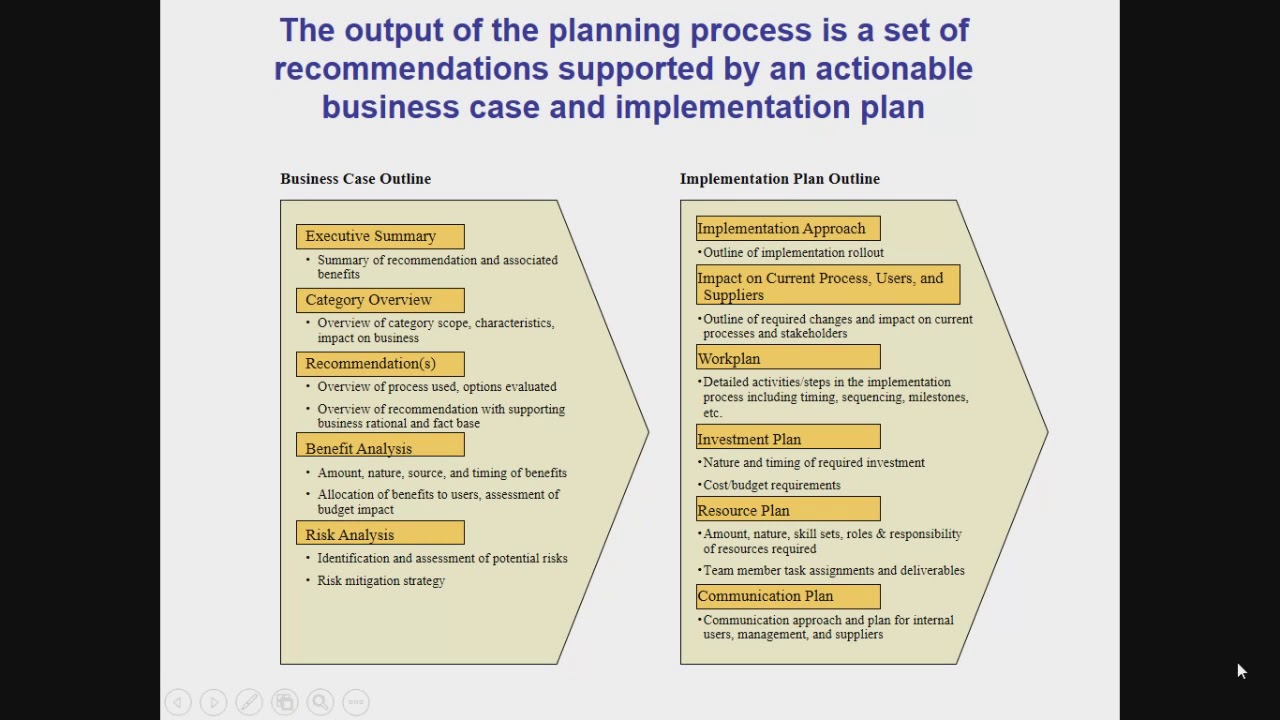
finally we get to the more logistics oriented bucket so-called supply chain consideration and what's our forecasting plans or methods in this case who will be responsible for freight duties and tariffs etc inventory locations what have you now just to give you a brief illustration of a typical sourcing strategy how it looks like it can be very complex or detailed i should say involving a document of 10 15 pages but it could also be very simply a one pager okay which obviously is sufficient for the more smaller routine like categories but also is quite often effective
in communicating for instance with senior management and here you will recognize most of the buckets that i've talked you through on the previous slides on the left top you see category definition and of course the product specifications you see an analysis of the current demand what's the volumes that we're buying we see uh under item three internal demand is let's say the requirements of the different internal customers is it the same well here you see that some of the internal customers are quality labs and others are research labs okay for this type of product elaborate
laboratory disposal so that could mean that they have slightly different requirements as to their products you see a definition or a description of the current suppliers that we're working with and you see a portfolio positioning here using the so-called crowledge model which i will explain in more detail later under item six there is the reflection of external trends sector dynamics and an analysis of of the buyers power and the suppliers power in this market that is also an element i will come to then on the top right uh you see the actual strategy so the
left is more defects in analysis to the right is the statute in the plan and the upper half focuses very much on the type of decisions that we've talked through earlier uh regarding let's say the sourcing decisions the bottom half right you see the so-called implementation adaptation plan that was not part of the six package showed earlier but that's more the let's say the process how to actually implement this in the organization how to get to that desired state if you like now let's before we go into detailed models uh archetypes of what our category
sourcing strategies let's first take a step back and look at what is a category okay i've talked about toilet paper id etc but how do you actually define the categories within a buying organization unfortunately as a buying organization you don't do not need to start from scratch there are several standard procurement classification systems around and many erp systems actually have such a classification system in there okay one of the most widely used ones is the united nations standard products and services code unspsc okay and that's what i have derived this illustration from so typically those
systems have or classification systems have four different levels starting with segments then families class and finally at the most detailed level category or commodity okay so here you see it start with logistics then you can within logistic services you can distinguish distribution warehousing and value-added services such as repacking etc refurbishment then within distribution for instance we can distinguish different modes of transport road air and sea and within road we can distinguish different categories of commodities uh full truckload less than truckload and parcel deliveries for instance okay now this is just an illustration when what are
the appropriate categories to use within each buying organization is up to the buying organization for instance your particular buying organization may not be buying air services okay but at least you can find in these existing classifications most of the categories that you would like to distinguish for your organization okay now the question is obviously how detailed should you go maybe for some organizations it's okay to define a purchasing strategy or sourcing strategy at the level of distribution services or road transportation but others maybe need to define it at the level of full truck load versus
less than truckload etc so how do we know well i can't give you the precise answer for each and every organization but there's a couple of rules to take into account so first of all you need to define categories at an increasing level of detail when you have a high degree of variety within the category okay so for instance variety in the function that the product or service fulfills because it affects the applicable requirements so think of for instance a dairy company that buys packaging okay say for a yogurt product okay some of these packagings
may actually be used for a private label okay which they sell to a supermarket but for other yoga products it may be for a a brand okay and that means that perhaps the demands that these final customers have on their products how they show up in their shelves differ okay the marketing people at the dairy company may also want to use the packaging in a different way for the private label it needs to be first and foremost functional and for the a brand it needs to contribute for instance to the brand image if those differences
are large enough it could actually mean that this dairy company needs to set up a specific category sourcing strategy for packaging for yogurt products for a labels and a separate one for private labels the other degree of variety can come not from the demand but from the supply so the more the supply markets are actually fragmented for instance in geographical terms or in the types of products and services that they offer the more need you will probably you will have to differentiate or specify your strategies so think of the situation going back to the logistics
services from a slide ago if there's different operators are operating in full truck load then in less than truckload you probably want to have a specific category sourcing for less than truckload road transportation and full truckload road transportation because there's no suppliers that actually offer both services at the same time and finally very simply stated if you have higher volumes of spend and this is all relative obviously within a given organization the higher spend you have in a certain category the more need or the more potential value can be derived from dissecting or disaggregating your
category strategy now let's then move to some of the tools that are actually used um to determine the appropriate category sourcing strategy and one of the most well-known tools for this is the so-called crawl each matrix or portfolio analysis and this was actually put forward already in 1983 in an article in harvard business review you'll find the reference at the end of the presentation and it's actually used by lots of organizations both in public and private settings and the basic idea that karate put forward here was that you should differentiate your category sourcing strategies based
on two factors first of all on the horizontal axis supply risk and secondly on the vertical axis impact on business value supply risk consists of a number of dimensions and it's important to have a look at these six uh different uh dimensions uh because colleagues actually had a very nuanced idea of how supply risk is built up it's for instance not just reflected in the number of potential suppliers available in the market but also by the capacity in the market okay is it a buyer's market or is it the suppliers market are there entry barriers
for instance in the netherlands we have the national railroad system operator pro rail that only has five parties that can do regular maintenance on the railroad track so there are a number of potential suppliers available but the entry barriers for accuration purposes these suppliers need to need to meet safety requirements etc the entry barriers are pretty high okay even if there's many suppliers for instance outside of the netherlands available also if there are no entry barriers if there is a large number of uh suppliers in the pool available you may still have switching costs or
time to take that needs to uh uh it requires time to actually be able to switch from one supplier to the other for instance because of administrative adjustments or because your machines need to uh be adjusted etc etc so all of these six factors actually contribute to supply risk on the vertical axis there's impact on business value now most organizations actually measure this in the form of spent okay and i think this is a fundamental misinterpretation or oversimplification of the model that travis put forward because he explicitly listed as just one of the criteria but
you see that the other criteria are not so much monetary so for instance the impact on overall strategy for instance if my organization has a strategy to really be environmentally responsible some of my categories on the buy side may play a very important role in actually achieving optimal environmental impact okay regardless of what the costs actually are involved so particularly when purchasing wants to use this as a tool to also align the rest of the organization and and it should as we've seen in the definitions it is important that the impact on business value if
you're using this segmentation acknowledges other dimensions than just spend okay now having measured a given category for instance less than truckload transportation services on these different dimensions you can plot it into this xy space and and then you find it sitting in one of those four quadrants quadrants which by the way are ideal types okay and the first ideal type if you like the first strategy or type of categories is the so-called strategic categories high supply risk high impact okay at the other extreme low impact low risk routine items okay and then the off diagonals
if you'd like upper left leverage lots of impact but little risk and the bottom right high risk but little impact okay i'll i'll go and discuss the different strategies in a minute but let me first point out that colleagues also made the observation that making this segmentation is very important in order to avoid that buyers are spending their time on relatively unimportant categories so the basic notion which we repeatedly get confirmed in when we study different organizations is that about eighty ninety percent of one of our firms spend is typically in the upper half it
obviously depends on how you define let's say the mid uh point on the vertical axis but usually 80 90 percent of a com an organization spend and uh ends up as leverage or strategic okay now on the other hand that represents only about 10 to 20 percent of the orders and the number of suppliers okay so the corollary is that about 10 20 of your spend is in the bottom half but it represents 80 90 of the number of suppliers and the number of sku stock keeping units or the number of orders okay so if
you allocate your time based on the number of suppliers and the number of orders you spend a lot of time on those categories that do not have the most important impact on business value okay so that is one key thing that that colleagues also try to bring across uh through this segmentation method now if you go to tender four different quadrants you can distinguish four ideal types of different strategies in the upper right hand corner you see performance-based partnership this is the kind of suppliers or categories where you want to work with suppliers to innovate
okay here you want to improve the quality of the products and services that you're buying etc here is where you will typically use one maybe two suppliers okay in the upper left hand quadrant you have much less supply risk but still it's very important so you still want to spend time on it but you can play off different suppliers against each other either in negotiations trajectories or even during the contract so you could have multiple suppliers to have them keep each other on their toes to have price and cost transparency etc in the bottom right
you have bottleneck products this is where you are facing for instance monopolistic uh suppliers uh large entry barriers etc okay the problem is that uh the the risk is very high but you cannot afford to pay too much time to this okay so what you want to do is in an effective way try and secure supply maybe search for alternatives so modify the specs go and find suppliers in totally new regions etc etc finally on the bottom left you have routine products now one and and i think this speaks for themselves you have a large
variety you want to focus on getting the products in at the efficient in an efficient way here by the way companies are also often applying single sourcing for very different reasons than in the upper right quadrant there it is in strategic products and services it is for quality and innovation purposes here it is to simplify the administrative and logistics uh first and foremost if you're not careful you spend more money and time on actually the process of buying this stuff than in the products and services themselves are actually worth okay so that's the four main
category sourcing strategies that kralit defines now coming back to my earlier point about the vertical axis i want to stress again that given that the category sourcing strategy is really meant to align the actions of different functions the the basis for the segmentation of the categories really needs to be supported by different stakeholders so it's fine if you use a slightly different method than what i've just suggested uh i will show other models as well particularly in the um in the subsequent advanced presentation but regardless of the accept model i think it's very important that
the different functions are aligned okay only in that way can purchasing as a whole contribute to realizing the objectives of the buying organization so if you don't do that many traditional purchasing departments have the tendency to simplify the vertical axis to purchase spend okay and that i think has significant negative consequences okay your the one thing is that that the category source instances may not be appropriate from the corporate strategy point of view and in doing so the other functions may not agree on the segmentation and finally suppliers are kind of driven into a corner
where sort of spend or cost savings is the only sort of value creation dimension that you can work on together okay now finally i want to close off with one caveat is that next to category segmentation methods we also have supplier segmentation methods and there's actually two methods or ways that buying organizations segment their suppliers first of all they do it within a category okay so if they do that and here's an illustration from columbia university uh using terms like strategic preferred department select agreement etc when they do that within a category it mainly pertains
to the preferential status that suppliers may or may not have okay so going back to the example of the laboratory equipment a few slides ago if you've read it carefully you can see actually that there's a couple of suppliers that were selected for a global preferred vendor status and others that were more let's say optional suppliers that could be used in any given country on a local basis okay so more of a tactical supplier if you like okay and those let's say status could be dependent on their delivery performance in the past quality or their
pricing levels for instance okay and you typically want to do that if you have multiple suppliers and if you have high volumes and multi-unit buying organizations okay with different plans different businesses etc okay then such further segmentation within the category makes sense now watch out the other level at which we can have supplier segmentation is also the supra category segmentation so across categories and this is a situation where say an automotive a automotive assembly firm buys different components from one and the same supplier such as for instance a robert wash okay it may buy different
types of electronics ignition systems etc etc so it may have different category buyers allocated to robert bosch to deal with the different products um but on top of that it may want to also try and harmonize some of or coordinate at least some of the approaches towards the supplier as a whole okay and that's where you get to turn strategic suppliers leverage suppliers etc okay so that is typically across the categories okay now again both type of supplier segmentations may be used by an organization one of them might be used or none of them may
be used but it is essentially something different than the category segmentation so in sum i've talked you through what is a category sourcing strategy i've talked about the different dimensions and we've talked about single versus multiple sourcing contract duration involvement of suppliers in specification setting we've talked about how to determine the scope of a category we've looked at four ideal types and there are other models around and i will show one of them in the subsequent and presentation talked about this very important issue of the personalization of the axis of the portfolio in the case
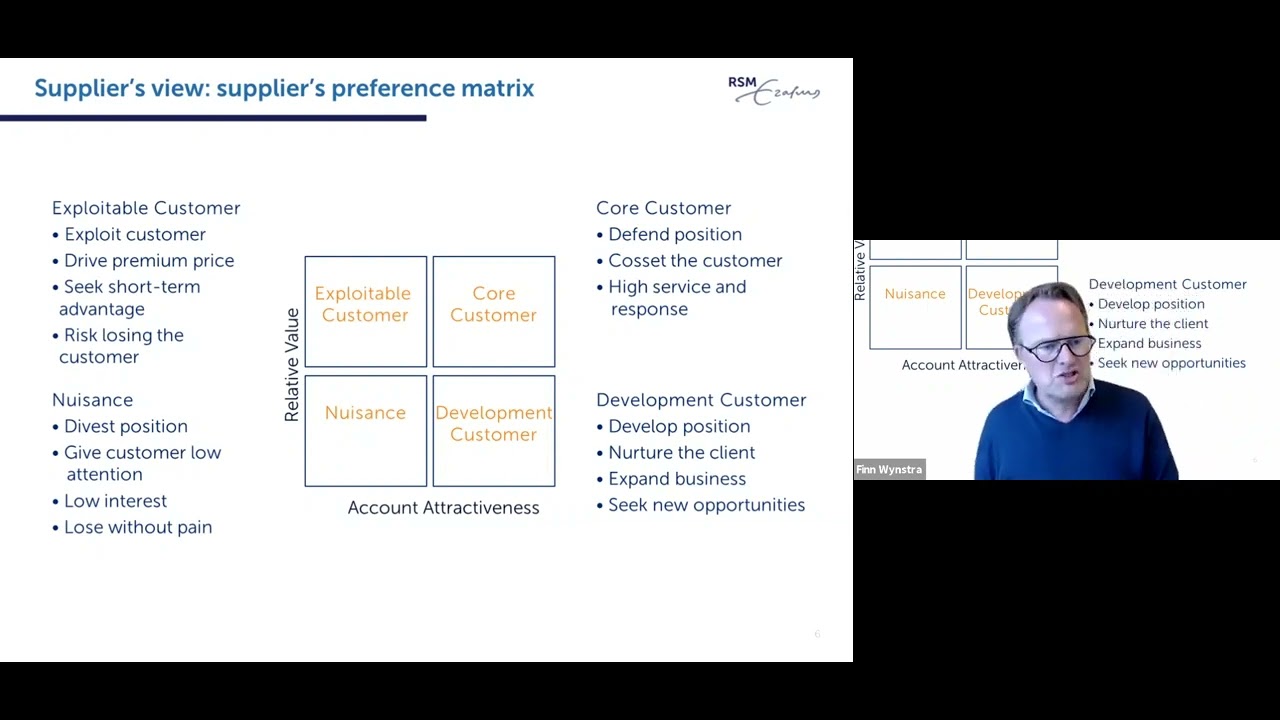
of crowded but more broadly if you use any segmentation method the criteria are very important and particularly to do that in a cross-functional setting now in the subsequent advanced session i will talk about looking at the suppliers perspective okay because we've now looked at suppliers from the buying firm's perspective but how do suppliers actually segment their buyers and should that affect our purchasing strategies and finally i'll talk about the appropriate portfolio distribution which talked about the vertical distribution but is there an idea of what is ideal or recommended in terms of the horizontal distribution of
your spend across the portfolio in the case of the crowded portfolio so i'll come to that in in the second presentation and here's a couple of references and uh some further reading the basic textbook by ariane van valer has a particular chapter on category sourcing strategies as well so thank you