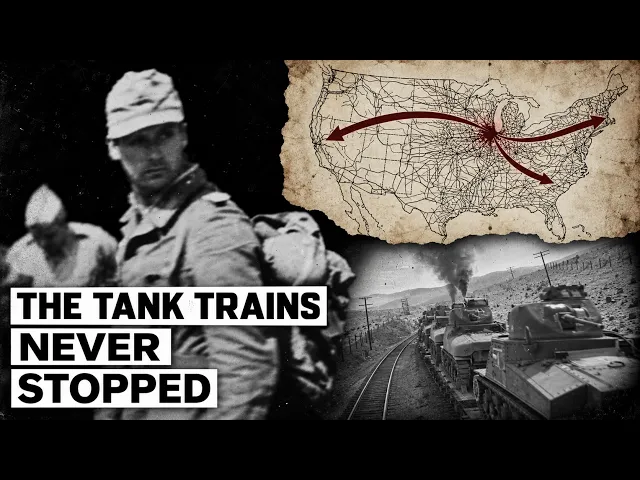
Imagine you're a German soldier. You've survived the furnace of North Africa, the grinding campaigns under Raml, the fear and the dust and the thirst. You've been captured.
You've been loaded onto a ship and carried across the Atlantic Ocean for weeks, crammed below decks, listening to the groaning steel and wondering what kind of hell waits on the other side. And then you arrive. You're marched off the ship in Virginia or New Jersey, and you're put on a train.
Not a cattle car, mind you. Not like the ones you've been riding across Europe. An actual passenger train with seats and windows and meals.
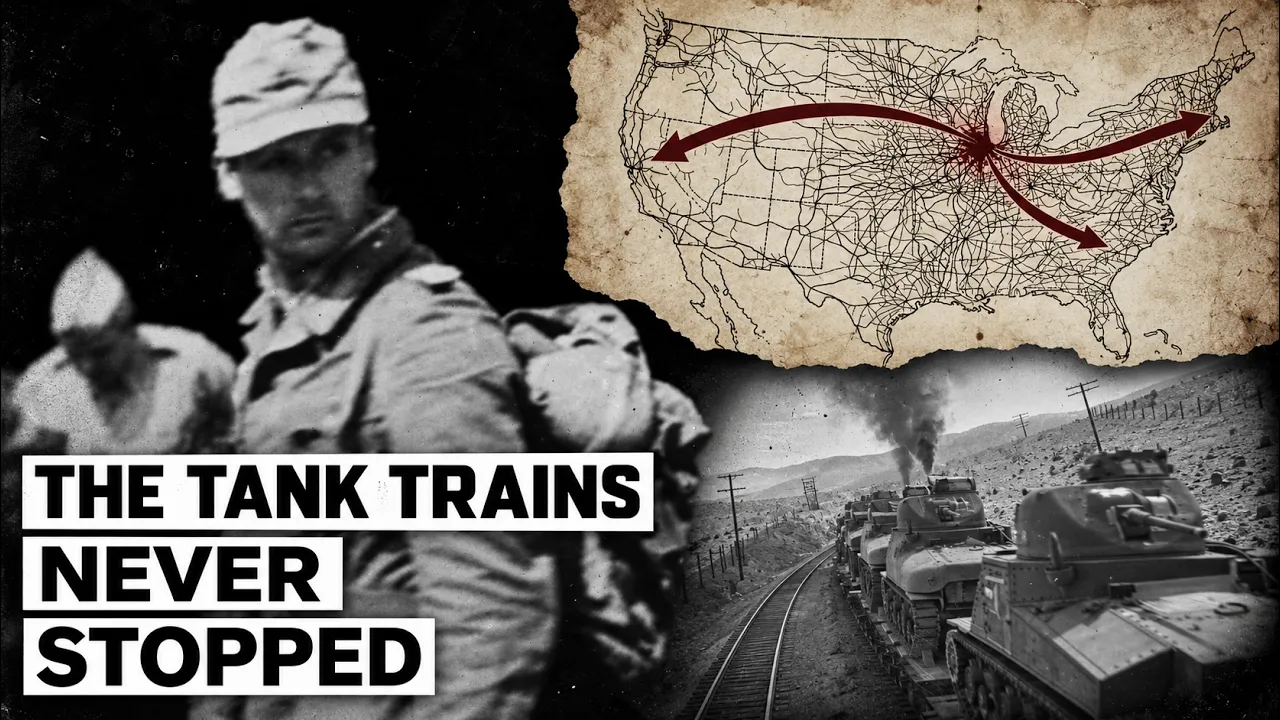
And then the train starts moving. You look out the window and what you see out there rolling past hour after hour after hour quietly and permanently dismantles everything you've ever been told about the country you were fighting against. Because the tank trains never stopped.
That's the detail that broke them. Not the battles, not the defeats, not even the capture. It was the trains.
Flat car after flat car after flat car, loaded with brand new Sherman tanks, stretching to the horizon in both directions, rolling through the American heartland without pause, without urgency, without any sign that this level of output required so much as a second thought. One flat car, one tank, another flat car, another tank. The count didn't end.
This is the story of how more than 400,000 German prisoners of war were transported across the United States between 1942 and 1945 and how the journey itself, more than any battle or any speech, shattered the mythology of a nation they had been trained to despise. It is the story of the moment the war was already lost, not in the foxholes of Normandy or the rubble of Stalingrad, but in the eyes of men who saw the truth rolling past their windows on American steel rails. Let me take you back to the world these men came from because the shock only makes sense if you understand the lie that came first.
For the better part of a decade before the war, the Nazi propaganda machine had been constructing a very particular image of the United States. Joseph Gobles, Hitler's minister of propaganda, was meticulous about it. In his weekly column in the Nazi publication Dasich, Gobles wrote that America was a nation of shallow materialists, culturally bankrupt, morally rotten, and racially impure.
He described America's greatest technical accomplishments as refrigerators and radios. He mocked the idea that Americans could build anything of lasting value. He wrote that Americans could not believe there are cultural values that are the result of centuries of historical development.
Values which cannot simply be bought. And this wasn't fringe talk. This was state doctrine.
Hitler himself called the United States a mongrel nation. too rich, too soft, too divided by racial conflict to ever sustain a serious military campaign. In private dinners and public speeches alike, he told his inner circle that America would never again be a danger to Germany.
He said the American soldier was no soldier at all. He dismissed the entire nation as decadent, governed by capitalist elites, and incapable of the kind of unified will that warfare demanded. In 1940, when President Franklin Roosevelt stood before Congress and called for the production of 50,000 military aircraft per year, Hitler's advisers looked at the number.
They studied it carefully, and they reported back to the Furer that the figure was absurd, a fantasy, propaganda meant for domestic consumption. Germany was producing fewer than 10,000 aircraft annually at that point, and it was straining every senue to do it. 50,000 was a number designed to sound impressive, they said.
Not a number anyone could actually reach. Within four years, American factories were producing over 96,000 aircraft annually. But the soldiers heading to the front didn't know that yet.
What they knew was what they'd been told. And what they'd been told was simple, consistent, and deeply ingrained. America was weak.
Its people were lazy and pampered. Its military was a joke. Its factories made toys and automobiles, not the instruments of real war.
Its democracy made it slow. Its diversity made it fragile. Its soldiers raised on comfort would break at the first shock of combat.
This was the belief system that traveled with every German soldier who crossed the Atlantic as a prisoner of war. And it was about to collide violently and permanently with reality. The first major wave of German prisoners arrived in the United States in 1943 following the Allied victory in the North Africa campaign.
Raml's Africa Corps, some of the most battleh hardened soldiers in the German military, had been encircled and forced to surrender in Tunisia. Tens of thousands of them were loaded onto cargo ships, many of the same Liberty ships that had just delivered American war supplies to the Mediterranean and sent across the ocean. Now, here's a detail worth pausing on.
Britain was running out of space. The British Isles were small, heavily bombed, and already overcrowded with Allied troops preparing for the eventual invasion of Europe. There was simply no room to house hundreds of thousands of prisoners.
The United States, on the other hand, had room, lots of it. And so, an agreement was made. The prisoners would cross the Atlantic on those returning cargo ships, and they would be housed in camps spread across the American interior, mostly in the South and Southwest, far from war critical industry.
By the war's end, there would be more than 700 P camps in 46 of the 48 states, housing a total of 425,000 German prisoners. But to get them to those camps, you had to move them. And the only way to move that many men across a continent that size was by rail.
And this is where the story begins to turn. The trains that carried German PS were not the box cars these men were accustomed to. In Europe, soldiers moved in cattle cars, cramped and dark and stinking of sweat and diesel.
The American trains were passenger coaches. They had seats. They had windows.
Some accounts describe meals being served on the train, sandwiches and coffee and fruit. The prisoners were stunned before the landscape even started moving. But then it started moving.
The trains departed from east coast ports, places like Norfol, Virginia or Camp Shanks in New York, and they headed west. Some went to Texas. Some went to Oklahoma or Arizona or deep into the rural plains of Kansas and Nebraska.
And the journey took days, not hours, days. Because the United States is enormous in a way that most Europeans even today struggle to fully comprehend. Germany, from its northern border to its southern tip, can fit inside the state of Texas.
The distance from New York to a P camp in the Texas panhandle is roughly the same as the distance from Paris to Moscow. And for the entire journey, the prisoners sat at their windows and they watched. They watched cities slide past that had no bomb damage, no rubble, no shattered buildings, no blackout curtains, cities with their lights on, with neon signs glowing, with automobiles filling the streets.
Not military vehicles, ordinary civilian automobiles driven by ordinary people going about their ordinary lives as if there wasn't a war consuming half the world. They watched factory complexes stretch along the rail lines, smoke stacks pouring out smoke at full capacity, three shifts a day, the night sky orange with industrial fire, assembly lines that never shut down. Near Detroit, near Pittsburgh, near Akran and Cleveland and Chicago, the evidence of American manufacturing power was not something you had to go looking for.
It was right there, pressed against the tracks, visible from every window of every passing train. They watched farmland, endless, staggering farmland, golden wheat fields that ran unbroken to the horizon. cattle ranches that were larger than entire German provinces, orchards loaded with fruit, grain silos standing like cathedrals in small towns that seemed to exist for no reason other than to collect and distribute the absurd agricultural surplus of a continent-sized nation that had more food than it could possibly consume.
And then they saw the other trains. This is the part of the story that gets told again and again in memoirs, in oral histories, in the accounts of camp guards and intelligence officers who debriefed these men. Because the American rail network wasn't just moving prisoners, it was moving the war.
And the prisoners could see it. Flat car after flat car, loaded with brand new M4 Sherman tanks, painted olive drab and gleaming with factory fresh steel, strapped down and heading east, heading to the ports, heading to the ships, heading to Europe, to the very battlefields these men had just been pulled from. The prisoners counted them.
It was almost instinctive. These were soldiers. They understood logistics.
They understood what it meant when you could see your enemy's supply chain in operation. And so they counted. 10 tanks, 20, 50, 100.
The train kept going. The flat cars kept coming. The count didn't stop.
Some accounts described prisoners who initially dismissed what they were seeing. They assumed it was staged. They believed, because their propaganda had told them to believe, that America was a nation of smokeokc screens and illusions.
They thought the Americans were running the same trains past them in loops, driving the same tanks in circles, creating an impression of abundance that didn't really exist. But then the train kept moving, and the landscape kept changing, and the factories were different factories, and the tanks were different tanks, and the towns were different towns, and the fields stretched on and on and on, and the illusion theory started to collapse under the sheer grinding, relentless weight of reality. Because America was not putting on a show.
America was just doing what America did. To understand why this mattered so profoundly, you have to understand what was happening in Germany at the same time. And the contrast is not just dramatic.
It is almost obscene. By 1943, Germany's industrial base was under severe and growing strain. Allied bombing campaigns were beginning to hit factories, rail junctions, and fuel depots across the Reich.
The Rurer Valley, the industrial heart of the German war machine, was being pounded night after night by British Lancasters and American B7 flying fortresses. Workers were being pulled from factories to fill gaps in the military. Raw materials were running short.
Synthetic fuel programs were consuming enormous resources just to keep the Luftvafa in the air. Germany produced approximately 19,000 tanks over the entire course of the war. That includes every model from the early Panzer 3es and fours to the fearsome Tigers and Panthers that rolled off the lines at a painful trickle.
The United States produced over 86,000 tanks during the same period. And it was producing them alongside 300,000 aircraft, 2. 5 million trucks, 6,500 naval vessels, and over 40 billion rounds of ammunition.
By 1944, the United States was manufacturing more war material than all of the Axis powers combined. Not more than Germany, more than Germany and Japan and Italy put together. And none of this production was happening under duress.
No bombs were falling on Detroit. No air raid sirens were interrupting the night shift at the Chrysler tank arsenal. No cities were being evacuated.
The factories ran around the clock, fed by an agricultural base that could sustain both an army of 12 million soldiers abroad and a civilian population of 130 million at home, all at the same time without rationing anything close to the level of deprivation that had become daily life in Germany. The Chrysler tank arsenal in Warren, Michigan is a perfect example of what the prisoners were seeing reflected on those flat cars. The plant was purpose-built for war production, designed from the ground up to mass-produce armored vehicles using the same assembly line techniques that had made the American automobile industry the most efficient manufacturing system on the planet.
By December of 1942, the plant's 5,000 workers set an all-time monthly production record of 97 Sherman tanks in a single month from a single plant. By the time tank production ended, the Detroit Arsenal alone had built more than 22,000 tanks. And that was just one facility.
There were 17 Chrysler, Cadillac, and other plants across the country converted to produce tanks. Fisher body plants, General Motors plants, factories that had been stamping out Buicks, and Chevrolets 12 months earlier were now producing the instruments of mechanized warfare at a pace that no nation on Earth then or since has ever matched. Then there was Willow Run.
Ford's Willowrun bomber plant located near Ipsellante, Michigan, was a mile long. That's not a metaphor. The assembly line literally stretched for a mile with a 90° turn partway through because Henry Ford didn't want to pay taxes in two counties.
At its peak, the plant employed 42,000 workers running two 9-hour shifts. And by early 1944, a completed B-24 Liberator heavy bomber, a machine containing 1. 2 2 million individual parts and 360,000 rivets was rolling off the end of that assembly line every 63 minutes.
One bomber per hour, every hour, day and night. Pilots and air crews slept on 1300 CS inside the plant, waiting for the next aircraft to be born so they could fly it away. By the war's end, Willowrun alone had produced 8,600 B-24 bombers, accounting for roughly 70% of the nation's total monthly liberator output.
Now, imagine you're a German prisoner on that train, and you've been told your whole life that America can build cars and make movies, but it cannot build an army. And then you watch this roll past your window for three straight days. The Liberty Ship program tells a similar story, but on water.
At the start of the war, it took American shipyards an average of 355 days to build a single cargo vessel. By 1943, the average was down to 41 days. Henry Kaiser's shipyards on the West Coast were launching vessels at a rate of three ships every 2 days.
And in November of 1942, Kaiser's Richmond Yard number two built the Liberty ship SS Robert E. Piri from Keellaying to completion in 4 days, 15 hours, and 29 minutes. a fully operational oceangoing cargo ship built in less time than it takes most people to finish a home renovation project.
In total, American shipyards produced 2,710 Liberty ships during the war, launching them faster than German hubot could sink them. At the peak of the Battle of the Atlantic, when submarine warfare was at its deadliest, the United States was still building more ships per month than it was losing. The math was simple and devastating.
Germany could not sink ships fast enough. America could not be starved. And the German prisoners riding those trains through the heartland could see it.
They could feel it. The sheer terrifying abundance of a nation that had not yet been touched by war, that was producing weapons of war as a side function of an economy so vast and so diversified that it could afford to feed its enemies 3,000 calories a day while simultaneously arming half the globe. Because that's the other part of the story that shattered these men, the food.
When German prisoners arrived at their assigned camps, they were fed, not prison rations, not survival portions, full meals three times a day. The Geneva Convention required that prisoners receive the same quality of food as the detaining p's own soldiers. And the United States followed that rule and then went beyond it.
German PS in American camps received between 3,00 and 3,200 calories per day. That was roughly equivalent to what American civilians were eating at home. Some accounts describe prisoners being given trays loaded with meat, potatoes, vegetables, bread, butter, coffee, and dessert.
Men who had been surviving on hard bread and thin soup in the desert or on the Eastern Front looked at their first American meal and assumed it was meant to last them a week. It was one meal, and there were two more coming that same day. Some prisoners wept, not from sadness, from the realization of what this abundance meant.
If this is how America feeds its enemies, they thought, what does it feed its own people? And if it can do this without strain, without shortage, without any visible sacrifice, then what chance did Germany ever have? There were adjustments made, of course.
The camps had to adapt their menus to German tastes. Most German prisoners refused to eat corn, considering it animal feed. The cooks learned to serve potatoes and dark bread instead, but the quantity and quality of food was never in question.
It was abundant, consistent, and for men who had spent years at war, almost incomprehensible. The camps themselves told the same story. German PS were housed in wooden barracks, not dungeons.
They had access to libraries, recreational facilities, educational programs, and even sports equipment. Some camps had orchestras. Some had theatrical productions.
Prisoners received 80 cents a day for their labor, working on farms and in caneries and lumber mills. Filling the labor gap left by the millions of American men who had gone overseas to fight. The work itself was revealing.
German prisoners who were sent to work on American farms found themselves laboring alongside machinery they'd never seen before. tractors and combines and mechanical threshers that could do the work of dozens of men. The scale of American agriculture was not just impressive, it was disorienting.
Nazi propaganda had told these men that the Germans who had immigrated to America were losers and traders, people who had abandoned the fatherland out of weakness. But the German-American farmers these prisoners met owned more land than some German aristocrats. They lived in houses with running water and electricity and automobiles in the driveway.
They were not desperate or downtrodden. They were prosperous and free. And they spoke German.
Many of them still spoke the language of their grandparents, the language of the men who were now picking their crops and bailing their hay as prisoners of war. The conversations that happened in those fields, quiet exchanges in German between a farmer and a prisoner, were some of the most psychologically devastating moments of the entire P experience. Because the propaganda collapsed entirely when you were standing in a field in Nebraska, speaking your own language with a man who had more wealth and more freedom than anyone you'd ever known back home.
And he'd gotten it all by leaving. But let's come back to the trains because the trains were where the realization hit hardest, where the mental architecture of the Third Reich was most thoroughly demolished. And it wasn't just the tanks.
As the trains moved west, the prisoners saw the full breadth of the American logistics system in operation. Railards that stretched for miles, filled with freight cars loaded with steel, aluminum, rubber, fuel, ammunition, food, vehicles, aircraft components, and every other conceivable ingredient of modern warfare. They saw parallel tracks carrying goods in both directions simultaneously, east to the ports and west to the factories.
A circulatory system of industrial power that pulsed with a regularity and a volume that no European nation could match. They saw trains carrying jeeps stacked three high on flat cars. Trains carrying artillery pieces crded and bound for shipping.
trains carrying pre-fabricated sections of ships, bridge components, radar equipment, rolls of communications wire, crates of Krations, pallets of uniforms, boots, helmets, and medical supplies. The American war effort was not a desperate scramble. It was a conveyor belt, and it never stopped.
Some prisoners became convinced the Americans were driving the trains in circles, that the same equipment was being paraded past them over and over again, that the whole thing was an elaborate psychological operation designed to break their morale. And in a way, you can understand the impulse because the alternative that all of this was real, that a single nation could produce this much material while simultaneously fighting a two-front war across two oceans was simply too large to accept. It violated everything they had been taught.
It contradicted every news reel and every speech and every barracks lecture they'd ever received. It made their entire worldview a lie. But it was real.
And the train kept moving and the landscape kept changing. And eventually, one by one, the prisoners stopped arguing about whether it was staged and started asking a different question entirely. How were we ever supposed to win?
That question asked silently in the minds of men who had been willing to die for the Reich was the real victory. Not the battles, not the treaties, not the unconditional surrender. The war was won in a profound psychological sense on the railroads of America's interior, in the minds of soldiers who finally saw what they were up against.
The numbers bear this out in brutal clarity. In 1941, German factories produced 3,256 tanks. American factories produced 4,052.
A close race, close enough to give Germany hope. But by 1942, the numbers diverged catastrophically. Germany produced 4,098 tanks.
The United States produced 24,997, more than six times the German output. And Germany, despite heroic efforts to increase production under Albert Shar's direction, never closed that gap. Not even close.
By 1944, the peak year of American production, the United States was producing roughly one tank every 5 minutes. Every five minutes around the clock from multiple plants, feeding them onto trains, rolling them to the coast, loading them onto ships, sending them to Europe and the Pacific in an unbroken industrial river of steel. The German prisoners on those trains were watching the river flow.
And it wasn't just the quantity, it was the quality of the system behind it. American production wasn't the frantic, improvised effort of a nation under siege. It was methodical.
It was optimized. It was, in many ways, the logical endpoint of the same assemblyline revolution that Henry Ford had started three decades earlier with the Model T. The same principles that had made the automobile affordable to the average American worker were now making the Sherman tank affordable to the Allied cause on a planetary scale.
The War Production Board, established in January of 1942, had orchestrated the most rapid industrial conversion in human history. Automobile factories stopped making cars. Literally stopped.
Not a single civilian passenger car was manufactured in the United States between February of 1942 and the end of the war. Every factory, every stamping press, every paint booth, every assembly line was retoled for war production. General Motors made aircraft engines and machine guns.
The Singer sewing machine company made navigation equipment. A piano company made glider fuselages. A pinball machine manufacturer made armor-piercing shells.
The transformation was total. And it was achieved not through coercion or forced labor, but through contracts and incentives and the sheer competitive energy of an industrial economy that had been looking for something to do since the Great Depression had knocked it flat. There is an irony here that is worth sitting with.
Nazi propaganda had described America as a nation of shopkeepers and entertainers, a people too soft and too divided to ever threaten the iron discipline of the German war machine. But it was precisely the things Gobles despised about America. Its commercial instincts, its entrepreneurial culture, its obsession with efficiency and profit, its democratic chaos that made it the most lethal industrial power the world had ever seen.
The very qualities the Nazis mocked were the qualities that buried them. The German prisoners saw this with their own eyes. And many of them understood it in their bones long before the diplomats signed the papers.
Now, I want to talk about what happened after the realization because the story doesn't end with the train ride. It continues in the camps and it continues after the war and it has implications that stretch all the way to the Cold War and beyond. The United States government understood fairly early on that it had an unusual opportunity with these prisoners.
Not just a logistical challenge, but a strategic one. These men were going to go home eventually. And when they did, they would be the ones rebuilding Germany.
The question was, what kind of Germany would they build? In 1944, the War Department quietly launched a re-education program for German PS. It was carefully designed to avoid the appearance of propaganda because the prisoners were highly skeptical of anything that smelled like indoctrination.
They'd been raised on propaganda and they knew what it looked like. So, the program was subtle. It used American newspapers, uncensored, with all their messy contradictions and editorial arguments to show the prisoners what a free press actually looked like.
It used films, not propaganda reels, but Hollywood movies and news reels that depicted American life as it actually was. It used educational classes offering everything from English language instruction to university level correspondence courses. And it used the camps themselves because the daily experience of living in an American P camp, eating American food, working alongside American civilians, reading American newspapers, playing American sports, and being treated for the most part with basic human decency was the most powerful argument against Nazi ideology that anyone could have designed.
Not because it was a deliberate psychological operation, but because it was real. Many prisoners learned the full extent of the Holocaust and Nazi. Atrocities for the first time through American newspapers and news reels.
Information that had been carefully hidden from ordinary German soldiers was now freely available. The effect was devastating. Some prisoners became angry, not at the Americans, but at the leaders who had sent them to fight with lies instead of truth.
When the war ended and repatriation began in late 1945, many German PS did not want to leave. They had experienced something in America that they had never known in their own country. Not just material abundance, but a certain kind of openness, a willingness to let people argue and disagree and figure things out for themselves.
Some of them came back to America after the war. Some married American women they'd met while working on farms. Some maintained lifelong friendships with their former guards.
And many of them went home and became exactly the kind of citizens that the re-education program had hoped they would become. They became teachers and civil servants and local politicians and small business owners in the new Federal Republic of Germany. They carried with them the memory of what they had seen on those trains, in those fields, in those camps, and they built a different country.
There's a question embedded in all of this that I think is worth considering, especially now, because the story of the German PS and the tank trains is not just a World War II anecdote. It's a story about the relationship between productive capacity and power, between industrial might and national survival, between what a society can build and what it can endure. When Franklin Roosevelt stood before Congress in 1940 and said that the United States must be the great arsenal of democracy, he was making a bet.
He was betting that a free market economy driven by private enterprise and voluntary labor could outproduce the command economies of the totalitarian states. He was betting that the same factories that made Fords and frigidairs could make Shermans and liberators. He was betting that the chaos and inefficiency of democracy, all the arguing and the competing interests and the messy compromises would ultimately prove more powerful than the centralized top- down control that the dictatorships claimed was their greatest strength.
and the tank trains proved him right. By 1944, the United States was producing 2/3 of all Allied military equipment. The comparison is almost absurd.
Germany produced about 46,000 tanks over the entire war. The United States produced 86,000. Japanese aircraft production peaked at 28,000 in 1944.
American aircraft production that same year was 96,000. The combined naval output of all Axis powers over the entire war was roughly 1,400 vessels. The United States built 6,755.
The war was won in the factories. The war was won on the assembly lines. The war was won in the rail yards and the shipyards and the steel mills and the grain elevators.
And the German prisoners pressed against the windows of those westbound trains, watching it all slide past in an endless, unstoppable procession, were the first enemy combatants in history to see the machinery of their own defeat laid out before them in broad daylight. They didn't need intelligence briefings. They didn't need decoded messages or captured battle plans.
They just needed to count the tanks on the flat cars. And when the count never ended, neither did the questions about everything they'd been told. There's a line that gets attributed to various German officers in various forms, but the sentiment is always the same.
After riding across the United States by train, after seeing the factories and the farms and the freight yards and the tank trains that never stopped, a German prisoner is said to have written with the weariness of a man who has finally accepted a truth he'd been resisting for years. Something along the lines of, "We entered America prisoners and we left America witnesses. " Because that's what those trains did.
They turned soldiers into witnesses. Witnesses to the sheer, overwhelming, unanswerable industrial power of a nation that hadn't even fully mobilized yet when it was already outproducing the entire axis by a factor of 2:1. And the tank trains never stopped.
They're still rolling in a sense. Not the same tanks, not the same wars, but the principle hasn't changed. The nation that can build more faster and sustain it longer is the nation that sets the terms of the world it lives in.
The German prisoners understood that in 1943, staring out of train windows at the American Midwest, watching the evidence roll past them one flat car at a time. They had been told America was weak. They had been told it was fragile, decadent, incapable of sacrifice or sustained effort.
They had been told all of this by leaders who had never set foot on American soil, who had never seen a Kansas wheat field or a Michigan assembly line or a California shipyard launching a new vessel every 48 hours. And then they rode the train. And the train showed them the truth.
The war was already over. They just hadn't been told yet. If you've made it this far, I'd love to know what hit you the hardest.
Leave a comment below and tell me. And if you haven't already, make sure you subscribe to the channel and hit that bell icon. We've got a lot more stories like this one coming.
Stories about the hidden machinery behind the biggest events in history.