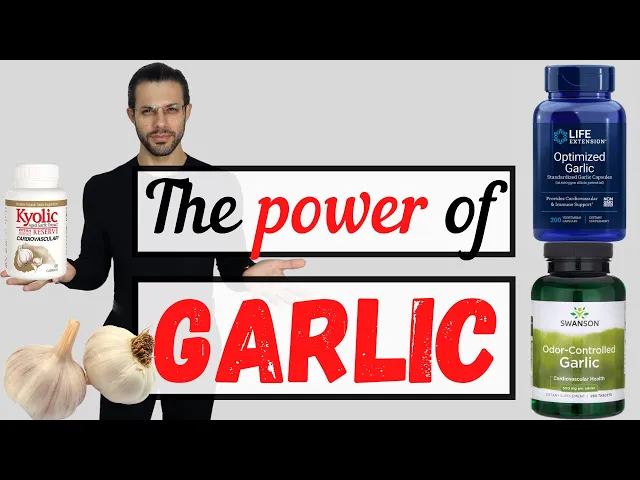
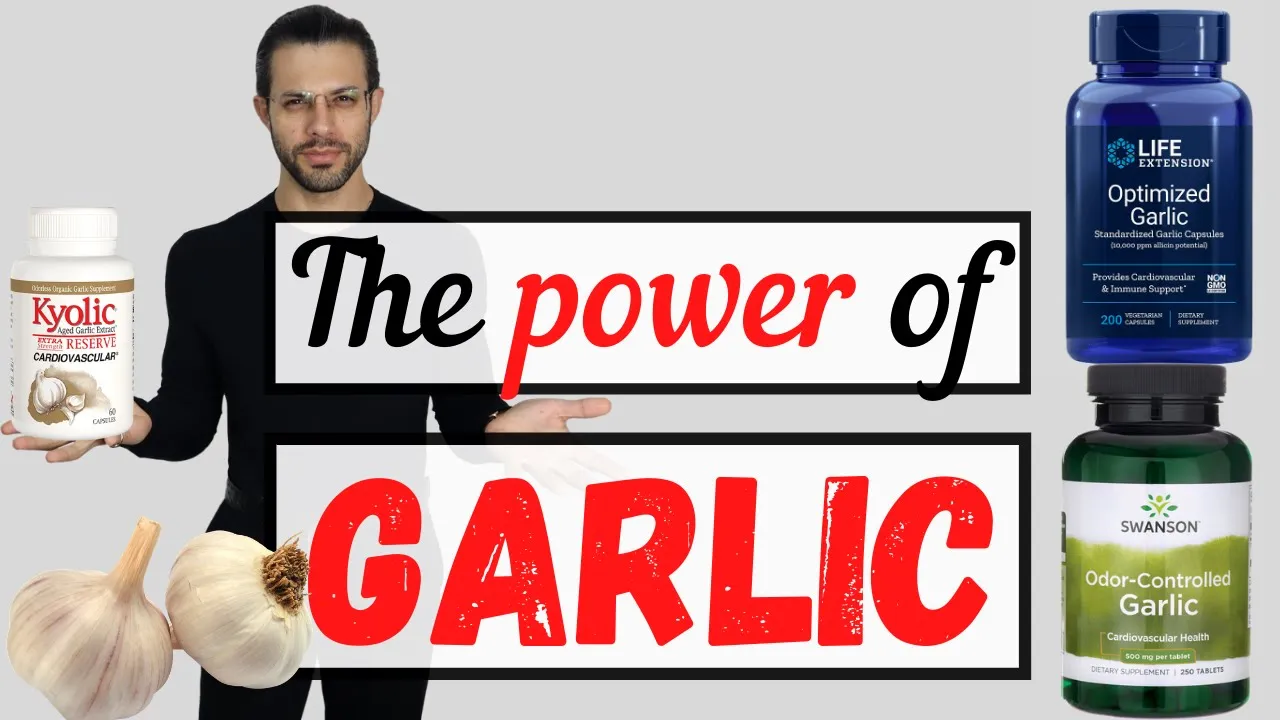
[Music] hello friends welcome to the most comprehensive video that you will ever see on supplemental garlic i will tell you things in this video that you've never known about garlic and i think by the end of the video you'll decide to supplement garlic yourself if you haven't already i'd like to draw your attention to the fact that in the description below you will find a link to a blog post in which i have citations for everything that i discuss in this video i highly recommend checking out the blog post because instead of just including the citations uh you can see this is sort of the blog post i have notes just a short note a sentence on what you can find on each of the papers there are also some things in the notes that i will probably not get to in this discussion to save some time anyway with that said as you guys know every week i'm doing a review of a supplement last week's was melatonin this week's is garlic and the reason why is because garlic is one of the supplements i most strongly believe in but i'm going to take you on a tour of why beginning first with the subject of allium vegetables so there are two vegetable families that i feel very strongly about one is the cruciferous family which includes broccoli and kale and the like and the other is the allium family which includes onions garlic leeks scallions and things like that briefly i'd like to draw your attention to the fact that so there are some things called phytochemicals phytochemicals include phenols they include flavonoids there's different classes of them the garlic doesn't have actually the highest amount of these so for example in terms of phenolic content onion is superior to garlic and by the way each of the phenols acts slightly differently in the body so i'm just talking about quantity now onions is superior to garlic in terms of quantity and garlic is slightly superior to leeks in terms of antioxidant status as judged by the dpph assay now remember there's many kinds of assays for antioxidants there's like four or five that are regularly used and the point is we're only studying it here with the dpph assay other assays may reveal different outcomes but in terms of that assay onions are superior to leeks which are then also superior to garlic a side note i'd like to mention is that garlic does produce more nitric oxide from n nitroso glutathione than onion extract which does more than leek extract in general a theme that you'll notice in this discussion is that garlic really potently improves glutathione status so to begin let's discuss what garlic is so garlic has is metabolized in the body and also in its cooking process into over 100 bioactive metabolites broadly categorized into organosulfur compounds those are organic compounds that contain sulfur and carotenoids and polyphenols i want to get too much into the carotenoids and polyphenols though the then the reason why i should say the most attractive element of garlic is the organo sulfur compounds and the same in my opinion for the allium family in general so when the first thing that you should know about is allicin allicin is the most uh probably the most important organo sulfur compound in garlic allicin is not present in an intact garlic clove it is similar to how sulforaphane is produced from uh broccoli uh it it develops when the uh garlic clove is crushed or somehow um pre you know processed so what happens specifically is that the enzyme alanis uh reacts with uh sulfur sulfinic acids to produce to transform allen into allicin allison being of course absent in the intact garlic clove allicin appears to be a defensive compound for the garlic plant it causes pain in predators that consume it and so it seems to be that when a predator would attack the garlic clove and crush it they would develop pain and then they would try not to attack this plant anymore but this allison also just like many other uh you could say hormetic stressors in the world of phytochemicals really produces great impacts on our health probably because we have evolved over hundreds of thousands or even millions of years to react to these uh phytochemicals that are signals from our environment allicin is as i said a sulfur containing very volatile compound uh it is the most abundant thiosulfate sorry thiosulfinate in fresh garlic accounting for about 70 percent of the thiosulfinates and 0. 4 percent of a crushed uh mass of fresh garlic by the way a single clove of garlic can produce up to four to five milligrams of allicin allicin can be transformed into lipophilic and hydrophilic uh metabolites that are also organosulfur compounds lipophilic means that they easily uh you know they easily enter into us through the cell membrane they can potentially cross the blood-brain barrier if the molecule is small enough and hydrophilic ones react also have a different kind of metabolism in the body um these different compounds the organosulfur compounds like for example al cysteine alan allison allyl disulfide all scavenge free radicals in slightly different ways meaning that having a variety of them may be helpful for our health uh just a note allison's shelf life is uh quite short once you have actually for example if you're creating like a garlic sauce where you've crushed garlic there is allicin there you can increase the shelf life by adding by lowering the ph level for example by adding vinegar to it in terms of flavonols onion is very you probably ever heard of this and actually i'll probably do a video on quercetin quercetin is a flavonol that is very well known to be present in onions and i supplement corset in myself because i don't eat enough fresh onion for the purpose of getting enough of it and it's very powerful but onions have a lot of quercetin they have a lot of something i've never pronounced before in my life but it's called camp for all i read it but never pronounce it and lutiolin i've actually never pronounced that either some things you know you read and you just never actually end up saying them to people so onions have high amounts of these much higher quercetin for example than garlic i mean it's it's incomparably it's about 30 times higher but garlic does have high amounts of miricitin and epigene which is more than what onions have but still in the total quantity is lower um this is probably not very important but i should mention that the lipids that are found in garlic the fats in garlic 23 of them are phospholipids 14 are glycolipids and 63 are neutral lipids i'm not sure what you would do with this information but i did decide to make this video very comprehensive so in terms i just want to mention broadly without getting too much detail you can look at the notes but the different varieties of garlic have different amounts of polyphenols or flavonoids of um of uh i know of antioxidant ability as well and not just the different species but also where they're grown and what time of year and so on now i want to talk briefly about aged garlic because it's quite popular to use aged garlic and there are some benefits and drawbacks to it first of all each garlic is manufactured by soaking the garlic in a solution that has 12 to 20 percent of aqueous ethanol in room temperature for up to 20 months the purpose of this is mainly to reduce the pungent smell of the garlic the problem with supplementing a lot of garlic because you begin to smell like garlic and aged garlic will do this a little bit less the problem with aged garlic is it produces it contains far less ah allocating or allicin sorry i don't know why i said alucifin it contains far less allicin which is the main organo sulfur compound that we're interested in however it increases the aging process increases the amount of s allyl cysteine which is called sac sac you'll commonly see sac sac is the reason that people other than the pungent the lack of pungent odor the other reason why people like myself supplement with aged garlic there's also there's other compounds as well that are increased the one that i'd like to mention is selenium i'm not very fond of selenium because it's very associated with uh the metabolic syndrome type 2 diabetes and those kind of things now compared to fresh garlic extract i want to mention uh one there's one large so one of the problems with diabetes and it's not the main problem but one of the problems is these things called they're called advanced glycation end products or ages basically these things cause harm to the body from people having too high blood sugar levels for a long time aged garlic extract is two times more capable at inhibiting cross linkages between ages it is also more capable at inhibiting post-amadori ag formation but only at higher doses it is one third better at it inhibiting fructosamine formation it is slightly worse at inhibiting glycation induced protein carbonyl formation but better at inhibiting glycation-induced protein theol formation basically aged garlic may be helpful for people that are diabetics maybe potentially more so than than you know fresh powdered garlic but aged garlic has a third more antioxidant power on the abts assay that's another assay but it has uh less on the dpph assay in terms of antioxidant status it is also uh worse at chelating metals from the body which we'll talk about a little bit later than fresh garlic but it has higher amounts of phenolics like phenols so for example aged garlic has 129 milligrams per gram whereas fresh garlic has 56 so it's quite a bit higher it also has about double the amount of flavonoids and it has also almost more than double the amount of flavonols so it has less allicin which is something we really care about but it has more sac and it has more of the phytochemical of phytochemical quantity in general so it has a different nature now let's get into some things that let's get into the studies of how garlic can improve health in rodents as well as in humans so first of all one of the most notable things about supplementing garlic is its effect on inflammation so garlic generally garlic extract improves the activity of glutathione i'll give you some specific examples of how it inhibits inflammation or lowers inflammation so for example it inhibits the pro-inflammatory pathway nf kappa b which results in a less of an inflammatory response to lipo polysaccharides which are inflammatory chemicals released by our microbiome that sometimes enter our blood they're very well studied and of interest to researchers a meta-analysis of 16 trials found that garlic reduced c-reactive protein level reduced interleukin-6 which is a pro-inflammatory cytokine and reduce tumor necrosis factor alpha which is also a pro-inflammatory cytokine and just to be clear i i'm not garlic is meaty is modulating pro-inflammatory uh pathways like nf kappa b but it is also reducing the actual causes of inflammation like oxidative stress which we'll talk about later there are other studies that have confirmed the reduction in c-reactive protein and it's been shown that even one meal of garlic containing garlic can improve immunity uh reduce apoptosis and do other things to the to the body allison's anti-inflammatory potential is so great that it has been shown to reduce cartilage um what did i call it this the destruction of cartilage in rodents in rodents models of osteoarthritis so osteoarthritis kind of arthritis that causes a really maybe the majority of the pain that elderly people have and the effect on on because the cartilage gets worn down by pro-inflammatory cytokines so allison's allicin being the main organo sulfur molecule we're interested in and garlic is so potent that it can reduce the car the wearing down of cartilage and these rodents in terms of metabolism one thing that i'm almost certain you've never heard of before and actually i don't think anyone's talked about it on youtube or on podcasts garlic has been shown to increase to upregulate the expression of ucp1 that's uncoupling protein 1. one is very involved in the um the activity of brown fat remember brown fat there are two kinds of fat there's white fat well there's also beige fat but there's white fat and brown fat white fat is mitochondria uh it doesn't have much mitochondria in it so it's not very metabolically active whereas brown fat is actually i have a lot of brown fat personally brown fat is actually um it's it's brown because of the amount of mitochondria it has in it and it generates a lot of heat and so it's considered to be a healthful kind of subcutaneous fat so um it seems that garlic may because of its activity on ucp1 may increase the browning of white fat or at least increase the activity of brown fat it also garlic has been shown to via its activation of brown fat it's been shown to improve insulin resistance decrease adiposity which means fat and improve glucose homeostasis in rodent in obese models in rodent models of obesity it's also been shown to attenuate weight gain in a fructose-induced model of the metabolic syndrome and rodents so where they give because fructose will cause metabolic syndrome so it actually limits the weight gain which is really interesting uh so this was a section on metabolism i wrote you'll see on the notes let's talk about the liver and the kidneys a little bit so allicin as i described before uh improves glutathione peroxidase glutathione reductase and glutathione s transferase and specifically does this add the liver where glutathione is the main antioxidants an antioxidant a lot of the damage that's done to the liver is because of oxidative stress that is not being that cannot be handled with glutathione with the the expression of glutathione that we have in our bodies so garlic extract also appears to uh protect the liver from acetometaphon induced damage in rodent models which acetaminophen causes a lot of liver damage in people it also protects against non-alcoholic fatty liver disease due to its anti-inflammatory and antioxidant effects allicin also protects the kidneys from toxins in a similar manner and seems to be therefore nephroprotective so kidney protective which i don't think anyone probably most people have not heard of that before but this is just because of the same mechanism that it has on the liver in terms of diabetes there's something very interesting so type 1 diabetes is characterized by it's an autoimmune disorder it's not very similar to type 2 diabetes they are very different causes and basically what happens is there are immune antibodies that attack the pancreatic isolates allicin appears to inhibit the activity of these anti-isolate antibodies in type 2 in rodent models of type 1 diabetes now one of the biggest fields of research in regards to to garlic is really cancer so there have been epidemiological studies that showed that garlic consumption and to a lesser degree onion consumption actually is inversely associated with gastric cancer incidence and mortality this is really robust i mean it's not robustly but it's one of the biggest epidemiological results if you search garlic cancer on google scholar you'll come a lot you'll come across a lot of things about gastric cancer by the way that's stomach cancer which is uh you know pretty prevalent around the world especially in asia but potentially by the way because of h pylori which is a kind of bacteria that unfortunately a lot of people in the in asia have and it is very destructive and causes gastric cancers causes ulcers as well as gastric cancers and we'll get to this in a bit but garlic actually is useful in the treatment of h pylori as well so uh epidemiological evidence or data has also shown that allium vegetables so that class of vegetables that have these organo sulfur compounds like leaks and so on is inversely associated also with prostate cancer risk allicin that same organosulfur compound that we've been talking about induces apoptosis in hepat in carcinoma cells which are liver cancer cells it does the same kills cells in glioma and glioblast blastoma cells which is in the brain brain cancers it inhibits telomerase and induces apoptosis in gastric cancer cells why would you want to inhibit telomerase because if telomerase think of it as like a you know your shoe string has a piece of plastic at the end that keeps it tied together telomerase does the same kind of thing for uh dna and cells and if telomerase is uh well so telomeres do that telomerase extends telomeres so if you have telomerase extending your telomeres your cells are going to keep dividing which is an issue in cancers cancers cells specifically so you'd like them to have shorter telomeres so that they don't replicate as much also allicin induces apoptosis in colon cancer cells via its upregulation of the anti-inflammatory pathway nrf2 in terms of cardiovascular now that's just cancer in terms of cardiovascular health one of the things most known about garlic is that it improves blood pressure but i'll take you through a tour of some of the things so first of all in terms of that how is that thought to happen so it seems to be through allison and allison what it does is interact with free theol groups and theo containing compounds like glutathione it in doing so it produces free hydrogen sulfide which interacts with nitric oxide therefore nitric oxide being the main vasodilator of the body garlic also inhibits platelet aggregation meaning that it can inhibit clotting to some degree which could be helpful for cardiovascular disease by the way omega-3 fatty acids epa and dha do the same thing it does this by the way by increasing cyclic nucleotides and by inhibiting fibrinogen binding and thus inhibiting platelet shape change a meta-analysis of 20 trials showed that garlic lowered systolic blood pressure by 5.
1 mmhg and lowered diastolic blood pressure by 2. 5 this reduction though is only evident in people that are hypertensive so it's not reducing blood pressure people that are normal-tensive so it's not something really to be concerned about if you don't have high blood pressure um a meta-analysis also found reductions in cholesterol so total cholesterol was reduced by 17 milligrams per deciliter ldl cholesterol by nine and uh oh within this sorry within uh within only people that had basically very high cholesterol levels they had total cluster of over 200 milligrams per deciliter however this is not as robustly so it's not as consistently found across studies so there some people improv their lipids improve when they have bad lipids but the blood pressure thing is really consistent so allicin also uh prevents oxidized ldl from producing injury to the endothelial walls and it does this by its uh effect on oxidative status and inhibiting apoptosis allicin also inhibits cholesterol synthesis in the liver while other metabolites of the organosulfur molecules do this to the synthesis differentially allicin may be also protected from atherosclerosis because it inhibits the production of tmao from bacteria in the from our microbiome tmao is one of the reasons that if you guys have seen the joe rogan debate between the vegan and chris cresser what you'll have seen is that the vegan one of the main reasons he was against eating meat other than the saturated fat is the tmao which is by the way one of the original paper that brought up the tmao was probably one of the most cited papers in the last 10 years i think it has maybe it has over a thousand citations maybe maybe three thousand i don't know it's very popular and actually garlic inhibits uh prevents the microbiome from producing tmeo for example in respect to l-carnitine which is in meat now um in terms of the brain again this is some stuff that i think i'm i'm almost certain nobody has discussed before from the research which is uh number one allicin may be neuro protective from glutamate excitotoxicity you guys that watch my videos on the brain will know that some neurotransmitters that are excitatory can cause the death of neurons including dopamine and glutamate allicin actually reduces glutamate uh transmission in the brain in rodents brains uh allicin is neuroprotective in rodent models of a traumatic brain injury and it does this by inhibiting oxidative damage and neuronal inflammation by increasing the phosphorylation of akt as well as nitric oxide synthase allicin is also neuroprotective in rodent models of ischemia reprofusion which means when there's a low blood flow to an area and then the blood comes back in this is a kind of damage that causes cell death and it does this again by inhibiting oxidative stress inflammation dysfunction of the mitochondrial respiratory chain as well as apoptosis and by upregulating antioxidant antioxidant enzymes such as catalase superoxide dismutase glutathione peroxidase and glutathione as transferase allicin dose dependently inhibits acetyl cholesterase and butyl cholesterase which are enzymes involved in breaking down acetylcholine so because of this allicin actually increases the uh presence of the neurotransmitter acetylcholine in the brain which for those of you who have watched my series on the cholinergic system you'll know is the main way that alzheimer's disease symptoms of cognitive decline that are associated with alzheimer's disease are attenuated um they give uh alzheimer's these patients drugs like galantamine and most particularly donopizil that inhibit the breakdown of acetylcholine because the acetylcholine is so intimately involved in learning and cognition and memory so allison does this as well in rodent models of alzheimer's disease allicin improves cognition by reducing oxidative stress mitochondrial dysfunction and reducing beta amyloid plaque presence in a rodent model of cognitive impairment allison improves cognition by up regulating nrf2 mediated antioxidant or by up regulating the nrf2 antioxidant pathway in a rodent model of social defeat stress induced depression which is rather particular allison attenuated depressive symptoms by reducing microglia activation the microglia are the main inflammatory components of the nervous system and by reducing inflammatory cytokine expression reducing abnormal iron accumulation and limiting neuronal apoptosis in the hippocampus maybe i should explain a couple of these things iron accumulation in the brain causes damage to the brain and is linked to alzheimer's disease by the way anything that you're doing that's damaging the brain will also affect um well-being cytokines inflammatory cytokines directly cause depressive symptoms so if you inject a rodent with for example tumor necrosis tumor necrosis factor alpha they will develop depressive symptoms so if you can reduce the pro-inflammatory cytokines and the activation of the microglia you will reduce depressive symptoms and allicin does this again the main organo sulfur molecule that we're interested in in garlic so now another thing that you probably didn't know is this garlic and heavy metal poisoning subject so allicin potently and dose dependently reduces the retention of lead when i say importantly i mean importantly by up to 70 percent in the liver where is very concerning it does this in the tissues and in the blood and it also although reduces zinc uh retention as well garlic extract can reduce uh the accum the retention of cadmium which is another heavy metal that we're concerned about allicin also protects the liver from iron induced damage now iron uh iron in the liver causes serious damage it's linked to non-alcoholic fatty liver disease and many other things cancers and all kinds of things which is why i always tell people do not take a multivitamin or multi-mineral with iron in it certainly don't do that and that's the reason i really want to uh start doing my own phlebotomies but i've been delaying it uh constantly it's really getting ridiculous now but anyway garlic extract also protects from the cytotoxicity associated with mercury poisoning and protects the liver from damage due to arsenic poisoning so those are the heavy metals now about the microbiome this is something you guys probably did know garlic extract inhibits it has antibacterial effects on both gram positive and gram-negative bacteria it is able also to sensitize bacteria to the effects of antibiotics it is also anti-parasitic and anti-fungal the chemical mechanism though by which it exerts this antibacterial effect is not clearly understood i really try to dig into the details and that it's not understood there are so one study shows one brand of aged garlic extract called kaiolic which we'll return to later was found to increase the species uh lactobacillus and claustradia i've never pronounced clostridium before after three months of basically what what we've seen is this garlic extract although it's antibacterial it seems to improve the function of the microbiome increasing the different species the variety and getting rid of some of the bad species or the species that are you know don't have a symbiotic relationship with us so it also um it should be known that the anti antibacterial or antimicrobial effects of garlic depend on the again the species of garlic and where it's grown i mentioned before that allicin particularly uh reduces the uh transformation of l-carnitine into tmao by the the microbiome and intra and i've mentioned this before also but allicin has proved useful in the treatment of h pylori the very concerning uh bacteria that causes gastric cancers by the way guys you can just go to your doctor on your next visit and there's like a breath test where you can test to see if you have h pylori if you live in asia i highly recommend doing so but you may also have it if you live in europe or america and it's something that's easily treatable and could prevent you from serious health complications and when you do get it treated you may want to take your garlic supplement as well now i just wanna this is toward the end of my discussion now we're gonna talk about supplements i just want you guys to know about the allicin content of different kinds of garlic so black garlic has the least followed by pickled garlic followed by boiled garlic followed by roasted garlic roasted garlic maintains the most of all the different kinds of these cooking methods or processing methods and taric coated garlic tablets are the worst absorbed and they're even absorbed worse when you eat a protein rich meal in general i would avoid enteric coated garlic tablets if you can also i should mention that some studies have shown that most of the garlic supplements contain far less allicin than they say they do about 15 percent of what they say they do and the reason seems to be because they have low alanis activity that's the enzyme that's involved in the conversion and that they do not disintegrate quickly enough once they're uh eaten which is why interrecorded tablets are not preferred so by the way that's an entire quoted tablet is one of those like hard tablets so now let's talk about supplements i'm going to give you guys some helpful uh tips um i don't know how much detail i should give you here uh well first of all let's know that one gram of fresh garlic produces one two three point three three milligrams of allicin and dried garlic should produce about three times that much because it has less water so when you weigh it per per gram obviously i subscribe to some companies that review garlic uh supplements and i'd like to let you guys know the reviews are actually not that extensive but stay away from two one is the walmart brand spring valley and one is garlic you're unlikely to come across garlic but stay away from the walmart walmart brand one now i'm gonna tell you guys which garlic supplements i personally take and i'm also gonna include links to those supplements in my notes so probably when you get down to the bottom of the notes the last page you'll see this section on garlic supplements and i'll just put a hyperlink there where you can click on it and go directly to amazon i'll also include my amazon affiliate link although it doesn't really matter but lucy tells me i should always include it so i will but here's what i wanted to say so first of all you can judge these supplements based on a few metrics the garlic supplements basically it's the cost per whatever okay yeah so it's the cost and then the cost per what usually they'll look at the cost per allicin either the proven allison or the estimated total allison or the sac that's one of the things i mentioned before that increases in the aged garlic or you can also um yeah it's basically those two things so but you have to keep in mind that the aged garlic may have more uh phytochemicals in general other kinds of phytochemicals like the flavonols and flavonoids and phenols so i take all three of these but i'll just uh explain so the main consumer review website uh yeah it's a website that i use their choice is based on the lowest cost so well first let me tell you the lowest cost for in in terms of allison is a company called life extension optimized garlic which is 4.