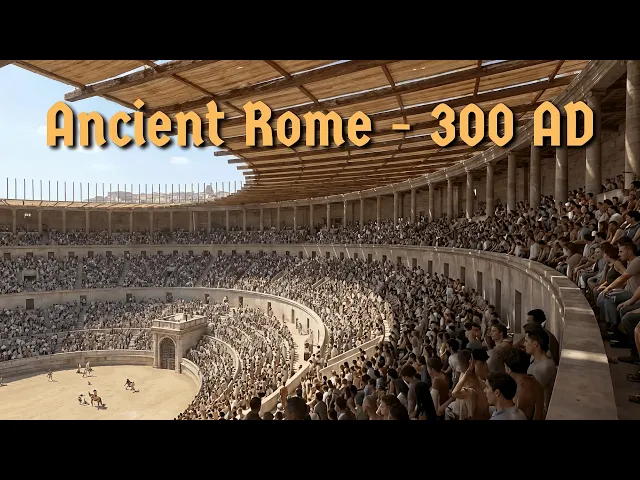
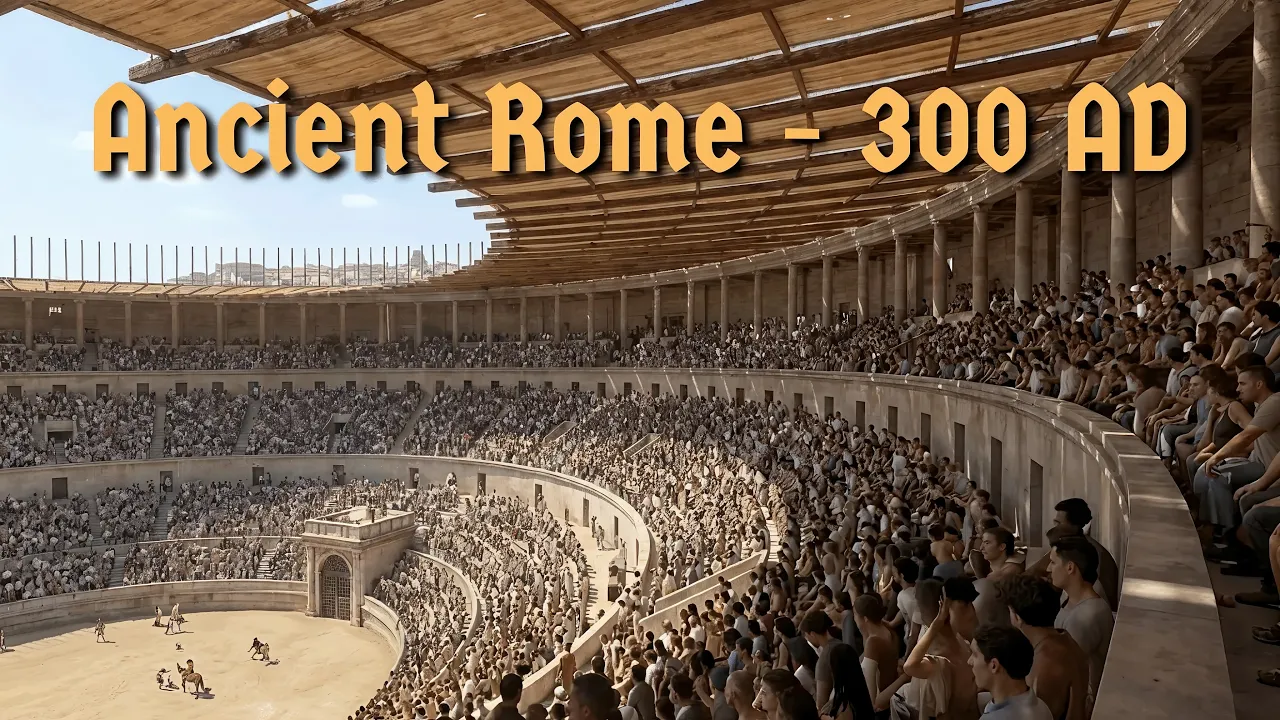
Rome. The year is 390 BC and GIC warriors have just sacked the city, burning it to the ground. Rome, barely more than a collection of villages, lies in ruins.
Most cities would never recover. But over the next few centuries, [music] the Romans transformed their destroyed settlement into the largest city on Earth. With over 1 million people, marble temples towering 10 stories high, and aqueducts carrying water.
I used modern AI tools to reconstruct [music] ancient Rome at its peak. All based on historical records and archaeology sites. We are going to move real close and talk about specific buildings and get a feel on how it was being right there.
70 million people, three continents, one empire, all controlled from here. And at its heart, the Roman Forum, the seat of power for the most powerful empire on Earth. The forum was home to dozens of temples and monuments.
But there are a few places where some of Rome's most pivotal moments happened. This is the Curia, the Senate House, where 600 senators gathered to debate [music] the laws of the empire. The building still stands today as one of the best preserved structures in the forum.
Here in the plaza in the middle stands [music] the rostra, the speaker's platform where Mark Anthony gave his famous funeral [music] speech after Julius Caesar's assassination. We don't have his exact words, but ancient sources tell us he held up Caesar's bloodstained toga and read his will aloud, revealing that Caesar had left [music] money and gardens to every Roman citizen. The speech was so powerful that the crowds cremated Caesar's body right here in the forum.
On that exact spot, Romans built the temple of Julius Caesar, [music] making him the first Roman ever to be declared a god. But perhaps the most sacred place in the entire forum was this small circular temple, [music] the temple of Vesta. Inside a flame burned continuously for over 1,000 [music] years, tended by vestal virgins.
Romans believed that if this flame ever went out, [music] the empire itself would fall. These women served for 30 years and had to remain virgins. If they [music] broke this vow meant being buried alive, but they did have privileges no other Roman women [music] possessed.
They could own property, pardon prisoners, and were among the most powerful figures in Rome until Christianity [music] ended the tradition in 394 AD. The Senate, the sacred [music] flame, the speaker's platform, and we've barely scratched the surface of what's here. This single plaza was the beating heart of the most powerful empire on Earth.
But the emperors themselves [music] lived just above on Palatine Hill. This is Palatine Hill. The emperors [music] turned the entire hill into their personal palace complex.
The Domus Augusti, the house of Rome's [music] first emperor, Augustus. Compared to what came later, it was relatively modest. But this is where the imperial tradition began.
Centuries later, Emperor Demission [music] decided to think bigger, much bigger. He built the Domus Flavia, a massive ceremonial palace where he [music] held state banquetss that could seat hundreds of guests, received foreign kings in throne rooms [music] with ceilings 30 m high, and displayed Rome's wealth and power to anyone [music] important enough to be invited. Right next to it stood the Disus Augustinana, his actual private [music] residence.
This was where the emperor and his family lived [laughter] with bedrooms, private baths, gardens, and [music] courtyards that guests never saw. So the mission essentially [music] had two palaces sitting side by side, one for show, one for living. And then there was this.
His private 160 m stadium complete with seating for the imperial family and their closest friends. The emperor could watch chariot races, athletic competitions, and gladatorial combat without ever leaving home. The Circus Maximus, seating over 150,000 people, was literally right down the hill.
But apparently that wasn't enough. He needed his own. Now while Demission watched races in his own backyard palace down below, the real action was happening.
The Circus Maximus, the largest stadium in the ancient world. Over 150,000 Romans would pack inside to watch chariot racing, the most dangerous and obsessive sport in the empire. Drvers raced at speeds of up to 75 kmh, crashing into each other in wrecks so violent they were called shipwrecks.
Charioters tied rains around their waists so if they crashed they'd be dragged to death. But if they survived they became insanely wealthy. One famous driver earned enough in his career to feed the entire city of Rome for a year.
And the fans just as intense. Romans were divided into four racing factions. Blues, greens, reds, and whites.
And their loyalty was so extreme that riots would break out in the stands, sometimes killing thousands. This wasn't just entertainment, it was obsession. But Rome's most famous surviving venue was the Colosseum.
Way smaller, merely 50,000 seats. But it survived almost 2,000 years. And the violence inside was far worse.
Because here, violence was the point, not an accident. Over 300 years, an estimated 400,000 people died in this arena. Gladiators, criminals, prisoners, and slaves.
Hundreds of thousands animals were slaughtered. Lions from Africa, bears from Germany, elephants from Egypt hunted to near extinction just to fill Roman entertainment. A typical day started with executions at dawn, followed by animal hunts at midday, then gladiators in the afternoon.
But what made it all possible was hidden beneath the arena floor. A twostory labyrinth where slaves operated 28 elevators to send animals and fighters up through trap doors. From the crowd's view, a lion would suddenly appear like magic.
Romans never saw the machinery, just the spectacle. During the 100 day opening games alone, 5,000 animals were killed. This went on for centuries.
So that was Roman entertainment, [music] blood, speed, and spectacle like the world had never seen. And when they weren't watching people die, Romans were also deeply religious, building magnificent temples [music] throughout the city. Most temples were dedicated to a single god.
But the pantheon was different. In this case, [music] some details in the reconstruction are educated guesses. The bronze fittings and decorative elements were stripped away long ago.
This temple was built to honor all the gods at once, which is exactly what pantheon means, all gods. It was Emperor Hadrien's way of covering all his bases. The Pantheon is the best preserved building from ancient [music] Rome, and for good reason.
It's an engineering masterpiece. The concrete [music] dome spans 43 m across with no internal supports. just a single opening at the top called the Oculus.
Today, you can walk inside and stand beneath this same dome that Romans stood under 1,900 years ago. This design has influenced architecture for 2,000 years from Brunoleski's dome in Florence to the US capital. It became a church in 609 AD, which is the only reason it wasn't destroyed or stripped for materials like most Roman temples.
The Pantheon was impressive, but it wasn't Rome's most sacred building. That honor belonged to the temple of Jupiter, the king of the gods, perched on top of capitaline hill, one of Rome's seven hills, rising directly above the forum. Built in 509 BC, the Temple of [music] Jupiter was one of Rome's oldest and largest temples dedicated to Jupiter, Juno, and Manurva, the three most important gods.
This is where triumphal processions ended. After conquering new territory, generals [music] would climb Capital Line Hill with prisoners, treasure, and their victorious armies to make sacrifices to [music] Jupiter. For over 800 years, this temple was the spiritual heart of the empire.
Visible from across the city. But unlike the Pantheon, it didn't survive. Fires destroyed it multiple times, and today almost nothing remains.
Temples and gods gave Rome spiritual power, but the empire was really built on military might. And breaking centuries of Roman tradition that forbade troops inside the city, emperors stationed the Ptorian Guard at the Castra Ptoria, turning their bodyguards into [music] their greatest threat. The Ptorian Guard was Rome's most prestigious military unit.
around 10,000 soldiers at their peak who served as the emperor's personal bodyguards paid three times more than regular troops. Unlike other Roman legions stationed at the empire's borders, the Ptorians lived right here in Rome at the Castra Ptoria, a massive military fortress built just outside the city in 23 AD. This was highly unusual.
[music] Roman law traditionally forbade armies inside the city limits, but emperors needed protection and the Ptorian Guard provided it. >> Well, sometimes they also assassinated at least 13 emperors, overthrew dynasties, and once sold the imperial throne to the highest bidder in an auction. The Castra Ptoria had thick fortified walls, not to defend [music] against foreign enemies, but to house the most politically dangerous force in Rome.
But how could you spot a Ptorian in a crowd? The Ptorian you're seeing wears ceremonial armor for palace [music] guard duty. That red horsehair crest running side to side across the helmet [music] rather than front to back like regular soldiers immediately identified him as elite guard.
The silver scale armor and shoulder plates show superior craftsmanship and the red oval shield decorated with the scorpion stars and moons. That was the Ptorian symbol. While the ceremonial spear and decorated bronze belt with its ornate sword scabbard all marked him as part of the emperor's personal protection.
[music] But in reality their appearance varied dramatically. On campaign standard legionary gear patrolling Rome often just civilian dress. [music] At state functions this ornate version.
Context was everything. But while emperors worried about their bodyguards, ordinary Romans depended on something far more vital. The aqueducts.
Like the massive Aquacia, one of Rome's 11 major aqueducts. It stretched 69 km from mountain springs in the Ano Valley all the way to Rome. And this is what it looked like as it entered the city.
Massive stone arches rising 27 m high about as tall as a 9-story building [music] carrying water on top in a stone channel. Romans walking beneath these arches every day could look up and see one of the greatest engineering achievements of the ancient world. Casually delivering fresh water over their heads.
Engineering efficiency at its finest. The aquacia alone delivered enough to supply fresh water to hundreds of thousands of people in Rome every single day. All powered [music] by nothing but gravity and precise engineering.
Impressive. And remarkably, sections of it [music] still stand today, nearly 2,000 years later. But Rome was more than its monuments.
It was a living, breathing city of over a million people. So, where did they actually live? Picture this.
You're a regular Roman, maybe a shopkeeper or a craftsman. You wake up in an insula, a multi-story apartment building packed with families just like yours. About 90% of Romans lived in these buildings.
They stood five or six stories high, built cheaply with wood and [music] brick, and families shared single rooms in cramped, noisy [music] conditions. The higher up you lived, the cheaper your rent, but also no running water, no kitchen, and if fire broke out, you were climbing down narrow stairs in a burning building. Collapses happened so often that emperors eventually passed laws limiting how tall these buildings could be.
Every morning you'd leave your cramped apartment and head somewhere like Trajan's Market to start your day. Built into the side of a hill, this massive complex had over 150 shops and offices spread across multiple levels. Walk through the ground floor and you'd find small shops, taberni selling everything.
Imported spices from the east, fresh fish from the coast, wine, olive oil, fabrics, pottery. Head upstairs and you'd find larger warehouses and administrative offices where the real business of the empire happened. Romans worked here, >> traded here, made deals here.
The economy of an empire humming away in one massive building. After a long day, there was one place every Roman wanted to go. The public baths.
The baths of Trajan covered over 11 hectares. and could hold thousands of people at once. Bathing in Rome meant spending hours there.
You'd exercise in the gymnasium, swim in the pools, sweat in the hot rooms, then shock your system with a cold plunge. Along the way, you'd meet friends, gossip about politics, conduct business deals, maybe even grab a meal. Entry cost almost nothing, just a small coin.
So, everyone came, slaves, merchants, even senators. All those aqueducts we saw earlier. The water could end up here, heating these massive complexes, filling the pools, giving ordinary Romans a quality of life that wouldn't be matched in Europe for over [music] a thousand years.
1 million people, one city. Rome was the first to do it. And to make it work, they had to invent the modern city.
They built [music] insuli, five and six-story apartment buildings that housed 90% of the population, the world's first highrises. They built the Aqua Claudia, 69 km of stone arches [music] carrying fresh water from the mountains, 190,000 cubic meters every day. They built Trajan's market, 150 shops stacked on multiple levels.
ancient Rome's shopping mall. They built the Colosseum and Circus Maximus, stadiums that could hold over 200,000 people combined. They built the baths of Trajan, 11 hectares, where everyone from slaves to senators [music] came to bathe.
And they built it all to last. The Pantheon's concrete dome, still standing after 1,900 years, remains the largest unreinforced concrete dome ever built. Rome didn't just build a city.
They answered a question nobody else could answer. How do you make 1 million people in one city work? Fast forward 2,000 years.
New York, London, Tokyo, Shanghai. Apartment buildings, same concept as insuli. Sports stadiums, coliseum design, just bigger.
Public spaces, Roman forums and baths, just modernized. Concrete, still based on [music] their chemistry. We've evolved the technology, but the foundation that's still Rome.
Rome solved it first. We've just been building on their blueprint ever since. Thank you so much for watching.
What should I reconstruct next? Drp a comment below.