okay linear momentum look they're asking whether letter P we use for linear momentum you figured L will make sense by Louisa for something else definition of linear momentum momentum is a vector is equal to mass times velocity linear momentum is really how much moving power and object has that's what linear momentum and it depends on two things on the mass of the object and how fast the object is moving there is a story true story here there was an incident about five six years of more than that five ten years ago he's the owner of that intersection you know that six way up Harbor intersection there was a base a softball game was going on our baseball game was going on a guy was driving I'm one of those garbage trucks you know it's a heavy truck and he's going like 20 miles per hour there were two sisters in front of him he was watching the game wasn't looking he hit their car crushed their car end up killing both of them and you look at the damage of the car they were sitting in I mean the damage looks like unbelievable and people going how fast was he going it really doesn't have he doesn't have to be going that fast to cause that much damage so I'll show you with a car going at 30 miles per hour how much power does it have how much damage can it do so if a car has a mass let's say twelve hundred kilogram this is small car going at 20 miles per hour let's see how much moving power does it have what is linear momentum the linear momentum of that car is the mass of the Claire which is 1200 and now I need to convert that velocity from miles per hour to meters per second we divide by what 2. 2 4 so 20 divided by 2 point 2 4 and that's eight point nine meters per second so times eight point nine years per second and the result is when 0 7 & 4 serve every 10700 the unit's for that with the uniform s kilogram and with the unit for velocity meters per second so kilogram times meters per second that's the unit for linear momentum that's how much power that car has with it moving power now replace that with the garbage truck I was talking about if it's loaded here there's a truck and if it's loaded probably weighs about I don't know let's say fifteen hundred kilogram fifteen thousand kilogram they've been collecting garbage all day long and let's say it's moving at speed of 20 miles per hour - and again the 20 miles per hour is 8. 9 so how much linear momentum that truck will have is going to be 15 thousand times 8.
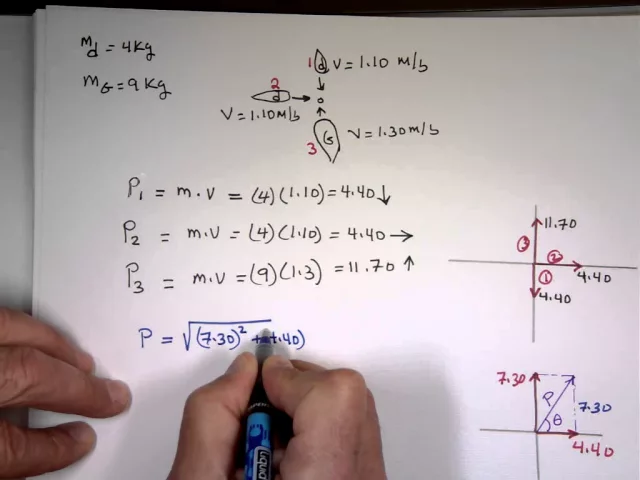
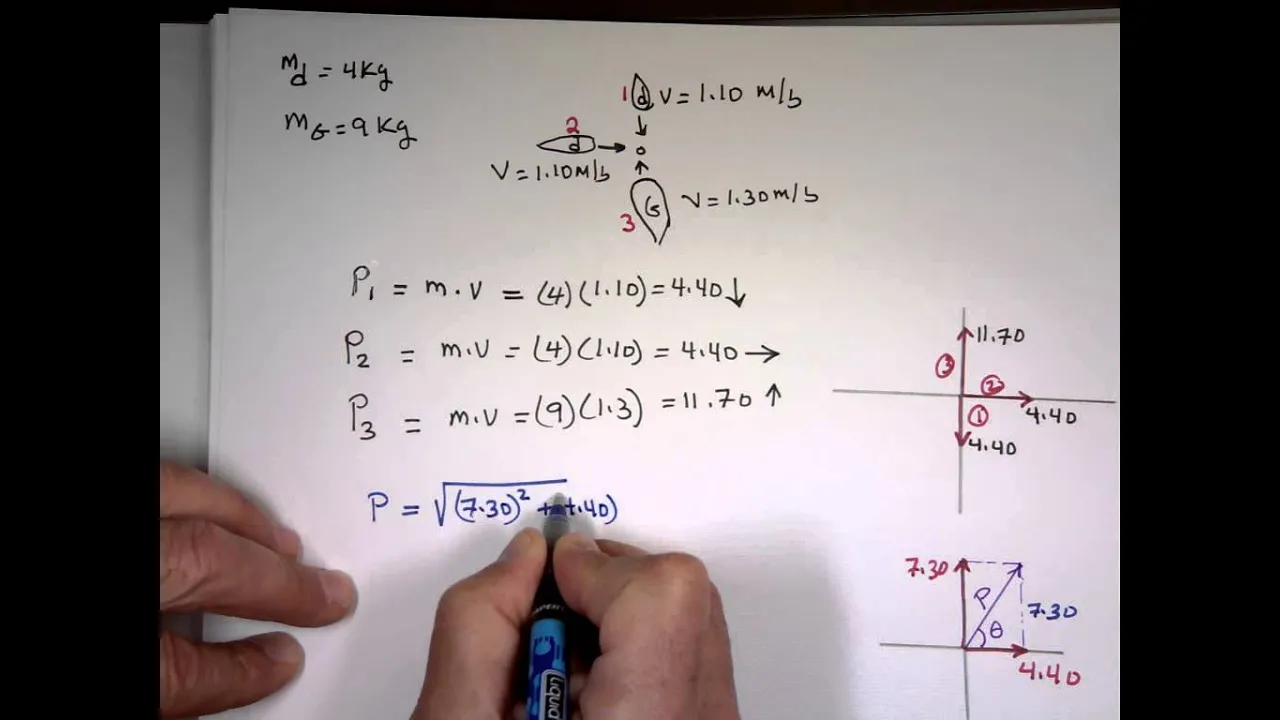
9 it's a praxis so this number is approximately ten thousand seven hundred of vk3 decimal place or three significant digit three significant digit this will be with one three four zero zero zero 134 thousand kilogram meter per second now let me rephrase the question because people couldn't believe the damage actually their car had so how fast the top car must move to produce the same linear momentum as a truck we talked about the cat on the top there how fast does that kinda have to move to generate that much linear momentum because they'll give an idea why the damage is so bad there when you see the speed 8. 9 yep it's 20 I convert that I've divided about two point two forty eight point nine three I think so let's see one the twelve hundred kilogram car to move in what speed times V to generate a linear momentum of one three four zero zero zero so the velocity of the car will have to be what one hundred thirty-four thousand divided by twelve hundred the car has to be going at a speed of roughly ready for this number one thousand one hundred and twelve meters per second multiply that by two point two four it has to be going approximately 225 miles per hour imagine if you stopped of the light and a car came from behind that 225 miles per hour or 250 I'm sorry not 225 250 a cloud came in at 250 miles per hour hit you from behind imagine the damage that's what that truck has for moving power so it doesn't have to be going that fast to cause that much damage when people saw the damage like oh my goodness look at the car he must have been flying no you look at the weight of that you had a different number what are you good that's 20 miles per hour to convert to meters per second yeah 20 divided by 2 point 2 4 to change it to meters per second 8. 9 3 roughly yeah 1200 yeah because that's the mass of the car right yeah what is that number different 1 3 4 0 0 0 let me just tell multiply now yep because you get meters per second 2 miles per hours right this 4 miles per hours 2 meters you divide from meters to miles you multiply yep so the car actually this truck caused much damage as a car like a normal car going 250 miles per hour yep I'm doing that was a big event that would that happen that incident there that was a big thing everyone have to hang that person like he must been speeding to cause that much damage he must be going 80 miles an hour no people doesn't have to be going down much faster that's how happy that Lord is so when you see these 18-wheelers coming your way at 50 miles per hour you can't really play games with them or a tray and sometimes you watch a train hitting a car get stuck on the track the train will hit it that car is gone like nothing a matchbox because that train is going at good speed go back to Leni 11 these players that hit the towers look how fast they go in 450 miles per hour look at the mass of that plane the power of that is bigger than any bomb will probably have in the US with the exception of nuclear weapons that's how much damage in them the same as the cars to create the same damage yep yeah because why because the truck knows 15,000 kilogram emitter which is about 10 times out of 10 of these more than temp these cars 12 of these cars much much heavier of course if it's much heavier it's like taking that number now multiply by 12 that speed you know this actually aggravates me with sports because you see that sometimes I know our fall football I'm sure some of you do that roughing the kicker or roughing the passer well when somebody's was about 280 pounds jumps in the air and one attack called Tom Brady he can't just stop if you just put your knees to stop you just shattered your knees because you got that much moving power they're not small they're big people and they go in a good speed they go in 10 meters per second 10 to 12 miles per hour running a good speed and they're you know 300 pounds 350 pounds they can just stop because of that equation momentum your momentum is going to carry you and sometimes they're doing tension but 9 out of 10 times already can't help it you cannot stop you can't change directions again YP I'm not sure maybe because pile move and power I don't know but we use the letter P for linear momentum we use L down the road because you went well we didn't we used earlier will you you'll see that coming up next we use it for something else okay let's try amiably another example here here's the example it says at a city park a person throws some bread into a duck pond who to four kilogram ducks and nine kilogram goose Oh pal rapidly toward the bread the ether so we have two ducks and one goose here we go this is a duck I just played d4 duck I can we throw there is another deck dealer swimming and I let chubby goose there g4 goose the bread is right here so this one's going this way this one's going this way this one's going that way remember they doesn't mentioned I'll just put it there well then your momentum is actually a vector which means what the direction of that vector is going to be the same directions the velocity so if the car is going to the right the linear momentum will be going to the right it's the same direction so these three animals here the two ducks and then one goose they're paddling toward the bread there now if the duck swims is the velocity of each duck of a speed of 1 point 2 1 0 meters per second this deck also has the same speed one point 1 0 meters per second and the goose can swim at one point three meters per second faster find the magnitude and direction of the total momentum of the three birds what is the magnitude and direction of the net momentum the total momentum this liberal view says that the first one is number one this is number two and the goose is number three now let's see what will happen what is the net result this is what we did while ago in the lab or in the homework vector addition duck number one it's moving to that down right so it's gonna have a linear momentum which way then we'll calculate what that is duck that's number one year that number two is going which way to the right it's gonna have a linear momentum to the right and the goose as number two here is going upward North is gonna have a linear momentum going in that direction and once we know what the three values are we can do vector addition to see what the net result is number linear momentum is a vector so Dec one will call d1 duck one has a linear momentum mass times the velocity do we know what the mass of each duck somewhere the mass is given it's gonna hunt it down and the goose is what nine the deck is the mass of the duck is four kilogram and the mass of the goose is nine kilogram so let's look at that number one is going to have a linear momentum again it's coming down it's called p1 then your momentum for that one p1 for that coin you know one is attack so the linear momentum for that number one is the mass of the deck which is four times the velocity which is one point one zero and that's what four point four and it's pointing down so this will have a value of four point four zero down duck number two it has linear momentum mass times velocity is the same thing four times one point one zero that's four point four zero which way to the right and linear momentum for girls number one or two the third animal it's the mass of it times the velocity of the mass is nine the velocity is one point three is it eleven point seven so now if I find the result to find the result what do we have we have basically two vectors the net result and we'll find the equivalent of them we got four point four to the way there's nothing is going to cancel that there is nothing to there left to cancel that that we have eleven point seven up and four point four down eleven point seven minus the four point four cause in opposite direction the net result is wet it is seven point three so notice our resulting vector is going to be which quadrant X is positive Y is positive which quadrants that quadrant one so the resulting vector is going to be in that direction that's the value of it this is P the net result and this is the angle theta they're asking for both what is the value of the net vector the linear momentum in what's the direction of it so to find P this one since you know the X in the way this is 7.
30 this is 4. 4 it is the square root of seven point three zero squared plus four point four squared the result is we take the square root of that eight point five two or eight again kilogram Newton and in meters per second nine Newton meters per second kilogram meters per second units fourth masses kilogram velocities meters per second say that you're in the first quadrant there's no adjustment needed the inverse tangent of the right value over the x value roughly 59-58 point fifty eight point nine degrees that's what the net result is so if that bread somehow when they got to hit it if each one like touch with their beak and they hit it that bread should go in that direction all three of them have that bump there it should go in that direction I'm gonna combine color sections together because I'm not just going to make a video for linear momentum so maybe I'll add to it momentum and Newton's second law so IV sections 91 and 92 you know I want to keep individual videos for each one and then 10 and Newton's second law if you remember Newton's second law says the net force equals mass times acceleration okay how do you find acceleration what's acceleration is an acceleration change in velocity over change in time sokka's a change in velocity divided by time what is change in velocity means to you isn't that V final minus V initial / time and if you multiply it by M that'd be M times V final minus M times V initial divided by T can't it is m / 120 must by a fraction the top times the top the bottom times the bottom now we just said linear momentum P equals with mass times velocity so this is mass times velocity see it and that's mass times velocity that this is the found velocity so if I do that substitution that's really my final when your momentum and this is what my initial linear momentum and what is final minus initial is another change and linear momentum so that's the equation I was trying to derive is the change in linear momentum divided by time now where we use that take baseball look at the Red Sox this thing I know on one video saying that well this year they do stink and I'm a big fan of them but they're pathetic so let's watch and see what happens a picture will say the bill that calls we throw the ball at a batter then this is the bat here so the ball is coming at the bat at a speed velocity on enough have many miles per hour the bat hits the bill and the bill now goes backward now in this direction at a speed velocity of let's see let's assume the velocity is that on a 105 miles per hour usually the contact time between the baseball and the bed is really short is less than like one hundredth of a second so sir the contact time T where the boat the bill was making contact with that that is point zero zero five second very quick time question yes the initial velocity or is it the velocity when the bat well that's the when the ball hits the bat yep when it hits the bet it's coming and right before his and it leaves in that direction 105 sir the best left you're looking at it like this the bet you throw an error the ball coming in this way of 90 miles per hour and you throw in one value of 105 miles per hour yep now that force between the bad weather if you watch this in slow motion this what happens I just started sure the ball comes in there's no force so it's not making contact with the bet nothing nothing nothing nothing nothing nothing nothing then it touches the bat once it touches the bat that ball had to push on the bat the bat bends a little bit like in golf the same thing then it will stop and will go forward and it will go backward in that direction so if you watching elated that force between the ball and the bat if you monitoring that it will look like this zero zero zero torque touches the bat once it touches the best at to rise to increase to a certain value then start to decrease then spec to zero once the ball leaves the bat that's if you watch on slow motion if you actually watch the ball you'll see the ball kind of self wrapped itself on the bat like it bends a little bit it's like a rubber there it bends it on the BET then it goes forward we might have a picture of that here yep can you see that picture you know can it bends around that one you know when you have that impact that time is really short usually about like one second one millisecond like one hundred thousandth of a second millisecond so what is the average force now what we're looking for the average force when I say the average force I'm looking for a high - your whip number constant force that if I take the width times the height here if I'm not like this height better with will give me the same area as this if you had Kepler the correct value that's what I'm looking for what is that height what's this force what's the height of it average force that will give me just say I'm looking circular this is where the stead of the impact that's the end of it so if I'm not there the width times the height are there an area I want to find out whether that hard I'll give me the same effect as Katla in that area the same result where we got the mutant second law which says the net force equals the change in linear momentum over time which is mass times V final minus mass times V initial divided by team so let's look at the mass here the baseball usually has a mass forgot exactly the mass of a baseball but it's about as see if we can google that look for it baseball mass 145 grams the mass of a baseball is roughly 145 grams so let's see what the momentum is the final velocity we're nervous is gone to the left the the force now indicate which direction when you hit in the ball you're pushing it to the left so my force should be going to the left that's where the bats I'm swinging the bat that's why the ball is going to the left so my value is going to be negative to indicate which way it's going to the left so it's going to be the mass which is 0. 14 five times the final velocity the phone the last is 105 if I change that to meters per second that's miles per hour u divided by 2.
2 for its forty six point nine there will be a negative forty six point nine negative which way is it going to the left right minus the mass which is 0. 14 five times the velocity initial velocity which is to the right that's positive right what is ninety divided by two point two four thirty point two all of that divided by the time it took which is point zero zero five second so the average force of impact the average force of impact during that time is going to be I came up with 25 26 Newton if I did the math correctly negative and negative to indicate you are going to the left so during that time the bat has an impact which is we know that's not the cases that's slower than it goes to a maximum value so does get higher than that value does get lower than that but as an average value during that time has an average value of two thousand five hundred and twenty-six Newton during that impact now let me look at that equation here again one more time the average force we served equals to a change in linear momentum divided by T now I don't like fractions to get rid of that T in the bottom what can I do multiply by what T so the average force times the time equals the change of linear momentum or the average force times the time equals the change in momentum that's M V final minus MV initial in physics this has a name this one we call that impulse so if you do on the homework and you hear the word impulse we use I for impulse it is equal to the average force times the time which happens to equal to this one to mass times velocity or change in potential energy but that's we call that the impulse we you might see a homework assignment says find the impulse so you can either use this or you can use that one either one let's draw a couple more examples then we'll stop here and go to the lab I'm doing like about three sections here together let's take another example let's see what we have who told you my book is it coming apart now - right jumping for Joey how's that mm-hmm today is 60% of the courses then you're jumping for Joey let's see what happened after winning a prize on a game show we ever can test in here seventy-two kilogram gets really excited jumps for joy jumps up in there by one he says if the jump results in this is part a if the jump so he jumps upward up there if it jump results in an upward speed of 2. 1 m/s what is the impulse notice dimples that's the first question but be here before the jump the floor at you is pushing upward the floor exerts an upward force that's what you're standing here Everett how big before is do you think when you're standing on it no I think again not a number you're standing on the floor are the normal force so if you're standing on the floor what do you have you have what pushing down your way down which is mg that means the floor is pushing up on you the value of mg Jimbo yep so if the floor pushes up of mg on the contestant here we go what additional there we go mr.
McDonald was my teacher in 1978 what additional average force does the floor exert on the contestant because to jump you gotta bend down push hard does the floor on the contestant if he pushes down the contestant here pushing down on the floor for 0. 3 seconds before he jumps tired of writing too much stuff there let's begin with the first one the first one's days of the 2 questions to look at first if he jumps because there you're the winner the jump result an upward speed of 2. 1 m/s what is the impulse well initially when the contestant was on the ground what was his initial speed zero so impulse you can calculate impulse two ways you can take the average force times the time in Part A we have no idea what the time or the average force you know will you know the time here let's part be out and get to it has nothing to do with it or you can says the change of linear momentum you can use either one I might want to use this when the change of linear momentum which is with the mass times V final minus the mass times V initial well the mass of the person is with 72 Willis's found velocity gentlemen and partner says he jumped with a speed of wit to 0.
1 minus the mass which is 72 those initial velocity 0 that tells me what my impulses 72 times 2. 1 which is approximately rounding to the significant digit 150 kilogram meters per second and if you are indicate which direction is which way upward so in the y-direction I can write up for the y-direction you know so that's part a well how do we calculate with the average forces hmm well let's look at that equation so this is in this equation says with impulse equals the average force times time do you know what their impulses which is wit 150 do we know what the average forces we're looking for it do we know what the time is which is with 0.