Scribe
Scribe

Нравится? Сделайте Scribe еще лучше оставив отзыв

Получить расширение Chrome

Обзор

  • Популярные Видео
  • Недавние Видео
  • Все Каналы

Бесплатные Инструменты

  • Загрузчик Субтитров Видео
  • Генератор Временных Меток Видео
  • Генератор Резюме Видео
  • Счётчик Слов Видео
  • Анализатор Заголовков Видео
  • Поиск по Транскрипциям Видео
  • Аналитика Видео
  • Создатель Глав Видео
  • Генератор Викторин Видео
  • Чат с Видео

Продукт

  • Цены
  • Блог
  • Получить расширение Chrome

Developers

  • Transcript API
  • API Documentation

Правовая информация

  • Условия
  • Конфиденциальность
  • Поддержка
  • Карта сайта

Авторское право © 2026. Сделано с ♥ Scribe

— Если мы сделали вашу жизнь проще (или хотя бы немного менее хаотичной), оставьте нам отзыв! Обещаем, это сделает наш день. 😊

Related Videos

Aging and cognitive abilities | Processing the Environment | MCAT | Khan Academy

Video thumbnail
149.87k472 Слов2m readGrade 11
Поделиться
Channel
khanacademymedicine
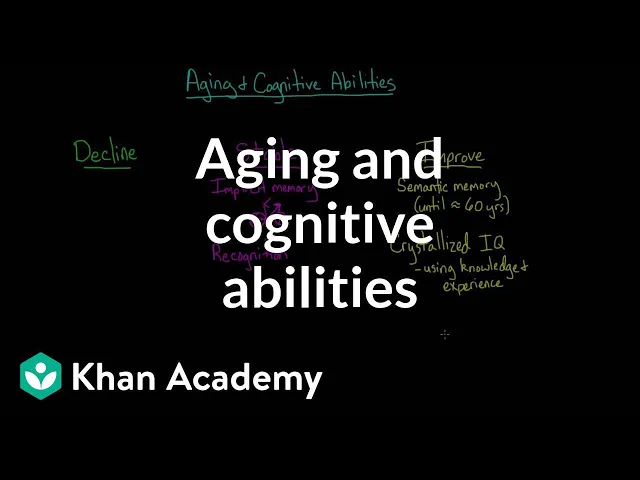
Aging is a natural process, and with it come changes in memory. Most people associate aging with declines in cognitive performance. My mom will say she's having a senior moment when she forgets something, for example.
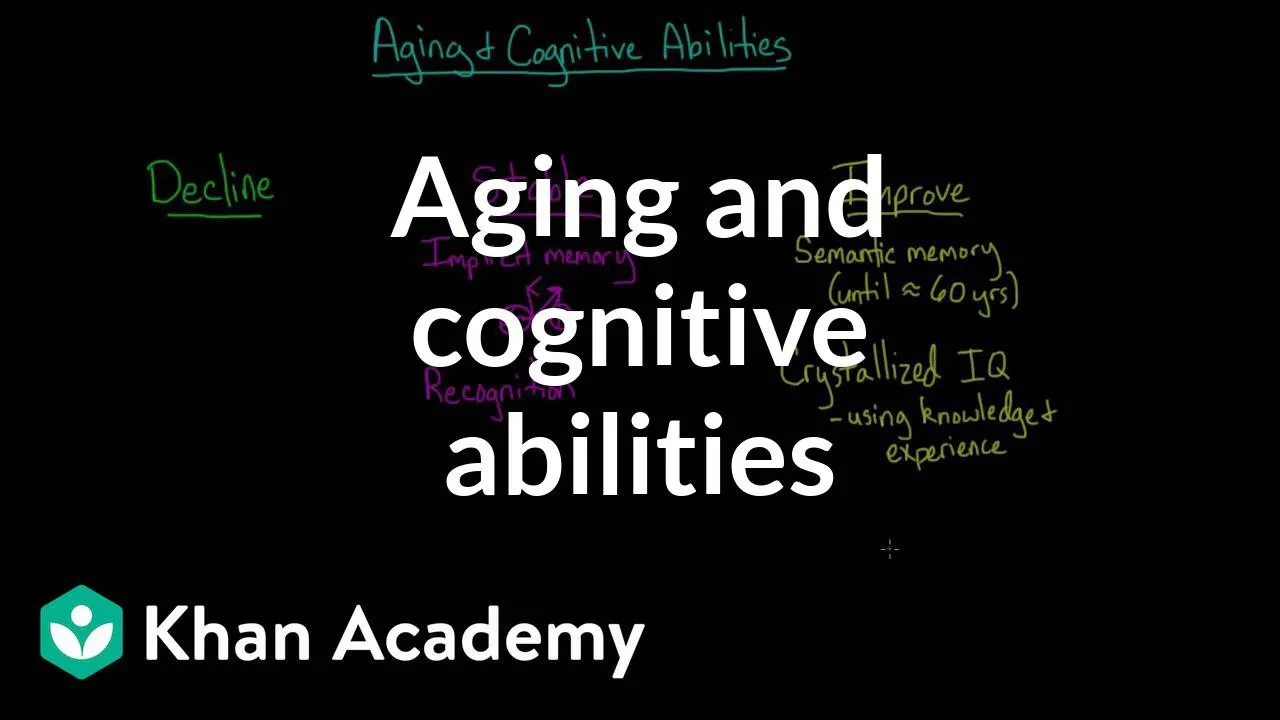
But never fear. Not all cognitive changes in adulthood are negative. Some abilities remain relatively stable and some even improve.
So let's start with a positive, abilities that remain stable. First of all, implicit memory stays about the same across the lifespan. In other words, once you've learned to ride a bike that procedural memory is likely to stay with you as you age, barring any brain damage or disease.
Recognition memory also stays relatively stable over time, meaning that once you learned something your ability to pick it out of a list later remains about the same whether you're 27 or 67. Now for abilities that improve. Semantic memory improves until around age 60 and only then starts declining.
This means that older adults still have good verbal skills and why they make excellent crossword puzzle buddies. A related area in which older adults tend to score better than younger adults is crystallized intelligence, which involves the ability to use knowledge and experience. Since older adults have had more time to gain knowledge and experience, this pattern make sense.
And crystallized intelligence is often tested with reading comprehension and analogy tests, so older adults tend to be better at those than younger adults. Finally, older adults tend to be better at reasoning in the face of interpersonal or emotionally-charged problems. Again, the theory is that with their greater experience and knowledge of these types of situations, they are more likely to have been through some similar situation and be able to draw from that experience.
Of course, there are some cognitive abilities that decline as we age. Recall becomes more difficult. Although recognition is stable, it's harder for older adults than younger adults to generate responses without cues, like there are in a free recall or sometimes cued recall task.
Similarly, episodic memory is impaired. Often memories formed a long time ago will be relatively stable, but forming new episodic memories becomes more difficult as we age. Processing speed slows down as we age, So if you're watching jeopardy with Grandma, she might know just as many answers as you do, if not more, but she'll have a harder time outputting the response within such a short period of time.
Related to processing speed, divided attention becomes more difficult. As we age it becomes increasingly harder to effectively switch our attention between tasks, so we become more easily distracted. The bottom line is that cognitive changes in adulthood aren't all negative.
Although some cognitive abilities do decline, it's important to remember that in healthy older adults some cognitive abilities will remain stable or even improve.
Похожие видео
Intelligence | Processing the Environment | MCAT | Khan Academy
7:58
Intelligence | Processing the Environment ...
khanacademymedicine
166,363 views
Encoding strategies | Processing the Environment | MCAT | Khan Academy
8:39
Encoding strategies | Processing the Envir...
khanacademymedicine
229,555 views
Information processing model: Sensory, working, and long term memory | MCAT | Khan Academy
7:34
Information processing model: Sensory, wor...
khanacademymedicine
841,965 views
Problem solving | Processing the Environment | MCAT | Khan Academy
5:51
Problem solving | Processing the Environme...
khanacademymedicine
182,719 views
Piaget's stages of cognitive development | Processing the Environment | MCAT | Khan Academy
5:52
Piaget's stages of cognitive development |...
khanacademymedicine
1,843,610 views
Emotions: limbic system | Processing the Environment | MCAT | Khan Academy
10:32
Emotions: limbic system | Processing the E...
khanacademymedicine
1,228,964 views
Sleep stages and circadian rhythms | Processing the Environment | MCAT | Khan Academy
7:57
Sleep stages and circadian rhythms | Proce...
khanacademymedicine
726,290 views
Theories of Emotion | Processing the Environment | MCAT | Khan Academy
8:14
Theories of Emotion | Processing the Envir...
khanacademymedicine
358,268 views
Theories of intelligence | Processing the Environment | MCAT | Khan Academy
7:11
Theories of intelligence | Processing the ...
khanacademymedicine
332,516 views
Decay and interference | Processing the Environment | MCAT | Khan Academy
4:33
Decay and interference | Processing the En...
khanacademymedicine
99,785 views
Alzheimer's disease and Korsakoff's syndrome | Processing the Environment | MCAT | Khan Academy
3:50
Alzheimer's disease and Korsakoff's syndro...
khanacademymedicine
87,078 views
Decision making | Processing the Environment | MCAT | Khan Academy
6:34
Decision making | Processing the Environme...
khanacademymedicine
199,286 views
Theories of selective attention | Processing the Environment | MCAT | Khan Academy
5:00
Theories of selective attention | Processi...
khanacademymedicine
299,617 views
Schemas, assimilation, and accommodation | Processing the Environment | MCAT | Khan Academy
5:24
Schemas, assimilation, and accommodation |...
khanacademymedicine
250,977 views
Retrieval: Free recall, cued recall, and recognition | MCAT | Khan Academy
4:25
Retrieval: Free recall, cued recall, and r...
khanacademymedicine
98,040 views
Retrieval cues | Processing the Environment | MCAT | Khan Academy
4:38
Retrieval cues | Processing the Environmen...
khanacademymedicine
108,001 views
Semantic networks and spreading activation | Processing the Environment | MCAT | Khan Academy
3:39
Semantic networks and spreading activation...
khanacademymedicine
129,976 views
Erikson's psychosocial development | Individuals and Society | MCAT | Khan Academy
14:43
Erikson's psychosocial development | Indiv...
khanacademymedicine
1,252,517 views
Memory reconstruction, source monitoring, and emotional memories | Khan Academy
4:47
Memory reconstruction, source monitoring, ...
khanacademymedicine
101,673 views
Worked example: Living in a rational society | MCAT | Khan Academy
19:32
Worked example: Living in a rational socie...
khanacademymedicine
94,647 views