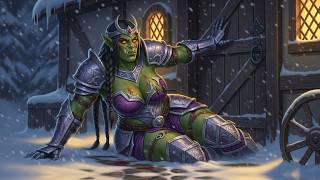
The blood on the kitchen floor was yelkers. It was usually yelkers. She pressed her palm flat against the stone, watching it pull between her fingers.
Dark green, almost black in the fire light, the color that orc blood turns when it meets cold air. The cut on her temple was shallow but messy. Head wounds always were.
Grener had caught her with the back of a ladle this time. Copper ladle, heavy handle swung with the casual precision of a woman who'd had 20 years of practice. "You think I can't hear it?
" Grener said from the table. She hadn't moved from her chair. She never needed to chase.
The house was small enough that everything was within arms reach. That humming. You do it in your sleep.
You do it when you cook. You do it when you breathe and it makes my teeth itch. I wasn't humming, mama.
Your throat was moving. Yelka touched her throat. It was possible.
The vibration that lived inside her didn't always ask permission. It leaked out in micro tremors of her vocal cords. A resonance so low that most people couldn't detect it.
Grena wasn't most people. Greta had spent two decades sharpening her senses specifically for the purpose of catching Yelka doing something wrong. Your father made that sound.
Grener poured herself another cup from the bottle that never seemed to empty, only refill. Right before he walked into the deep mines and didn't come back, he said the rocks were singing to him. You know what was really singing?
The gas. The fire damp. It sang him right into a collapse.
Yela mopped blood with the hem of her dress. She didn't argue. Arguing extended the event.
The forgemaster asked about you today, Krena said. Wanted to know if your ears could tell bad or from good. I told him you were sick.
Why? Because if they find out what you can do, they'll use you. And if they use you, they'll take you from me.
And then who cooks? Who cleans? Who carries the water from the well because my back can't take the hill anymore?
There it was. The geometry of Grena's love. A shape built entirely from need with no room inside it for the person being needed.
Go to bed, Grena said. And if I hear that hum one more time tonight, I'll find something heavier than a ladle. Yelka's room was a closet behind the kitchen.
No window, no door, just a curtain that Grena could push aside at any hour. She lay on the straw mat and pressed her ear to the stone floor and listened to the mountain underneath. The deep, slow pulse of magma moving through channels carved over millennia.
It was the only music Grena couldn't take from her. Tonight, the mountain sounded restless, a low vibration she'd never felt before. not dangerous, but urgent, like a massive animal shifting in its sleep.
Yelka lay in the dark and thought about the forgem's question. She thought about the fact that her ability, the thing Grener called a disease, had a name somewhere, had value somewhere. She thought about the ladle and the belt, and the time Grener had cracked her wrist against the table edge, and it had healed crooked.
She thought about 20 more years of this, 40, a lifetime of someone else's kitchen floor with her blood on it. At some point between midnight and dawn, thinking turned into deciding. She moved without planning because planning would have given her time to stop.
Boots oversized inherited from Grener. The obsidian comb her father had carved the scrap of leather with his tuning fork drawing. Grener was asleep in the chair, bottle empty on the floor.
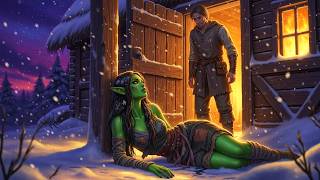
Yelka opened the front door. The cold hit her like a wall of glass. Gorath's thermal ring kept the village warm, but 300 steps past the last house, the mountain became what mountains are.
indifferent and lethal to the underdressed, she walked north because north was the direction Grena never let her look. Past the forge, past the well, past the last house. Then she was outside GTH, and the world opened up.
The sky was choked with stars, more than she'd known existed. The wind carried ice and sulfur and pine sap from the forests below. The path was a series of cans placed by trappers, stacked stones barely visible in starlight.
Two hours in, the cold stopped being uncomfortable and started being structural. It turned her fingers to wood, her feet to stone, her thoughts into short sentences that snapped before finishing. She stopped, not by choice, her legs simply quit.
She sat on a flat rock, pulled her knees to her chest, and felt the warmth leaving her body like water from a cracked vessel. She closed her eyes. A sound woke her, metal on stone, the rhythmic clink of a hammer tapping a chisel.
Then a voice, human, talking to itself. 17° off center. Compensate left.
No, too much. She was alive, which surprised her. She'd collapsed next to a volcanic vent by accident.
The mountains indifference had saved her life through geography. Below the ridge, a human man worked at the base of a rock face. A small portable forge, a bellows, mineral samples.
His movements were precise but strange. A stutter in them, a rhythmic interruption. His hands were shaking.
He worked around the tremor the way water works around a rock. His tools were arranged on a leather roll, and he reached for each without looking. He was small, compact, weathered, dark hair threaded with gray.
His leather apron was scarred with burn marks. Then her foot dislodged a pebble. It clattered down the slope.
The man spun fast, surprisingly fast. His chisel raised in a grip that said he knew what tools could do to flesh. His brown eyes locked onto her, then widened.
He saw an orc girl, young, half frozen, bleeding from the temple, wearing a dress designed for July. She saw the chisel slowly lower, the calculation behind his eyes, not hostile, but careful. He stood there for four full seconds.
She counted. Then he picked up his canteen, climbed the slope, and held it out to her. His hand shook.
Water sloshed inside the metal. Drnk, he said. I don't need help.
You need a lot of help. Start with the water. I'm fine.
You're hypothermic. Your lips are gray. Drnk the water or I pour it on your head.
Either way, the water is getting involved. She drank. The water was warm.
He'd kept the canteen near his forge. It hit her stomach like a small sun. I'm Edric, he said.
He didn't extend a hand. His hands were occupied with shaking. There's a cave system about 200 yd down that trail.
I've been sleeping there. It's warm. Volcanic vents run underneath it.
You can stay long enough to get your temperature up. And then he looked at her the way you look at a question you're not ready to answer. And then you decide.
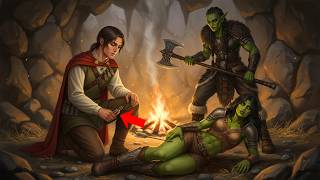
The cave was larger than expected. A natural chamber warmed by volcanic vents. Edric had turned it into a workshop, bed roll, portable anvil, tool rack, crates of metal samples organized with obsessive precision.
He made tea, real tea, not bark water, and set a cup on the floor next to her. He sat on the opposite side of the cave, as far from her as the space allowed. That cut on your head.
It's not from a fall. I didn't say it was lately. Curved edge, blunt force, slightly off center.
I've seen the mark before. He sipped his tea. What I haven't seen is an orc girl on a mountain at 3:00 in the morning in house clothes.
I wasn't running. I was leaving. There's a difference.
Running means you plan to stop somewhere. Leaving means you just need to not be where you were. He didn't push.
He sat with his shaking hands around his tea and let the silence fill the cave until it became something Yela could breathe inside. She fell asleep sitting up. When she woke hours later, Edric was at his anvil tapping at something small.
The sound was irregular but persistent, like a heart with an arhythmia that refuses to quit. She watched him work. His hands betrayed him every few strikes, a wobble, a drift, a micro tremor that sent the hammer a fraction off target.
Each time he'd pause, breathe, and adjust. The piece he was working on was small. A hinge, simple hardware, not art.
But Yelka could hear the metal. The hinge wasn't just a hinge. The iron Edric was using had a grain structure that was crying out, misaligned from a previous heating.
The carbon distributed unevenly, the whole piece singing a discordant note that made her mers ache. "It's going to crack," she said. Edric stopped, turned.
"What? The iron, the grain is wrong. There's a stress line running from the left fold to the center.
If you strike there again, it'll split. He looked at the hinge, turned it over, ran his thumb along the surface, and found nothing. His hands were too unsteady for the fine tactile work that would reveal a floor that small.
How do you know that? The old reflex deflect, minimize, disappear. I just I can hear it.
The metal when it's heated or stressed, it makes a sound, a frequency. I can, she stopped. Greta's voice filled her head.
Don't tell anyone. They'll think you're broken. They'll burn you.
Edric set down his hammer. He picked up the hinge, walked to the cave entrance where the light was better, and examined it with a magnifying lens he pulled from his apron pocket. There's a hairline fracture, he said quietly.
Left side, running towards center, exactly where you said. How long have you been able to do this? Always, and nobody knows.
My mother knows. She says it's a defect. Edric looked at the hinge, then at her, then at his own shaking hands.
I know something about defects, he said. Stay another night. I want to show you something in the morning.
Yala sat in the dark after Edric had gone to sleep. The cave was warm, the tea was in her stomach, and nobody had hit her for 12 hours. A personal record for any day that didn't involve Grener passing out early.
She should go back. The thought arrived with the weight of a stone dropped into still water. She should go back.
Grener would be awake by now. Grener would be furious. But furious Grener was a known quantity.
A weather system Yelka had survived for 20 years. This cave, this shaking human, this uncertain future, that was an unknown, and unknowns killed orc girls on mountains. She stood up quietly.
She pulled on her boots and moved toward the cave entrance. The night air hit her, and she stopped. Below, far below, she could see the glow of Gorath's forges, orange pin pricks in the dark slope, warm and familiar, and shaped exactly like a trap.
She knew every corner of that house. She knew which floorboard creaked before Grener's arm swung. She knew how to hold her head, so the ladle hit skull instead of temple, because skull hurt less.
She knew the geometry of survival inside that cage. But she also knew, standing on the cold mountain with the stars pressing down like witnesses, that survival and living were not the same word. She went back into the cave.
She lay down. She didn't sleep, but she stayed. In the morning, Edric was already at the forge.
He looked at her, and something in his expression told her he knew exactly what she'd done in the night. He didn't mention it. "Come here," he said.
"I want to try something. " He placed a raw iron bar on the portable anvil, lit the forge pot until the coals glowed the deep orange of a sunset seen through smoke. Then he slid the bar into the heat.
"Tell me what you hear," he said. Yelka closed her eyes. The iron entered the fire, and its voice changed.
The cold, rigid hum loosened, spreading outward as the grain expanded. She could track the heat moving through the bar like a tide, warming unevenly from the outside in. The core still singing its cold, tight note, while the surface began to open.
The outside is ready. The core isn't. The grain is pulling in two directions.
When is the whole piece aligned? Wait. She listened.
The two temperatures converged. The discordant frequencies sliding toward each other like two voices finding the same pitch. Almost.
Almost. Now, Edric struck. The hammer fell clean.
The iron flattened precisely where it should, and Yelka heard the grain comply. A smooth, satisfied note like a string finding its tuning. Then his hand shook on the upswing and the second strike went wide, glancing off the edge.
The note soured. "Stop," Yelka said. "You drifted right.
" Edric examined the bar. The floor was invisible to the eye, but she could hear it. A tiny misalignment in the grain, a crack that hadn't happened yet, but would if they kept going.
"How far off? " he asked. A fingernail's width.
Maybe less. He set down the hammer, rubbed his hands together, trying to squeeze the tremor into submission. It didn't work.
It never worked. She'd watched him try this enough times to know. What if I tell you where to strike?
Yela said, not just when, but where. If I tap the exact spot on the bar, can you aim for the sound? Aim for the sound.
You can't see the grain. You can't feel it anymore. But if I tap the spot with a rod, you'll hear where to land.
Your hands shake, but your ears still work. Edric stared at her. The idea was either brilliant or absurd, and the distance between those two things was about the width of a successful hammer blow.
"Let's try," he said. She picked up a thin iron rod. Edric reheated the bar.
When the grain aligned, she tapped the rod against the precise point on the iron. A clear, bright ping that said, "Here. " Edric struck.
The hammer landed within a hair of the tap. The iron sang. She tapped again.
He struck again. Tap strike. Tap strike.
a conversation in a language that had no words, just two frequencies. Her rod and his hammer, calling and answering across the width of an anvil. The bar came out clean.
Six strikes, six perfect impacts, the grain flowing straight and true. Edric held it up. The iron caught the cave, a simple flat bar, nowhere near a blade, but structurally flawless.
His hands were trembling around it. The bar didn't move. It was too perfectly balanced to show the shaking underneath.
That hasn't happened in 3 years, Edric said quietly. They didn't name what had happened. They just did it again the next day and the next.
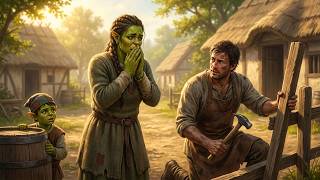
Within a week, they'd moved from the cave to the edge of Gorath, where Edric rented forge space. Yelka slept in a storage room adjoining the forge, small, but hers. "I'll put one in today," Edric said.
"On the inside. " He looked at her as if she'd asked where the water was wet. "Where else would a bolt go?
" She touched it after he'd installed it and listened to it click into place. a small definitive sound that said, "This space answers to you. " Gorath did not welcome her.
The whispers started on the third day. She heard them the way she heard everything, not just words, but frequencies. The vibration of contempt has a specific texture, like metal heated too fast and cooled too slow.
Grener's broken girl, the one who hears things, now she's hearing humans. What does a human need with an orc girl? Use your imagination.
The forge worker stopped talking when she entered. Someone moved Edric's tool rack to a different corner. A territorial violation.
Ignore them, Edric said, repositioning his tools. I'm a human on an orc mountain. I've been ignored in seven dialects.
The trick is, he picked up his hammer. Make something good enough that they have to look. Yelko was sitting on the stone wall behind the forge, eating lunch alone.
The village spread below, stone houses, smoke, the distant clang of the main forge. Nobody had spoken to her since morning except Edric. and Edrich was not what you'd call a conversationalist.
"You're in my spot," a voice said. Yelka turned. An old orc woman stood behind her, ancient spine curved like a question mark.
White hair pulled back so tight it seemed to be the only thing holding her skull together. Her amber eyes was sharp enough to cut glass. I'm sorry.
I'll move. Did I say move? I said you're in my spot.
That's an observation, not an order. There's room for two. The old woman sat down with the careful deliberation of someone whose joints had strong opinions about gravity.
She pulled a piece of dried meat from her pocket and began to chew. I'm Kela Yelka. I know who you are.
Grener's girl, the one the whole village is whispering about. Kela chewed thoughtfully. They say you hear metal.
I don't bother lying. I'm 86 years old. I've heard every lie this village has to offer, and yours wouldn't even rank.
Do you hear metal or don't you? I do. And the human?
What does he hear? Nothing. His hands won't let him.
So you're the ears and he's the hands. Something like that. Keela looked out over the village.
My husband was a smith, she said. 50 years at the central forge. When his eyes went bad, I used to stand behind him and tell him where the color changed in the iron.
He never admitted he needed me. I never admitted I liked being needed. We were very stubborn people.
She paused. He made the best blades in Gorath. She stood up.
joints cracking like green wood in a fire. The village will come around or it won't. Either way, you eat lunch in my spot tomorrow.
I get bored talking to myself. She left. She'd left half her dried meat on the wall next to Yelka.
Keela's cruelty. Yelka was beginning to suspect was just wrapping paper. On the 14th day, Edric told her about the tremor.
Not all at once, in pieces. The way he worked metal, small strikes carefully placed, building a shape. I wasn't always a traveling knife maker.
They were cleaning tools at the end of a long day. The forge was cooling. Shadows grew on the cave walls like slowmoving animals.
12 years ago, I was the royal weaponsmith of Aldenmir, the king's personal forge. She'd guessed something like this. The quality of his steel, the precision of his technique, even compromised by the tremor.
It was leagues beyond the traveling knife makers she'd seen at the market. The king commissioned a campaign sword for his general. I made the finest blade I'd ever produced.
32 folds. The grain so fine you could see your reflection in the flat. They called it the king's tooth.
His voice was steady. His hands were not. The campaign wasn't a war.
It was a butchery. Villages. Families.
The general used my blades to execute prisoners in public squares. Children watched. The forge crackled.
A coal shifted and settled. I confronted the king. He laughed.
Said a smith doesn't choose what his tools are used for. I tried to destroy the blade. Broke into the armory.
They caught me. The king ordered me to make another one. I heated the steel, raised the hammer, and he held up his hands.
They trembled in the amber light. My body refused. Not a single clean strike.
The physician said, "Nerve damage, but it only happens when I forge. Every other task," he picked up a needle from the workt and threaded it on the first attempt, hands perfectly still. Then he picked up the hammer.
The shaking returned. My hands decided before my mind did that they were done making things that kill people. But you still forge, Yelka said.
Knives, hinges, tools, small things, things that cut bread, hang doors, fix carts. My hands allow those, but anything that could be used as a weapon, anything with an edge longer than my palm. The tremor gets worse, as if they know the difference.
Yelka looked at the tool rack. Every piece on it was small, useful, harmless. A catalog of a conscience expressed in iron.
Broken things still have a voice, she said. Yours is saying not that, but this. The forge light caught the gray in his hair, the lines around his eyes, the particular weariness of a man who had been listening to his own hands say no for 12 years.
Maybe, he said, or maybe it's just saying no, and I'm too stubborn to hear it. That's not what stubbornness sounds like. I would know.
I lived with Grener for 20 years. Something happened to Edric's face. It wasn't a smile.
More like the place where a smile would live if it ever decided to move in. An opening, a space. Fair point, he said.
Grena came on a market day. Of course she did. Grener had the theatrical instincts of a woman who understood that cruelty requires an audience.
Yelka was at the forge when she heard the voice. Not the words, but the frequency. The particular pitch of Grener's vocal cords that her body recognized the way a dog recognizes the sound of the belt sliding through loops.
her shoulders hunched before her mind caught up. "There she is. " Grener stood in the market square, arms wide, voice pitched to carry.
"My daughter, the one who was stolen from me in the night by a human. She was sober. That was the dangerous part.
Drnk Grenner was imprecise. She flailed. She slurred.
She spent her fury quickly. Sober Grenner was a siege weapon. " "Stlen," Grener repeated, turning in a slow circle to collect the eyes of every merchant and passerby.
A human man took my daughter from her bed. A child and this village, our village, lets him keep her in his workshop behind a locked door. The square went quiet.
Not sympathetic quiet, calculating quiet. The whispers that had followed Yelka for two weeks were finding a new shape, hardening from gossip into grievance. Edric came out of the forge.
He stood in the doorway, hammer still in hand, and watched Grena perform. His face was empty in a way Yela had learned to recognize. Not calm, but deliberately cleared.
The way you clear a table before an operation. I didn't steal your daughter, Edric said. His voice was quiet.
The square leaned in. Then why is she here? Grener's voice cracked with manufactured grief.
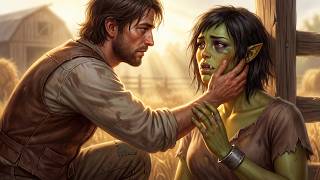
Why is she sleeping in your workshop instead of her mother's house? What have you done to her? She came to me in the night, bleeding from the head, in the cold.
That humming, it's driven her mad. She doesn't know what she wants. I'm her mother.
I know what's best for her. Grena stepped toward Yelka. Her hand reached out.
Not fast, not violent, but with the slow, certain gravity of a woman reclaiming what she owned. The same hand that had swung the ladle. The same fingers that had bent her wrist until it cracked.
Yelka stepped back. One step, small, but it drew a line on the ground that the whole square could see. Don't, Yelka said.
Yelka. Grener's voice softened. The dangerous softening.
The one that came before the worst blows. The voice that said, "I love you with the inflection of I own you. Come home.
I'll be better. I promise. " Who else is going to take care of you?
Who else understands what you are? What I am? Yelka repeated.
A defect. A disease. That's what you told me.
I was protecting you. You were keeping me. The square held its breath.
Grener's face underwent a series of rapid changes. grief, fury, calculation, and finally the expression Yelka feared most, the cold, pragmatic mask of a woman switching tactics. Grena turned to the crowd.
"I want the village council to hear this," she said, her voice steady now, stripped of performance. "A human man is keeping an orc girl in his workshop. He has no clan rights, no family claim.
He pays forge rent, but that doesn't buy the right to steal our children. I want him removed for her safety. " The word safety landed like a stone in a well because it sounded reasonable.
That was Grener's genius. She could make a cage sound like a shelter if she used the right words. Edric looked at Yelka.
He didn't speak. He didn't defend himself. He just looked at her with those steady brown eyes above his shaking hands.
And the look said, "This is your fight. I can't win it for you. You have to decide.
" She wasn't ready. Not today. Today.
The old wiring was too strong. the hunched shoulders, the lowered eyes, the voice inside her that said, "Go back. You know the geometry of that cage.
At least in the cage, you know where the walls are. Tomorrow," Grener said to the square, "Council meets tomorrow. I'll be there.
" She didn't look at Yelka. She didn't need to. The threat was planted.
It would grow overnight. Edric went back into the forge without a word. Yela stood in the square alone with the village looking at her the way you look at a problem that hasn't decided yet whether it's going to be somebody else's.
The council met at dawn in the central forge, the only space in Gorath large enough to hold an argument, and the people who wanted to watch it. Keela was there, sitting on her usual stone bench with the authority of someone who had been sitting on it longer than most of the village had been alive. Six other elders lined the wall.
Grena stood at the center, her hands folded in front of her, her face arranged in the particular mask of maternal suffering she'd rehearsed overnight. Yelka stood opposite. Edric was beside her, but a step behind, present, not leading.
His hands shook at his sides. "The charge is simple," Grena said, addressing the elders. "A human man has taken my daughter from her home.
He has no clan right. No marriage bond. He keeps her in his workshop.
She keeps herself," Edric said. "The bolt is on the inside. I'm speaking.
" "You're lying. " "There's a difference, though. I understand if the distinction is new.
" A murmur rippled through the gathered crowd. Grener's jaw tightened, but she held her composure. The question for this council, Grena continued, is whether a human with no standing in this village has the right to house an orc girl against her mother's wishes.
Not yours, mine. You're confused, child. I'm 20 years old, and I'm not confused.
I'm just not agreeing with you, and you've never learned to tell the difference. The forge went silent. Grener looked at Yelka, and for a half second, something cracked in the mask.
Not grief, not rage, but the disorientation of a woman whose weapon had just spoken back. Keela leaned forward on her bench. The girl speaks for herself.
The mother speaks for herself. I see two adults in disagreement. Where is the crime?
The forge door slammed open. Six riders, dark iron armor. The lead rider dismounted with the efficiency of a man who considered gravity a suggestion.
A scar from temple to jaw that looked earned on purpose. "Tarn, apologies for the interruption," he said in a tone that contains no apology whatsoever. "I'm here for a blade.
" Kela's expression didn't change. The Ashcrown summit isn't for another 20 days. The summit moved.
The southern clans are threatening secession. The elders at Ashkrown have called an emergency gathering. I need a ceremony blade in 4 days.
4 days. Keeler looked at Durac's empty station. The village's master had died 2 years ago, and nobody had replaced him.
The forge produced nails, tools, horseshoes, not ceremony blades. The charter says Gorath's forge provides the summit blade. Than said, "If the forge can't provide, I know what the charter says.
I was alive when it was written. " Th's eyes moved across the room and landed on Edric on his shaking hands. Then on Yelka, "I've heard rumors.
" Th said, "A human smith and an orc girl who can hear metal. Apparently, they've been producing work that makes the village smiths nervous. Is this true?
We've made practice bars," Edric said. knife blanks. Nothing the size of a ceremony blade.
Can you? She looked back. They'd never attempted a full blade.
The sequence of strikes needed was nearly a hundred, and Edric's hands had never held past 50 in practice. I don't know, Yela said. Honest, the only thing she knew how to be.
Tarn nodded. I appreciate honesty. It's rare in a forge.
He turned back to Keela. 4 days, a blade or the charter falls. He left the way he'd arrived, fast, certain, leaving a wake of disrupted air and recalculated priorities.
The council forgot about Grener. When a warlord walks into a room, domestic disputes evaporate like water on a hot anvil. The elders clustered around Keela, arguing about the charter, the timeline, the impossibility of producing a ceremony blade in 4 days from a forge that hadn't produced one in two years.
Grena stood in the middle of the room, abandoned mid accusation, her audience stolen by a larger drama. She looked at Yelka. This changes nothing, Greta said quietly.
You'll fail, and when you do, you'll come home. She walked out. Yelka watched her go and felt the old architecture tremble inside her, the walls Grena had built, the rooms she'd locked.
But the trembling was different now, less like a building shaking with fear, and more like a building shaking itself loose. Four days they worked in shifts measured not by hours but by the metal's patience. Edric selected his finest steel, the 16-fold stock, his last reserve.
Yelka sat with the raw bar for an hour before they began. Her hands flat against the cold metal, listening to its deepest structure. Mapping the grain the way a navigator maps a coastline, every ridge, every current, every hidden shell that could wreck them mid strike.
The core has a knot, she told Edric. a cluster of carbon about 3 in from the right end. If we work around it, we lose an inch of blade length.
If we work through it, we risk a fracture. Can you guide me through it? I can try.
Day one, 26 clean strikes. The blade took shape. Rough, thick, the outline of what it would become.
Yelka's taps on the rod were constant. A rhythm Edric's hands followed the way a river follows a riverbed. When the tremor surged, she adjusted.
Wider taps for the moments his hands needed more margin. tighter taps for the precision strikes. Day two, 41 strikes.
The blade narrowed. The carbon knot appeared under the hammer. Yelka heard it screaming in a frequency that made her vision blur.
She guided Edric around it. Three strikes left of center, two at a shallow angle, one feather light touch that redistributed the carbon without breaking the grain. His hands shook through all of it.
None of the strikes missed. Day three, 58 strikes. The edge was forming, not yet sharp, but promising.
the grain flowing in clean lines toward a point that Yelka could already hear singing. They were in the rhythm now, the language they'd built. Tap, strike, tap, strike.
Two broken instruments playing a piece that neither could perform alone. 60 strikes, 65, 70. At 73, Edric's hand seized.
Not a tremor, a full lock. The fingers clamped around the hammer handle, the tendons rigid from wrist to elbow. His face went white.
"Stop," he said through clenched teeth. "I can't. You can.
My hand is Listen to me. Yela stepped around the anvil. She placed her hand on his forearm.
The first time she'd touched him. His skin was hot from the forge, slick with sweat, and underneath she could feel the tremor running through his muscles like an electrical current. Your hands aren't refusing, she said.
They're asking. They want to know what this blade is for. It's for a ceremony, an altar.
Tell them that, not me. Edric looked at his locked hand at the hammer. At the blade on the anvil, 73 strikes toward completion.
The grain singing a clear, sustained note that only Yelka could hear. He closed his eyes. His lips moved.
No sound or a sound too low for her to catch. A conversation between a man and his hands conducted in a frequency that was theirs alone. His fingers opened.
The tremor returned, but softer, chastened, like a wave that had spent its fury on the shore. Now, Yelka said, she tapped. He struck.
74 75 80 The forge door opened. Grener. She hadn't come for the council this time.
She hadn't come with an audience or a speech. She'd come because she was drunk and because drunk Grena was a projectile that didn't need a target to cause damage. Still playing with your little human.
Grena slurred from the doorway. Still pretending you're something you're not. Not now, Mama.
Not now. Grena laughed. She stepped into the forge.
It's always not now. Not now when I need water carried. Not now when the fire needs feeding.
20 years of not now and the one time I need you, you're banging metal with a [ __ ] She was moving toward the anvil. The forge floor was cluttered. Tools, coal buckets, cooling racks.
Grener was drunk and the footing was treacherous, and she was walking straight toward the open fire pit, where the ceremony coals still burned at 1300°. Yelka saw it before it happened. The way she heard a crack in metal before it split.
The trajectory, the stumble, the inevitable geometry of a heavy body on an unstable floor near an open flame. Mama, stop. Grener's boot caught the edge of a coal bucket.
She pitched forward, arms windmilling, and her hand reached out for the nearest solid thing to grab. The nearest solid thing was the forge rim. Black iron heated to the temperature of the coals it contained.
Yelka moved. She didn't think. Thinking was too slow for what happened next.
She dropped the anvil rod, crossed the three steps between them, and caught Grener's arm before her mother's palm closed on the burning iron. The momentum carried them both sideways. Yelka's hip hit the quenching trough, and Grena's weight slammed into her, driving the air from her lungs.
They landed on the stone floor, Greta on top, heavy and confused. Yela underneath, her hands still locked around her mother's wrist, the crooked wrist holding the unbroken one, the forge heat beating down on both of them like a living thing. Grena looked at her daughter's hand on her wrist.
Looked at the forge rim inches away, still radiating heat that would have melted skin to bone. Looked at Yelka's face underneath her, not angry, not triumphant, not afraid, just there. You, Grena started.
Get up, Mama. You're heavy. Edric helped pull Gren off.
The old orc woman sat on the forge floor, legs spled, dignity in ruins, staring at her daughter with an expression that Yelka had never seen on her face before. Not love. Grena might not have had the equipment for love the way Edric's hands didn't have the equipment for swords, but something adjacent.
Recognition. The sudden unwelcome understanding that the thing she'd spent 20 years breaking had just chosen to save her. Why?
Greta whispered. The word was small and raw, and it cost her something to say it. Yela stood up.
Her hands were shaking. Not Edric's tremor, but the ordinary shaking of adrenaline and exhaustion and the particular vibration that happens when you do something that rewrites your own story. Because you're not worth becoming like, Yelka said, "And if I let you burn, that's who I'd be.
" Grena's mouth opened closed. She looked at the forge floor at her own hands, at the place where fire met iron, and neither one. Kela appeared in the doorway.
She took in the scene. Greta on the floor, Yelka standing, Edric at the anvil with a half-finish blade and shaking hands, and made the sound that was either a laugh or a cough. "If you're all done with the family theater," Kela said.
"There's a blade that needs finishing. " Grena got up. She walked to the door.
She paused. She didn't apologize. Grena didn't have that word in her vocabulary, and forcing it would have been like asking iron to be copper.
But she looked at Yelka, and the look lasted longer than any look she'd ever given her daughter. and inside it was the first faint clumsy stirring of something that in 20 years might grow into a form of respect. She left.
Yela turned back to the anvil. The blade waited 73 strikes deep, the grain humming its steady patient note. "Where were we?
" she asked. "74," Edric said. She picked up the rod.
He picked up the hammer. She tapped. He struck.
74 80 90 95. The final strike number 97 rang through the forge and out into the village and down the mountain and into the stone itself. A single pure note that had no business existing in a world full of cracked things and shaking hands.
And yet there it was, broken things still have a voice. The blade was dark steel folded 16 times, shaped by 97 strikes, guided by an ear that the world had called a defect, and held by hands that the world had called broken. It was three feet of proof that damage is not the same as destruction.
Tarn came on the fourth morning. He held the blade, tested its balance, its edge, the way the grain caught light. Who struck it?
I did, Edric said. Who guided it? I did, Yelka said.
Tarn looked at them. A shaking human and a humming orc standing side by side in a forge that should not have been able to produce what it had produced. The blade is worthy, he said.
The forge stands. He sheathed it and rode out. The square settled.
The vents hissed. Life in Gorath resumed its rhythm of smoke and stone, adjusted slightly, imperceptibly, to accommodate two people who had proven that the space between broken and useless was wide enough to build a life in. Yelka stood in the forged doorway.
The sun was hitting the volcano's slope, turning the steam vents to gold. Edric stood beside her, his hands trembling at his sides, his eyes steady. "What now?
" she asked. He looked at the forge at the anvil. at the space they'd built.
Not a home, not yet, but the raw material for one. The iron was there, the fire was there, the rest was just strikes, placed carefully, one after another. "Now," he said, "we make another one.
" She placed her hand on the door frame. The iron hummed under her fingers, warm, alive, singing a note that nobody else in the world could hear, the same note it had always been singing through all the years of silence and ladles and locked curtains. Broken things still have a voice.
And sometimes what they're saying, past the damage, past the years of being told they're wrong, is the simplest thing in the world. Begin again. If that last line stayed with you, if somewhere in a story about a shaking blacksmith and an orc girl who hears metal, you recognized a cage you've been calling home, you already know why this channel exists.
We wrapped truth in fantasy because some truths are too sharp to hold with bare hands. But wrapped in forge smoke and volcanic stone, you can turn them over safely. Subscribe because the next story cuts deeper than this one.
A question only you can answer. Yelka caught Grener's hand before it hit the burning iron. She saved the woman who'd spent 20 years breaking her.
Would you have caught her? Be honest. Tell me in the comments.
Your answer says more about Yelka. And if you're still here, still feeling that hum, tap the like button. One tap on the anvil.
That's all the algorithm needs to hear. Strike.