Hello. I'm Terry Fisher. This is the fifth of 12 lectures on copyright.
Our topic today is authorship. We'll be examining the rules that determine what person or organization owns the copyright in a particular copyrighted work. How those rules have evolved over time.
And whether they make sense. As usual, I'll be concentrating on the law in the United States, but will also mention some issues on which the law in other countries diverges from that in the US. Also, as usual, I'll be illustrating the lecture with various audiovisual materials.
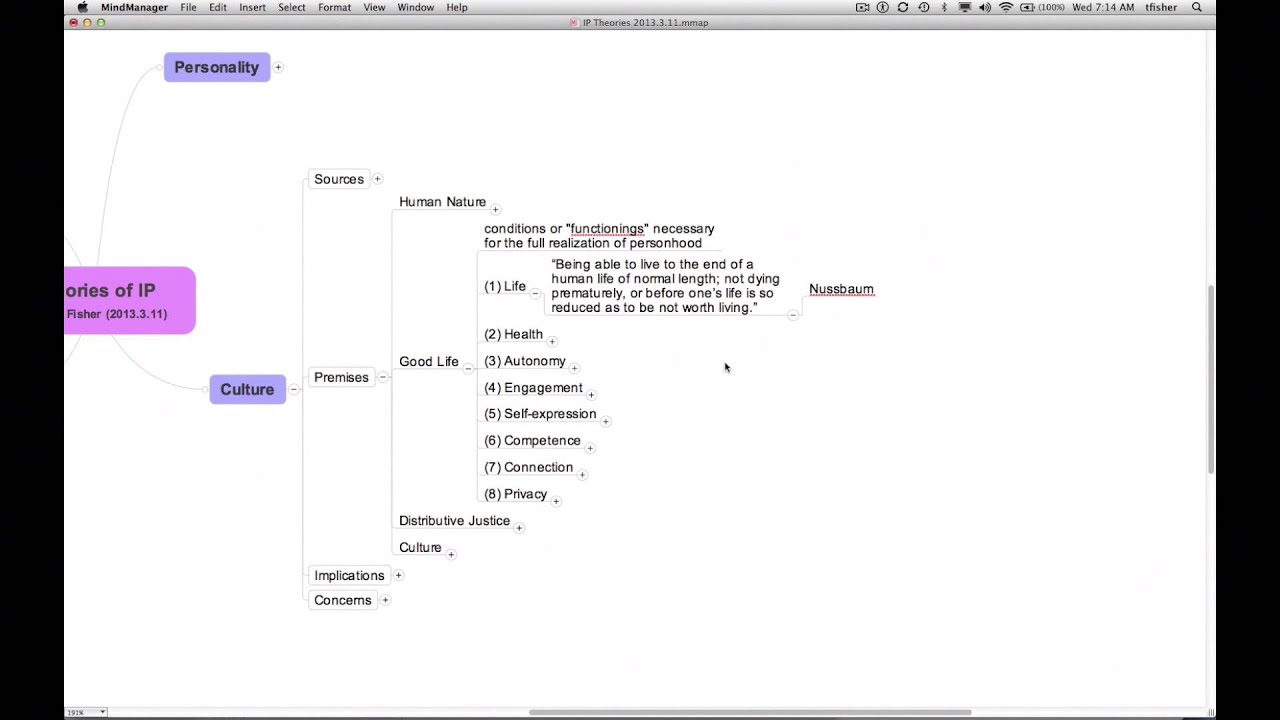
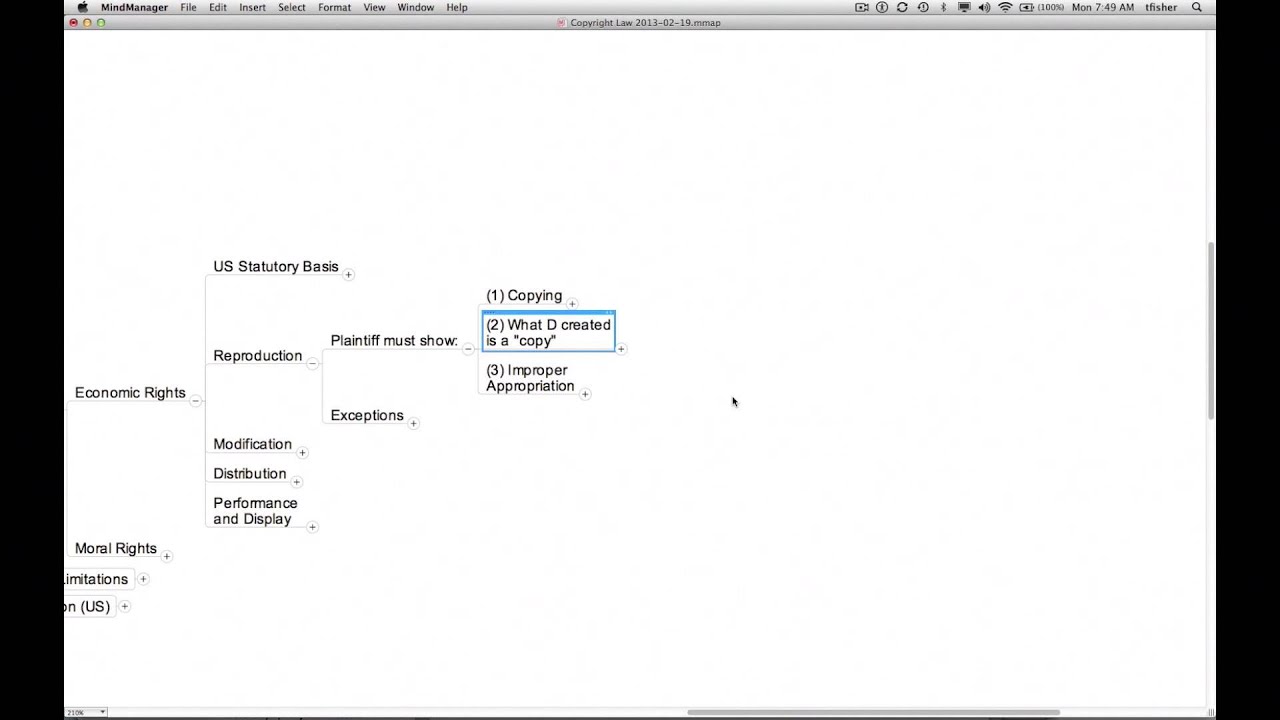
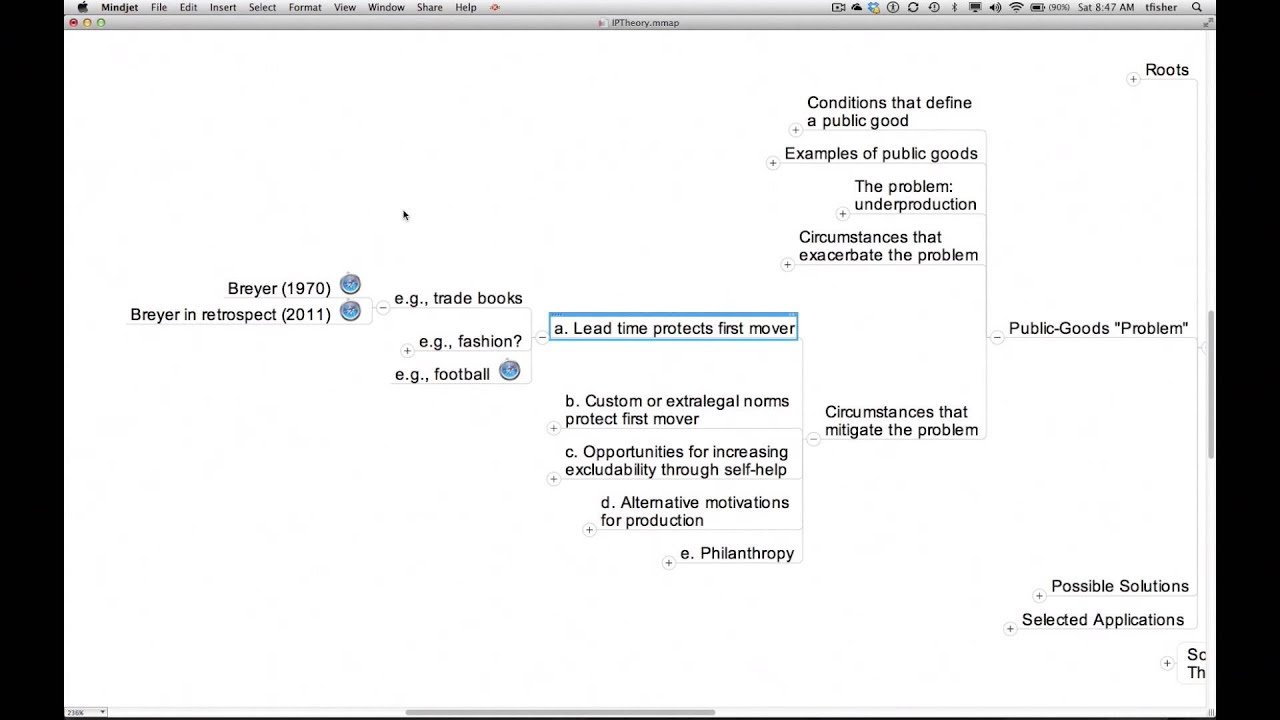
So it would be best if you watch the lecture on a device with a good sized screen. One of those illustrative materials will be a map prepared using the MindManager software of copyright law. I'll be showing the native version of the map on your screen during portions of the lecture.
An interactive PDF version of the current addition of that map can be obtained through my home page. The address of which is tfisher. org.
So if you happen to encounter this lecture any time after the spring of 2013, you might want to go to my website to download an updated version of the map. The concept of authorship permeates copyright law. In general, and in the United States in particular, at least rhetorically, the law celebrates and rewards authors, the creators of original works.
The clearest statutory manifestation of this orientation in the United States comes in section 201 of the copyright statute, which provides simply, "Copyright in a work protected under this statute vests initially in the author or authors of the work. " In most of the cases that naturally come to mind when we think about the copyright system, the application of this principle will be straightforward. Some examples, the author of a novel or a poem is the person who writes it.
The author of a musical composition is the composer. The author of a painting is the person who paints it. The author of a sculpture is the sculptor, and so forth.
It's very important to differentiate the author of a work from the owner of a particular embodiment of it. Suppose, for example, I write a letter to a friend and then mail it to her. She owns the piece of paper on which the letter is written.
But I still own the copyright. As the owner of the physical copy of the letter, she important rights. She can, of course, read it.
She can also burn it. Or give it away. But she can't copy it because that would violate my exclusive right as the copyright owner to reproduce the work.
Nor may she, or anyone else, publish without my permission a compilation of the letters I've sent to her for the same reason. When applied to letters, this rule may strike you as puzzling or misguided. Certainly, it's hard to justify under the dominant theory of copyright.
The utilitarian argument that we discussed in the last lecture. That theory contends in brief, that the law should be crafted so as to stimulate the creation and distribution of socially beneficial creative works. Copyright protection for letters, one might argue, is not necessary to induce people to write them.
So the law in this instance seems to impede dissemination of works without any offsetting social benefit. Viewed from another theoretical angle, the rule may seem less odd. You'll recall, I hope, that one of the personhood interests that figures in the personality theory of property in general and copyright in particular is a fundamental human need for privacy.
Perhaps the rule that accords the copyright in a letter to its writer, rather than to its recipient, or to no one at all, works to shield the privacy interests of the writer. If so, however, the rule does so only crudely. You'll recall, I hope, that the facts and ideas contained in a letter that I write are not shielded by my copyright in it.
Only the distinctive way in which I've expressed those facts and ideas is protected. So if I've revealed in my letter some intimate or embarrassing fact, the recipient is perfectly free-- at least as a matter of copyright law --to tweet about it or shout it from the rooftop. She just can't use or mimic my language.
The upshot is that the rule doesn't align at all well with privacy interests. The bottom line, the copyrights enjoyed by the authors of letters is hard to justify on the basis of the author's personhood interests. And sometimes, arguably, has pernicious social consequences as when that impedes the work of biographers.
Courts are sensitive to those troubling implications. And, as we'll see later in this lecture series, sometimes invoke the exceptions and limitations built into copyright law to override or temper the author's rights. But the starting point of the analysis is that an author gets a copyright.
And keeps it even when a physical embodiment, even a unique embodiment, is transferred to someone else. That principle is certainly not limited to the context of letters. So, for example, a painter hired to paint a portrait retains the copyright in the portrait.
Even after he's been paid. And even after he's delivered the painting to the person who commissioned it. Same with a photographer.
Copyrights, in short, are sticky. They stay attached to the author unless they're formally transferred in some way. This stickiness is important in practice.
A surprisingly large percentage of copyright disputes involve the following basic narrative. Person or Company A does work for Person or Company B in relation to a particular project. The work is satisfactory and B pays A.
Neither of the parties notices that A's work consists of or contains copyrighted material. And so they don't write a contractual provision that deals with copyright. B later decides that A's work could be deployed in a second unrelated project.
A demands an additional payment. B refuses. A brings a copyright infringement suit contending that A retain the copyright in the original work product.
And B's use of it in the second project would abridge one of A's exclusive rights. Typically, the exclusive right of reproduction. Or public performance or display.
Now, if A is an employee of B, and the work that A does falls into the scope of A's job, then in the United States, the copyright in A's work product will belong to B. We'll examine the rules governing such employment relations in detail in the third segment of this lecture. But often, A's not an employee of B, but rather, an independent contractor.
In that situation, the copyright will initially attach to A. And will stick there, giving A a potential copyright claim. Here's an example of a dispute of the sort.
Toyota makes, among other things, Solera brand cars. In 2003, Toyota and its advertising agency decided to launch a new ad campaign. For this campaign, they needed to create digital models of their cars.
Digital models, as many of you know, are useful because they enable advertisers easily to alter the color and accessories of a depicted car, enable consumers to manipulate those images on websites, and so forth. In this case, the ad agency working for Toyota hired a company named G&W to prepare the digital models. And G&W, in turn, hired another company called Meshwerks to prepare so-called digital wire frames.
Some of which are shown on your screen. These wireframes are images formed by a network of lines that represent in great detail the external dimensions of objects. In this case, cars.
Wireframes are prepared partly through an automated measurement system. And partly through manual adjustment of those automated measurements to make the resulting set of lines look realistic. In this instance, G&W took Meshwerks' wireframes, draped over them images of the lights, body, tires, and so forth of each car.
And provided the net product to the ad agency which used them in the advertising campaign. Meshwerks and G&W were paid the amount specified in their contracts. And everyone, as best we could tell, was happy.
Things went awry, however, when Toyota began using the images in another setting. Specifically, in a variety of ads other than the television spot for which Meshwerks thought its work was originally intended. Meshwerks asked for more money.
Toyota refused. Meshwerks then brought a copyright infringement suit contending that it owned the copyright in the wireframes. And, therefore, that Toyota could not reproduce them or derivatives of them in unlicensed contexts.
The case was finally resolved in 2008. Five years after the original advertising campaign. Now, the plaintiff doesn't always win in lawsuits like this.
Sometimes B is able to avoid liability. For example, by showing that A's work did not fall within the zone of copyrightable subject matter. Or that the later use of A's material was expressly or impliedly authorized by the terms of their original contract.
Indeed, Toyota, in the case I just summarized, eventually prevailed on the first of those bases. But often, B loses. And, therefore, either has to pay A an extra fee.
Or cease using the work in question. Even when B prevails, resolving the dispute typically takes years. And costs both parties a lot of money, as it did in this case.
The frequency of lawsuits of this sort is attributable not just to the fact that such situations are distressingly common, but also to the fact that the moral intuitions of the parties commonly diverge. Typically the attitude of B's managers is that they've already paid A an agreed upon and fair price. For A to demand more money now, they see as a form of extortion.
By contrast, A feels like he or they has created a valuable work and thus deserves a share of the revenues that are generated when that work is put to an unexpected, but lucrative later use. Underlying this attitude are some of the beliefs associated with the Lockean theory that we discussed in lecture number two. Both parties, in other words, are convinced typically that the other is behaving immorally.
That's a prescription for litigation. Controversies of this sort can almost always be avoided by addressing the issue up front. Companies in situations of this sort should be watchful for commercial relationships that will generate potentially copyrightable works.
And clearly provide in advance who will own those works. It's a mistake to rely on trust, friendship, or a history of amicable dealings to prevent disputes from arising down the road. Because, as I've suggested, moral intuitions commonly diverge in such cases.
This kind of anticipatory contractual resolution of copyright issues is like the antenuptial contracts sometimes entered into by prospective spouses. Sometimes awkward and seemingly unnecessary when the relationship is fresh, but extremely helpful when the relationship later unravels. So to review, the general point illustrated by this example is that the copyright in a work vests automatically in the author of the work.
And it stays with the author unless expressly transferred to someone else. Failure to be alert to this phenomenon can create big and expensive problems. Up to now, we've been dealing with situations in which the identity of the author of a work is obvious.
Sometimes it's not. Here's an example. As I'm sure you know, in 1912, the steamship Titanic-- shown here just before her first and final voyage --collided with an iceberg in the North Atlantic and sank.
Most of the passengers died. Including one, Harry Elkins Widener. A Harvard graduate.
The Principal library here at Harvard was later funded by Harry's mother who survived the accident. And the library is named for and dedicated to Harry. The ocean where the accident occurred is over 12,000 feet deep.
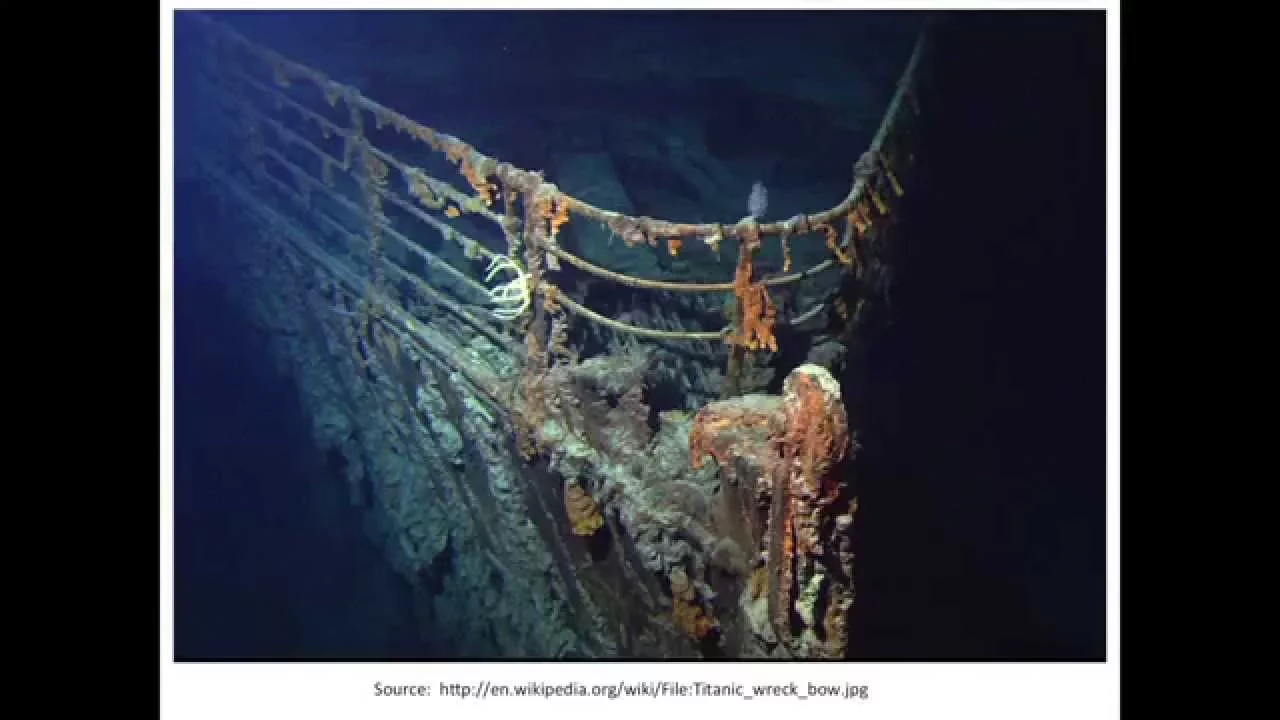
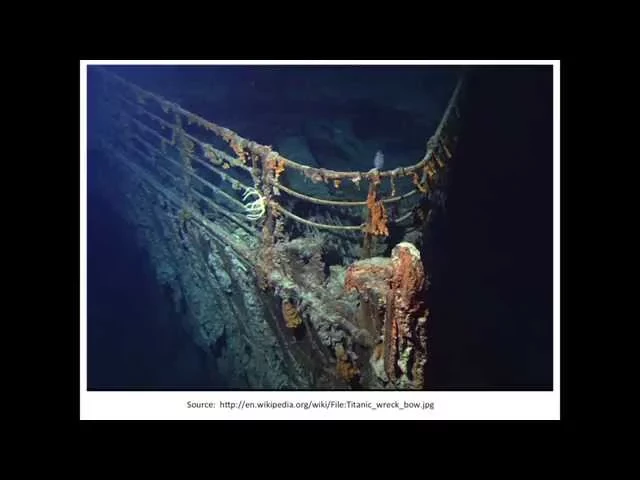
As a result, for 60 years, no one knew exactly where the wreck of the Titanic lay. And certainly no one saw it. Then in 1985, a joint US and French expedition found the wreck.
Subsequently, several other expeditions were organized to photograph and film it. One of which produced this photo. One of those filming ventures was organized by a consortium that included a company called RMS Titanic, Incorporated, which technically was the salvor in possession of the wreck.
That consortium-- we'll call it RMST for short --entered into an arrangement with a filmmaker named Alexander Lindsay. Lindsay had previously done a British documentary on the Titanic. And he now agreed to do another one for RMST.
Unfortunately, for all concerned, the parties failed adequately to capture the terms of their deal in a contract. Thus, planting the seeds for a subsequent dispute. Lindsay spent a lot of time and effort preparing for and overseeing the making of the film.
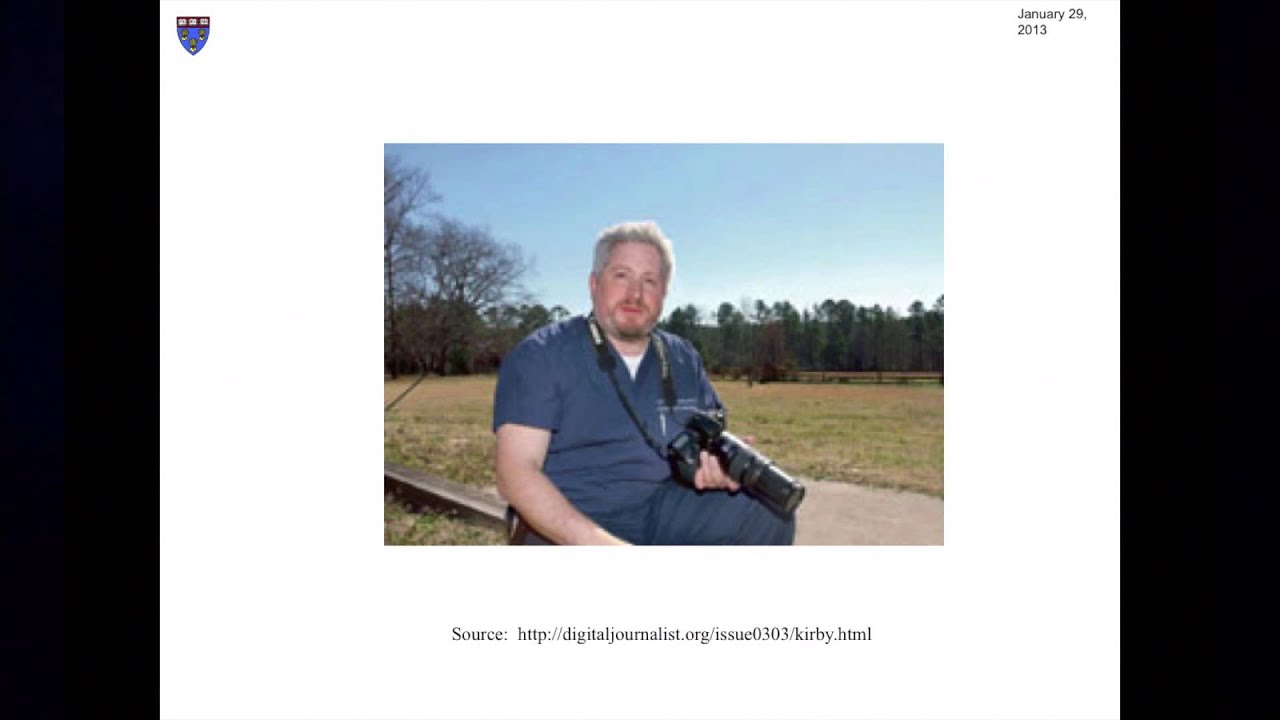
He was pretty closely involved in the filmmaking process. But here's the crucial fact, Lindsay did not himself do the actual filming. Instead, he scripted and supervised the filming of the underwater footage.
More specifically, Lindsay claimed that he created storyboards which identified specific camera angles and shooting sequences. Designed and personally constructed the underwater light towers that were used to illuminate the wreck. Provided the photographers who actually did the filming with detailed instructions for positioning and utilizing those light towers.
Directed the filming from onboard the salvage vessel, Ocean Voyager. Screened the footage at the end of the day to ensure that he had the images he wanted. And, in general, supervised all aspects of the preparation of the footage.
Lindsay contended that he was never paid for his work. Or at least not adequately paid. In an effort to secure appropriate compensation, he brought suit against RMST asserting-- and here's the rub --that he was the author of the underwater footage, and therefore, owned the copyright [INAUDIBLE].
The defendants, RMST, objected. Pointing out that Lindsay did not operate the cameras. As a result, RMST argued Lindsay could not claim the status of author.
In the end, the court sided with Lindsay. If the facts were as he had claimed, the court ruled, Lindsay should be deemed the author. Here's the language the court used.
All else being equal, where a plaintiff alleges that he exercised such a high degree of control over a film operation, including the type and amount of lighting used, the specific camera angles to be employed, and other detail intensive artistic elements of a film, such that the final product duplicates his conceptions and visions of what the film should look like, the plaintiff may be said to be an author within the meaning of the Copyright Act. The principle that underlies this passage is important. To qualify as an author, it's neither necessary, nor sufficient that you have your hands on the instruments that create the work.
If you direct the behavior of others sufficiently closely, that it's your ideas that are being transposed into tangible form, then you, and not they, are the author. And thus, it is you, and not they, that acquire the copyright. This concludes our analysis of the topic of sole authorship.
In the next segment of the lecture, we'll take up joint authorship.

![Upbeat Lofi - Deep Focus & Energy for Work [R&B, Neo Soul, Lofi Hiphop]](https://img.youtube.com/vi/THh4fT0O7IY/maxresdefault.jpg)
![Upbeat Lofi - Power and Energize Your Workday - [R&B, Neo Soul, Lofi Hiphop]](https://img.youtube.com/vi/ONcY0BM5EAg/maxresdefault.jpg)