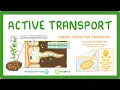
in this video we're going to run through what active transport is and see how it works in the root hair cells of plants now i think the best way to understand active transport is to compare it with diffusion which we covered in a previous lesson if you remember diffusion is the process by which substances move down their concentration gradient from a region of higher concentration to a region of lower concentration and the important thing to remember about diffusion is that it's a completely passive process which means that it doesn't require any energy from the cell
is kind of like water flowing downhill it will just happen by itself active transport on the other hand is the movement of molecules against their concentration gradient so from an area of lower concentration to an area of higher concentration you can think of this more like water moving uphill it won't happen by itself and instead requires energy from the cell or in other words it's an active process the other differences are that active transport always takes place across a membrane like this cell membrane and also requires special proteins that sit in the membrane and transfer
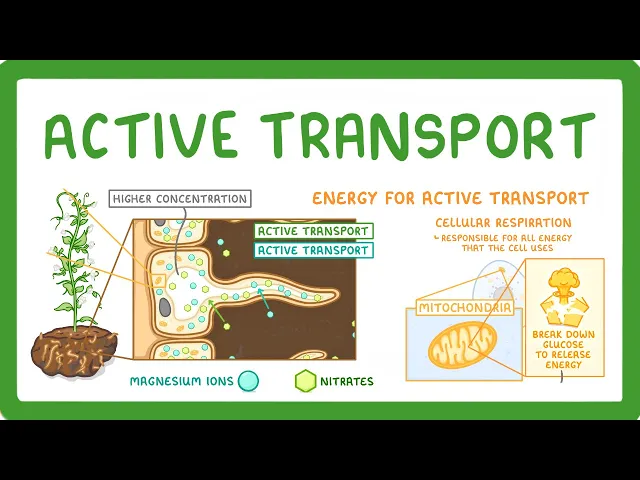
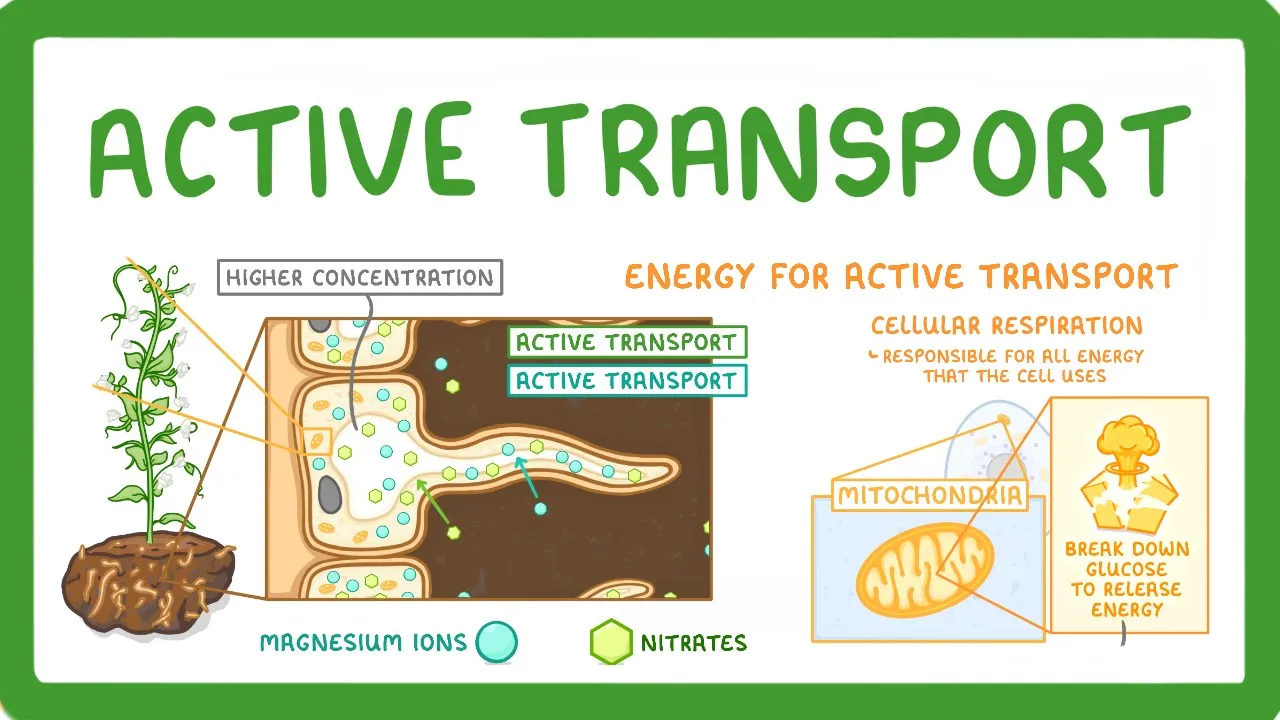
the molecule from one side to the other something else to say here is that like all energy in the cell the energy for active transport comes from solar respiration which is the process that happens mainly in the mitochondria when they break down glucose to release energy we cover it in more detail in another video but for now just remember that the process is responsible for all of the energy that the cell uses and that it stores the energy in literal molecules called atp these molecules act like little batteries taking the energy from the mitochondria to
the different parts of the cell that need it so if we put everything that we've covered together we can define active transport as the movement of molecules across a cell membrane from a region of lower concentration to a region of higher concentration and requiring energy from a cellular respiration next up we need to look at an example of where active transport is actually used if we take a plant like this one it needs to absorb loads of water and mineral ions in order to survive which you will have to get from the soil to help
with this plants have networks of roots that protrude into the ground and if we zoom in a bit we can see that around the outside of the roots are special cells called root hair cells these are the cells that absorb the water and mineral ions and they're adapted to their role by having these long hair-like protrusions where they stick out into the soil and so you give the cells a large surface area for absorption now the issue is that the minerals the plants need like the magnesium ants they need to produce chlorophyll or the nitrates
they need to produce proteins are at a higher concentration inside the cell than they are outside in the soil and so they can't absorb them by diffusion instead they have to use energy to absorb them by active transport against their concentration gradient and like we said earlier this energy comes from cellular respiration which happens in mitochondria so another adaptation of root hair cells is having lots and lots of mitochondria so as a takeaway just remember that root hair cells use active transport to absorb mineral ions and are adapted for that role by having a large
surface area and lots of mitochondria hey everyone amadeus here i just wanted to let you know that we also have a learning platform where you can watch all of our videos practice what you've learned with questions and keep track of all of your progress for both the sciences and maths it's completely free so if you haven't already you can check it out by clicking on our logo here on the right or if you'd like to do the lesson for this particular video we put the link to that in the description down below we've also arranged
all the videos for this subject in a playlist for you here that's all though so hope you enjoy and i'll see you next time thanks