A relatively recent addition to the set of copyrightable works consists of fictional characters. A character described in a larger fictional work, such as a novel or a movie, now enjoys copyright protection independent of the work in which he or she appears. The primary practical implication of this principle is that no one without permission may write a sequel to a fictional narrative that includes one or more of the characters who appeared in the original.
To be sure, not all fictional characters get this protection. To qualify, a character must be important. US courts have articulated two different tests for determining which characters are shielded.
The first test, commonly known as the Sam Spade Test, was announced long ago by the Court of Appeals for the Ninth Circuit. To be protectable under this approach, a character must, "constitute the story being told. " The facts of the case that prompted the Ninth Circuit to adopt this restrictive approach were as follows-- Dashiell Hammett, the author of the classic detective story, The Maltese Falcon assigned the copyright in the story to Warner Brothers, which made a film based on the book.
Subsequently, Hammett granted the copyright to the Sam Spade character, older than his incarnation in The Maltese Falcon to CBS. Warner Brothers brought suit, contending that Sam Spade already belonged to Warner Brothers. The Ninth Circuit eventually rejected this argument, announcing the Story Being Told Test and suggesting that Sam Spade did not satisfy it.
So that's the first approach. The Ninth Circuit has never expressly repudiated it, however, in several recent opinions, the court has implicitly distanced itself from that approach, moving toward the rule applied in all other US jurisdictions, which is simpler and more lenient. Under the second approach a character is protected under copyright law so long as he or she is well delineated.
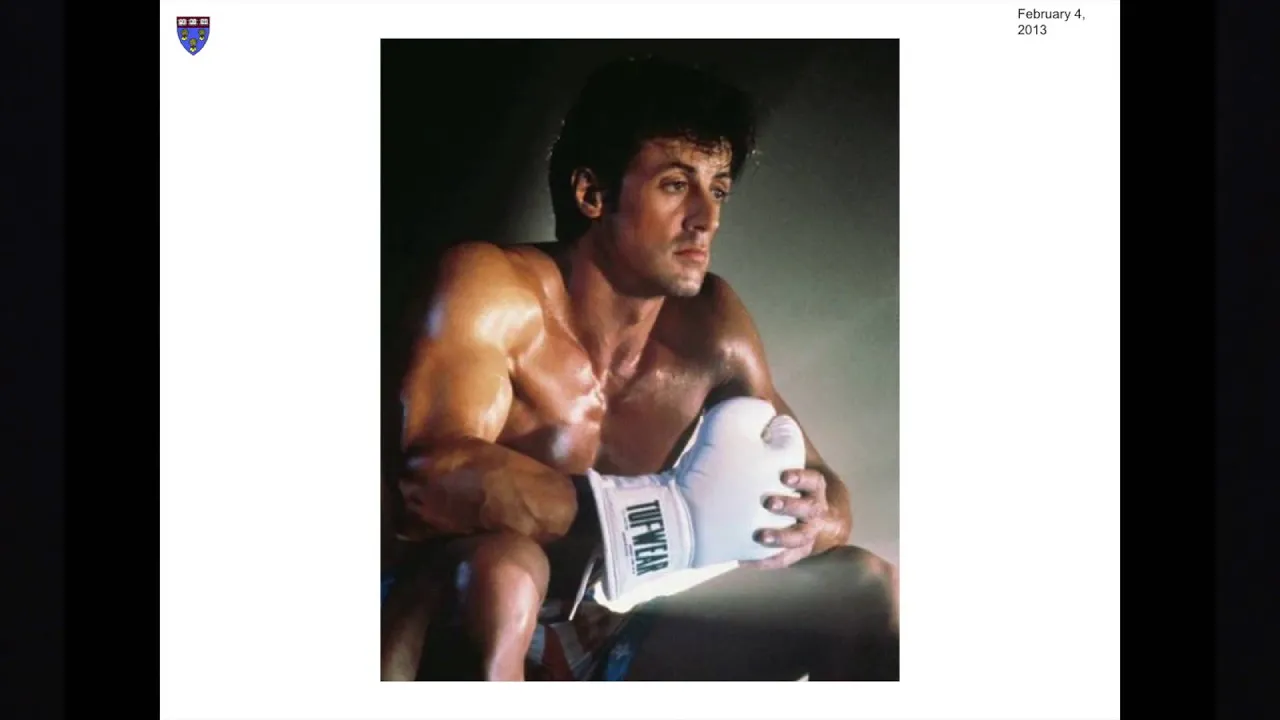
Here's a relatively recent controversy that suggests the scope of this doctrine. Sylvester Stallone, as you probably know, wrote the scripts for each of the first three Rocky movies. He then also played the role of the title character, Rocky Balboa.
In each of the three movies, Rocky is depicted as an under appreciated, sullen, but heroic boxer. In 1982, Stallone and MGM were considering producing yet another, fourth, movie in the series. An unaffiliated author by the name of Timothy Anderson wrote a script for such a fourth movie.
The central figure in the script was, of course, Rocky. This time, Rocky is depicted as fighting a Russian boxer in a contest with strong nationalist overtones. MGM apparently seriously considered using Anderson's script, but eventually decided not to do so.
When MGM and Stallone eventually produced their own version of Rocky IV in which Rocky is depicted as fighting a Russian, Anderson brought suit, contending that his copyright in his script was infringed by the MGM Rocky IV movie. The district court rejected Anderson's argument on several grounds, one of which is central to the issue before us. In the court's judgment, the character of Rocky clearly satisfied both the old Sam Spade Test and the modern Well Delineated test.
Indeed, in the court's judgment, this was obvious. The Rocky character, "has become identified," says the court, "with specific character traits ranging from his speaking mannerisms to his physical characteristics. " Presumably, the court is here referring to Stallone's famous physique, which is more or less the same in all four of the movies.
Anderson's script, the court pointed out, appropriated the character of Rocky without permission. Indeed, says the judge, the character was "lifted lock, stock, and barrel from the prior Rocky movies. " As a result, Anderson's script constituted an infringing derivative work.
In US copyright law, infringing derivative works are denied copyright protection, at least if the material taken from the plaintiff's work pervades the infringing derivative. The net result was that even if the MGM Rocky IV movie closely tracked Anderson's script, Anderson could not prevail because his script was tainted by its unauthorized inclusion of the copyrighted character, Rocky, and thus did not, itself, enjoy copyright protection. Application of these principles is reasonably straightforward in cases like Anderson's in which the character at issue is stable and well-etched, and in which the defendant appropriates that character verbatim.
But many monitor modern controversies don't fit this pattern. For example, some of the most famous fictional characters evolve over the course of their commercial careers. An important example would be Superman, whose depiction in the original comic books changes as he becomes more popular, as the narrative associated with his character shifts, and finally, when he becomes associated in the minds of the public at large with the face and body of Christopher Reeve.
Which, if any of the Superman incarnations, thus enjoys copyright protection? Difficult to say. Here's another complicating factor-- it's sometimes said that a fictional character is more likely to enjoy protection if he or she is presented visually-- as in a comic book or movie-- than if he or she is described in prose.
But this advantage could become a disadvantage if more than one actor plays the part of the character, thereby blurring the character's characteristics. The premier example is James Bond, who has now been presented by six different actors. Tuxedos and a British accent can only go so far in obscuring the differences among these depictions.
In circumstances of these two sorts, in which the character changes significantly over time, or in which the character is associated with several different actors, does the character forfeit copyright protection? Typically, no. Modern courts are quite forgiving of indeterminacy of these sorts.
Pretty much the only kind of character who will fail to qualify for copyright protection nowadays is a lightly sketched, so-called stock character. In other words, a simple or familiar stereotype. This exclusion, you will probably notice, is a cousin of the Scenes A Faire doctrine, which we discussed in lecture number one, which denies copyright protection to an image or scene that has become standard in a genre.
This exclusion doesn't much matter, however, because there's usually not much point in appropriating stock characters. So to return to the main line, a crucial implication of the protectability of fictional characters is that almost all fan fiction, which is increasingly common nowadays, is legally problematic. Now, I hasten to add that fan fiction may escape liability under one of the affirmative defenses to copyright infringement that we'll discuss in detail in lecture number nine.
But the fact that fan fiction almost always lifts one or more character from a famous work creates a legal risk.